
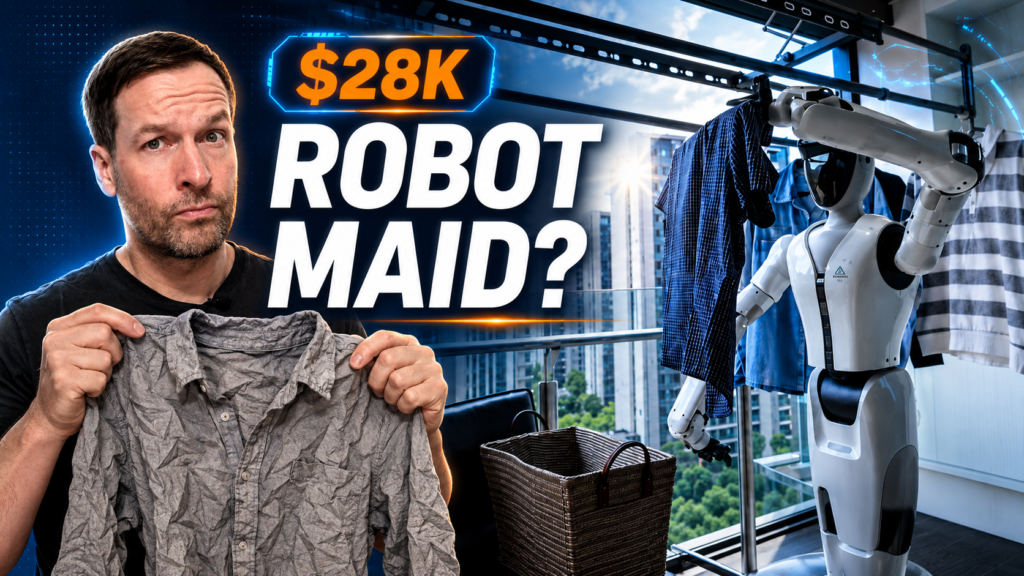
The Rise of Robot Maids: What China’s SeeLight S1 Tells Us About the Future of Humanoid Robots
The idea of a robot maid has lived in science fiction for decades. A machine that can fold clothes, cook food, tidy the table, make the bed, open the curtains, and help around the home has always felt like the perfect symbol of the future.
Now that future is starting to look less like fantasy and more like an early product roadmap.
China has unveiled the SeeLight S1, also known as the Shiguang S1, a household humanoid robot designed to help with everyday domestic tasks. It has been shown performing chores such as laundry, folding clothes, cooking simple meals, tidying, making the bed, and assisting in the home. It is not yet a mass-market consumer product. It is not about to appear in every kitchen next week. But it is an important signal for the robotics industry.
The SeeLight S1 matters because home environments are some of the most difficult places for robots to operate. A factory is structured. A warehouse is mapped. A restaurant has repeatable processes. A home is messy, unpredictable, and constantly changing.
That is why a robot maid is not just about housework. It is about the next stage of AI robots, humanoid robots, physical AI, and real-world automation.
If robots can learn to work in homes, they can also work in hotels, hospitals, care homes, restaurants, retail spaces, offices, schools, logistics centers, and many other human environments. That is where the commercial opportunity becomes much bigger than simply folding shirts.
What Is the SeeLight S1?
The SeeLight S1 is a household humanoid robot developed in China for domestic use. It has been presented as a general-purpose robot for home scenarios, with the ability to carry out multiple household tasks rather than one narrow function.
The robot has been demonstrated doing or attempting tasks such as:
- Folding clothes
- Hanging laundry
- Loading or handling washing
- Cooking simple food
- Tidying a table
- Making a bed
- Opening curtains
- Supporting companionship-style interaction
The important point is not that the robot has mastered all of these tasks perfectly. The important point is that robotics companies are now seriously targeting the home as a real deployment environment.
For years, domestic robotics has largely meant robotic vacuum cleaners, lawnmowers, basic smart home devices, and single-purpose automation products. These systems can be useful, but they are narrow. They do not understand the whole home. They do not move through multiple rooms solving different problems. They do not perform varied physical tasks in a human-like way.
The SeeLight S1 is part of a new category: the general-purpose home robot.
That does not mean it is ready to replace human cleaners, carers, or housekeepers. It means the robotics industry is moving toward machines that can understand broader goals, use embodied AI, and physically interact with the real world.
Why the Robot Maid Story Matters
It is easy to laugh at the idea of a $28,000 robot folding a shirt badly.
In fact, it is probably healthy to laugh. Robotics needs more realism. The industry has often suffered from overhyped demonstrations, polished promotional videos, and bold claims that take years to become commercially practical.
But behind the humor is a serious business story.
The robot maid is one of the hardest challenges in robotics because homes are not designed for robots. They are designed for humans. They contain irregular furniture, clutter, pets, children, narrow spaces, soft materials, fragile objects, different lighting conditions, and constantly changing layouts.
A robot in a factory may perform the same action thousands of times per day. A robot in a home may need to pick up a towel, avoid a dog, understand that a plate belongs in the kitchen, recognize that a shirt should be folded differently from a bedsheet, and move around a chair that was not there yesterday.
This is why home robotics is such an important test for the future of robotics technology.
If a robot can manage a home, even imperfectly, it demonstrates progress in several critical areas:
- Computer vision
- Object recognition
- Grasping and manipulation
- Task planning
- Human-robot interaction
- Safety systems
- Mobility
- Real-world AI decision-making
- Learning from changing environments
These technologies are not only useful in homes. They are useful in almost every industry.
From Industrial Robots to AI Robots
The robotics industry has traditionally been dominated by industrial robots. These machines are highly effective in structured environments such as automotive manufacturing, electronics assembly, packaging, welding, and material handling.
Industrial robots are powerful, accurate, and reliable. However, they usually need defined workspaces, safety controls, programming, fixtures, and repeatable tasks. They are brilliant at doing the same thing again and again.
The new generation of AI robots is different.
AI robots are being developed to understand more flexible environments. They combine robotics hardware with artificial intelligence, sensors, machine learning, language models, vision systems, and increasingly sophisticated control software.
This shift matters because many of the world’s most valuable automation opportunities are not perfectly structured.
Warehouses change. Hospitals are busy. Hotels have guests. Retail stores have customers. Restaurants have spills, staff, and unpredictable orders. Care homes involve people with different needs. Events are chaotic. Homes are even more unpredictable.
The future of robotics will not only be about machines behind safety cages. It will be about robots that can share spaces with people.
That is where humanoid robots and service robots become commercially interesting.
Why Humanoid Robots Are Getting So Much Attention
Humanoid robots are one of the most discussed areas in robotics today. Companies around the world are developing robots with arms, hands, heads, sensors, and body shapes inspired by humans.
The reason is simple: the world has been built around the human body.
Doors, handles, cupboards, kitchens, stairs, tools, vehicles, shelves, chairs, and workstations are all designed for people. A robot with a human-like shape may be able to use the same environments without requiring every building, tool, or process to be redesigned.
This does not mean humanoid robots are always the best option. In many cases, a wheeled robot, robot arm, mobile manipulator, drone, or automated system will be more practical and cost-effective. The best robot is not always the one that looks most human.
However, humanoid robots have an important advantage when tasks involve human spaces and human tools.
A humanoid robot can potentially:
- Open doors
- Pick up objects
- Carry items
- Use existing work surfaces
- Operate in buildings designed for people
- Interact more naturally with humans
- Perform a wider range of tasks than a fixed robot
The challenge is making them useful, safe, reliable, and affordable.
That is why robots like the SeeLight S1 are interesting. They represent the industry’s attempt to move humanoid robots from demonstration stages into real-world human environments.
The Home Is the Ultimate Robotics Test Lab
The home may become one of the most important testing grounds for the future of robotics.
In a factory, you can design the environment around the robot. In a home, the robot must adapt to the environment.
This difference is enormous.
A household robot needs to understand context. It must know that a towel on the floor may need washing, but a phone on the floor should not be thrown into a laundry basket. It must understand that a child running into the room changes the task immediately. It must be able to stop safely around people and pets.
A home robot also has to deal with soft objects. This is one of the hardest areas in robotics. Clothes, towels, bedding, cushions, and bags change shape. They are difficult to detect, grasp, fold, and manipulate. Folding laundry may look simple to a human, but it is a serious robotics challenge.
That is why a robot folding a shirt is more impressive than it first appears.
It is not just folding a shirt. It is sensing, planning, gripping, adjusting, and executing a task with a deformable object in an unstructured environment.
This has implications far beyond the home.
The same type of technology could be used in:
- Hospitals handling bedding and supplies
- Hotels managing towels and linens
- Restaurants handling flexible packaging
- Warehouses picking irregular items
- Retail stores restocking shelves
- Care homes assisting with daily tasks
- Cleaning and facilities management
- Food production and preparation
The robot maid is a consumer-facing symbol of a much larger robotics shift.
The Business Opportunity Behind Domestic Robots
For businesses, the SeeLight S1 story is not about whether every household will buy a robot maid tomorrow. The commercial lesson is much broader.
Robots are moving into less structured environments.
This creates major opportunities for companies that understand how to test, deploy, and integrate robotics technology before their competitors do.
The businesses that benefit most from robotics are usually not the ones that chase the most futuristic machine. They are the ones that identify a real operational problem and match the right robotic solution to it.
That problem might be:
- Labor shortages
- Repetitive manual work
- High staff turnover
- Health and safety risks
- Customer engagement
- Event marketing
- Cleaning requirements
- Inspection needs
- Stock movement
- Food service support
- Warehouse efficiency
- Data collection
- Security patrols
- Healthcare assistance
Robotics adoption works best when it starts with the task, not the robot.
A humanoid robot may be the right answer in some cases. In others, a mobile robot, robot arm, delivery robot, cleaning robot, inspection robot, or software-connected automation system may provide a stronger return on investment.
The key is understanding the use case.
Why Businesses Should Pay Attention Now
Many business leaders still think robotics is something for the future.
That assumption is becoming risky.
Robotics technology is not developing in isolation. It is being accelerated by advances in AI, computer vision, sensors, batteries, simulation, edge computing, cloud robotics, and manufacturing scale. At the same time, labor shortages, rising costs, supply chain pressure, and customer expectations are forcing companies to look at automation more seriously.
The result is a robotics industry that is moving from experimental innovation into practical deployment.
This does not mean every robot is ready. It does not mean every company should rush into buying expensive machines. It does mean every serious business should start learning where robotics could create value.
The companies that wait until robots are completely mainstream may find themselves behind competitors who have already tested systems, trained staff, collected data, redesigned workflows, and built internal confidence.
Robotics adoption is not just a purchase decision. It is a learning curve.
Businesses need time to understand:
- Which tasks can be automated
- Which robots are reliable
- How robots integrate with staff
- What safety requirements apply
- How customers respond to robots
- What data is needed
- How to measure return on investment
- Whether to buy, lease, rent, or use Robotics as a Service
- How to manage maintenance and support
- How to train teams to work alongside robots
That is why early exploration matters.
The Role of Physical AI
One of the most important ideas behind the rise of robots like the SeeLight S1 is physical AI.
Traditional AI often lives inside screens. It writes text, analyzes data, generates images, recommends products, answers questions, or automates digital workflows.
Physical AI brings intelligence into the real world.
A physical AI system must understand the environment, make decisions, and then act through a robotic body. This is much harder than producing text or recognizing an image. The real world is messy, three-dimensional, and full of consequences.
If a chatbot makes a mistake, it can produce a wrong answer. If a robot makes a mistake, it might drop a plate, bump into furniture, damage stock, block a corridor, or create a safety issue.
That is why physical AI requires a combination of software intelligence and physical reliability.
It needs:
- Sensors to perceive the world
- AI models to interpret what is happening
- Robotics control systems to plan movement
- Hardware capable of safe action
- Feedback loops to learn from mistakes
- Safety systems to protect people and property
The future of robotics will depend on how well companies can connect AI intelligence with physical capability.
The SeeLight S1 is part of this bigger movement. It is not only a home robot. It is an example of AI trying to become useful in physical human environments.
Service Robotics Is Expanding
Service robotics is one of the most important growth areas in the robotics industry.
Unlike industrial robots, service robots operate in commercial or public environments. They may help with delivery, cleaning, customer service, guidance, entertainment, healthcare support, security, inspection, hospitality, or events.
Examples include:
- Delivery robots in hotels and offices
- Cleaning robots in shopping centers and airports
- Reception robots at exhibitions
- Telepresence robots in healthcare
- Security patrol robots
- Restaurant service robots
- Event robots for brand engagement
- Inspection robots for industrial sites
- Retail robots for stock checking
- Care robots for elderly support
The robot maid concept fits into the service robotics trend because domestic tasks overlap with many commercial environments.
A hotel needs beds made, towels handled, rooms cleaned, and items delivered. A hospital needs linens moved, supplies transported, and routine support tasks completed. A care home needs assistance with repetitive physical tasks and companionship support. A restaurant may need help with cleaning, carrying, or food preparation.
The line between home robotics and commercial service robotics may become increasingly blurred.
What starts as a household robot could influence robots used across hospitality, healthcare, cleaning, and facilities management.
Why Robotics Startups Are Moving Fast
The robotics startup ecosystem is becoming increasingly active because several technology trends are converging at the same time.
AI models are improving. Hardware components are becoming more available. Investors are looking for the next major technology wave after software AI. Manufacturers are becoming more open to automation. Public interest in humanoid robots is rising. Governments are also investing in robotics as a strategic industry.
This creates an environment where robotics startups can move faster than before.
However, robotics is still difficult. It is not like launching a software application.
Robotics companies must deal with hardware costs, supply chains, manufacturing, safety, maintenance, deployment, field support, customer training, and real-world reliability. A robot has to work outside the demo video. It has to survive real customers, real buildings, real tasks, and real business expectations.
That is why the winners in robotics will not only be the companies with impressive videos. They will be the companies that can deliver practical value repeatedly.
A robot that looks exciting online is one thing.
A robot that works every day in a business environment is another.
The Investment Case for Robotics
Robotics investment is growing because robots sit at the intersection of several major economic trends.
Companies are looking for ways to increase productivity. Many sectors face labor shortages. The cost of human labor is rising in several markets. Businesses want more resilient operations. Customers expect faster service. AI is creating new possibilities for machines to understand and act.
Robotics offers a way to connect digital intelligence with physical productivity.
This is why investors are paying close attention to humanoid robots, warehouse robotics, healthcare robotics, logistics automation, agricultural robots, construction robots, inspection robots, and service robotics.
But investors should be careful.
The most exciting robot is not always the best business.
A strong robotics company needs:
- A clear use case
- Reliable hardware
- Scalable manufacturing
- Strong software
- Field support capability
- A realistic pricing model
- Customer demand
- Repeatable deployment
- Safety compliance
- Maintenance planning
- Data advantage
- A route to profitability
The SeeLight S1 shows why the category is exciting, but it also highlights the challenge. A household robot must be useful enough, safe enough, and affordable enough to justify adoption.
That is a difficult equation.
The Challenge of Cost
The reported cost around the SeeLight S1 has attracted attention because it shows the gap between early robotics development and mass consumer adoption.
A robot costing tens of thousands of dollars may be interesting for trials, research, premium markets, or commercial use cases, but it is not yet a normal household purchase for most people.
This is common in emerging technology.
Early computers were expensive. Early mobile phones were expensive. Early electric vehicles were expensive. Early robots will also be expensive. Over time, costs may fall through better manufacturing, scale, component improvements, software reuse, and clearer business models.
However, cost reduction alone is not enough.
A robot must deliver value.
For a household customer, that value might be time saved, care support, independence, convenience, or status. For a business, the value may be labor efficiency, customer engagement, safety, productivity, data collection, or operational consistency.
The future of robotics depends on whether robots can move from interesting demonstrations to measurable value.
Safety and Trust
Safety is one of the biggest barriers to robotics adoption, especially in homes and public spaces.
A robot working near people must be predictable, controlled, and safe. It must detect humans, pets, obstacles, and unexpected movement. It must stop when necessary. It must avoid dangerous force. It must be designed with real-world accidents in mind.
Trust is just as important as technical safety.
People need to feel comfortable around robots. Staff need to understand how to work with them. Customers need to know what the robot is doing. Families need confidence that a home robot will not create more problems than it solves.
This is why robotics adoption is partly technical and partly psychological.
A robot may be capable, but if people do not trust it, adoption will be slow.
Businesses need to think about training, communication, demonstrations, staff involvement, and customer experience when introducing robots.
Why Robot Deployment Is More Than Buying a Robot
One of the biggest mistakes businesses make is thinking robotics adoption is simply about purchasing a machine.
It is not.
Robot deployment involves strategy, planning, testing, integration, training, measurement, and continuous improvement.
A successful robotics project should ask:
- What problem are we solving?
- What task is repetitive, costly, risky, or difficult to staff?
- What environment will the robot operate in?
- What are the safety requirements?
- What happens when the robot fails?
- Who supports the robot?
- How do staff interact with it?
- How do customers respond?
- What data will be collected?
- How will success be measured?
- What is the return on investment?
- Should the business buy, rent, lease, or trial first?
This is where robotics consulting becomes valuable.
A consultant can help businesses avoid buying the wrong robot, choosing the wrong use case, underestimating integration, or expecting too much too soon.
The goal is not to make robots look impressive. The goal is to make robots useful.
The RoboPhil Perspective
Philip English, known as RoboPhil, works across the robotics industry through Robot Center, Robots of London, and Robot Philosophy.
Through this work, RoboPhil helps connect robotics technology with real commercial use cases. That includes working with robot manufacturers, businesses exploring automation, companies launching robotics products, event teams using robots for engagement, and organizations trying to understand where robotics fits into their future strategy.
This perspective is important because the robotics industry is full of both opportunity and confusion.
Many businesses are interested in robots but do not know where to start. Some are attracted by humanoid robots because they look exciting, while others need practical automation but are unsure which technology is suitable. Some manufacturers have strong products but need help entering markets, creating visibility, building partnerships, or explaining their value clearly.
RoboPhil’s role is to help make robotics understandable, practical, and commercially relevant.
The SeeLight S1 story is a perfect example of why this matters. The headline is a robot maid. The deeper story is physical AI, humanoid robots, service robotics, home automation, and the future of robots working in human environments.
Businesses need help separating hype from opportunity.
That is where industry insight becomes essential.
What the Future of Robotics Looks Like
The future of robotics will not arrive all at once.
It will arrive task by task, industry by industry, and use case by use case.
Some robots will be humanoid. Many will not. Some will work in factories. Others will work in warehouses, farms, hospitals, hotels, homes, shops, construction sites, energy facilities, airports, and events.
The most successful robots will be the ones that solve real problems.
In the near future, we are likely to see growth in:
- Humanoid robot trials
- Warehouse automation
- Healthcare support robots
- Hospitality service robots
- Inspection and security robots
- Cleaning robots
- Retail automation
- Food service robotics
- Robotics as a Service
- Robot rental and event robotics
- AI-powered mobile robots
- Home assistance robots
- Robotics consulting and deployment strategy
The biggest shift will be the move from robots that simply repeat programmed actions to robots that can understand, adapt, and assist.
That is the promise of AI robots.
It will take time. There will be failures, overhyped launches, awkward demonstrations, and expensive prototypes. But the direction is clear.
Robots are moving closer to everyday life.
What Businesses Should Do Now
Businesses do not need to wait for perfect humanoid robots before exploring robotics.
In fact, waiting may be the wrong strategy.
The best approach is to start with education and small experiments. Companies should identify areas where automation could help, evaluate available robot technologies, test solutions, measure results, and build internal knowledge.
A business might begin by asking:
- Where are we struggling with labor?
- Which tasks are repetitive or physically demanding?
- Where do we need better consistency?
- Where could robots improve customer experience?
- Could robots help with events, exhibitions, or marketing?
- Could automation reduce costs or increase capacity?
- Which departments are open to innovation?
- What would a successful robot trial look like?
Robotics adoption should be practical, not emotional.
The wrong approach is to buy a robot because it looks futuristic.
The right approach is to understand the business problem and then decide whether robotics is the right solution.
The Real Meaning of the Robot Maid
The SeeLight S1 robot maid is not important because it will immediately transform every home.
It is important because it shows the direction of travel.
Robots are moving from controlled spaces into human spaces. AI is moving from screens into physical machines. Humanoid robots are moving from research labs into real-world trials. Businesses are moving from curiosity to adoption.
The robot maid may be imperfect today, but it represents a much bigger shift in robotics technology.
A machine that can do laundry, fold clothes, make beds, and support people at home is not just a domestic convenience. It is a test case for robots that can operate in unpredictable, human-centered environments.
That is why business leaders, investors, robotics companies, automation professionals, and technology enthusiasts should pay attention.
The future of robotics will not only be built in factories.
It may also be built in kitchens, bedrooms, hotels, hospitals, care homes, restaurants, warehouses, and event spaces.
Conclusion: The Future of Robotics Is Becoming Physical
The rise of robot maids, humanoid robots, and AI robots marks a new phase in automation.
For decades, robots have been most successful in controlled industrial environments. Now the industry is trying to bring robots into the messy, complex, human world.
That shift will not be easy. Robots will need better intelligence, safer hardware, lower costs, stronger reliability, and clearer business cases. Many early products will be expensive and limited. Some will fail. Others will evolve into important platforms.
But the direction is unmistakable.
Robotics is becoming one of the most important technology sectors of the next decade.
The companies that understand this early will be better positioned to benefit from automation, improve operations, attract attention, and create new business models.
The future of robotics is not just about robots replacing people.
It is about robots becoming tools that help people, businesses, and industries do more.
For businesses exploring robotics consulting, robot sourcing, robotics industry insights, automation strategy, robot deployment, or practical advice on how to use robots commercially, RoboPhil can help.
Robot Center
https://robotcenter.co.uk/
Robots of London
https://robotsoflondon.co.uk/
Robot Philosophy
https://robophil.com/
Business enquiries
sales@robotcenter.co.uk