
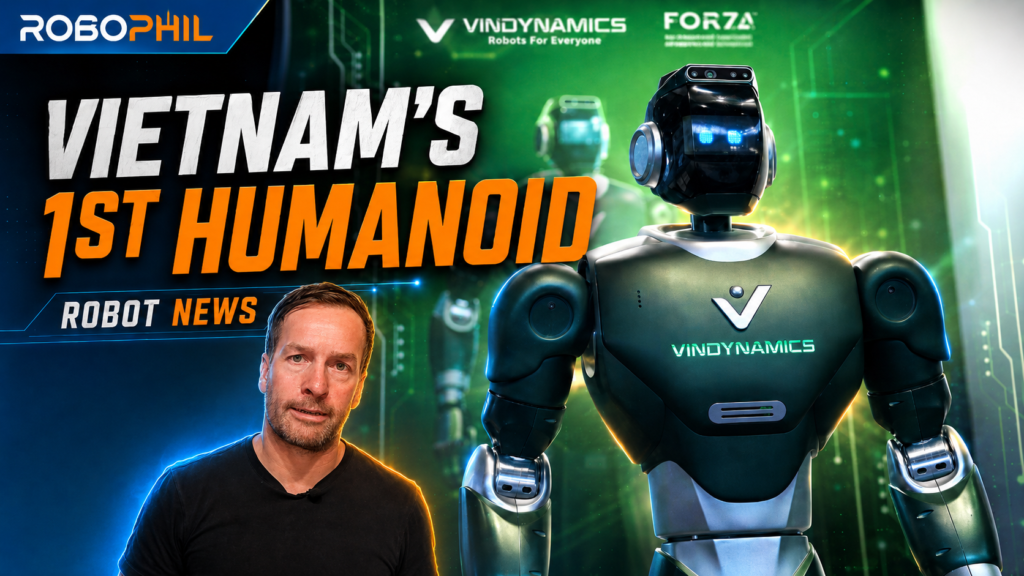
Vietnam’s First Humanoid Robot Dyno: What It Means for the Future of AI Robots, Automation, and Business
Introduction: A New Country Enters the Humanoid Robot Race
Humanoid robots are no longer just a futuristic idea from science fiction films or research labs in Silicon Valley. They are becoming a serious part of the global robotics industry, and the latest sign of that shift comes from Vietnam.
VinDynamics, a Vietnamese technology company, has unveiled Dyno, the country’s first humanoid robot. Designed for security, surveillance, customer service, tourism, and future household assistance, Dyno represents more than a single robot launch. It shows how quickly the robotics race is becoming global.
For years, most conversations around humanoid robots have focused on the USA, Japan, South Korea, China, and Europe. Those regions still play a major role in robotics technology, automation, AI robots, industrial robots, and humanoid robot development. But the launch of Dyno is a reminder that the future of robotics will not be owned by one country or one company.
It will be built by a global ecosystem.
That matters for business leaders, investors, engineers, robotics companies, automation professionals, and entrepreneurs because humanoid robots are moving from “interesting demos” into real commercial conversations. The question is no longer whether robots will become part of everyday life. The question is where they will be useful first, which industries will adopt them fastest, and how businesses can prepare.
Dyno’s development points toward a future where AI robots support security teams, guide visitors, assist customers, interact with people in public spaces, and eventually help in homes. It also highlights the growing importance of robotics consulting, robot deployment, robot sourcing, and automation strategy.
The rise of humanoid robots is not just a technology story.
It is a business story.
What Is Dyno?
Dyno is Vietnam’s first humanoid robot, developed by VinDynamics. It is designed as an intelligent robot assistant for modern environments, with potential use cases across security, surveillance, tourism, customer service, commercial spaces, and household assistance.
The robot combines artificial intelligence, advanced sensors, autonomous navigation, environmental awareness, and human-robot interaction. In simple terms, Dyno is being designed to move through real environments, understand what is happening around it, interact with people, and perform useful tasks.
This is important because many robots are excellent in controlled environments but struggle when placed in the real world.
The real world is messy.
People move unpredictably. Lighting changes. Floors are uneven. Background noise interferes with speech recognition. Customers ask strange questions. Weather can affect sensors. Objects are rarely exactly where they are supposed to be.
A humanoid robot that can operate in dynamic environments has to combine mobility, perception, interaction, and reliability. That is a much harder challenge than simply creating a robot that looks impressive on a stage.
Dyno has already been demonstrated as a robotic guide in a real-world setting at Vinpearl Safari Phu Quoc. That type of pilot deployment is significant because it moves the robot beyond the showroom and into a public environment with real people.
For robotics, that is where things become interesting.
A robot that can perform in front of real visitors, answer questions, navigate outdoor spaces, and maintain interaction with people is much closer to commercial usefulness than a robot that only performs in a controlled lab.
Why Vietnam’s First Humanoid Robot Matters
The launch of Dyno is important because it shows how the humanoid robotics industry is expanding beyond the traditional robotics powerhouses.
Historically, many of the world’s best-known robotics developments have come from countries with deep manufacturing, automation, engineering, and AI ecosystems. The USA has produced major robotics and artificial intelligence companies. Japan has long been associated with humanoid robots and industrial automation. South Korea has invested heavily in service robots and advanced robotics technology. China has rapidly scaled robotics manufacturing and humanoid robot development.
Vietnam entering the humanoid robot race suggests that the global robotics industry is broadening.
This is important for several reasons.
First, it increases competition. More companies and countries working on humanoid robots means faster experimentation, more ideas, and potentially more affordable solutions over time.
Second, it creates new regional robotics ecosystems. As countries develop their own robots, they also develop skills in actuators, sensors, software, AI training, robot manufacturing, data collection, maintenance, and deployment.
Third, it shows that humanoid robotics is becoming commercially attractive enough for more technology companies to enter the market.
This is a major signal.
When humanoid robots were mainly research projects, only highly specialized labs and well-funded technology companies could justify the investment. Now, as the commercial potential becomes clearer, more companies are looking at robots as business platforms.
Security robots, service robots, event robots, healthcare robots, logistics robots, hospitality robots, and humanoid robots are all part of a wider automation shift. Businesses are dealing with labor shortages, rising costs, customer service expectations, safety requirements, and pressure to improve efficiency.
Robots are increasingly being seen as one possible answer.
The Current State of Humanoid Robotics
Humanoid robotics is one of the most exciting areas in the robotics industry, but it is also one of the most misunderstood.
A humanoid robot is a robot designed to resemble the human body in some way. That usually means a head, torso, arms, and sometimes legs. The reason humanoid robots are so compelling is that much of the world has been designed for humans.
Doors, desks, stairs, tools, shelves, reception areas, corridors, vehicles, and public spaces are all built around human size and movement.
In theory, a humanoid robot could operate in human environments without requiring businesses to redesign everything around the robot. That is a powerful idea.
However, building a useful humanoid robot is extremely difficult.
A humanoid robot needs balance, movement, perception, manipulation, safety systems, speech interaction, task planning, and reliable software. It may also need hands that can grip objects, arms that can move safely around people, sensors that can understand the environment, and AI systems that can respond intelligently.
This is why humanoid robots are still at an early stage compared with more mature forms of automation.
Industrial robots are already widely used in factories. Warehouse robots are increasingly common in logistics. Service robots are used in hospitality, cleaning, delivery, and events. Inspection robots are used in energy, utilities, and industrial sites.
Humanoid robots are different because they aim to be more general-purpose.
That is both their greatest opportunity and their greatest challenge.
A single-purpose robot can be optimized for one job. A humanoid robot is often expected to do many different things. That makes the technology more complex, but it also makes the potential market much larger.
Dyno’s Commercial Applications
Dyno is being developed for several important use cases. Each one reveals where humanoid robots may start to create value for businesses.
Security and Surveillance
Security is one of the most interesting early markets for humanoid robots and mobile robots.
Many businesses already spend heavily on security guards, CCTV systems, access control, patrols, monitoring, and incident response. A humanoid robot could support security teams by patrolling certain areas, detecting unusual activity, speaking to visitors, reporting incidents, and providing a visible security presence.
This does not necessarily mean robots replacing human security teams. In many cases, the better model is robots supporting humans.
A robot can perform repetitive patrols. It can collect data. It can monitor areas consistently. It can provide a first point of interaction. Human staff can then focus on judgment, escalation, customer care, and decision-making.
For commercial buildings, campuses, shopping centers, hotels, and public venues, this type of support could become increasingly valuable.
Customer Service
Customer service is another strong use case for humanoid robots.
Many businesses need to answer simple questions repeatedly. Where is reception? What time does the event start? Where are the toilets? How do I check in? Which direction is the meeting room? What floor is the exhibition on?
A humanoid robot with speech interaction and navigation could support front-of-house teams by handling basic visitor questions and guiding people around a venue.
This could be valuable in hotels, airports, museums, exhibitions, trade shows, shopping centers, tourist attractions, and corporate offices.
The key is not replacing hospitality staff. The key is reducing repetitive pressure and improving the visitor experience.
A robot can be memorable, consistent, multilingual, and always available. Used well, it can become both a service tool and a marketing asset.
Tourism and Visitor Experiences
Dyno’s demonstration as a robotic guide at Vinpearl Safari Phu Quoc is especially interesting because tourism is a natural market for service robots.
Tourist attractions need to inform, guide, entertain, and support visitors. A humanoid robot can create a sense of novelty while also providing practical information.
In tourism, experience matters. People remember unusual interactions. A robot guide can become part of the attraction itself.
This is where robotics overlaps with marketing, entertainment, and customer engagement. A robot is not only a machine. It is a point of attention.
For event agencies, exhibition organizers, visitor attractions, and brand experience teams, humanoid robots can create engagement in a way that static displays cannot.
Household Assistance
Household humanoid robots are one of the most ambitious areas of robotics technology.
The home is a difficult environment for robots. Every home is different. Objects are placed unpredictably. Tasks vary widely. Safety is critical. People expect natural interaction.
A household humanoid robot needs to understand context, handle objects safely, move around furniture, interact with humans, and perform tasks reliably.
That is why household robots may take longer to become mainstream than commercial service robots. Commercial environments can be more structured. Tasks can be limited. Deployment can be managed by trained teams.
However, the long-term potential is enormous.
If humanoid robots can eventually assist with basic domestic tasks, elderly care support, household monitoring, simple object handling, and companionship, the market could become very large.
Dyno’s mention of household assistance suggests that VinDynamics is thinking beyond one commercial application and toward a broader humanoid platform.
The Technology Behind AI Robots Like Dyno
Modern AI robots rely on several key technologies working together.
A robot is not just a body. It is a complete system.
Artificial Intelligence
AI gives robots the ability to interpret information, make decisions, understand language, and adapt to different situations.
For humanoid robots, AI may support speech recognition, natural language interaction, object recognition, navigation, task planning, and human-robot communication.
The rise of generative AI has created new excitement around AI robots because robots can now potentially interact with people in more natural ways. Instead of pressing buttons or using fixed commands, users may be able to speak to robots more conversationally.
That is a major shift for service robots.
The easier robots are to use, the easier they are to adopt.
Sensors and Environmental Awareness
Robots need sensors to understand their environment. These may include cameras, depth sensors, lidar, ultrasonic sensors, force sensors, microphones, inertial measurement units, and other perception systems.
For a humanoid robot, environmental awareness is essential.
It needs to know where people are. It needs to avoid obstacles. It needs to understand open spaces, walls, doors, objects, and movement around it.
Without strong perception, robots become unreliable and potentially unsafe.
Autonomous Navigation
Autonomous navigation allows robots to move through environments without constant human control.
This is critical for security patrols, visitor guidance, delivery tasks, and service applications.
A robot that requires constant teleoperation is less scalable. A robot that can navigate independently can become a much more useful business tool.
Navigation is not just about movement. It is about planning, obstacle avoidance, localization, mapping, and decision-making.
Robotic Manipulation
One of the hardest parts of robotics is manipulation: the ability to use arms and hands to interact with objects.
VinDynamics has also showcased robotic hand technology and actuator components. This matters because humanoid robots need physical capability, not just intelligence.
A robot that can talk is interesting.
A robot that can talk, move, sense, and handle objects is much more commercially powerful.
Robotic hands, actuators, and force sensors are vital for tasks that involve gripping, carrying, pressing buttons, opening doors, or handling items.
Actuators: The Robot’s Muscles
Actuators are the components that allow robots to move. They are often compared to muscles because they create motion and force.
In humanoid robots, actuators are extremely important because they influence strength, precision, speed, reliability, and energy efficiency.
Better actuators can make robots more capable, more compact, and more reliable. They can also reduce maintenance issues and improve safety.
This is why companies developing humanoid robots often focus heavily on actuator technology.
Why Businesses Are Paying Attention to Robotics
Businesses are becoming more interested in robotics for practical reasons.
The robotics industry is not growing simply because robots are exciting. It is growing because companies face real operational problems.
Labor Shortages
Many industries struggle to recruit and retain staff. Hospitality, logistics, manufacturing, care, events, security, and facilities management all face staffing pressures.
Robots can help fill gaps where repetitive, difficult, dangerous, or low-availability roles exist.
Rising Costs
Labor costs, energy costs, property costs, and operational costs continue to rise. Automation can help businesses improve efficiency and consistency.
A robot is not always cheaper than a person, especially at the beginning. But in the right use case, robotics can create long-term operational value.
Customer Expectations
Customers expect fast service, clear information, personalization, and memorable experiences.
Service robots can help businesses stand out while also providing useful support.
For hotels, exhibitions, events, retail environments, and visitor attractions, robots can create a strong first impression.
Data and Visibility
Robots can collect useful operational data.
A security robot can record patrol routes and incidents. A service robot can track common customer questions. An inspection robot can gather site data. A warehouse robot can improve visibility across operations.
This data can help businesses make better decisions.
Brand Differentiation
Robots are powerful attention tools.
At events, exhibitions, product launches, and public spaces, robots attract curiosity. They create conversations. They make people stop, look, film, and share.
For marketing teams, this can be extremely valuable.
The Robotics Industry Is Becoming an Ecosystem
One of the most important points about robotics is that successful deployment requires more than just a robot manufacturer.
The robotics industry includes hardware companies, software developers, AI companies, sensor manufacturers, integration specialists, maintenance teams, consultants, distributors, event specialists, recruitment businesses, training providers, and investors.
This ecosystem matters because buying a robot is only one part of the journey.
Businesses also need to know:
Which robot is right for the application?
What problem is the robot solving?
How will the robot integrate with existing workflows?
Who will maintain it?
Who will train the staff?
What data will it collect?
How will success be measured?
How will customers react?
What happens if the robot fails?
This is where robotics consulting becomes important.
A robot deployment can fail if the business buys the wrong robot for the wrong reason. A successful deployment starts with understanding the problem, the environment, the people, the process, and the commercial outcome.
Robotics is not just about technology.
It is about implementation.
Challenges Slowing Humanoid Robot Adoption
Despite the excitement, humanoid robots still face major challenges.
Cost
Humanoid robots can be expensive to build, buy, maintain, and deploy. The hardware is complex, and the software requires ongoing development.
For many businesses, the return on investment must be clear before adoption becomes realistic.
Reliability
Businesses need robots that work consistently.
A robot that works well in a demonstration but fails in daily operation will quickly lose trust. Reliability is one of the biggest factors in successful robotics adoption.
Safety
Humanoid robots often operate near people. That means safety is critical.
Robots must avoid collisions, move predictably, respond to unexpected situations, and comply with relevant safety standards.
Public Acceptance
People need to feel comfortable around robots.
Some users will be excited. Others may be skeptical. Some may find humanoid robots strange or intimidating.
The design of the robot, the way it communicates, and the environment in which it is deployed all affect acceptance.
Integration
Robots must fit into real workflows.
A robot that creates more work than it removes is not useful. Businesses need robots that support operations, not disrupt them unnecessarily.
Maintenance and Support
Robots need servicing, software updates, repairs, monitoring, and support.
This is why local partners, service teams, and robotics consultants are important. A robot deployment is not finished on delivery day. In many ways, that is when the real work begins.
The Future of Humanoid Robots in Business
The future of humanoid robots will likely develop in stages.
The first stage is demonstration and awareness. This is where businesses see humanoid robots at events, exhibitions, conferences, trade shows, and media launches.
The second stage is limited commercial deployment. Robots begin to perform specific tasks in controlled environments such as reception areas, tourist attractions, showrooms, campuses, and innovation centers.
The third stage is broader operational integration. Robots become part of security, hospitality, facilities, retail, healthcare, logistics, and customer service workflows.
The fourth stage is general-purpose usefulness. This is the long-term vision, where humanoid robots can perform a wider range of tasks across many environments.
We are still early in that journey.
However, the pace is increasing.
AI is improving. Sensors are becoming better. Actuators are becoming more capable. Robotics startups are attracting investment. Businesses are becoming more open to automation. The public is becoming more familiar with robots.
Humanoid robots may not become common overnight, but they are moving steadily closer to practical use.
What Businesses Should Do Now
For businesses, the best approach is not to panic, overinvest, or chase hype.
The best approach is to start learning.
Companies should begin by identifying where robotics could create value. That might be in customer service, repetitive tasks, data collection, cleaning, inspection, delivery, security, events, marketing, warehouse operations, or staff support.
The key is to focus on business problems, not just robot features.
A good robotics strategy should ask:
What problem are we trying to solve?
Is a robot the right solution?
What is the return on investment?
How will staff interact with the robot?
How will customers respond?
What does success look like?
Can we trial the robot before purchasing?
Do we need robot hire, robot rental, robotics consulting, or a permanent deployment?
This is especially important for humanoid robots because the technology is exciting but still evolving.
Some companies may benefit from using robots at events first. Others may start with service robots or industrial robots. Some may need automation consulting before choosing a technology. Others may need help sourcing robots or understanding the market.
The businesses that benefit most from robotics will be the ones that approach it strategically.
The RoboPhil Perspective
Philip English, known as RoboPhil, works across the robotics industry through Robot Center, Robots of London, and Robot Philosophy.
This gives RoboPhil a practical view of robotics from multiple angles: commercial robot deployment, robot hire for events, robotics consulting, robot sourcing, automation strategy, robotics insights, and business adoption.
Through Robot Center, the focus includes robot consultancy, commercial robots, industrial robots, robot deployment, robotics as a service, and helping businesses understand how physical AI and automation can be applied in the real world.
Through Robots of London, the focus includes robot hire, robot rental, exhibition robots, event robotics, brand engagement, and using robots to create memorable experiences at live events, conferences, and launches.
Through Robot Philosophy, the focus is on robotics insights, robot ideas, robotics strategy, future technology thinking, robot recruitment, and helping the market understand where robotics is heading.
This combination is important because robotics is not one single market.
A robot at an exhibition, a robot in a warehouse, a robot in a hotel, a robot in a factory, and a humanoid robot in a public space all require different thinking.
RoboPhil’s perspective is that businesses should not adopt robots simply because they are impressive. They should adopt robots because they solve a problem, create attention, improve service, generate data, support teams, or open new commercial opportunities.
That is the difference between buying a robot and building a robotics strategy.
Why Humanoid Robots Are a Signal of the Next Automation Wave
Dyno is important because it represents a wider trend.
Humanoid robots are becoming symbols of the next phase of automation. They combine AI, robotics hardware, mobility, sensors, interaction, and physical presence.
This is sometimes described as Physical AI: artificial intelligence that does not just exist on a screen but can move through the world and take action.
Physical AI is a major shift.
For years, AI has mainly been associated with software, data, chatbots, recommendation systems, image generation, and digital tools. Robotics brings AI into the physical world.
That means AI can potentially inspect, guide, carry, clean, patrol, interact, deliver, manipulate, and assist.
This is why the future of robotics is so important. The combination of AI robots and automation could transform many industries.
Manufacturing will continue to use industrial robots.
Warehouses will use mobile robots and picking systems.
Hotels and events will use service robots.
Security teams may use patrol robots.
Hospitals and care environments may use assistive robots.
Retailers may use robots for inventory, customer service, and marketing.
Construction, agriculture, energy, and infrastructure may use inspection and field robots.
Humanoid robots could eventually overlap with many of these areas.
Investment and Startup Opportunities in Robotics
The rise of humanoid robots also creates opportunities for robotics startups and investors.
The most obvious companies are the robot manufacturers themselves, but the wider opportunity is much larger.
There will be opportunities in:
robot components
actuators
robot hands
sensors
robot operating software
AI training data
simulation
robot maintenance
robot leasing
robot insurance
robot safety systems
robot recruitment
robot integration
robot marketing
robot deployment
robot education
robotics consulting
Many of the biggest opportunities in robotics may not come from building a complete humanoid robot. They may come from solving one difficult part of the robotics ecosystem.
For example, better robotic hands could benefit multiple humanoid companies. Better actuator joints could improve many robot designs. Better AI training platforms could help robots learn faster. Better deployment services could help businesses adopt robots more successfully.
This is why robotics is such an exciting industry.
It is not just one market.
It is an ecosystem of hardware, software, services, strategy, and support.
Conclusion: The Future of Robotics Is Becoming Global
Vietnam’s first humanoid robot Dyno is more than an interesting technology announcement. It is a sign of where the robotics industry is heading.
Humanoid robots are becoming a global race. AI robots are moving closer to real commercial environments. Businesses are beginning to ask how automation can help with service, security, events, operations, staffing, and customer experience.
The future of robotics will not arrive in one dramatic moment.
It will arrive through pilot projects, demonstrations, small deployments, practical use cases, and businesses learning how to work with robots effectively.
Some robots will fail. Some will be overhyped. Some will be too expensive. Some will not yet be ready for the real world.
But the direction is clear.
Robots are becoming more capable, more intelligent, more interactive, and more commercially relevant.
The businesses that understand robotics early will have an advantage. They will know which technologies matter, which use cases make sense, how to test robots properly, and how to avoid expensive mistakes.
Humanoid robots like Dyno are not just about the future of machines.
They are about the future of work, service, security, customer experience, and business innovation.
The robotics revolution is becoming global.
And it is only just beginning.
Work With RoboPhil
For businesses exploring robotics consulting, robot sourcing, robotics industry insights, automation strategy, robot deployment, robot hire, or commercial robot opportunities, RoboPhil can help you understand the market and choose the right approach.
Robot Center
https://robotcenter.co.uk/
Robots of London
https://robotsoflondon.co.uk/
Robot Philosophy
https://robophil.com/
Business enquiries
sales@robotcenter.co.uk