
XRZero-G0: The Open-Source Breakthrough That Could Cut Robot Training by 20X
By RoboPhil (Philip English) — Robot YouTuber, Robotics Influencer, Robot Consultant, and founder of Robot Philosophy
Let me tell you about the most exciting thing in robotics this week. And here’s the twist — it’s not a shiny new humanoid striding across a stage, and it’s not a backflipping dog. It’s data. Yes, data. I know how that sounds. But stick with me, because this is the unglamorous, behind-the-scenes breakthrough that quietly decides how fast the entire industry moves. And X Square Robot just kicked the door wide open by making it free for everyone.
The system is called XRZero-G0, and the company says it can reduce the amount of real-robot training data you need by up to 20 times. That’s not a typo. Twenty. Let’s unpack why that matters, how it actually works, and what it means for the future of robots showing up in our homes, warehouses, and businesses.
The Problem Nobody Talks About: The Data Bottleneck
Here’s the dirty secret of modern robotics. The hardware is, frankly, getting brilliant. Arms are dexterous, sensors are cheap, and the AI “brains” are improving at a frankly dizzying pace. So what’s holding everything back?
Data.
To teach a robot to do something genuinely useful — pick up a coffee mug without crushing it, fold a shirt, sort parts on a production line — you need to show it how. Thousands and thousands of times. And traditionally, that means operating real robots for endless hours to capture all that training data. It’s slow. It’s expensive. It ties up hardware that costs a fortune. And it simply doesn’t scale to the mountains of examples that modern embodied AI is hungry for.
X Square Robot calls this the “data bottleneck,” and it’s the single biggest reason your house isn’t already full of helpful robots. Break that bottleneck, and everything downstream speeds up. That’s exactly what XRZero-G0 is built to do.
The Big Idea: Let Humans Collect the Data
Here’s the clever part. Instead of using expensive robots to gather training data, XRZero-G0 lets humans do it. The company calls this “robot-free data collection,” and it’s a genuinely smart way around the bottleneck.
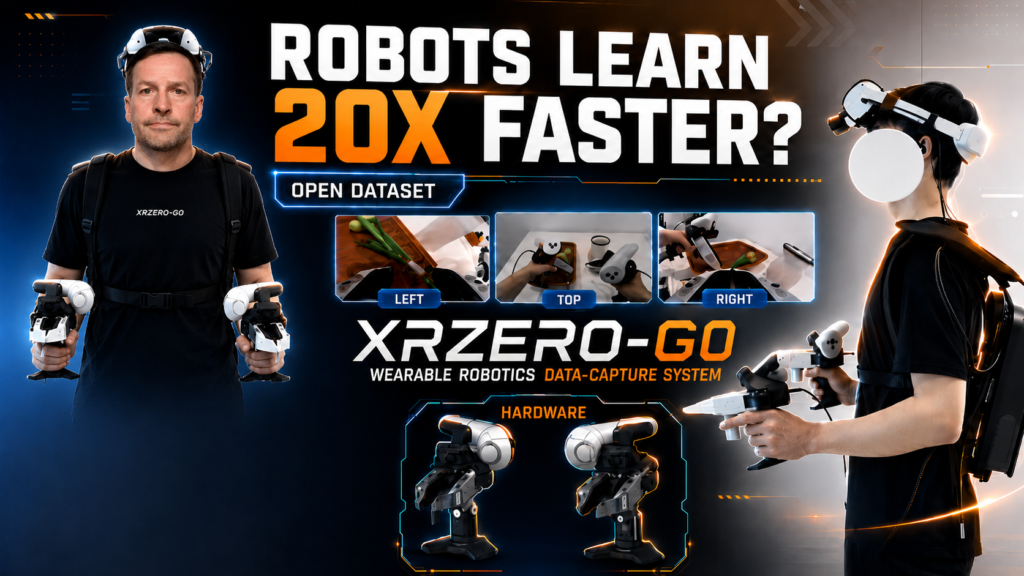
The setup is wearable and surprisingly approachable. You put on a high-precision PICO 4 VR headset, which uses inside-out spatial tracking to know exactly where you are in 3D space. Then you grab a pair of specialized grippers — one is an H-shaped, press-actuated design, and the other is a G-shaped, finger-driven design. These let a human operator perform real, dexterous tasks while the system records everything in glorious detail.
And it really does capture everything. The system combines a head-mounted camera with dual wrist cameras, so it sees both the big-picture global context and the fine, close-up hand-object interactions. It supports millimeter-accurate 6-DoF pose estimation — meaning it tracks position and orientation with serious precision — and it parses the visual, language, and trajectory data together so it all stays perfectly synchronized.
The genius of decoupling human mobility from robot kinematics is that you’re no longer limited by the robot. A person can move naturally, fluidly, and quickly, capturing high-quality demonstrations without being slowed down by mechanical constraints. The result is sustained, stable, high-throughput data collection.
The Headline Number: Up To 20X Less Real-Robot Data
So how good is it? This is where it gets properly exciting.
X Square Robot says it ran controlled experiments showing that combining roughly 10 robot-free episodes with just 1 real-robot episode can match the performance of datasets built entirely from real robots — at least in the tasks they evaluated.
Think about that for a second. Ten human demonstrations plus a single robot run, delivering performance comparable to a fully robot-collected dataset. That’s the source of the up-to-20X reduction in real-robot data requirements under experimental conditions. You’re replacing huge swaths of slow, costly robot time with fast, cheap human demonstrations.
To put it in everyday terms: it’s a bit like training for a marathon and discovering you can get most of the benefit by jogging to the fridge and back. Obviously the real robot still plays a role — it’s the final reality check — but the bulk of the heavy lifting moves to humans, and that changes the economics completely.
Quality Control: Not Just More Data, But Better Data
Now, here’s a fair objection. If humans are collecting the data, how do you keep it clean and reliable? Bad data is worse than no data — it teaches robots the wrong things. X Square Robot clearly anticipated this, because they built a closed-loop “collection–inspection–training–evaluation” pipeline to govern quality at every level.
It works on three levels:
- Observation level: Multi-view geometric consistency suppresses mismatches between what the cameras see and the actual motion, keeping the visual and kinematic data aligned.
- Kinematic level: Full-body inverse kinematics, complete with collision and joint-limit constraints, filters out invalid trajectories — the impossible or nonsensical movements a robot couldn’t actually perform.
- Policy level: Real-robot playback serves as the final validation criterion. If the robot can actually reproduce the task, the data passes the ultimate test.
That last step is the key. The real robot isn’t gathering the bulk of the data anymore, but it still acts as the final judge of whether a human demonstration genuinely transfers. It’s a smart way to keep human convenience without sacrificing real-world reliability.
Cross-Embodiment: Teach Once, Use Everywhere
There’s another piece of this that deserves attention, because it’s the part with the biggest long-term implications: cross-embodiment policy transfer.
In plain English, that means a task demonstrated by a human can be reliably checked for quality and then transferred to entirely unseen robotic platforms. You’re not locked into one specific robot. The skills you capture can move across different machines.
For anyone deploying robots in the real world — and as a consultant, this is the bit that makes my ears prick up — that’s enormous. It means the work you put into teaching a capability doesn’t have to be redone from scratch every time you adopt new hardware. The data becomes a durable, transferable asset rather than a one-off cost tied to a single robot model.
The 2,000-Hour Gift: The G0-Dataset
X Square Robot didn’t just describe the framework and keep it locked away. They scaled it up into the G0-Dataset — a 2,000-hour multimodal repository — and open-sourced the whole thing.
That dataset integrates robot-free collection, automated quality inspection, mixed-data training, and real-robot evaluation, all aimed at research use. It’s designed to support large-scale pretraining and cross-embodiment transfer experiments, and crucially, it’s a reproducible open resource. That word — reproducible — matters a lot in research. It means other teams can verify the results and build on them with confidence.
By open-sourcing XRZero-G0 and releasing the G0-Dataset, the company is handing the research community a full toolkit: hardware designs, automated inspection pipelines, training methodologies, and high-quality datasets. The stated goal is to accelerate the development of general-purpose robots and scalable embodied AI, pushing the field toward more systematic, large-scale data generation.
If you want to dig into the technical details yourself, the research paper is available on arXiv, the code is up on GitHub, and the open dataset lives on HuggingFace. This is about as open as open-source gets.
Why This Matters for the Rest of Us
Let me zoom out, because it’s easy to get lost in the technical weeds and miss the headline.
Cheaper, faster, scalable data collection is one of the clearest accelerants toward genuinely capable robots. Every hour of robot time you don’t have to spend collecting data is an hour you can spend deploying, refining, and actually using robots in the real world. And every barrier you remove — cost, time, hardware lock-in — brings practical, general-purpose robots that much closer.
This is the kind of foundational progress that doesn’t trend on social media but quietly reshapes what’s possible. The flashy humanoid demos grab the headlines, but it’s breakthroughs like this — in the boring, essential plumbing of how robots learn — that determine whether those humanoids ever become genuinely useful and affordable.
For businesses thinking about automation, the signal here is clear: the cost curve for capable robots is bending in the right direction, and faster than many people realize. The tools to train robots are getting cheaper and more accessible, which means the robots themselves are going to get more capable, more quickly.
My Take
I genuinely love stories like this. It’s not the robot that’s the star — it’s the method. X Square Robot looked at the single biggest thing slowing the industry down, found a clever way around it, proved it worked, and then gave it away for free. That’s the kind of move that lifts the whole field.
Will robot-free data collection completely replace real-robot data? No — and they’re not claiming it does. The real robot still has the final say. But shifting the bulk of the effort onto fast, cheap, human-collected demonstrations is exactly the sort of practical step that gets us to useful robots sooner. And making it open-source means everyone gets to build on it, not just one company.
Keep your eye on this one. The breakthroughs that change everything aren’t always the loudest.
Brought to You By My Sponsors
This content is proudly supported by four brilliant organizations doing real work in the robotics space:
- Robot Center — Your go-to for robot sales, deployment, and Robotics-as-a-Service: https://www.robotcenter.co.uk
- Robots of London — Event robotics and unforgettable robot experiences: https://www.robotsoflondon.co.uk
- Robot Philosophy — My home base for robotics insight, content, and consultancy: https://www.robophil.com
- Robot Charity — Supporting the mission to bring robotics to everyone: https://www.robo.charity
RoboPhil (Philip English) is a robot YouTuber, robotics influencer, robot consultant, and trainer, and the founder of Robot Philosophy. Follow for daily robotics news, reviews, and insight.
#Robotics #EmbodiedAI #XSquareRobot #RobotNews #OpenSource #RoboPhil