
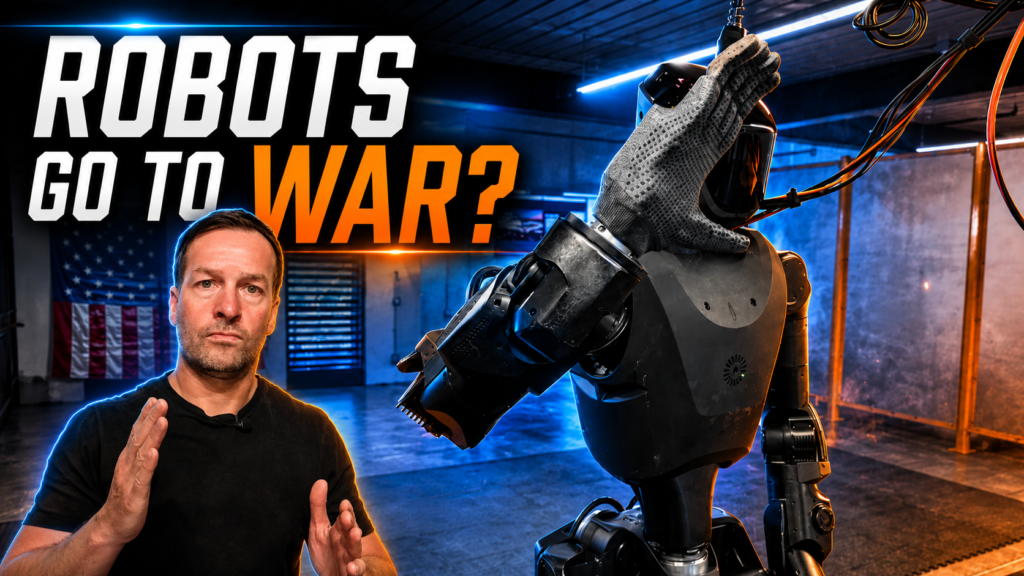
The Rise of Humanoid Robots: How AI Robots Like Phantom Could Transform Work, Industry, and Dangerous Jobs
Humanoid robots are moving from science fiction into serious business conversation.
For years, the idea of a human-shaped robot walking through a factory, carrying equipment, inspecting hazardous spaces, or supporting workers in dangerous environments felt like something from a film. Impressive, exciting, slightly unsettling, and always just a few years away.
That is changing.
A new generation of AI robots and humanoid robots is beginning to emerge. These machines are no longer being discussed only as futuristic helpers for the home. They are being positioned for logistics, industrial inspection, warehouse automation, security, emergency response, construction, manufacturing, and even military-style applications.
One of the most interesting examples is Phantom, the humanoid robot from Foundation Future Industries, which has attracted attention because of its reported connection to dangerous, industrial, and defense-related environments. Whether humanoid robots like Phantom become mainstream quickly or take longer to prove themselves, one thing is clear: the robotics industry is entering a new phase.
The big question is no longer simply, “Can we build a humanoid robot?”
The better question is, “Where can humanoid robots create real commercial value?”
That is the question every business leader, automation professional, robotics startup, investor, and technology founder should be asking.
Why Humanoid Robots Are Suddenly So Important
Humanoid robots are important because the world was built for humans.
Factories, warehouses, offices, hospitals, ships, vehicles, corridors, doors, staircases, tools, ladders, and workstations were designed around the human body. Traditional industrial robots are incredibly powerful, but they usually need controlled environments, safety cages, programming, fixtures, and carefully designed workflows.
Humanoid robots offer a different possibility.
Instead of rebuilding the world around the robot, the robot is built to operate in the world we already have.
That is the core argument behind humanoid robotics.
A humanoid robot can, in theory, walk through a doorway, climb stairs, carry objects, use tools, inspect equipment, and work in spaces designed for people. This makes humanoid robots especially interesting for industries where automation has been difficult because the environment is unpredictable, messy, or constantly changing.
Warehouses are not always perfect.
Construction sites are chaotic.
Industrial plants are complex.
Emergency situations are unpredictable.
Military and disaster zones are dangerous.
These are exactly the types of environments where robotics technology could eventually offer huge value.
From Robot Demos to Real-World Deployment
For a long time, humanoid robots were mostly seen in demonstrations.
They walked across a stage. They waved. They balanced. They danced. They carried small boxes. They occasionally fell over, which made them oddly more relatable.
Those demos were important because they showed progress in movement, balance, control systems, batteries, AI, sensors, and mechanical design. But businesses do not invest in robots because they can entertain a conference audience.
Businesses invest in robots when they solve real problems.
This is where the robotics conversation is changing.
The next stage of humanoid robotics is not about whether a robot looks impressive. It is about whether it can do useful work reliably, safely, and cost-effectively.
Can it move goods?
Can it inspect hazardous areas?
Can it support workers?
Can it reduce injuries?
Can it improve productivity?
Can it operate for long enough to justify the investment?
Can it produce measurable return on investment?
These are the questions that matter.
The robotics industry is maturing from spectacle to strategy. That shift is incredibly important for the future of robotics and automation.
Why Dangerous Jobs Could Be the First Major Market
One of the strongest commercial arguments for humanoid robots is not comfort. It is danger.
There are many jobs where humans are still required to enter environments that are hazardous, exhausting, repetitive, or unpredictable. These include industrial inspection, disaster response, defense logistics, mining, energy, construction, chemical plants, nuclear facilities, offshore operations, and emergency services.
In these environments, the business case for robots becomes much stronger.
If a robot can reduce the need for a person to enter a dangerous area, the value is not just productivity. It is safety. It is risk reduction. It is business continuity. It is insurance. It is operational resilience.
That matters.
A robot that saves a few minutes in a safe office environment may be nice to have.
A robot that prevents a human from entering a hazardous zone may be mission critical.
This is why humanoid robots being tested or discussed for dangerous environments should not be dismissed as science fiction. The business logic is real.
Many of the earliest successful robotics applications have been built around jobs that are dull, dirty, dangerous, or difficult. That pattern is likely to continue.
The Commercial Opportunity Behind AI Robots
The phrase “AI robots” is becoming more important because modern robots are no longer just mechanical machines. They increasingly combine physical hardware with artificial intelligence, sensors, computer vision, mapping, navigation, natural language interaction, and machine learning.
This creates a new category of robotics technology.
A traditional robot may follow a programmed path.
An AI robot can potentially understand its environment, respond to changing conditions, make decisions, interact with people, and improve its performance over time.
That is why AI robotics is such a powerful trend.
The combination of artificial intelligence and physical robots could change how businesses think about automation. Instead of automating only fixed, repetitive tasks, companies may eventually automate more flexible work in semi-structured environments.
This could affect:
Logistics
Warehousing
Manufacturing
Retail
Healthcare
Hospitality
Events
Security
Construction
Agriculture
Energy
Defense
Inspection
Facility management
The opportunity is not just to replace a single task. The opportunity is to rethink operations.
Why Businesses Are Investing in Robotics
Businesses are investing in robotics for several reasons.
The first is labor pressure. Many industries are struggling to recruit and retain staff for repetitive, physically demanding, or low-margin roles. Robots can help fill gaps where human labor is difficult to find or expensive to maintain.
The second is productivity. Robots can work consistently, collect data, reduce downtime, and perform repetitive tasks with precision.
The third is safety. Robots can take on tasks that expose people to hazards, heavy lifting, fatigue, poor visibility, dangerous materials, or extreme environments.
The fourth is customer experience. In events, retail, hospitality, and public-facing environments, robots can attract attention, create engagement, and make a brand feel innovative.
The fifth is data. Modern robots are not just machines. They are mobile data platforms. They can scan, measure, monitor, map, inspect, and report.
This data layer is often underestimated.
A robot that moves through a warehouse, event space, factory, or industrial site is not only performing a task. It can also help a business understand what is happening in that environment.
That is where robotics becomes more than automation.
It becomes intelligence.
Humanoid Robots Versus Other Types of Robots
Humanoid robots are exciting, but they are not always the best solution.
This is one of the most important points for businesses to understand.
A humanoid robot may be useful in a human-designed environment, but it may also be more expensive and complex than other robotic systems. In many cases, a wheeled robot, tracked robot, drone, robot arm, autonomous mobile robot, cleaning robot, delivery robot, or inspection robot may be more practical.
For example, if the task is moving goods around a flat warehouse, an autonomous mobile robot may be cheaper and more reliable than a humanoid robot.
If the task is aerial inspection, a drone may be better.
If the task is repetitive manufacturing, an industrial robot arm may be the obvious choice.
If the task is outdoor security patrol, a quadruped robot or rugged mobile platform may be more suitable.
This does not make humanoid robots unimportant. It simply means businesses need to match the robot to the problem.
That is where robotics consulting becomes valuable.
The smartest companies will not buy robots because they are fashionable. They will identify the business problem first, then select the best robotic solution for that specific application.
The Role of Physical AI
Physical AI is one of the most important concepts in the future of robotics.
Artificial intelligence has already transformed software. It can generate text, images, code, analysis, and decision support. But when AI is connected to a physical robot, it moves from the digital world into the real world.
That is a major shift.
Physical AI means robots that can sense, understand, move, interact, and take action in physical environments.
This is much harder than software-only AI.
The real world is messy. Lighting changes. Floors are uneven. Objects move. People behave unpredictably. Doors stick. Batteries run down. Weather changes. Machines break. Environments are not always mapped properly.
That is why robotics is difficult.
But it is also why robotics is such a major opportunity.
If AI can successfully move into physical systems, the impact could be enormous. It could transform how goods are moved, how buildings are maintained, how people are supported, how inspections are performed, how events are delivered, and how dangerous work is managed.
The future of robotics is not just about smarter software.
It is about intelligence with arms, legs, wheels, sensors, tools, and real-world capability.
Robotics Startups and the Investment Race
The robotics startup ecosystem is growing rapidly.
Investors are paying close attention to humanoid robots, AI robots, warehouse automation, autonomous mobile robots, delivery robots, inspection robots, agricultural robots, healthcare robots, and industrial automation platforms.
There is a reason for this.
Robotics sits at the intersection of several powerful trends:
Artificial intelligence
Labor shortages
Supply chain pressure
Industrial automation
Aging populations
Defense technology
Smart infrastructure
Data collection
Manufacturing resilience
Onshoring and nearshoring
The robotics industry is not one single market. It is a collection of markets, each with different use cases, customers, regulations, price points, and adoption barriers.
This creates both opportunity and confusion.
Some robotics companies will become extremely valuable. Others will struggle because their technology is impressive but not commercially practical.
The winners will understand deployment.
They will understand service.
They will understand maintenance.
They will understand customer education.
They will understand ROI.
They will understand that selling a robot is not just selling hardware. It is selling a solution.
The Biggest Challenges Slowing Robotics Adoption
Despite all the excitement, robotics adoption still faces major challenges.
Cost is one of the biggest barriers. Many robots require significant upfront investment, and businesses need confidence that the robot will deliver measurable value.
Reliability is another challenge. A robot that works beautifully in a demo must also work in a real environment, with real staff, real customers, real obstacles, and real operational pressure.
Integration is also critical. Robots need to fit into existing workflows, software systems, safety requirements, physical spaces, and staff routines.
Training matters too. A robot deployment can fail if employees are not trained properly or if the business does not understand how to manage the technology.
Maintenance and support are often underestimated. Robots are physical machines. They need servicing, troubleshooting, spare parts, updates, and operational support.
There is also the human factor. People may be excited by robots, but they may also feel uncertain about them. Businesses need to communicate clearly about why robots are being introduced and how they will support the workforce.
The companies that succeed with robotics will be the ones that treat adoption as a strategic project, not a simple purchase.
What Businesses Should Do Before Buying Robots
Before buying a robot, a business should ask several important questions.
What problem are we trying to solve?
Is the task repetitive, dangerous, time-consuming, or difficult to staff?
What does success look like?
How will we measure return on investment?
Does the robot need to interact with people?
Does it need to move indoors, outdoors, or both?
Does it need to integrate with existing systems?
Who will operate it?
Who will maintain it?
What happens if it fails?
How will staff be trained?
What is the long-term business case?
These questions may sound simple, but they can prevent expensive mistakes.
Robotics is exciting, but excitement alone is not a strategy.
A successful robot deployment needs a clear use case, the right technology, operational planning, staff engagement, and ongoing support.
The Event Robotics Opportunity
One of the most accessible areas for robotics adoption is events.
Robots at exhibitions, conferences, product launches, retail activations, hospitality venues, and corporate events can create immediate engagement. They attract attention, start conversations, generate content, and make brands memorable.
Event robots may not always be about replacing labor. Often, they are about creating experience.
A robot can greet guests, deliver messages, display branding, interact with attendees, serve drinks, provide directions, capture leads, or act as a futuristic centerpiece.
For companies launching technology products, robots can also help communicate innovation visually. A robot at an event makes people stop, look, film, and share.
This is an important part of the robotics ecosystem because it introduces people to robots in a positive and memorable way.
Before robots become normal in workplaces, many people will first experience them at events, exhibitions, and public demonstrations.
Robotics Consulting and the Need for Expert Guidance
As robotics technology becomes more advanced, businesses will need more guidance.
The market is becoming crowded. There are humanoid robots, delivery robots, cleaning robots, service robots, telepresence robots, robot arms, warehouse robots, inspection robots, security robots, drones, and specialist automation systems.
For a business owner or innovation team, it can be difficult to know where to start.
This is where robotics consulting becomes important.
A robotics consultant can help businesses understand what is possible, identify use cases, compare robot options, assess ROI, plan deployment, train teams, and avoid buying technology that is not suitable.
Robotics consulting is not just about knowing robots.
It is about understanding business operations.
The best robotics advice connects technology with commercial reality.
That means asking practical questions about cost, safety, staff, workflow, maintenance, customer experience, and long-term value.
The RoboPhil Perspective
Philip English, known as RoboPhil, works across robotics, automation, robot hire, robot deployment, robotics insights, and robotics consulting through Robot Center, Robots of London, and Robot Philosophy.
This gives RoboPhil a practical view of the robotics industry from multiple angles.
Robot Center focuses on commercial robots, industrial robots, robotics consultancy, robot deployment, Physical AI, and Robotics as a Service.
Robots of London focuses on robot hire, robot rental, event robotics, exhibition robots, and using robots to create attention and engagement in live environments.
Robot Philosophy focuses on robotics insights, consulting, education, strategy, robot ideas, and helping businesses understand the future of robotics.
Across these areas, one pattern becomes clear: businesses are increasingly interested in robots, but many still need help understanding where robots fit commercially.
The real opportunity is not simply showing people impressive machines.
The opportunity is helping businesses identify the right robot, for the right task, at the right time, with the right deployment strategy.
That is where robotics becomes useful.
The Future of Humanoid Robots
Humanoid robots are likely to become more capable over the next decade.
They will become stronger, more stable, more intelligent, and more affordable. Their batteries will improve. Their movement will become smoother. Their hands will become more useful. Their AI systems will become more adaptable. Their ability to work safely near humans will improve.
But adoption will not happen evenly.
Some industries will adopt robots faster than others.
Warehousing, logistics, manufacturing, inspection, defense, events, and hazardous industrial work may move quickly because the business case can be clearer.
Other areas, such as home robotics, may take longer because homes are highly varied, price-sensitive, and difficult environments for robots.
The future may not be one humanoid robot in every home.
It may be many different types of robots working across many different industries.
Humanoid robots will be part of that future, but they will not be the only solution.
The real robotics revolution will involve a wide range of machines, systems, and services.
Why Robotics Will Become a Boardroom Topic
Robotics is becoming too important to remain a technical side project.
As automation becomes more advanced, robotics will increasingly become a boardroom topic. Business leaders will need to understand how robots affect productivity, workforce planning, safety, customer experience, supply chains, and competitive advantage.
Companies that ignore robotics may find themselves behind competitors that use automation to work faster, safer, and more efficiently.
This does not mean every company needs to buy a robot immediately.
It means every company should begin understanding where robotics could impact their industry.
The smartest businesses will start with education, exploration, and small pilot projects. They will learn what works, what does not, and where automation creates the most value.
Robotics adoption is not a single event.
It is a journey.
Conclusion: The Future of Robotics Is Practical, Commercial, and Closer Than Many Think
The rise of humanoid robots and AI robots marks an important moment in the robotics industry.
Robots are no longer just futuristic machines designed to impress audiences. They are becoming practical tools for business, industry, events, logistics, inspection, safety, and automation.
Humanoid robots like Phantom show where the conversation is heading. The future of robotics may involve machines working in environments that are too dangerous, difficult, or inefficient for humans to handle alone.
But the real winners will not be the companies that simply buy the most advanced-looking robots.
The winners will be the companies that understand robotics strategically.
They will identify real problems. They will evaluate the right technologies. They will train their teams. They will measure ROI. They will integrate robots properly. They will see robotics not as a gimmick, but as a serious business capability.
The future of robotics is exciting.
But more importantly, it is becoming commercially practical.
For businesses, the time to start learning is now.
Work With RoboPhil
If your business is exploring robotics, automation, AI robots, humanoid robots, robot sourcing, robotics consulting, robot deployment, event robotics, or future robotics strategy, RoboPhil can help you understand the opportunities and avoid the common mistakes.
Robotics services and partners:
Robot Center
https://robotcenter.co.uk/
Robots of London
https://robotsoflondon.co.uk/
Robot Philosophy
https://robophil.com/
Business enquiries
sales@robotcenter.co.uk