
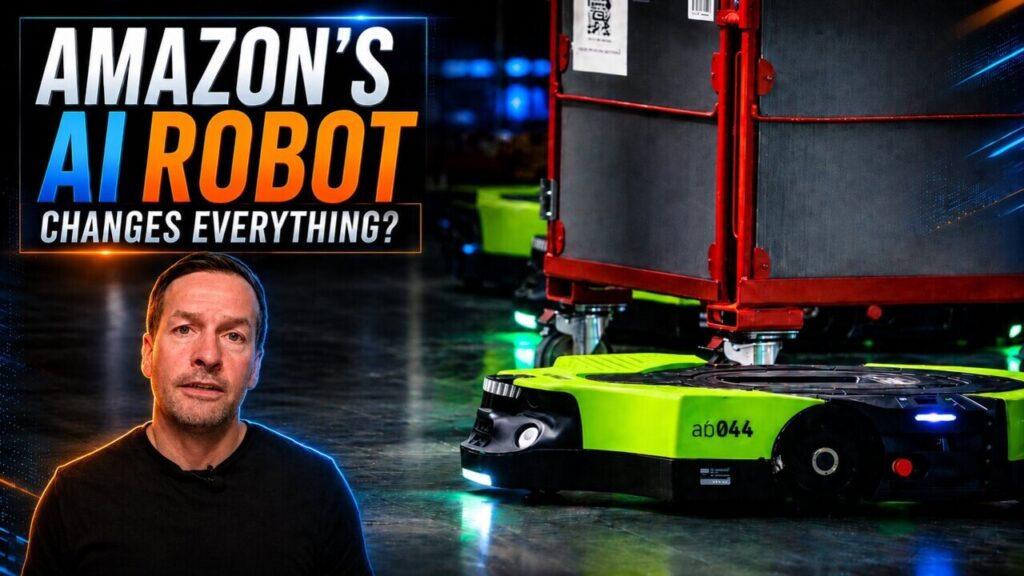
Amazon’s New Proteus Robot: The AI Warehouse Worker That Understands Human Commands
Amazon has just made one of the boldest moves in its history, and it happened on a stage in London. At the company’s “Delivering the Future” event, Amazon pulled back the curtain on a next-generation version of its autonomous Proteus robot — a machine you don’t program, but simply talk to. And to back it all up, the company committed a staggering $11 billion (€10 billion) to expanding and modernizing its fulfillment operations across Europe.
If that sounds like a turning point for warehouse automation, that’s because it is. Let’s break down exactly what Amazon announced, why the new Proteus is such a big deal, and what it all means for the future of work, robotics, and the way goods move around the world.
The $11 Billion Bet on Robotics
Let’s start with the number, because it’s a big one. Amazon plans to invest over $11 billion across the next few years to expand and modernize its fulfillment network in Europe. That’s not a rounding error in some quarterly report — it’s a deliberate, long-term signal that Amazon believes the future of logistics is physical AI: intelligent machines operating in the real world, alongside real people.
But here’s the part that surprised a lot of people. Alongside this enormous automation push, Amazon also announced it plans to grow its European fulfillment center workforce by 25,000 people in the coming years. So this isn’t a story about robots replacing humans wholesale. It’s a story about robots and humans working side by side — a theme Amazon hammered home throughout the event.
We’ll come back to the jobs question, because it’s one of the most interesting parts of this whole announcement. But first, let’s meet the star of the show.
Meet the New Proteus: A Robot You Can Talk To
The original Proteus was already an impressive piece of engineering. It’s an autonomous mobile robot that operates in the dock areas of fulfillment centers, navigating safely around people while hauling heavy carts that can weigh close to 880 pounds (around 400 kilograms). It’s currently deployed at 25 fulfillment centers in the United States, taking on the kind of physically demanding work — pushing carts, lifting heavy items, covering miles of floor during a single shift — that wears human bodies down over time.
The next-generation Proteus takes everything that made the original useful and pushes it much, much further. And the headline feature isn’t a faster motor or a bigger battery. It’s the way you communicate with it.
Here’s the genuinely revolutionary part: employees can now direct Proteus using plain, conversational language — the same way they’d talk to a coworker. There’s no technical command syntax to memorize. No programming interface to wrestle with. No specialized training required. An employee simply tells the robot what needs to be done, and Proteus handles the rest.
“You tell it what needs to be done. It figures out the priority, the route, the timing,” said Scott Dresser, vice president of Amazon Robotics. “It becomes your assistant for material movement.”
Think about how significant that is. In most warehouse automation systems, the humans have to adapt to the machines — learning their interfaces, following their rules, working around their limitations. The new Proteus flips that relationship. The machine adapts to the human. You speak naturally, and the AI does the heavy lifting of interpreting your intent, planning a route, and executing the task safely.
Beyond the Loading Dock: Where the New Proteus Can Go
The original Proteus was limited to dock areas. That made sense for a first-generation system — start in a contained, predictable environment and prove the concept. But the new Proteus is designed to operate anywhere items need to be moved across a facility.
That means it can:
- Transport containers as they arrive at a site
- Transfer items between workstations
- Assist employees across fulfillment centers and delivery sites
In other words, Proteus is evolving from a specialized dock robot into a general-purpose material-movement assistant that can roam the entire operation. It handles the heavy, repetitive, physically punishing work — moving heavy carts and covering long distances — so human employees can focus on higher-skilled tasks like managing inventory flow and ensuring quality control.
The new system is currently being piloted in Amazon’s labs, with deployment in Europe planned for the first half of 2027. So while you won’t see fleets of conversational robots tomorrow, the timeline is closer than you might think.
It’s Not Just Proteus: Vulcan and STARK
The new Proteus might be grabbing the headlines, but it’s just one piece of a much broader robotics roadmap. Amazon is simultaneously advancing mobile robots, collaborative technology, and robotic manipulation — the ability to handle individual objects with precision. Two other robots stood out at the event.
Vulcan: The Robot That Can Feel
Vulcan is Amazon’s first robotic system with a genuine sense of touch. That might sound like a small detail, but it’s actually a major leap. Most robots “see” their environment through cameras and sensors, but they don’t feel anything. Vulcan can see and feel objects simultaneously, which lets it navigate densely packed environments and handle delicate picking tasks that would stump a vision-only system.
Originally developed for a facility in Spokane, Washington, Vulcan has already expanded to handle more complex picking tasks at Amazon’s facility in Hamburg, Germany. As part of the new investment, it’s set to support a growing number of sites.
STARK: Born From an Employee’s Idea
STARK is a collaborative robotic tote-handling system, and its origin story is one of the most charming details of the whole announcement. STARK was born from an operations employee’s idea to improve a process and support site safety. It works side by side with employees, picking full totes from conveyors and placing them on carts — exactly the kind of repetitive heavy lifting that leads to strain and injury over a long shift.
First piloted in Barcelona, Spain, STARK is planned to expand to 15 sites across Europe by 2027. The fact that it came from a frontline worker’s suggestion is a nice reminder that some of the best innovations come from the people closest to the actual work.
The Big Question: Will Robots Take Jobs?
This is the question on everyone’s mind whenever automation makes headlines, and it deserves an honest look.
Amazon’s answer is that this transformation is about supporting employees, not replacing them. The company points out that since introducing robotics into its operations, it has hired hundreds of thousands of employees globally and created entirely new categories of jobs — including reliability, maintenance, and engineering roles that simply didn’t exist before robots entered the picture.
“This transformation is designed to deliver a step-change in how we support our employees and serve our customers,” said Armin Cossmann, vice president of operations for Europe. “Customer expectations aren’t slowing down — and neither are we.”
The logic Amazon is presenting goes like this: robots take on the physically strenuous, repetitive, injury-prone tasks, while humans move up the value chain into roles that require judgment, problem-solving, and technical skill. The planned addition of 25,000 European jobs is offered as evidence that automation and employment can grow together rather than at each other’s expense.
Of course, the reality of automation is always more nuanced than any single company’s framing. The jobs that get created aren’t always the same jobs that get displaced, and they don’t always go to the same people. But it’s worth noting that Amazon is at least publicly committing to workforce growth alongside its robotics expansion — and 25,000 is not a small number.
“Europe is at the center of how we’re building our operations for the future,” Dresser said. “The investment we’re making here, the talent we’re building with here, the technology we’re deploying here — this is where the next chapter of operations innovation is being written.”
Why This Matters for the Broader Robotics Industry
Step back from Amazon specifically, and this announcement tells us something important about where the entire robotics industry is heading.
For years, “robotics” in industrial settings meant rigid, pre-programmed machines bolted to factory floors, doing one task over and over with no flexibility. The new wave — what’s increasingly being called Physical AI — is fundamentally different. These are machines that perceive their environment, understand natural language, make decisions, and adapt to changing conditions in real time.
The conversational interface on the new Proteus is a perfect example. When you remove the requirement for specialized programming and let any employee direct a robot just by talking to it, you dramatically lower the barrier to deployment. You don’t need a team of robotics engineers on site to reconfigure the system every time the workflow changes. You just talk to it. That’s the kind of shift that takes robotics from a niche capital investment to something far more flexible and widely accessible.
This has enormous implications for businesses of all sizes — not just retail giants like Amazon. As these technologies mature and become more affordable, commercial and industrial robots will become viable for warehouses, factories, events, and operations that could never have justified the cost and complexity before. The question for most businesses is no longer if robotics will play a role, but when and how.
Thinking About Robotics for Your Own Operation?
The Amazon announcement is a glimpse of where the cutting edge is heading, but you don’t need an $11 billion budget to start exploring what robotics can do for your business. Whether you’re looking to buy, deploy, hire, or simply understand how Physical AI fits into your strategy, there’s a growing ecosystem of expertise to tap into.
If you’re considering bringing robotics into your operation, Robot Center offers commercial and industrial robots, robotics consultancy, and Robotics-as-a-Service — covering everything from buying and deployment to navigating the world of Physical AI.
For events, exhibitions, and experiences that need a wow factor, Robots of London specializes in robot hire and rental, putting show-stopping event robotics within reach without the long-term commitment.
When it comes to strategy, Robot Philosophy provides robotics consultancy, recruitment, and the kind of sharp insights and advice that turn robot ideas into real-world results.
And on the human side of all this technology, Robot Charity — the world’s first robot charity — is dedicated to deploying robotics where it’s needed most to support humanity. It’s a reminder that the same technology transforming warehouses can also be a genuine force for good.
Final Thoughts: The Next Chapter Is Being Written Now
Amazon’s next-generation Proteus is more than a new robot — it’s a statement about the direction of an entire industry. A machine you can talk to, that figures out the priority, the route, and the timing on its own, that works anywhere across a facility and takes on the tasks that grind human bodies down — that’s not science fiction. It’s piloting in labs right now, with European deployment penciled in for the first half of 2027.
Combine that with Vulcan’s sense of touch, STARK’s collaborative tote-handling, an $11 billion investment, and a pledge to add 25,000 jobs, and you’ve got one of the clearest pictures yet of what the future of operations looks like. It’s a future where robots and humans share the floor — each doing what they do best.
The next chapter of robotics is being written as we speak. The only real question is how quickly the rest of the world catches up.
What do you think — are voice-controlled robots like the new Proteus a genuine breakthrough, or are we underestimating the challenges ahead? Drop your thoughts in the comments, and subscribe for daily robotics news and analysis.