
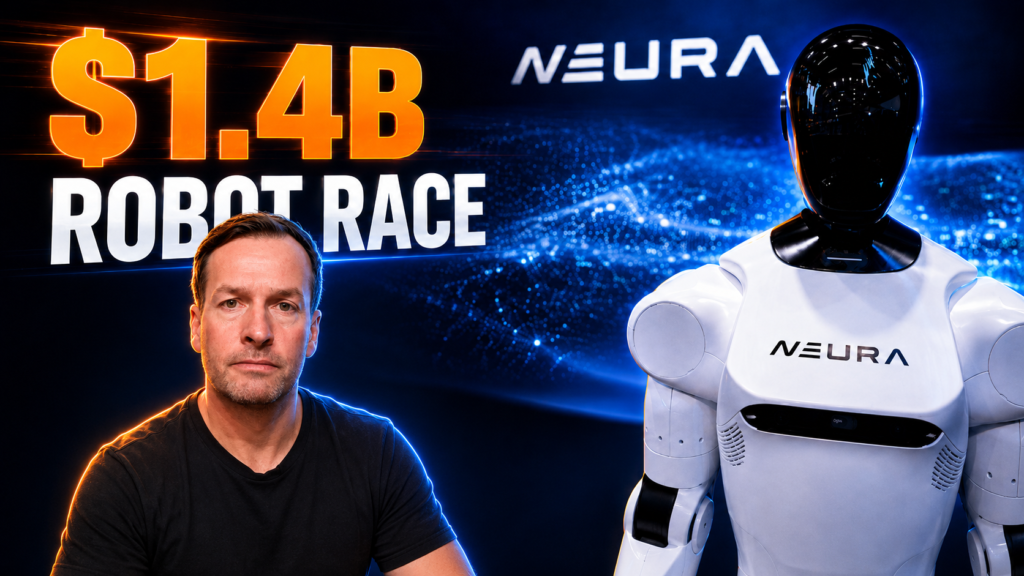
NEURA Robotics Just Raised $1.4 Billion — And the Humanoid Robot Race Just Got Serious
Every so often, a story lands in the robotics world that makes you stop, put down your coffee, and read the number twice. This is one of those stories. Germany’s NEURA Robotics has just announced a Series C funding round that could reach a staggering $1.4 billion. That’s billion, with a B. To put that in perspective for my American friends, that’s roughly the price tag of a brand-new NFL stadium — except instead of hot dogs and end zones, NEURA is spending it on robots that walk, think, and work right beside you.
I’m RoboPhil, and if you follow my channel, you know I get genuinely excited about moments like this. Because this isn’t just a big number for the sake of a headline. This is a signal — a flare shot up into the sky telling the entire industry that the humanoid robot race has officially entered its heavyweight phase. So grab a seat, because we’re going to break down exactly what NEURA Robotics is, why investors are throwing more than a billion dollars at them, and what it all means for the future of automation in your home, your workplace, and beyond.
Who On Earth Are NEURA Robotics?
Let’s start with the basics, because if you haven’t heard of NEURA Robotics, you’re not alone. Tucked away in Metzingen, Germany — a town better known for outlet shopping than cutting-edge AI — this company was founded back in 2019. That makes them relatively young in the grand scheme of things. And yet, in just a few short years, they’ve muscled their way into the same conversation as the biggest robotics players in the United States and China.
That alone is worth pausing on. For years, the prevailing wisdom was that globally significant AI infrastructure companies could only emerge from Silicon Valley. NEURA’s founder and CEO, David Reger, is making a very direct argument against that idea. He believes the next generation of AI leaders can emerge anywhere in the world where there’s enough vision, engineering talent, and execution speed. And with $1.4 billion in fresh funding behind him, it’s hard to argue he’s wrong.
So what does NEURA actually build? Quite a lot, as it turns out. Their product lineup spans light robot arms, mobile robots, and — the headliner — their 4NE1 humanoid robot. They also produce sensor kits designed for manufacturing and supply chain applications. In other words, this isn’t a one-trick company betting everything on a single flashy humanoid. They’re building an entire ecosystem of machines designed to operate across real-world environments.
The Secret Sauce: Welcome to the “Neuraverse”
Here’s where things get genuinely clever, and where NEURA separates itself from the pack. Building a humanoid robot is hard. Building a humanoid robot that’s actually useful is harder still. But the truly difficult part — the holy grail of modern robotics — is getting these machines to learn and adapt without an army of engineers reprogramming them for every new task.
NEURA’s answer to this challenge is something they call the Neuraverse. Think of it as a shared brain — an open physical AI ecosystem where robots learn across deployments. Here’s the magic: when one robot figures something out, every other robot connected to the Neuraverse can benefit from that knowledge. Picture it like this — a robot working a warehouse in Texas cracks a tricky problem, and almost instantly, a robot in a factory in Tokyo knows how to do it too. It’s a bit spooky when you first think about it, but it’s also a genuine stroke of genius. Instead of each robot learning in isolation, the entire fleet gets smarter together.
To feed this shared intelligence, NEURA is also expanding what they call NEURA Gyms — specialized, large-scale training environments that combine real-world sensor interaction, simulation, and multimodal learning pipelines. Essentially, these are places where robots go to “work out” and get better at their jobs, blending physical practice with digital simulation. It’s a fascinating approach, and it’s exactly the kind of infrastructure thinking that separates serious long-term players from companies chasing a quick viral demo.
Follow the Money: Who’s Backing NEURA?
A company can have all the vision in the world, but vision doesn’t pay the bills. So let’s talk about who’s actually writing the checks here — because the investor list reads like a who’s who of the technology world.
NEURA’s Series C round drew in NVIDIA, Amazon, Qualcomm, Bosch, Schaeffler, the European Investment Bank, Tether, and several others including imec.xpand, Lingotto Horizon, and InterAlpen Partners. When you’ve got chip giants, retail behemoths, and major industrial players all lining up to invest, it tells you something important: the smart money believes physical AI is the real deal.
Qualcomm’s perspective is especially telling. Nakul Duggal, who leads the company’s automotive, industrial, and robotics group, described physical AI as the next major evolution of computing — extending intelligence into real-world environments. He pointed out that robotics is one of the most demanding edge AI use cases out there, because these systems have to perceive, reason, and act instantly and reliably, often in safety-critical situations. That’s a polite way of saying: robots can’t afford to lag or glitch when they’re working alongside humans.
Then there’s Tether — yes, the blockchain and stablecoin company. Their CEO, Paolo Ardoino, framed NEURA’s mission in terms of autonomy: as robotics moves beyond scripted automation and into true independence, the infrastructure behind it has to evolve too. He talked about machines being able to process information locally, make decisions, and even transact without relying on centralized intermediaries. Whether or not you’re a crypto enthusiast, it’s an intriguing glimpse at where some of these investors think the technology is heading.
And it’s not just about money. NEURA has been busy building a global partner ecosystem. Back in January 2026, they announced a collaboration with Robert Bosch to develop software for humanoid robots. In April, they teamed up with Dassault Systèmes to close the notorious “sim-to-real” gap — the frustrating disconnect between how robots perform in simulation versus the messy real world. Add in strategic partners like Kawasaki, Delta Electronics, and Amazon, and you start to see a company weaving itself deep into the fabric of the global robotics industry.
The Goal: Millions of Robots by 2030
Now, here’s the figure that really made me sit up. NEURA isn’t just talking about building a few impressive robots for trade show demos. Their stated goal is to scale manufacturing and deployment infrastructure across Germany and India with an aim of producing millions of robots by 2030.
Millions. Let that sink in for a moment.
And this isn’t just hopeful ambition pulled from thin air. NEURA claims its existing order book and strategic deployment pipeline already exceed $1 billion. That’s real demand, with real customers, before this latest funding round even fully kicks in. The new money is earmarked to accelerate several things at once: the global deployment of cognitive robots and humanoids from Europe to the US, China, and Japan; expansion of the Neuraverse platform; the rollout of more NEURA Gyms; scaling up manufacturing; and the development of next-generation physical AI systems.
In short, they’re not just trying to win a race — they’re trying to build the entire racetrack.
What Does This Mean for You?
So why should you care about a German robotics company raising a huge pile of cash? Because moments like this are how the future quietly arrives. Reger believes physical AI and cognitive robotics will become one of the largest technology shifts of the coming decades, transforming industries from manufacturing and logistics to healthcare, services, and yes — even household robotics.
That last one is the kicker. NEURA has been showing off a mobile manipulator called MiPA, designed with household use in mind. We’re not quite at the “robot butler making you breakfast” stage yet, but companies like NEURA are laying the groundwork for a world where cognitive robots in the home stop being science fiction and start being something you can actually buy.
Reger put it in a way I really like. He said that in the future, people won’t only ask what AI can say — they’ll ask what AI can physically do. And that’s the heart of this whole story. We’ve spent the last few years marveling at AI that can write essays, generate images, and hold conversations. The next frontier is AI that can pick things up, move around, and get its hands dirty in the physical world.
Of course, I’d be doing you a disservice if I didn’t add a dose of healthy skepticism. Big funding rounds and bold 2030 targets are exciting, but the robotics graveyard is full of companies that promised the moon and delivered a prototype. Scaling to millions of robots is a monumental challenge — manufacturing, supply chains, safety regulation, and real-world reliability all have to line up perfectly. NEURA has the backing and the partnerships to give it a serious shot, but the proof, as always, will be in the deployment.
My Take
Here’s where I land on all of this. NEURA Robotics raising up to $1.4 billion is one of the clearest signals yet that the humanoid and cognitive robot race is no longer a futuristic curiosity — it’s a full-blown industrial gold rush. The fact that this is happening in Germany, not Silicon Valley, is a healthy reminder that innovation is global, and that the leaders of tomorrow can emerge from anywhere.
The Neuraverse concept genuinely excites me, because shared learning across a robot fleet is exactly the kind of compounding advantage that could let one company pull ahead fast. And with the likes of NVIDIA, Amazon, and Qualcomm in their corner, NEURA has the muscle to back up the ambition.
Will we really see millions of cognitive robots out in the wild by 2030? I’m cautiously optimistic. The trajectory is pointing firmly upward, the money is flowing, and the technology is maturing at a pace that’s genuinely hard to keep up with — which, lucky for you, is exactly why I do this every single day.
So here’s my question to you: would you welcome a cognitive robot into your home? Are you thrilled by the idea of a helping hand around the house, or does the thought of a thinking machine in your kitchen send a shiver down your spine? Drop your thoughts in the comments — I read them all, and I love hearing where you stand.
Until next time, I’m RoboPhil, keeping you plugged into the future of robotics. Now if you’ll excuse me — I’m off to teach my robot some manners.
Stay connected and explore the world of robotics with my trusted partners:
- 🤖 Robot Center — your one-stop shop for all things robotics: https://www.robotcenter.co.uk
- 🎉 Robots of London — event and entertainment robots that wow every crowd: https://www.robotsoflondon.co.uk
- 🧠 Robot Philosophy — robotics insights, consultancy, and training: https://www.robophil.com
- ❤️ Robot Charity — using robotics to make a real difference: https://www.robo.charity