
AI Robot Barbers and the Future of Service Robotics: Are Automated Everyday Services Coming Next?
The idea of a robot cutting your hair sounds like something from a science fiction film.
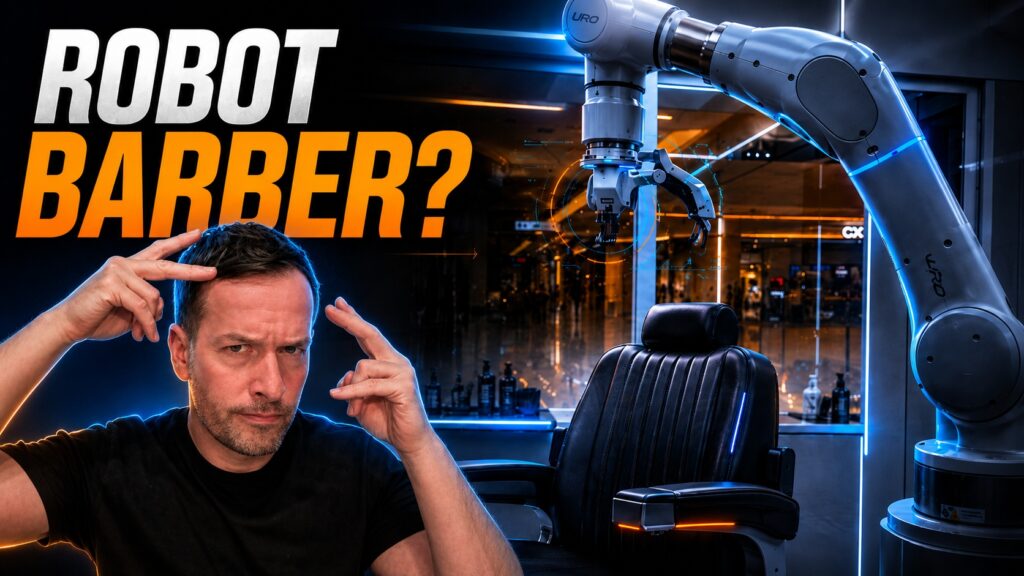
A customer walks into a smart kiosk. The system scans their head in 3D. Artificial intelligence analyses the shape of the head, hairline, hair pattern, and cutting angles. Then a robotic arm begins trimming with precision.
It sounds futuristic. It also sounds slightly terrifying.
But behind the novelty of an AI robot barber is a much bigger story. This is not just about haircuts. It is about the next generation of service robotics, AI robots, automation, and the future of how everyday services may be delivered.
For years, robots have been associated mainly with factories, warehouses, manufacturing lines, and industrial automation. That is changing quickly. Robotics technology is moving into retail, hospitality, healthcare, logistics, events, public spaces, and customer-facing environments. The rise of AI robots is creating a new category of machines that can interact with the physical world while using intelligent systems to make decisions.
The robot barber kiosk is a fascinating example of this shift. Whether or not robot haircuts become mainstream, the concept points toward a future where more everyday services are automated, measured, repeated, and delivered through smart robotic systems.
The real question is not simply, “Would you trust a robot to cut your hair?”
The bigger question is: what happens when robotics moves from the factory floor into everyday life?
The Rise of Service Robotics
Service robotics is one of the most exciting areas in the robotics industry.
Unlike traditional industrial robots, which are usually designed for controlled environments such as factories, service robots are created to operate around people, customers, staff, and public spaces. They may clean floors, deliver food, guide visitors, support healthcare workers, provide entertainment at events, inspect buildings, assist in warehouses, or interact with customers in retail environments.
The robot barber concept fits into this wider movement. It is a specialist service robot designed to perform one focused job in a repeatable way. That is important because many people imagine the future of robotics as humanoid robots walking around doing everything a human can do.
In reality, much of the future of robotics may be more practical and more specific.
Not every robot needs to look human.
Some robots will be kiosks. Some will be mobile platforms. Some will be robot arms. Some will be built into furniture, machines, vending systems, vehicles, or smart service booths. The robot itself may not always be the center of attention. It may simply become part of the service experience.
That is where the commercial opportunity becomes very interesting.
Why a Robot Barber Matters
At first glance, an AI-powered robot barber sounds like a novelty. It is easy to focus on the strange visual image of a robotic arm trimming someone’s hair.
But from a business perspective, the concept raises important questions about automation, customer service, and the future of personal services.
A haircut is a highly personal service. It involves trust, style, precision, safety, and customer preference. If robotics technology can enter a space as personal as hair cutting, it suggests that many other services could also be automated over time.
This matters because businesses across many industries are looking for ways to deliver services faster, more consistently, and at scale. Customers increasingly expect convenience. They are used to self-checkout, mobile ordering, online booking, contactless payments, delivery apps, and automated customer support.
A robot barber kiosk is part of that same trend.
It suggests a future where customers may interact with automated service points in shopping centers, airports, hotels, gyms, residential buildings, workplaces, and public spaces. These systems could provide services that are available on demand, require less waiting, and deliver consistent results.
The haircut is only one example. The broader idea is automated personal service.
From Self-Checkout to Robotic Services
There was a time when self-checkout seemed unusual. Now it is common in supermarkets, convenience stores, airports, and retail chains.
There was a time when ordering food from a screen felt impersonal. Now quick-service restaurants, cinemas, hotels, and delivery platforms use digital ordering systems every day.
There was a time when people hesitated to use mobile banking, contactless payment, or app-based services. Now they are normal parts of modern life.
Robotics may follow a similar adoption curve.
At first, robot services may feel strange, risky, or gimmicky. Then people will try them out of curiosity. Some applications will fail. Some will work. The useful ones will improve, become cheaper, and eventually become normal.
That does not mean every service should be automated. It also does not mean people will stop valuing human service. In many cases, human interaction will remain essential.
But in the right situations, robotics can create value.
For simple, repeatable, structured tasks, robots can help businesses offer faster service, extend operating hours, improve consistency, and collect useful operational data. When paired with good design and proper deployment, service robots can become part of a better customer experience rather than a replacement for it.
The Technology Behind AI Robot Services
A robot barber kiosk would require several important technologies working together.
The first is perception. The system needs to understand the customer’s head, hair, and position. This may involve cameras, depth sensors, 3D scanning, and computer vision. The robot must be able to recognise where the person is, how they are seated, and where the cutting tool should move.
The second is artificial intelligence. AI can help interpret the scan, identify hair patterns, compare the customer’s request with available styles, and plan the robot’s movements. In future systems, AI could also help personalise services by remembering customer preferences or suggesting styles based on previous visits.
The third is robotics control. The robotic arm must move safely and accurately. Hair cutting requires careful motion, fine positioning, and constant awareness of the human subject. Unlike moving boxes in a warehouse, the robot is working close to a person’s head.
The fourth is safety. This is absolutely critical. Any robot operating near people must include safety systems, emergency stops, sensors, soft motion planning, protective design, and clear operating procedures. In personal service robotics, trust depends on safety.
The fifth is user experience. The technology may be impressive, but if the customer experience feels confusing, uncomfortable, or unsafe, adoption will be limited. The service must be easy to understand, simple to use, and reassuring.
That is why robotics consulting and deployment strategy are so important. Buying a robot is only one part of the process. The real challenge is integrating the robot into a working business model.
Trust Is the Biggest Challenge
The biggest barrier to robot barbers may not be the technology.
It may be trust.
Would customers feel comfortable sitting in a chair while a robotic arm moves near their head? Would they trust the machine to stop if something went wrong? Would they feel confident that the system understands their hairstyle? Would they believe the result will be good enough?
Trust is central to the future of robotics.
In factories, robots often work behind barriers, away from the public. In service environments, robots operate around customers. That means the machine must not only be safe; it must feel safe.
This is where design, communication, branding, training, and customer education become essential.
People need to understand what the robot is doing. They need clear instructions. They need visible safety features. They need reassurance that the system has been tested. They need confidence that a human can intervene if necessary.
Trust does not happen automatically. It is built through repeated positive experiences.
This is true for robot barbers, humanoid robots, delivery robots, healthcare robots, cleaning robots, event robots, and industrial robots working around people.
The companies that win in robotics will not simply be the ones with the most advanced machines. They will be the ones that understand human trust.
Business Opportunities in Robotic Services
The robot barber concept shows how robotics can create new business models.
A robotic service kiosk could be placed in a shopping center, airport, hotel, office building, or retail location. It could operate for extended hours. It could attract attention. It could collect data on usage patterns. It could be updated over time. It could potentially create recurring revenue through services, maintenance, subscriptions, or robotics as a service.
This is where robotics technology connects with business strategy.
For entrepreneurs, the opportunity is not always to build the most complex robot. Sometimes the opportunity is to identify a specific service that can be improved through automation.
For investors, the question becomes whether a robotic system can scale commercially. Is the market large enough? Is the problem painful enough? Can the robot deliver consistent value? Can it be maintained? Can it be deployed across multiple locations? Can it generate repeat revenue?
For business owners, the question is whether robotics can solve a real operational challenge. Can it reduce waiting times? Improve customer experience? Increase capacity? Support staff? Create a new service offering? Generate attention? Improve consistency?
Robotics is not just a technology conversation. It is a commercial conversation.
Why Businesses Should Pay Attention Now
Many companies still view robotics as something for the future.
That is a mistake.
Robotics adoption is already happening across manufacturing, warehousing, logistics, cleaning, healthcare, food service, agriculture, security, events, and retail. AI is accelerating this because robots can now become more flexible, more interactive, and more adaptable.
Businesses do not need to adopt every new robot immediately. In fact, they should not. Many robots are not ready for every environment, and some applications are still too early.
But businesses should start learning now.
The companies that understand robotics early will be better positioned to make smart decisions later. They will know what is possible, what is hype, what is practical, what is expensive, and what can create real value.
Waiting until competitors have already deployed automation may be too late.
The best approach is to start with education, audits, pilot projects, and strategic planning. Businesses should look at their operations and ask where robots could realistically help. They should identify repetitive tasks, labour-intensive processes, customer service bottlenecks, safety challenges, and areas where consistency matters.
Robotics should not begin with the question, “Which robot should we buy?”
It should begin with the question, “What problem are we trying to solve?”
Humanoid Robots vs Specialist Robots
Humanoid robots are receiving huge attention. They are exciting because they promise general-purpose automation. A humanoid robot could theoretically work in human-designed environments, use human tools, and perform many different tasks.
That is why humanoid robots are important.
But they are not the only future of robotics.
Specialist robots may be more commercially practical in many areas. A robot designed specifically to clean floors, move shelves, inspect pipes, serve drinks, deliver items, or cut hair may outperform a general-purpose humanoid in that specific task.
The robot barber is a good example. It does not need to walk, talk, or look human. It needs to deliver a specific service safely and consistently.
This is an important lesson for businesses.
The future of robotics will include humanoid robots, but it will also include thousands of specialist machines designed around specific business problems.
Some of the biggest opportunities in the robotics industry may come from these focused applications.
The Role of AI in the Future of Robotics
Artificial intelligence is changing robotics because it allows machines to interpret information, make decisions, and respond to changing environments.
In the past, many robots were programmed for fixed, repetitive movements. That worked extremely well in factories, where the environment could be tightly controlled. But the real world is messy. People move. Objects vary. Lighting changes. Customer behavior is unpredictable.
AI robots are designed to handle more variation.
A robot barber kiosk could use AI to understand the customer’s head shape and hair pattern. A warehouse robot could use AI to navigate around obstacles. A healthcare robot could use AI to guide patients. A retail robot could use AI to answer questions. A humanoid robot could use AI to understand instructions and adapt to different tasks.
The combination of AI and robotics is often described as Physical AI.
This is where artificial intelligence leaves the screen and enters the physical world.
That is a major shift.
Chatbots and software AI can answer questions, generate content, and process information. Physical AI can act. It can move through spaces, handle objects, inspect assets, interact with people, and perform tasks.
That is why the future of robotics is so important.
Challenges Slowing Robotics Adoption
Despite the excitement, robotics adoption is not simple.
There are several challenges businesses need to consider.
Cost is one challenge. Robots often require upfront investment, integration, training, maintenance, and support. Even when robotics as a service models reduce upfront costs, businesses still need to understand the return on investment.
Reliability is another challenge. A robot that works well in a demonstration may struggle in a real business environment. Floors may be uneven. Lighting may change. Customers may behave unpredictably. Staff may not use the system correctly.
Maintenance is also critical. Robots are physical machines. They need servicing, repairs, software updates, spare parts, and technical support.
Safety and regulation matter too, especially when robots operate near people. Businesses must think carefully about risk, liability, insurance, compliance, and operational procedures.
Finally, there is the human factor. Staff and customers need to accept the technology. If employees see robots only as a threat, adoption can create resistance. If customers do not trust the robot, usage may remain low.
Good robotics deployment requires more than technology. It requires planning, communication, training, and strategy.
How Businesses Can Approach Robotics Successfully
Businesses interested in robotics should take a structured approach.
The first step is to identify the business problem. This may be staff shortages, repetitive tasks, customer wait times, safety risks, quality issues, operational inefficiency, or the need to create a more engaging customer experience.
The second step is to assess whether robotics is the right solution. Not every problem needs a robot. Sometimes software, process improvement, better training, or simpler automation may be more effective.
The third step is to research available robotics technology. This includes understanding the robotics industry, comparing suppliers, reviewing case studies, and evaluating whether the technology is mature enough.
The fourth step is to run a pilot. A small, controlled trial can reveal practical issues before a business commits to a larger deployment.
The fifth step is to measure results. Businesses should track performance, costs, customer response, staff feedback, uptime, maintenance requirements, and return on investment.
The final step is scaling carefully. Successful robotics adoption is not about buying one exciting machine. It is about building a repeatable model that works commercially.
The Robotics Industry Ecosystem
The robotics industry is not made up of robot manufacturers alone.
It includes hardware companies, software developers, AI specialists, integrators, consultants, distributors, maintenance providers, training companies, event agencies, investors, research institutions, and end-user businesses.
This ecosystem is important because robotics is rarely plug-and-play.
A robot manufacturer may build the machine, but the customer still needs help understanding how to use it commercially. A business may know it wants automation but may not know which solution is suitable. An investor may understand the market opportunity but need insight into which robotics startups are practical and scalable.
Robotics consulting plays a key role in connecting technology with real-world adoption.
As robotics expands, more companies will need guidance on robot sourcing, deployment, integration, training, commercial strategy, marketing, and recruitment.
The businesses that benefit most from robotics will be the ones that understand the full ecosystem.
RoboPhil Perspective: Making Robotics Practical
Philip English, known as RoboPhil, works across Robot Center, Robots of London, and Robot Philosophy, helping businesses understand and adopt robotics in practical ways.
This includes working with robot manufacturers, companies exploring automation, businesses looking to deploy robots, events using robots for engagement, and organisations seeking robotics industry insight.
The RoboPhil approach is focused on making robotics commercially useful rather than simply exciting.
That means asking practical questions.
What problem does the robot solve?
How will the robot be deployed?
Who will operate it?
How will it be maintained?
What is the customer experience?
What is the business case?
What happens if it fails?
How does it create measurable value?
These questions matter because the robotics industry is full of exciting demonstrations, but businesses need more than demonstrations. They need clear strategy, reliable deployment, and real commercial outcomes.
The future of robotics will belong to companies that can connect innovation with practical business value.
What the Future of Robotic Services Looks Like
The future of robotics will not arrive all at once.
It will arrive through specific use cases.
A robot that cleans floors in a supermarket. A robot that delivers medicine in a hospital. A robot that serves drinks at an event. A robot that inspects a warehouse. A robot that welcomes visitors. A robot that supports a manufacturing line. A robot that scans shelves. A robot that helps with security patrols. A robot that prepares food. A robot that cuts hair.
Each use case may seem small on its own.
Together, they represent a major shift.
As robotics technology becomes cheaper, smarter, safer, and easier to deploy, more businesses will experiment with automation. Some robots will fail. Some will become normal. Some will create entirely new markets.
AI robots will become more capable. Humanoid robots will become more practical. Specialist service robots will spread into more industries. Robotics startups will continue to attract investment. Businesses will increasingly need robotics strategy as part of their future planning.
The next decade will be about moving from robotics hype to robotics adoption.
That is where the real opportunity sits.
Conclusion: The Robot Barber Is a Glimpse of What Comes Next
The AI robot barber may seem unusual today.
But it represents something important.
Robotics is moving into everyday services. Automation is becoming more visible. AI robots are entering physical environments. Businesses are beginning to explore how robots can improve service delivery, customer experience, and operational efficiency.
The future of robotics will not be limited to factories or science fiction.
It will be in shopping centers, airports, hospitals, hotels, warehouses, restaurants, events, offices, and high streets.
Some robots will be humanoid. Some will be robotic arms. Some will be kiosks. Some will be mobile platforms. Some will disappear into the background of everyday services.
The winners in this new robotics era will not simply be the companies that buy robots first. They will be the companies that understand where robotics creates real value, how to deploy it safely, and how to build trust with customers and staff.
A robot barber might sound strange.
But so did many technologies before they became normal.
The question is not whether robots will enter everyday life.
The question is how quickly businesses will prepare for them.
For robotics consulting, robot sourcing, robotics industry insights, and automation strategy, contact RoboPhil and explore the robotics services and partners below:
Robot Center
https://robotcenter.co.uk/
Robots of London
https://robotsoflondon.co.uk/
Robot Philosophy
https://robophil.com/
Business enquiries
sales@robotcenter.co.uk