
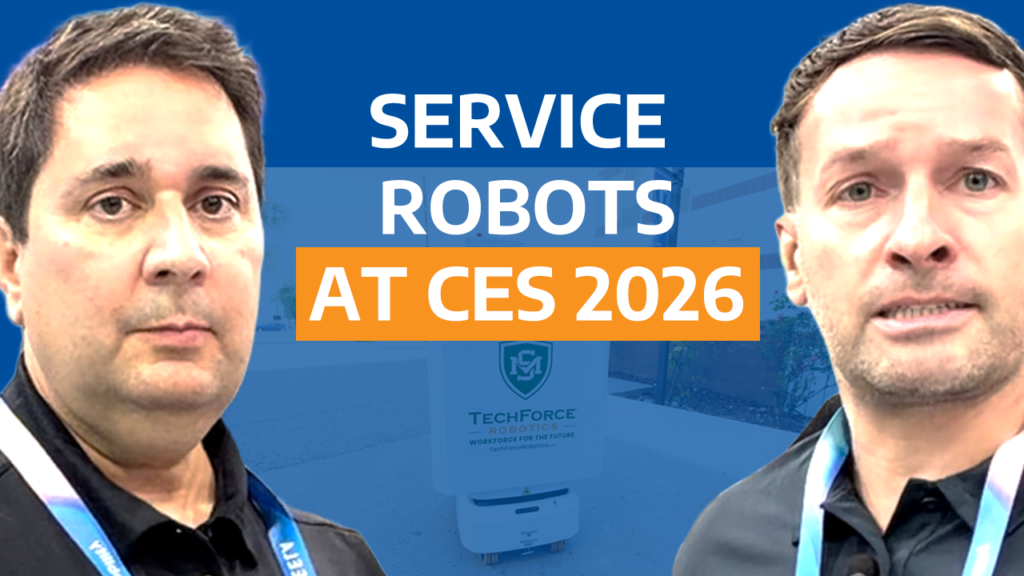
TechForce Robotics Interview at CES 2026 – Service Robots Transforming Hospitality & Healthcare
Service Robots in the Real World: How Companies Like TechForce Robotics Are Transforming Hospitality and Healthcare
For years, robots were seen as futuristic machines destined for laboratories, factories, or science fiction films. When people imagined robots in everyday life, they often pictured humanoid robots walking through cities or android assistants replacing entire workforces.
But the real robotics revolution is unfolding in a much more practical way.
Across hotels, hospitals, airports, and venues, service robots are quietly taking on repetitive tasks that keep operations running smoothly. These robots are not designed to replace humans entirely. Instead, they are built to support staff, reduce workload, and improve efficiency in environments where operational demands are high.
At CES 2026 in Las Vegas, one company demonstrating this shift was TechForce Robotics. Their focus is clear: deploying autonomous service robots that help operational teams perform physically demanding transport work such as moving linens, delivering supplies, and managing logistical tasks in busy environments.
The emergence of companies like TechForce Robotics signals something important about the future of automation. The next phase of robotics adoption is not about spectacle. It is about practical robots solving real operational problems in the physical world.
The Evolution of Service Robots
The robotics industry has evolved dramatically over the past decade.
Early robotics deployments were primarily focused on industrial automation. Manufacturing plants and warehouses were the first to adopt robotics at scale because their environments were controlled, structured, and predictable. Industrial robots could operate behind safety cages performing repetitive tasks like welding, assembly, and packaging.
However, advances in sensors, artificial intelligence, and autonomous navigation have opened the door to a new generation of robots capable of operating in dynamic environments.
Service robots represent this next stage of robotics technology.
Unlike industrial robots, service robots operate in places where people work, move, and interact. These environments are unpredictable, which means robots must be capable of navigating crowds, avoiding obstacles, and performing tasks without constant human supervision.
Recent advances in AI-powered perception systems, lidar sensors, mapping software, and edge computing have made this possible.
As a result, service robots are now appearing in places such as:
Hotels
Hospitals
Airports
Shopping centres
Universities
Conference venues
Large office buildings
Instead of replacing staff, these robots typically handle repetitive logistical work that can slow down operations.
This is where the real value of robotics begins to emerge.
Why Hospitality and Healthcare Are Ideal for Robots
Two of the industries seeing the most interest in service robots today are hospitality and healthcare.
Both sectors share a common challenge: operational workload.
Hotels and hospitals rely heavily on logistical support tasks. These tasks include moving supplies, transporting equipment, delivering items between departments, and managing operational flows behind the scenes.
These tasks are essential but rarely considered high-value work.
They are also physically demanding.
Staff in these environments often spend significant amounts of time walking long distances moving items from one location to another.
In large hospitals, for example, nurses and operational staff can spend hours per day transporting supplies, medications, linens, or waste.
Similarly, in hotels and resorts, staff frequently move laundry, housekeeping supplies, and room service items across large properties.
This is where service robots provide an immediate benefit.
Autonomous transport robots can move these items continuously throughout the day, reducing the physical burden on staff and allowing human workers to focus on tasks that require judgment, care, and customer interaction.
In healthcare environments especially, this can have a significant impact.
If nurses spend less time performing logistical work, they can spend more time with patients.
From a business perspective, the efficiency gains can be substantial.
The Rise of Robotics-as-a-Service
One of the most important developments accelerating the adoption of robots is the rise of Robotics-as-a-Service (RaaS).
Traditionally, robotics required companies to make large capital investments in hardware, integration, and specialist technical expertise. This made robotics accessible mainly to large corporations with dedicated engineering teams.
But the robotics industry is evolving toward a different model.
Instead of purchasing robots outright, companies can now subscribe to robotic solutions.
This model works similarly to software subscriptions.
The robotics provider manages the entire deployment process, including:
Robot installation
Facility mapping
Navigation configuration
Monitoring and diagnostics
Maintenance and support
Software updates
This dramatically lowers the barrier to entry for automation.
Businesses do not need robotics engineers or internal robotics expertise. They simply integrate robots into their operations as a managed service.
Companies like TechForce Robotics are helping drive this shift.
By offering fully managed autonomous service robots, they allow organisations to adopt automation without taking on the complexity traditionally associated with robotics technology.
This subscription-based approach could play a major role in accelerating the global adoption of robots.
Key Technologies Powering Modern Service Robots
Behind the scenes, several key technologies are enabling the rapid growth of service robots.
Autonomous Navigation
Modern service robots rely on advanced navigation systems that allow them to move safely through complex environments.
These systems often combine lidar sensors, cameras, and simultaneous localisation and mapping (SLAM) algorithms.
The robot builds a detailed map of the environment and continuously updates its understanding of where it is within that space.
This allows robots to move autonomously without requiring fixed infrastructure.
Artificial Intelligence and Machine Vision
AI systems allow robots to recognise obstacles, understand environments, and make navigation decisions in real time.
Machine vision systems can identify people, objects, and pathways, ensuring safe operation even in crowded environments.
Fleet Management Platforms
Many robotic deployments involve multiple robots working together.
Fleet management software allows operators to monitor robot activity, schedule tasks, track performance, and optimise operations across large facilities.
This software layer is increasingly important in the robotics ecosystem.
Cloud Connectivity
Robots are becoming part of broader digital infrastructure.
Cloud connectivity allows robotics companies to monitor systems remotely, deploy updates, and gather operational data that improves robot performance over time.
Together, these technologies are turning robots into intelligent operational tools rather than isolated machines.
Real-World Applications of Service Robots
The applications for service robots are expanding rapidly.
In hospitality environments, robots can perform tasks such as:
Delivering supplies to hotel rooms
Transporting laundry between floors
Moving housekeeping equipment
Delivering beverages or room service items
Supporting back-of-house logistics
In healthcare environments, robots can assist with:
Transporting medications
Moving sterile supplies
Delivering linens
Handling waste logistics
Supporting hospital supply chains
In airports and large venues, robots can transport equipment, assist with logistics, and support facility operations.
These deployments often begin with simple tasks.
But once organisations become comfortable with robots operating in their environment, additional automation opportunities often follow.
The Human Side of Robotics
One of the most common misconceptions about robotics is that robots are designed primarily to replace human workers.
In reality, many of today’s service robots are designed to support staff rather than eliminate jobs.
In industries like healthcare and hospitality, labour shortages and high workload levels are ongoing challenges.
Robots can help alleviate these pressures.
Instead of spending hours performing repetitive transport tasks, human workers can focus on roles that require empathy, creativity, and decision-making.
In many cases, robots improve working conditions rather than replace workers.
This collaborative model of human-robot interaction is likely to define the future of robotics adoption.
Challenges Slowing Adoption
Despite the progress in robotics technology, several challenges still influence adoption rates.
Cost Perception
Even though Robotics-as-a-Service models reduce upfront investment, many organisations still perceive robotics as expensive or experimental.
Education and real-world demonstrations are helping to overcome this perception.
Operational Integration
Deploying robots into complex environments requires careful planning.
Facilities must ensure pathways are suitable for robots, workflows are adapted, and staff are trained to work alongside robotic systems.
Cultural Resistance
Perhaps the biggest challenge is mindset.
Some organisations are hesitant to adopt robotics because they view automation as disruptive.
But as robots become more common in operational environments, this resistance is likely to diminish.
The RoboPhil Perspective
From the perspective of Philip English, also known as RoboPhil, the robotics industry is entering a fascinating phase.
Through work across Robot Center, Robots of London, and Robot Philosophy, RoboPhil collaborates with robot manufacturers, automation companies, and businesses exploring robotics adoption.
This work includes consulting on robotics strategy, sourcing robotic technologies, and helping organisations understand where robots can add real operational value.
One key observation is that robotics adoption rarely starts with dramatic transformations.
Instead, it usually begins with a simple use case.
A single robot solving a practical operational problem.
Once businesses see the impact of that first deployment, their perspective on automation changes.
Robots move from being perceived as futuristic technology to becoming useful operational tools.
What the Future of Service Robots Looks Like
Looking ahead, the growth of service robots is likely to accelerate.
Several trends will shape the future of robotics over the next decade.
First, robots will become more intelligent and adaptable.
Advances in AI will allow robots to handle increasingly complex environments.
Second, the robotics ecosystem will expand.
More robotics startups are entering the market, bringing new designs and capabilities.
Third, integration with broader automation systems will increase.
Robots will connect with building management systems, logistics platforms, and AI software to create fully automated operational environments.
Finally, public familiarity with robots will grow.
As people encounter robots in hotels, airports, hospitals, and events, the technology will gradually become normalised.
This cultural shift may be just as important as technological progress.
Conclusion: The Quiet Robotics Revolution
The future of robotics will not arrive all at once.
Instead, it will unfold gradually as robots become integrated into everyday environments.
Companies like TechForce Robotics are demonstrating what this future looks like.
Not dramatic humanoid robots replacing entire workforces, but practical autonomous machines supporting operational teams and improving efficiency.
In hospitality, healthcare, and many other industries, service robots are already proving their value.
The question is no longer whether robots will become part of everyday operations.
It is how quickly businesses will adapt.
Explore Robotics with RoboPhil
If your organisation is exploring robotics, automation, or AI robots, RoboPhil works with companies to help identify practical opportunities for robotics adoption.
Robotics services and partners:
Robot Center
https://robotcenter.co.uk/
Robots of London
https://robotsoflondon.co.uk/
Robot Philosophy
https://robophil.com/
Business enquiries
sales@robotcenter.co.uk