
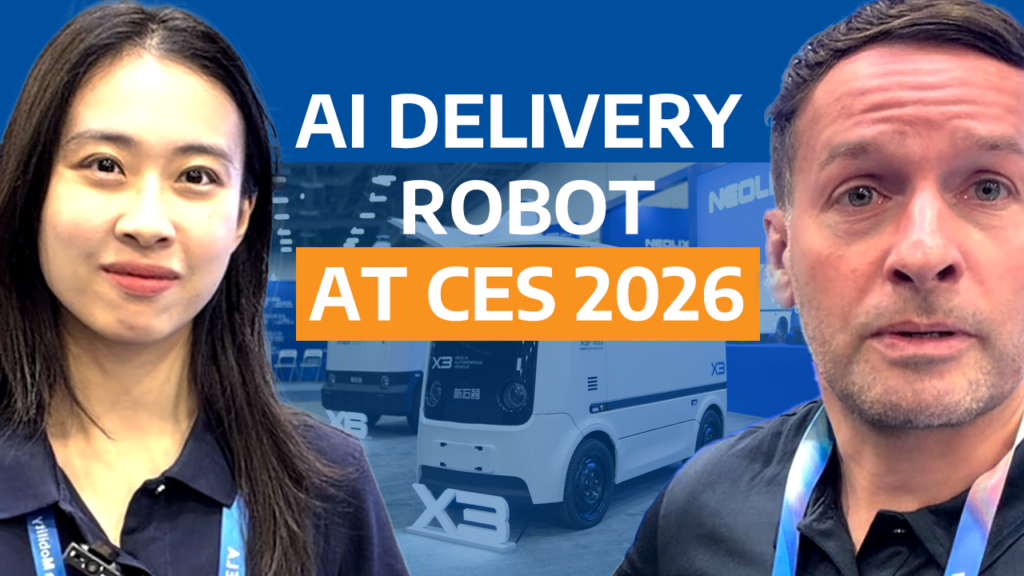
Neolix AI Delivery Robot
Most people still think robot delivery is a futuristic concept.
It isn’t.
At CES 2026, I had the opportunity to speak with the team behind Neolix, a company building autonomous delivery robots that are already operating in real environments. Not controlled demos. Not lab experiments. Real-world deployment.
And that changes everything.
Because once robots move from concept to commercial reality, adoption accelerates fast.
The Problem Robots Are Solving
To understand why companies like Neolix matter, you need to understand one key challenge in logistics:
The last mile.
The last mile is the final step in the delivery process — getting a package from a local depot to the customer’s door.
It is also the most expensive part of the entire logistics chain.
Why?
Because it is fragmented, unpredictable, and heavily dependent on human labour.
Drivers deal with traffic, parking, failed deliveries, inefficient routes, and rising labour costs. Multiply that across thousands or millions of deliveries, and the cost becomes enormous.
This is where robotics becomes not just interesting — but essential.
Enter the Neolix Delivery Robot
Neolix is building autonomous delivery vehicles designed specifically for last-mile logistics.
These aren’t humanoid robots walking down the street with packages.
They are purpose-built delivery robots — small autonomous vehicles that can navigate urban environments.
They use a combination of:
AI-based navigation
Sensors and cameras
Obstacle detection systems
Route optimisation software
The result is a robot that can move through real environments, make decisions, and complete deliveries without a human driver.
That’s a big shift.
Because autonomy at this level means scalability.
Why This Matters for Business
From a business perspective, this is where things get serious.
A delivery robot offers several advantages:
1. Lower Operating Costs
No driver salaries, reduced insurance costs, and optimised routing.
2. Increased Efficiency
Robots don’t need breaks, shifts, or time off.
3. Scalability
Once a fleet is deployed, it can be scaled much faster than hiring and training human drivers.
4. Consistency
Robots perform tasks the same way every time.
5. Data-Driven Optimisation
Every movement can be tracked, analysed, and improved.
This is why logistics companies are paying close attention.
Because this isn’t just automation.
It’s infrastructure transformation.
From Demo to Deployment
One of the biggest shifts I’ve seen in robotics over the past few years is the move from:
“Look what this robot can do”
to
“Here’s where this robot is already working.”
That’s a critical transition.
At CES, there are always impressive demos.
But what stood out with Neolix was simple:
They are already deploying.
That puts them ahead of a huge number of robotics companies still stuck in prototype mode.
And in robotics, deployment is everything.
The Bigger Robotics Trend
Neolix is part of a much larger trend.
Robots are moving out of controlled environments and into the real world.
We are seeing this across multiple sectors:
Delivery robots in logistics
Inspection robots in industrial environments
Security robots patrolling sites
Service robots interacting with customers
Humanoid robots entering pilot programmes
The common thread is this:
Robots are no longer experiments. They are becoming tools.
And tools get adopted quickly when they solve real problems.
What I’m Seeing in the Market
Working across Robot Center and Robots of London, I get to see both sides of the robotics industry.
On one side, you have the manufacturers building increasingly capable robots.
On the other side, you have businesses trying to understand how to use them.
There is still a gap.
Many companies are curious about robotics.
Few are operationally ready for it.
They don’t have:
The internal processes
The technical understanding
The integration strategy
That’s where the opportunity is.
Because the companies that figure this out early will have a significant advantage.
Robotics Is Not Just Replacement
A common narrative is that robots replace humans.
That’s too simplistic.
What’s actually happening is more interesting.
Robots are redefining workflows.
In delivery, for example, it’s not just about removing the driver.
It’s about redesigning the entire delivery system around autonomous capability.
That includes:
New routing strategies
New depot structures
New customer interaction models
New service expectations
This is why robotics adoption isn’t just a technology decision.
It’s a business transformation decision.
The Role of AI in Robotics
AI is what makes all of this possible.
Without AI, a robot is just a machine.
With AI, it becomes:
Adaptive
Responsive
Capable of decision-making
Neolix robots rely on AI to:
Navigate complex environments
Detect obstacles
Make real-time decisions
Optimise routes
As AI continues to improve, so will the capability of robots.
And that will accelerate adoption even further.
What Happens Next
Over the next 5–10 years, we’re likely to see:
More cities trialling delivery robots
Logistics companies deploying robot fleets
Regulations evolving to support autonomous delivery
Increased investment into robotics startups
Integration between robots and smart city infrastructure
What feels novel today will become normal.
Just like we’ve seen with smartphones, electric vehicles, and e-commerce.
The Competitive Advantage
Here’s the key point most businesses are missing:
Robotics is not just a cost-saving tool.
It’s a competitive advantage.
Companies that adopt robotics early can:
Deliver faster
Operate more efficiently
Scale more effectively
Offer new services
And once that advantage is established, it’s hard for competitors to catch up.
Final Thoughts
Seeing Neolix at CES reinforced something I’ve been saying for a while:
The robotics shift is already happening.
Not in theory.
Not in the future.
Right now.
The question is no longer:
“Will robots be part of business?”
It’s:
“Who will adopt them first — and who will be left behind?”
What Do You Think?
Would you trust a robot to deliver your package?
How soon do you think delivery robots will become normal in your city?
Sponsored by
Robot Center
https://robotcenter.co.uk/
Robots of London (robot rentals for events)
https://robotsoflondon.co.uk/
Robot Philosophy – robotics insights and consulting
https://robophil.com/
Business enquiries
sales@robotcenter.co.uk