
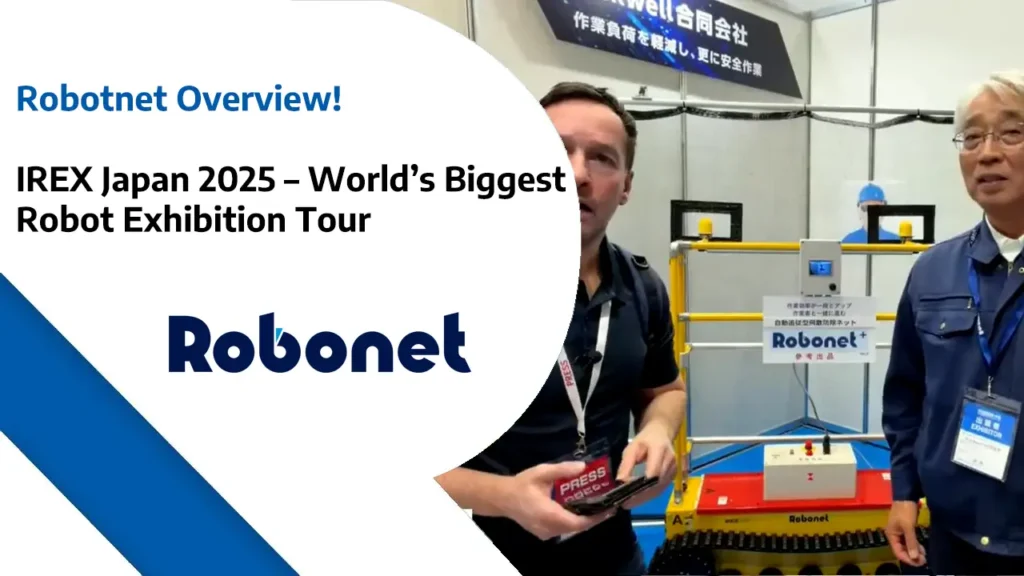
Robotnet Overview! – IREX Japan 2025 –
Robotnet Overview – IREX Japan 2025
Exploring the Connected Future of Robotics Networking
The global robotics industry continues to accelerate at an extraordinary pace, and nowhere is that momentum more visible than at IREX Japan 2025 — widely recognised as the world’s largest robotics exhibition. Held at Tokyo Big Sight, IREX brings together the most advanced robotics manufacturers, AI developers, automation integrators, and industrial technology providers from across the globe.
Among the hundreds of groundbreaking technologies showcased this year, one platform stood out not because of its physical presence — but because of the invisible infrastructure it provides behind the scenes.
That platform is Robotnet by Rockwell Japan.
While humanoids, service robots, and industrial arms often capture the headlines, the real future of robotics lies in connectivity — how robots communicate, collaborate, and integrate into wider operational ecosystems.
Robotnet represents a major step forward in solving that challenge.
The Shift from Standalone Robots to Connected Ecosystems
Historically, robots were deployed as isolated automation units. A robotic arm on a production line, an AGV in a warehouse, or a service robot in a facility would operate largely within its own programmed environment.
But as robotics adoption scales, this siloed model creates limitations:
• Lack of centralised monitoring
• Limited production visibility
• Data fragmentation
• Inefficient task coordination
• Integration complexity
• Scaling challenges across sites
Modern automation demands more than individual robot performance — it requires orchestration.
Factories, warehouses, and logistics hubs now deploy fleets of robots from multiple manufacturers, each performing different roles. Without a unifying network, managing these environments becomes operationally complex.
This is the gap Robotnet is designed to fill.
What Is Robotnet?
Robotnet is an advanced robotics networking platform developed by Rockwell Japan to connect multi-brand robotic systems, factory infrastructure, and automation technologies into a single intelligent ecosystem.
Rather than focusing on robot hardware, Robotnet focuses on the digital backbone that enables robots to operate cohesively within Industry 4.0 environments.
Key capabilities include:
• Multi-robot connectivity
• Cross-brand interoperability
• Real-time production monitoring
• Centralised analytics dashboards
• Operational performance tracking
• Predictive maintenance insights
• Scalable automation infrastructure
In simple terms, Robotnet transforms disconnected robots into a unified workforce.
Live Demonstration at IREX Japan 2025
Seeing Robotnet live at IREX provided a clear view of its practical application.
The exhibition demo showcased multiple robotic systems connected through a shared network interface, enabling operators to monitor performance, utilisation, and operational status in real time.
Key demonstration highlights included:
1. Centralised Robot Monitoring
Operators could view multiple robots across different tasks through a single dashboard, removing the need to monitor individual systems separately.
2. Production Visibility
Live production data flowed into the network, offering instant insights into throughput, efficiency, and downtime.
3. Predictive Maintenance
Robotnet aggregated performance data to flag potential maintenance issues before failure occurred — a major cost-saving capability.
4. Cross-System Communication
Robots from different manufacturers could operate within coordinated workflows, improving operational synchronisation.
Industry 4.0 Integration
Robotnet is deeply aligned with Industry 4.0 principles — the shift toward smart, connected, data-driven industrial environments.
Industry 4.0 is built on several foundational pillars:
• Connectivity
• Automation
• Data analytics
• Machine learning
• Cloud infrastructure
• Cyber-physical systems
Robotnet sits at the intersection of these pillars, acting as the connective tissue between robotic hardware and digital intelligence systems.
By networking robots into factory IT environments, businesses gain:
• End-to-end production visibility
• Data-driven decision making
• Automation scalability
• Workforce augmentation insights
• Remote monitoring capability
Why Robotics Networking Matters
As robot adoption increases, networking platforms like Robotnet will become mission-critical infrastructure.
Consider the trajectory:
• More robots per facility
• More facilities per company
• More automation vendors involved
• Greater need for data harmonisation
Without networking platforms, automation scaling becomes fragmented and inefficient.
With networking platforms, automation becomes orchestrated and optimised.
This shift mirrors what happened in computing — standalone PCs evolved into networked systems, then into cloud ecosystems.
Robotics is following the same path.
Applications Across Industry
Robotnet’s use cases span multiple sectors:
Manufacturing
• Production line robotics coordination
• Assembly automation monitoring
• Quality control integration
Warehousing & Logistics
• Fleet management for AMRs & AGVs
• Order fulfilment analytics
• Traffic optimisation
Automotive
• Multi-robot welding & assembly synchronisation
• Production throughput tracking
Electronics
• Precision manufacturing automation networking
Food Production
• Hygiene-compliant robotic coordination
The Data Advantage
One of Robotnet’s most powerful capabilities lies in data aggregation.
Connected robots generate enormous operational datasets, including:
• Cycle times
• Error rates
• Utilisation levels
• Energy consumption
• Maintenance intervals
When centralised, this data unlocks:
• Process optimisation
• Cost reduction
• Downtime minimisation
• Workforce planning insights
• Automation ROI measurement
Data transforms robotics from mechanical automation into intelligent automation.
Japan’s Leadership in Robotics Infrastructure
Japan has long been a global leader in robotics manufacturing — but platforms like Robotnet demonstrate leadership in robotics infrastructure as well.
Rather than focusing solely on building robots, Japanese firms are investing in the ecosystems that enable robots to scale effectively across industries.
This systems-level thinking is critical as robotics moves from novelty to necessity.
Exhibition Reflections
Walking the floors of IREX Japan 2025, it became clear that robotics is entering a new phase.
The first wave was mechanical capability.
The second wave was AI integration.
The third wave — now emerging — is connectivity.
Robotnet sits firmly within this third wave.
The future factory will not be defined by how many robots it has — but by how intelligently they are connected.
Sponsors & Partners
This exhibition coverage and robotics insight content is proudly supported by organisations actively deploying and advancing robotics adoption across the UK and internationally.
Robot Center
Website: https://robotcenter.co.uk/
Robot Center specialises in industrial robotics, warehouse automation, and collaborative robot (cobot) integration.
Services include:
• Industrial robot supply
• Warehouse robotics deployment
• Automation consultancy
• System integration
• Robotics maintenance & support
Robot Center works with manufacturers and logistics providers to design, deploy, and optimise automation infrastructure tailored to operational needs.
Robots of London
Website: https://robotsoflondon.co.uk/
Robots of London is the UK’s leading robot hire and event robotics company, providing cutting-edge robotic experiences for exhibitions, corporate events, brand activations, and live showcases.
Offerings include:
• Humanoid robot hire
• Service robots
• Reception robots
• Exhibition robots
• Promotional robotics
• Interactive event automation
The company helps brands and organisations create high-impact technology experiences through robotics engagement.
Robot Philosophy (RoboPhil)
Website: https://robophil.com/
Robot Philosophy, founded by RoboPhil, focuses on robotics strategy, consultancy, workshops, and industry insights.
Services include:
• Robotics adoption strategy
• Automation consultancy
• Industry workshops
• Speaking & keynote sessions
• Robotics ROI frameworks
The platform helps businesses understand not just how robotics works — but how to profit from it.
Final Thoughts
Robotnet may not be the most visually dramatic technology showcased at IREX Japan 2025 — but it may be one of the most important.
Because as robotics scales globally, connectivity will determine success.
The winners in automation will not simply deploy robots… they will network them, orchestrate them, and optimise them through intelligent infrastructure.
Robotnet offers a glimpse into that connected future.
And based on what was demonstrated at IREX, that future is arriving faster than many businesses expect.
If your organisation is exploring robotics deployment, factory automation, or connected infrastructure strategy, now is the time to look beyond hardware — and toward the networks that will power the next generation of intelligent industry.