
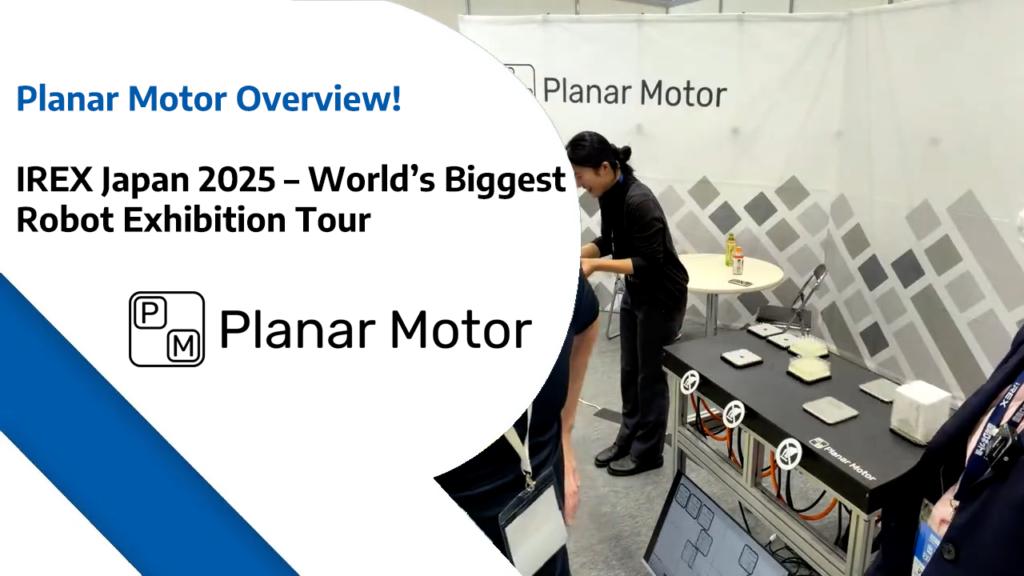
Planar Motor Overview! - IREX Japan 2025
Planar Motor Overview – A Deep Dive from IREX Japan 2025
The International Robot Exhibition (IREX) Japan 2025 once again proved why it is regarded as the world’s largest and most influential robotics and automation showcase. Held in Tokyo, the exhibition brought together the globe’s most advanced robot manufacturers, AI developers, automation integrators, and industrial innovators — all presenting their vision of the future.
Among the many groundbreaking technologies on display, one system stood out as a true game-changer in motion and transport automation:
The Planar Motor system.
Filmed live during our IREX 2025 exhibition tour, this technology represents a fundamental shift in how factories, laboratories, and logistics facilities move products — replacing rigid conveyor infrastructure with fully flexible, programmable motion platforms.
This article explores what Planar Motor is, how it works, its industrial applications, and why it signals the next evolution of Industry 4.0 manufacturing.
What Is the Planar Motor?
At its core, the Planar Motor is an intelligent transport system that eliminates the limitations of traditional conveyor belts and linear track systems.
Instead of products being carried along fixed mechanical routes, Planar Motor uses independently controlled movers that float above a planar surface using electromagnetic force.
Each mover can travel freely across the platform in multiple axes:
X axis (side to side)
Y axis (forward and backward)
Rotational movement
Independent or synchronised motion
This creates a transport environment that is not mechanically defined — but software defined.
In simple terms:
Production flow is controlled by code, not hardware.
How the Technology Works
The system consists of two primary components:
1. Planar Surface (Stator Platform)
The surface contains embedded electromagnetic coils. These generate controlled magnetic fields that levitate and move the carriers above the platform.
2. Intelligent Movers (Carriers)
These movers float frictionlessly above the surface. Each is individually addressable and programmable through the system’s control software.
Because there are no belts, gears, or chains, movement is:
Silent
Low wear
Highly precise
Infinitely reconfigurable
This architecture allows manufacturers to redesign workflows instantly without mechanical retooling.
Why This Matters: The Death of the Conveyor Belt
For over 100 years, conveyor belts have defined factory layouts. While effective, they come with limitations:
Fixed routes
Mechanical wear
Maintenance downtime
Limited flexibility
Space inefficiency
Planar Motor removes these constraints entirely.
Instead of designing production around conveyor paths, manufacturers can design motion paths around production needs — dynamically.
This is especially critical in high-mix, low-volume manufacturing environments where product variation is high.
Key Benefits of Planar Motor Systems
1. Total Layout Flexibility
Movers can change routes instantly. Production lines can be reconfigured via software rather than mechanical rebuilds.
2. Independent Product Control
Each product carrier moves autonomously, allowing different process times without slowing the overall system.
3. Ultra-High Precision
Positioning accuracy is measured in microns — essential for semiconductor and electronics manufacturing.
4. Reduced Maintenance
No belts or chains mean fewer wear components and lower servicing costs.
5. Cleanroom Compatibility
Because there is minimal friction and particle generation, Planar Motor systems are ideal for sterile environments.
6. Silent Operation
Electromagnetic motion significantly reduces noise pollution in factories.
Industry Applications
One of the most impressive aspects of Planar Motor technology is its cross-industry relevance.
Semiconductor Manufacturing
Chip production requires extreme precision and contamination control. Planar Motor enables wafer transport with micron-level positioning in cleanroom conditions.
Pharmaceutical Production
Drug manufacturing often involves small batch processing with strict sterility requirements. Flexible routing allows dynamic quality control and inspection workflows.
Electronics Assembly
PCB and component assembly benefit from independent carrier control, allowing different assembly times per product.
Laboratory Automation
Diagnostic labs and research facilities use planar transport for sample handling, testing sequences, and robotic interfacing.
Food Processing
Cleanable surfaces and flexible routing make the system viable for hygienic production environments.
Precision Logistics
High-value goods can be transported safely with collision avoidance and route optimisation.
Collision Avoidance and Intelligent Routing
A major advantage of software-defined motion is traffic control.
Each mover is monitored and controlled in real time. The system can:
Prevent collisions
Reroute traffic dynamically
Optimise flow rates
Prioritise urgent products
This transforms production into something closer to air traffic control than traditional conveyor logistics.
Integration with Robotics
Planar Motor systems integrate seamlessly with robotic arms, inspection systems, and AI vision platforms.
For example:
Robots can perform assembly tasks as movers stop precisely in work zones.
AI cameras can inspect products mid-route.
Cobots can interact safely with carriers.
This creates modular robotic workcells connected by intelligent transport rather than fixed lines.
Industry 4.0 and Digital Manufacturing
Planar Motor is not just a transport system — it is a digital manufacturing enabler.
Because every mover is software controlled, factories gain access to rich operational data:
Cycle times
Routing efficiency
Bottlenecks
Product tracking
Predictive maintenance insights
This data feeds into MES, ERP, and AI optimisation platforms — enabling continuous improvement.
Scalability and Modularity
Another standout feature is scalability.
Manufacturers can expand systems by adding more planar tiles and movers without redesigning the entire production line.
This makes Planar Motor ideal for:
Growing factories
Pilot production lines
R&D facilities
Contract manufacturers
Energy Efficiency Considerations
While electromagnetic systems require power, they often offset energy consumption by:
Reducing mechanical friction
Eliminating pneumatic systems
Lowering maintenance energy costs
Optimising routing efficiency
As factories move toward net-zero targets, intelligent transport systems will play a role in energy optimisation.
Filmed Live at IREX Japan 2025
Our coverage of Planar Motor took place during our wider tour of IREX Japan 2025 — an exhibition that featured:
Humanoid robots
AI service robots
Warehouse automation
Inspection robotics
Autonomous mobility platforms
The exhibition continues to be the global benchmark for robotics innovation and future manufacturing technologies.
The Future of Motion Platforms
Planar Motor represents a broader trend:
The shift from mechanical automation to software-defined automation.
Just as cloud computing virtualised IT infrastructure, planar transport virtualises motion infrastructure.
In the coming decade we can expect:
AI-optimised routing
Self-healing production flows
Digital twin integration
Autonomous factory orchestration
Transport will no longer be a passive function — but an intelligent one.
Sponsor & Partner Acknowledgements
Our IREX 2025 exhibition coverage is proudly supported by companies driving real-world robotics deployment:
Robot Center
Robot Center specialises in industrial robotics, collaborative robots, and warehouse automation solutions — helping businesses deploy robots profitably and efficiently.
Robots of London
Robots of London is the UK’s leading robot hire and event robotics company — delivering humanoids, service robots, and AI activations for exhibitions, brand experiences, and corporate events.
🌐 https://robotsoflondon.co.uk/
RoboPhil (Robot Philosophy)
RoboPhil provides robotics consultancy, strategy, workshops, and advisory services — helping organisations identify where robots create the greatest ROI.
Work With Us
If you’re exploring robotics, automation, or intelligent transport systems like Planar Motor, our team can support with:
Consultancy & audits
Robot sourcing
Integration strategy
Event robotics
Lead generation campaigns
📧 enquiries@robotsoflondon.co.uk
📞 0845 528 0404
Final Thoughts
The Planar Motor system is more than an incremental improvement — it is a paradigm shift in industrial transport.
By removing fixed mechanical constraints and replacing them with programmable motion intelligence, manufacturers gain flexibility, precision, and scalability never before possible.
As Industry 4.0 accelerates, technologies like Planar Motor will form the backbone of autonomous, data-driven factories.
From semiconductor fabs to pharmaceutical labs, the future of production is no longer linear.
It’s planar.