
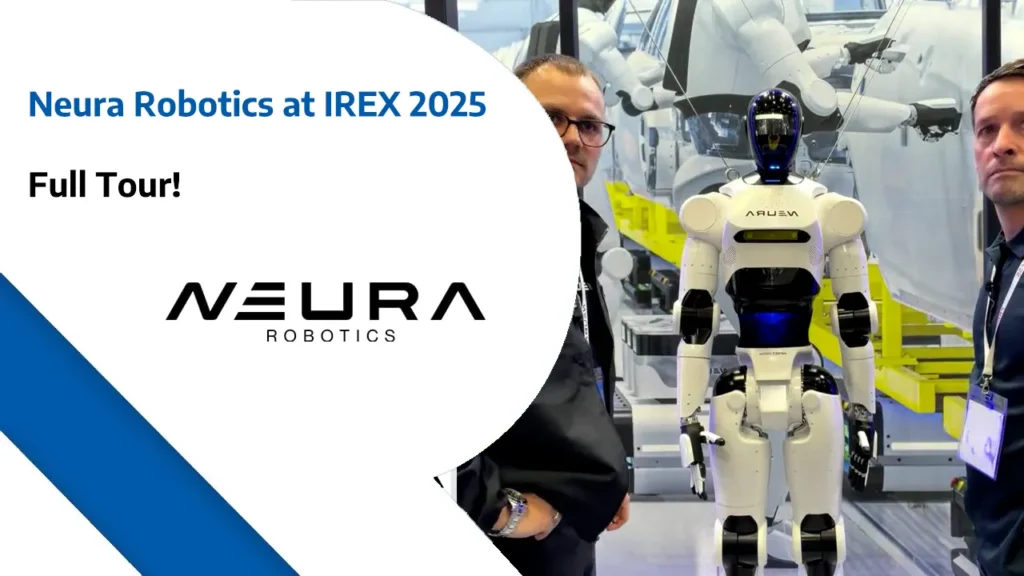
Neura Robotics at IREX 2025
🤖 Neura Robotics at IREX Japan 2025 — Humanoids, Cognitive AI & The Future of Human-Robot Collaboration
Introduction — Inside the World’s Biggest Robot Exhibition
The International Robot Exhibition (IREX) Japan 2025 once again proved why it is regarded as the world’s most important robotics showcase.
Held in Tokyo, IREX brings together the most advanced robotics manufacturers, AI developers, automation integrators, and humanoid pioneers from across the globe. It’s where future technologies move beyond concept and into real-world deployment.
Among the many innovators exhibiting this year, one company stood out for its ambitious vision and rapidly advancing technology:
Neura Robotics.
Positioned at the intersection of cognitive AI, humanoid robotics, and collaborative automation, Neura Robotics is developing machines designed not just to work for humans — but alongside them.
In this article, we explore what Neura Robotics showcased at IREX Japan 2025, the technology behind their robots, and what it means for the future of automation and embodied AI.
About Neura Robotics — Building Cognitive Robots
Neura Robotics is a European robotics company focused on what it calls cognitive robotics — robots that can perceive, interpret, and interact intelligently within human environments.
Rather than building traditional industrial robots limited to repetitive factory tasks, Neura’s mission is to create machines that can:
See through advanced vision systems
Hear via integrated audio recognition
Sense surroundings using multimodal sensors
Make decisions powered by AI
Collaborate safely with humans
This approach positions Neura Robotics firmly within the next wave of automation — often referred to as embodied AI.
Embodied AI moves intelligence out of software and into physical machines operating in the real world.
And at IREX 2025, that vision was on full display.
Humanoid Robots — Designed for Human Environments
One of the biggest attractions at the Neura Robotics stand was its humanoid robot development.
Humanoid robots are gaining global momentum because they are designed to operate in spaces already built for humans — warehouses, hospitals, hotels, airports, and retail environments.
Rather than redesigning infrastructure, humanoids adapt to it.
Key humanoid capabilities on show included:
Bipedal mobility and balance
Advanced arm articulation
Object handling and manipulation
Human interaction gestures
Sensor-driven navigation
The physical design emphasised both functionality and approachability — a critical factor as robots move into customer-facing and service roles.
Neura’s humanoids are not conceptual prototypes — they are being engineered for commercial deployment across logistics, service, and industrial sectors.
Cognitive Robotics — The Intelligence Layer
Where Neura Robotics truly differentiates itself is in its cognitive technology stack.
Traditional robots operate through pre-programmed instructions.
Cognitive robots operate through perception and interpretation.
At IREX, Neura demonstrated how its robots process real-world environments using layered AI systems.
Cognitive capabilities included:
Vision Systems
Robots can recognise objects, people, and spatial layouts in real time.
Audio Recognition
Voice commands and environmental sound detection enable interaction and awareness.
Sensor Fusion
Combining LiDAR, cameras, and proximity sensors creates a unified environmental model.
Decision AI
Robots assess situations and adjust actions dynamically rather than following rigid scripts.
This transforms robots from tools into collaborative agents.
Human-Robot Collaboration — Safety Meets Productivity
Collaboration — not replacement — is central to Neura Robotics’ philosophy.
Its robots are designed to work safely in shared human spaces without cages or exclusion zones.
At IREX, this was demonstrated through live interaction scenarios where robots operated fluidly around people.
Collaboration features include:
Force-sensing arms
Collision avoidance
Predictive movement modelling
Human detection tracking
Safe object handovers
This opens deployment across sectors where traditional robots struggled to integrate.
Industrial & Commercial Applications
Neura Robotics’ technology is not limited to laboratories or exhibitions — it is being engineered for real commercial use.
Key sectors include:
Logistics & Warehousing
Picking, packing, and goods movement.
Manufacturing
Collaborative assembly and machine support.
Healthcare
Material transport and patient assistance.
Hospitality & Service
Front-of-house support and delivery.
Retail
Customer assistance and shelf operations.
The flexibility of humanoid form factors combined with cognitive perception allows robots to transition across roles without extensive reprogramming.
Why Humanoids Are Surging Now
Humanoid robots have existed for decades — but three technological shifts are accelerating adoption:
1️⃣ AI processing power
2️⃣ Sensor cost reduction
3️⃣ Battery efficiency improvements
Neura Robotics is leveraging all three.
This convergence enables robots that are:
Mobile for longer periods
More perceptive in real environments
Faster at interpreting data
Safer around humans
Humanoids are no longer PR showcases — they are workforce tools.
Exhibition Presence — Standing Out at IREX
IREX Japan is not a small exhibition.
Thousands of robots operate simultaneously across multiple halls.
Yet Neura Robotics drew consistent crowds thanks to:
Live humanoid demos
Interactive cobot showcases
AI perception demonstrations
Hands-on engagement
The stand balanced technical depth with visual accessibility — appealing to both engineers and commercial buyers.
Industry delegates, integrators, and investors were all present — reinforcing Neura’s growing global profile.
Market Position — Europe’s Humanoid Contender
While much humanoid attention focuses on US and Asian companies, Neura Robotics represents a major European contender in the race toward embodied AI.
Its positioning combines:
German engineering heritage
AI software development
Collaborative robotics expertise
Scalable commercial focus
This integrated approach could allow Neura to compete strongly in sectors prioritising safety, compliance, and human collaboration.
What This Means for the Future of Work
The rise of cognitive and humanoid robotics signals a shift in how automation integrates into society.
Rather than isolating robots in factories, the next wave brings robots into:
Public environments
Service industries
Healthcare facilities
Logistics centres
Commercial buildings
Robots become co-workers rather than background machinery.
Companies like Neura Robotics are accelerating this transition by building machines designed around human interaction first — productivity second.
Watch the Full Video Tour
To see Neura Robotics’ technology in action, watch the full exhibition walkthrough here:
[Embed YouTube Video]
This includes live demos, humanoid movement, and cognitive robotics showcases filmed directly from the IREX show floor.
🤝 Sponsors & Industry Partners
Robot Center
Robot Center specialises in industrial robotics, warehouse automation, and commercial robot integration.
From consultancy through to deployment, Robot Center helps organisations identify where robotics delivers operational impact — improving productivity, safety, and efficiency.
Robots of London
Robots of London is the UK’s leading robot hire and event robotics company.
Supplying humanoid robots, exhibition robots, and brand activation technologies, the company helps businesses create high-impact experiential marketing and live event engagement.
🌐 https://robotsoflondon.co.uk/
Robot Philosophy (RoboPhil)
Robot Philosophy provides robotics consultancy, strategic advisory, and educational workshops — helping organisations understand where robots fit within their industry and how to commercialise automation opportunities.
Final Thoughts
Neura Robotics’ presence at IREX Japan 2025 reinforced one clear message:
The era of cognitive, collaborative, and humanoid robotics is no longer theoretical — it is operational.
As embodied AI continues to mature, robots will move beyond controlled environments and into everyday business operations.
For companies exploring automation, the question is no longer if robots will integrate — but how soon.
And innovators like Neura Robotics are helping define that timeline.