
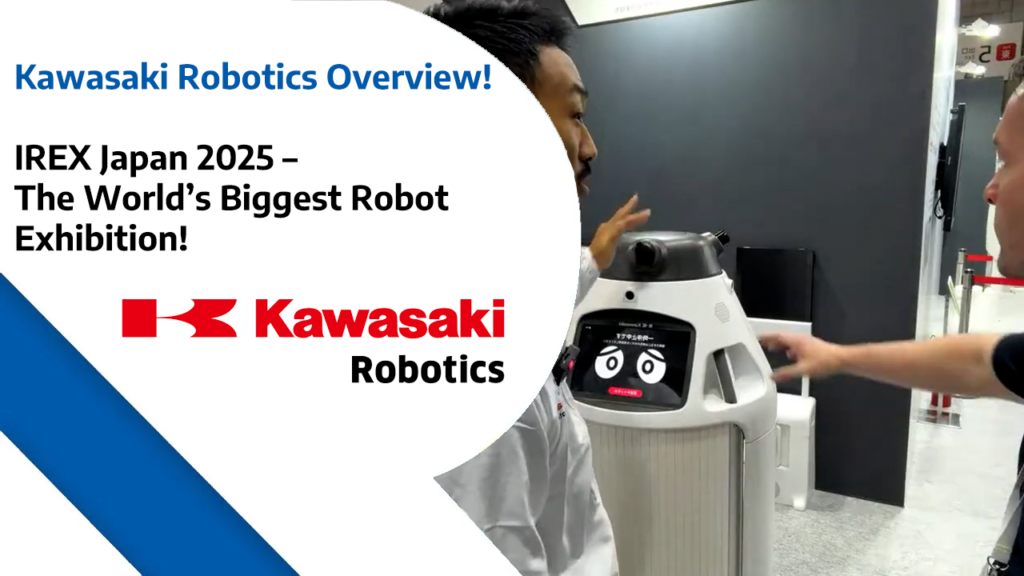
Kawasaki Robotics Overview!
Kawasaki Robotics Overview at IREX Japan 2025 – The World’s Biggest Robot Exhibition
If you want to know where the robotics industry is heading next, there’s one event that consistently gives the clearest signal: IREX Japan.
The International Robot Exhibition (IREX) is widely recognised as the world’s biggest robotics exhibition, bringing together the most important players in industrial automation, AI-driven robotics, manufacturing innovation, and next-generation human–robot collaboration.
And at IREX Japan 2025, one brand that stood out once again was Kawasaki Robotics.
In this article, I’ll break down the key takeaways from Kawasaki’s presence at IREX 2025, what it means for businesses in the UK and Europe, and how industrial robotics is evolving right now — not in theory, but in real-world applications that companies can deploy today.
Why IREX Japan 2025 Matters So Much
Robotics is growing faster than most people realise, but what’s even more important is how it is growing.
We’re not just seeing “more robots” in factories — we’re seeing new categories of robotics solutions emerging across:
Manufacturing and production lines
Packaging and palletising
Warehousing and logistics automation
Quality control and inspection
Human and collaborative workflows
Flexible production and mixed SKU environments
IREX is one of the few exhibitions where you can get a clear look at the entire robotics ecosystem in one place — from component-level engineering through to full systems integration.
For me, the value of IREX isn’t just the technology. It’s the direction.
You can see what companies are prioritising.
You can spot where investment is increasing.
And you can understand where robotics is becoming commercially viable for more businesses — including SMEs.
Who Are Kawasaki Robotics?
Kawasaki is one of the most established names in industrial automation, and their robotics division is known globally for building robust, high-performance systems used in demanding environments.
Kawasaki’s industrial robotics portfolio typically covers a wide range of use cases, such as:
High-speed pick and place
Material handling and transfer
Welding and heavy-duty production
Machine tending
Assembly operations
Factory automation integration
They’re a company that has been in the industrial robotics space long enough to understand one critical truth:
✅ Robots don’t win because they look impressive.
Robots win when they produce measurable results.
That’s why Kawasaki’s presence at events like IREX is always worth paying attention to — they focus heavily on practical robotics that can actually be deployed at scale.
What Kawasaki Showcased at IREX Japan 2025 (And Why It Matters)
At IREX 2025, the theme across the exhibition was very clear:
Robots are becoming more flexible, more integrated, and more business-ready than ever before.
Kawasaki Robotics fit perfectly into that narrative.
While every booth is different year to year, Kawasaki’s displays are usually designed to demonstrate three things:
1) Industrial robotics that can work in the real world
Not just a prototype, not just “concept automation”.
Kawasaki tends to show solutions that can run in:
Busy environments
Heavy production settings
Repetitive cycles
Multi-shift operations
Demanding uptime expectations
2) Automation that improves throughput and reduces downtime
Speed matters. So does reliability.
Businesses want automation that keeps production running without disruption, and industrial robots are increasingly judged on:
Overall equipment effectiveness (OEE)
Maintenance intervals
Reliability across long working cycles
Integration with existing processes
3) Systems that can integrate into modern smart factories
The “smart factory” conversation has matured a lot.
A few years ago, companies discussed smart factories in abstract terms.
Now, it’s about practical deployment:
How data is captured
How robots connect to line management systems
How production performance can be measured
How downtime can be predicted before it happens
The Big Trend: Industrial Robotics Is Becoming More Accessible
One of the biggest takeaways from IREX Japan 2025 is this:
✅ Industrial robotics is no longer reserved for enormous manufacturers.
Yes, automotive giants still invest heavily in robots, but now we’re seeing adoption expand into:
Smaller manufacturers
Warehousing operations with seasonal demands
Food and beverage production environments
Packaging and distribution centres
Companies that need automation but don’t have internal robotics teams
This matters because it changes the question businesses ask.
It used to be:
“Should we invest in robotics?”
Now it’s becoming:
“Where should we deploy robotics first for the fastest ROI?”
That shift is massive.
The Business Case: Why Companies Buy Industrial Robots
Industrial robots aren’t purchased because they’re exciting. They’re purchased because they solve business problems.
Here are some of the most common reasons companies start looking seriously at automation:
✅ 1) Labour availability is unreliable
In many industries, recruiting stable labour is difficult.
Even when companies can hire staff, retention can be unpredictable and training costs can rise quickly.
Robots don’t replace people in a simplistic way — but they stabilise output when labour fluctuates.
✅ 2) Production targets keep increasing
Customers expect faster turnaround times and consistent delivery.
Robotics gives businesses the ability to run production more efficiently and increase throughput without expanding headcount at the same rate.
✅ 3) Quality control requirements are rising
Consistency is becoming a bigger competitive advantage.
Robots excel at repeatable performance, which supports:
Reduced defects
Less variation
Better product consistency
Better compliance
✅ 4) Warehousing and logistics are under pressure
Whether it’s eCommerce, distribution, or internal supply chains, companies are under pressure to move products faster and more accurately.
Robotics becomes attractive when businesses want:
Faster handling
Fewer picking errors
Reduced damage
Improved processing speed
What UK and European Businesses Can Learn from Japan
Japan has been one of the most advanced robotics markets in the world for a long time.
The cultural approach to automation is different:
Robotics is viewed as normal, not disruptive
Industrial automation is integrated into planning early
Robotics deployment often happens proactively, not reactively
That means IREX gives UK and European businesses something priceless:
✅ A look into what automation looks like when a country is truly ahead of the curve.
For UK businesses especially, this is important because we’re now in a window where robotics adoption is accelerating.
The companies who move early are going to win long-term.
The Key Question Isn’t “Which Robot?” It’s “Which Job?”
One of the biggest mistakes businesses make when exploring robotics is starting with the robot itself:
“Which robot should we buy?”
But the smarter approach is:
✅ Which job should a robot do first?
That’s the difference between buying a robot because it’s impressive… and deploying robotics because it delivers ROI.
Some of the best first robotics deployments include:
Repetitive material handling
Pick-and-place operations
Machine tending
Packaging and palletising
Basic assembly steps
Goods transfer between stations
When businesses start with a clear task and measurable outcome, selecting the right robot becomes much easier.
The Real Future: Human + Robot Workflows
The best robotics deployments aren’t purely robotic environments.
They’re hybrid environments.
Robots handle the repetitive, high-volume, and physically demanding work.
Humans handle:
Decision making
Exception handling
Setup changes
Quality interpretation
Flexible tasks that change daily
IREX Japan 2025 made one thing very clear:
✅ Robotics is not just about replacing labour.
It’s about increasing the capability of the workforce.
That’s where the real competitive advantage is.
Want Help Deploying Robotics in Your Business?
If you’re currently exploring automation — or you’re trying to figure out whether robotics is viable for your business — my team can help you move faster with fewer mistakes.
At Robot Center, we support companies with:
✅ Robotics audits and strategy
✅ Choosing the right robot for the right application
✅ Integration and deployment
✅ Service support and long-term optimisation
✅ Recruiting the right robotics professionals
📩 Email: sales@robotcenter.co.uk
📞 Call: 0845 528 0404
Sponsors / Partners
This article and video content are supported by:
🤖 Robot Center – Industrial & next-generation robotics solutions
https://robotcenter.co.uk/
🎪 Robots of London – Robot hire for events, exhibitions & brand activation
https://robotsoflondon.co.uk/
🎙️ Robot Philosophy (RoboPhil) – Robotics insights, workshops, news & reviews
https://robophil.com/
Final Thoughts: Kawasaki Robotics at IREX 2025
Kawasaki Robotics continues to represent what industrial automation is really about:
✅ Practical deployment
✅ High-performance engineering
✅ Reliable, scalable solutions
✅ Robotics that improves productivity and output
IREX Japan 2025 was a reminder that robotics is not “coming someday”.
It’s here right now — and the companies that learn from global leaders like Kawasaki will be in the best position to win in the next era of manufacturing and automation.
If you’d like more content like this — including breakdowns of the best robots at IREX 2025 — make sure you follow along through Robot Philosophy (RoboPhil), and I’ll keep bringing you the best insights from inside the robotics industry.