
Intelligent Actuator - IAI
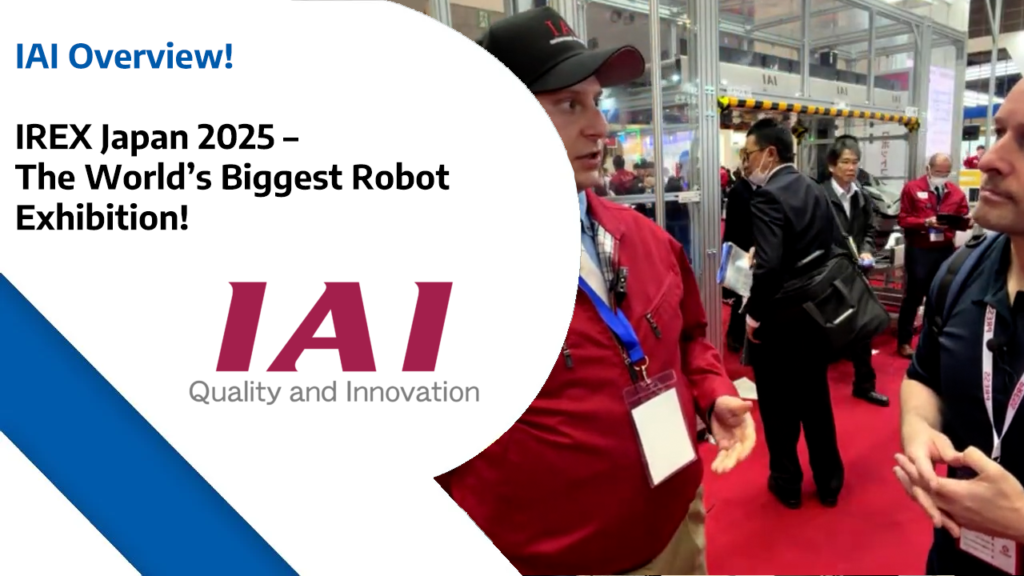
IAI Overview at IREX Japan 2025: The Actuator Technology Powering the Next Wave of Robotics and Automation
If you’ve ever watched a robot move—whether it’s a high-speed pick-and-place system on a production line, a compact assembly robot in an electronics factory, or a precision mechanism positioning a part within fractions of a millimetre—you’ve witnessed the real “muscle” of automation in action.
That muscle is motion control.
And at IREX Japan 2025, one of the most important companies showcasing motion technology was IAI (Intelligent Actuator).
In this blog, I’m going to give you a clear, practical overview of what IAI does, why actuator technology matters more than most people realise, and how IAI fits into the future of factory automation, robotics integration, and smarter manufacturing systems.
Whether you’re a robotics engineer, a factory manager, a systems integrator, or simply someone tracking where industrial robotics is heading, this is a company worth paying attention to.
🌍 IAI official website: https://www.intelligentactuator.com/
IREX Japan 2025: Where the Real Robotics Industry Shows Up
IREX (International Robot Exhibition) is often described as the world’s biggest robotics exhibition, and once you step onto the show floor, it becomes obvious why.
This isn’t just “futuristic robot hype”.
IREX is where you see:
Real industrial automation systems
Commercial robotics platforms being deployed today
Component manufacturers building the core tech inside robots
Machine builders and integrators showing full solutions
Companies competing on performance, cost, reliability, and scalability
And while humanoid robots and AI demos often get the headlines, the reality is simple:
The future of robotics will be defined by the companies building reliable motion systems that can run all day, every day.
That’s where IAI comes in.
Who Is IAI (Intelligent Actuator)?
IAI (Intelligent Actuator) is a well-established manufacturer specialising in:
✅ Electric actuators
✅ Linear motion systems
✅ Motion control solutions
✅ Industrial automation components
In simple terms: IAI develops the systems that create controlled movement inside machines.
It’s not “just a motor”.
It’s a fully engineered motion product—designed so manufacturers and engineers can build automation that is:
Faster
More accurate
Cleaner
Easier to control
Easier to maintain
Easier to scale across production
This matters because modern factories increasingly demand flexibility.
The old world of rigid, mechanical automation is being replaced with programmable, adaptable systems that can handle:
Shorter product cycles
More SKU variation
Higher quality demands
Labour shortages
Small batch manufacturing
Fast changeovers
Electric actuators are at the centre of that shift.
What Is an Electric Actuator (And Why It Matters)?
An electric actuator converts electrical energy into physical movement.
That movement could be:
Linear motion (in/out movement)
Rotary motion (rotation)
Lift movement (vertical motion)
Guided motion (precise controlled travel)
But the real advantage isn’t simply “movement”—it’s control.
Electric actuators allow you to program:
Speed
Position
Acceleration
Deceleration
Force limits
Repeatability parameters
Sequencing and motion profiles
In modern automation, control is everything.
Because once you can control the motion precisely, you can:
✅ Reduce waste
✅ Improve quality
✅ Increase output
✅ Lower downtime
✅ Improve safety
✅ Make automation more flexible
Why Electric Actuators Are Replacing Pneumatics
If you’ve worked in industrial automation, you’ve probably seen factories filled with pneumatic cylinders—air-driven systems that push, pull, clamp, and lift.
Pneumatics can still work well in many scenarios, but the world is shifting.
Electric actuators are increasingly preferred because they offer:
1) Precision and Repeatability
Pneumatics are often “good enough” but not always exact.
Electric actuators can repeat movements precisely, which matters in:
electronics assembly
quality inspection stations
packaging systems
robotic handling
2) Programmability
Changing pneumatic behaviour often requires physical changes:
new air settings
different valves
new cylinder sizes
Electric actuator behaviour can often be modified in software.
3) Energy and Maintenance Efficiency
Pneumatics require air systems:
compressors
air lines
filters
leaks and pressure drops
Electric systems reduce dependency on compressed air and can lower maintenance burden in many facilities.
4) Cleaner Automation
For industries like:
food production
pharma
medical manufacturing
lab automation
cleanliness and controllability are huge advantages.
IAI at IREX 2025: Why Their Booth Matters
At a show like IREX, it’s easy to walk past component manufacturers and focus only on full robots.
But in reality, the components often define what a robot can actually do.
IAI stands out because they are positioned in a category that affects almost every automation trend right now:
High-mix production
Compact manufacturing cells
Space-saving industrial design
Faster line speeds
Smarter integration
Robotics that can be maintained by smaller teams
Their technology is not a “nice-to-have”.
In many deployments, it’s a requirement.
Where IAI Systems Are Used in the Real World
When people think of robotics, they picture robots.
But the automation world is broader than robots. Many factories use combinations of:
robotics arms
conveyors
actuators
lifting systems
feeders
inspection modules
sorting mechanisms
safety gates
guided motion systems
IAI products often fit inside automation systems such as:
✅ Pick-and-Place Automation
Automated selection and movement of products or components.
✅ Packaging Lines
Fast and repeatable positioning systems are essential.
✅ Assembly Automation
Especially for electronics, automotive components, and precision products.
✅ Test and Inspection Stations
Actuator systems move parts into testing positions or present items to vision systems.
✅ Material Handling and Transfer
Moving items between stations, loading/unloading modules, or indexing workflows.
✅ Compact Automation Cells
Space is expensive. Compact motion designs become valuable.
The “Hidden Robotics Industry”: Why Motion Control Is a Competitive Weapon
One of the biggest misunderstandings in robotics today is thinking the robot itself is the value.
In many industrial settings, the competitive advantage comes from:
cycle time improvements
reduced scrap rates
fewer maintenance callouts
easier changeovers
easier training
better reliability
Those are achieved through motion control, integration design, and smart automation architecture.
In other words:
The best robots are useless if the automation system around them can’t keep up.
This is why a motion control specialist like IAI is strategically important.
As factories become more advanced, they need components that behave predictably, integrate easily, and deliver consistent performance.
Smart Manufacturing: The Big Picture Trend
Smart manufacturing gets talked about a lot, but in practical terms it’s about a few key goals:
real-time production monitoring
higher efficiency
better quality
better uptime
connected and data-driven operations
Electric actuators fit naturally into smart manufacturing because they can be:
monitored
controlled
measured
optimised
As automation becomes more connected, motion systems will increasingly become part of larger “factory intelligence” platforms.
And the companies building reliable motion hardware will be the backbone of that evolution.
Why Robotics Integrators Should Pay Attention to IAI
If you are a robotics integrator (or you work with one), your success depends on building systems that meet the real-world requirements of your client.
That means:
predictable motion
speed and accuracy
compact footprint
safety compliance
low downtime
easy maintenance
scalable architecture
Motion components might not be the “headline” in a project, but they absolutely shape whether the deployment succeeds.
The more integrators can standardise on reliable motion systems, the easier it becomes to deliver:
repeatable builds
faster installation timelines
predictable performance
better customer satisfaction
Why This Matters for the UK, Europe, and Global Manufacturing
Even though IREX is held in Japan, the insights are global.
The same pressures exist everywhere:
labour shortages
cost pressure
higher customer expectations
tighter margins
rising energy costs
supply chain complexity
Factories in the UK and Europe are being pushed toward automation—not because it’s trendy, but because it’s becoming necessary.
Companies like IAI support this shift by enabling machine builders and engineers to deliver automation systems that are:
✅ more flexible
✅ more programmable
✅ more efficient
✅ more scalable
For many businesses, automation isn’t about replacing people.
It’s about ensuring continuity of production.
The Bigger Robotics Future: Automation Isn’t Just Humanoids
Humanoids get views. They go viral. They generate excitement.
But the real robotics economy today is built on:
industrial automation
logistics automation
inspection systems
mobile robots
security and patrol robots
service robots
component manufacturing
And inside all of those is motion.
You can’t have robotics without movement.
IAI is a motion company. That’s why they matter.
Key Takeaways: What We Learn From IAI at IREX Japan 2025
Here are the key lessons from looking at IAI in the context of the world’s biggest robotics show:
✅ 1) Motion control is the foundation of modern automation
AI software is powerful, but robots need precision movement to deliver results.
✅ 2) Electric actuators unlock flexibility
Factories are moving toward systems that can be reconfigured and updated.
✅ 3) Reliability matters more than hype
Industrial customers buy systems that work daily, not just demos.
✅ 4) The future is compact and scalable
Space-saving automation cells will become more common globally.
✅ 5) Companies like IAI power the silent majority of robotics deployments
Not every company is building the robot—but many are building the systems inside it.
Want Help Deploying Real Robotics?
If you’re reading this and thinking:
“Great — but how do I actually apply this in my own business?”
That’s exactly what we do.
Whether you’re selecting robotics platforms, automating workflows, or building robotics into your operations, the key is moving from curiosity to deployment.
Sponsors
Robot Center
Robot Center is a UK-based robotics consultancy and Robot-as-a-Service (RaaS) provider, helping businesses deploy, manage, and scale real-world robotics solutions.
We specialise in robot consultancy, Robotics as a Service, and the supply of commercial and industrial robots, including digital signage robots, inspection robots, security robots, and autonomous mobile robots. Robot Center supports businesses across the UK, Europe, and globally, from robot selection and purchase through to deployment, integration, and ongoing support.
Robot Center works with leading platforms such as Capra Robotics and Temi, helping organisations buy robots, adopt robots as a service, and implement robotics safely and effectively.
Robots of London
Robots of London is a leading robot hire and robot rental company, supplying interactive robots for events, exhibitions, trade shows, conferences, and brand activations in the UK, Europe, and worldwide.
We specialise in robot hire in London and across the UK, with full coverage throughout Europe and global international events. Our range includes humanoid robots, AI robots, service robots, and promotional robots, all delivered as a fully managed service with logistics, setup, operation, and on-site technical support.
If you’re looking to hire a robot for an event, rent a robot for an exhibition, or work with an experienced robotics hire company for international events, Robots of London delivers reliable, high-impact robotic experiences globally.
🔗 https://robotsoflondon.co.uk/
Robot Philosophy (RoboPhil)
Robot Philosophy (RoboPhil) is a leading robotics insight and consultancy platform, founded by Philip English, also known as RoboPhil, one of the UK’s most established robot YouTubers and commentators.
Robot Philosophy provides robot consultancy, robot recruitment insight, robotics advice, and strategic perspectives on real-world robotics adoption. The platform shares robot insights, ideas, trends, and analysis, helping businesses, professionals, and investors understand where robotics creates real value.
Through videos, articles, workshops, and advisory services, RoboPhil connects robot strategy with practical deployment, supporting organisations across the UK, Europe, and globally.
Service Robotics Summit (SRS)
Service Robotics Summit (SRS) is a global, invitation-led conference series dedicated to the service robotics industry, bringing together founders, investors, enterprise buyers, and senior decision-makers shaping the future of robotics.
Held annually in London, Singapore, Dubai, and the United States, SRS is a high-ticket, premium summit hosted in five-star hotels, designed for meaningful conversations, strategic partnerships, and high-value deal flow within the service robotics ecosystem.
The summit focuses on real-world deployment of service robots, including hospitality, retail, healthcare, security, inspection, logistics, and smart environments. SRS offers a curated agenda of keynotes, closed-door panels, private networking, and executive roundtables, positioning it as the definitive meeting place for leaders in service robotics.
🔗 https://serviceroboticsummit.com/
Final Thoughts
IREX Japan 2025 proves once again that robotics is not just about flashy demos.
It’s about the technologies that make machines work reliably, repeatedly, and profitably.
IAI is one of the companies shaping that reality.
And as global manufacturing continues to modernise, motion control and actuator technology will be one of the biggest enablers behind scalable automation.
If you want more breakdowns from IREX 2025 and the companies shaping the future of robotics, follow along on Robot Philosophy — and keep building.
👋 Until the next one,
Philip English (RoboPhil)