

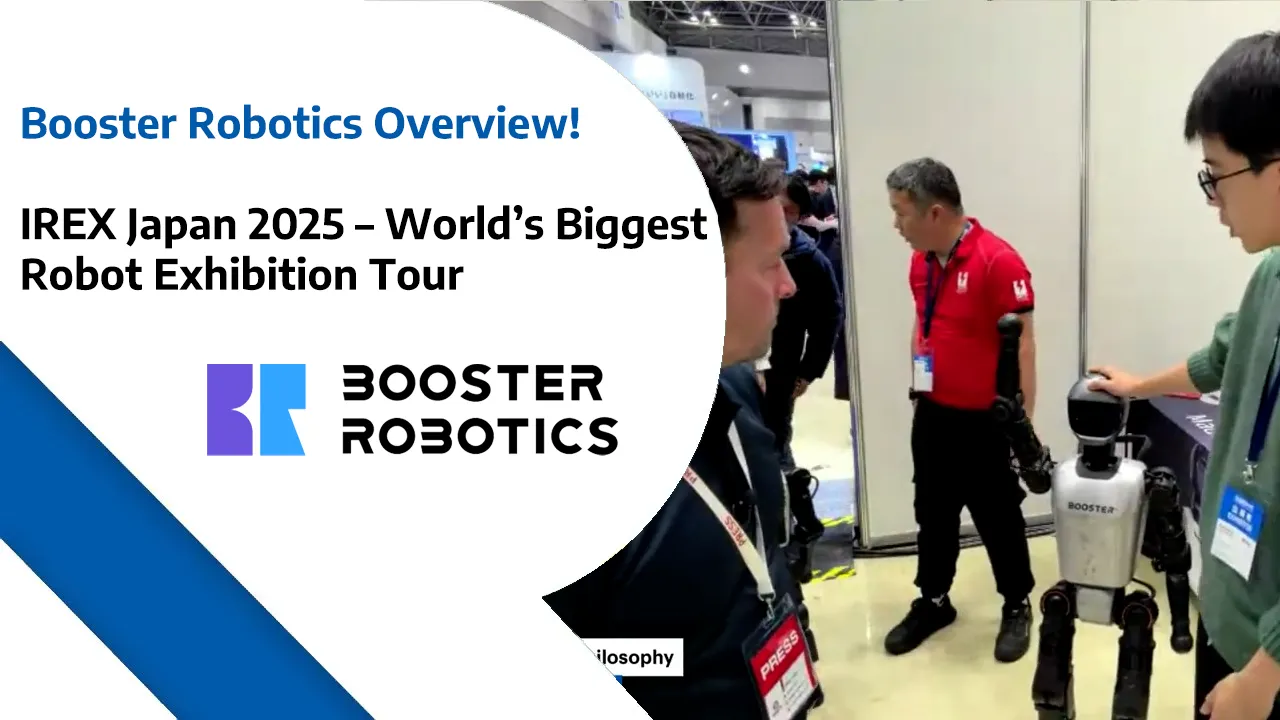
Booster Robotics Overview – IREX Japan 2025 – World’s Biggest Robotics Exhibition Tour
Booster Robotics Overview – IREX Japan 2025
Inside the World’s Biggest Robotics Exhibition
The global robotics industry gathered once again in Tokyo for IREX Japan 2025 (International Robot Exhibition) — widely recognised as the largest and most influential robotics trade show in the world.
Spanning multiple exhibition halls and featuring hundreds of robotics manufacturers, AI developers, automation companies, and research institutions, IREX provides a front-row seat to the future of robotics.
Among the standout companies exhibiting this year was Booster Robotics — an emerging humanoid robotics manufacturer focused on building commercially deployable service robots designed for real-world environments.
In this article, we’ll explore:
-
Who Booster Robotics are
-
Their humanoid robot platform
-
Key technology and design features
-
Commercial deployment opportunities
-
Industry trends observed at IREX 2025
-
What this means for the future of humanoid robotics
The Significance of IREX Japan
Before diving into Booster Robotics specifically, it’s important to understand the scale and importance of IREX itself.
IREX is not just another robotics exhibition — it is the global benchmark.
Manufacturers use the event to:
-
Launch new robot platforms
-
Showcase R&D breakthroughs
-
Announce partnerships
-
Demonstrate commercial deployments
-
Test global market reactions
Unlike smaller regional expos, IREX attracts the full robotics ecosystem:
-
Industrial robotics giants
-
Humanoid developers
-
Service robot manufacturers
-
AI software companies
-
Sensors & mobility innovators
-
Logistics automation providers
Walking the exhibition floor, one thing becomes immediately clear:
Robotics is accelerating — and humanoids are central to that growth.
Introducing Booster Robotics
Booster Robotics is part of the new generation of humanoid robotics companies emerging primarily from Asia, focused on bridging the gap between research robots and commercially viable platforms.
Historically, humanoid robots were limited to:
-
University labs
-
Government research programs
-
Technology demonstrations
-
High-cost prototypes
Booster Robotics is working to change that narrative by engineering robots designed for deployment rather than experimentation.
Their humanoid platform is built with three core priorities:
-
Affordability – Lower cost than legacy humanoids
-
Functionality – Designed for real tasks
-
Scalability – Built for commercial rollout
First Impressions from the Exhibition Floor
Seeing Booster Robotics live at IREX provided a completely different perspective compared to watching promotional videos online.
In person, you can evaluate:
-
Movement fluidity
-
Balance stability
-
Build quality
-
Interaction responsiveness
-
Public engagement reactions
The robot demonstrated smooth bipedal locomotion, stable turning capability, and controlled upper-body articulation — all essential for operating in human environments.
The design philosophy appears to prioritise:
-
Safety around humans
-
Visual approachability
-
Functional mobility
-
Modular hardware architecture
This positions the robot well for customer-facing roles.
Movement & Mobility
Mobility remains one of the most complex engineering challenges in humanoid robotics.
Booster Robotics showcased:
-
Stable walking gait
-
Controlled directional turning
-
Upright balance correction
-
Smooth stop/start transitions
While not yet matching the extreme athleticism of Boston Dynamics-style research robots, that is not the commercial objective.
Instead, Booster focuses on:
-
Reliability over acrobatics
-
Safety over speed
-
Practical movement over spectacle
For indoor commercial environments — hotels, exhibitions, retail — this is exactly what’s required.
AI Interaction & Communication
Beyond movement, humanoid value is heavily tied to interaction capability.
The Booster platform integrates AI systems designed to support:
-
Voice interaction
-
Customer greeting
-
Information delivery
-
Wayfinding assistance
-
Brand engagement
This positions the robot within the rapidly expanding service robotics category.
Potential integrations include:
-
Large Language Models (LLMs)
-
Multilingual communication
-
Facial recognition (where compliant)
-
CRM system connectivity
-
Event data capture
As AI continues advancing, the humanoid form factor becomes the physical interface layer for digital intelligence.
Commercial Use Cases
One of the most important shifts at IREX 2025 was the emphasis on real-world deployment — not theoretical capability.
Booster Robotics highlighted multiple commercial applications:
1. Exhibitions & Trade Shows
Humanoid robots attract attention naturally, making them ideal for:
-
Booth engagement
-
Lead generation
-
Product demonstrations
-
Brand amplification
2. Retail Environments
In retail, humanoids can function as:
-
Store greeters
-
Product guides
-
Promotion assistants
-
Queue managers
3. Hospitality & Hotels
Service roles include:
-
Guest reception
-
Check-in assistance
-
Information delivery
-
Concierge support
4. Corporate Environments
Front-of-house roles such as:
-
Visitor greeting
-
Meeting guidance
-
Security desk augmentation
5. Airports & Transport Hubs
High-footfall environments benefit from:
-
Wayfinding assistance
-
Multilingual passenger support
These use cases are not futuristic — many are already in pilot deployment globally.
Engineering & Design Philosophy
From a hardware perspective, Booster Robotics appears to be focusing on scalable engineering.
Key design observations include:
-
Lightweight composite materials
-
Enclosed joint systems
-
Commercial-grade actuator design
-
Modular repair architecture
This is crucial.
For humanoids to scale commercially, maintenance and serviceability must be practical — not research-lab complex.
The Bigger Industry Trend
Booster Robotics is not operating in isolation.
They are part of a broader macro trend:
The Commercialisation of Humanoid Robotics
Key drivers include:
-
Labour shortages
-
Rising wage costs
-
Ageing populations
-
AI capability breakthroughs
-
Sensor cost reductions
-
Battery efficiency improvements
Humanoids are uniquely suited to human environments because our infrastructure is designed around the human form.
This removes the need to redesign buildings for robots.
Asia’s Growing Leadership in Humanoids
IREX 2025 reinforced Asia’s leadership position in humanoid robotics manufacturing.
Companies across:
-
China
-
Japan
-
South Korea
Are accelerating development cycles and reducing production costs faster than Western competitors.
This mirrors what happened in:
-
Consumer electronics
-
EV manufacturing
-
Drone technology
The result: faster commercial availability globally.
Sponsored & Supported By
Coverage of IREX Japan 2025 and global robotics innovation is proudly supported by the following industry partners:
🤖 Robot Center
Robot Center specialises in industrial robotics, collaborative robots (cobots), and warehouse automation solutions across the UK and Europe.
Their services include:
-
Robotics consultancy
-
Automation audits
-
Robot procurement
-
Systems integration
-
Deployment support
-
Maintenance & servicing
For businesses facing labour shortages or productivity challenges, Robot Center helps identify where robotics can deliver measurable ROI.
🎪 Robots of London
Robots of London is the UK’s leading robot hire and event robotics supplier, providing cutting-edge robotic experiences for:
-
Exhibitions
-
Corporate events
-
Brand activations
-
Product launches
-
Experiential marketing campaigns
Their fleet includes:
-
Humanoid robots
-
Service robots
-
Robot arms
-
AI interaction robots
From greeting guests to serving drinks, Robots of London helps organisations create memorable, tech-driven experiences.
🌐 https://robotsoflondon.co.uk/
📧 sales@robotsoflondon.co.uk
📞 0845 528 0404
🧠 Robot Philosophy (RoboPhil)
Robot Philosophy focuses on the commercial strategy behind robotics deployment.
Services include:
-
Robotics consulting
-
Industry education workshops
-
Deployment strategy
-
Market entry advisory
-
Speaking & media
The goal is simple: help businesses understand not just what robots do — but how robots make money.
🌐 https://robophil.com/
📧 info@robophil.com
Final Thoughts
Booster Robotics represents a key evolution point in humanoid robotics.
We are moving from:
Experimental → Deployable
Prototype → Commercial
Spectacle → Utility
Events like IREX Japan allow us to see that transition happening in real time.
Humanoid robots are no longer a distant concept.
They are being engineered, refined, and prepared for integration into everyday business environments.
Over the next decade, we can expect humanoids to become as familiar in public spaces as self-service kiosks are today.
And companies like Booster Robotics are helping lead that shift.
https://www.youtube.com/watch?v=D4RfZOJ55kI