
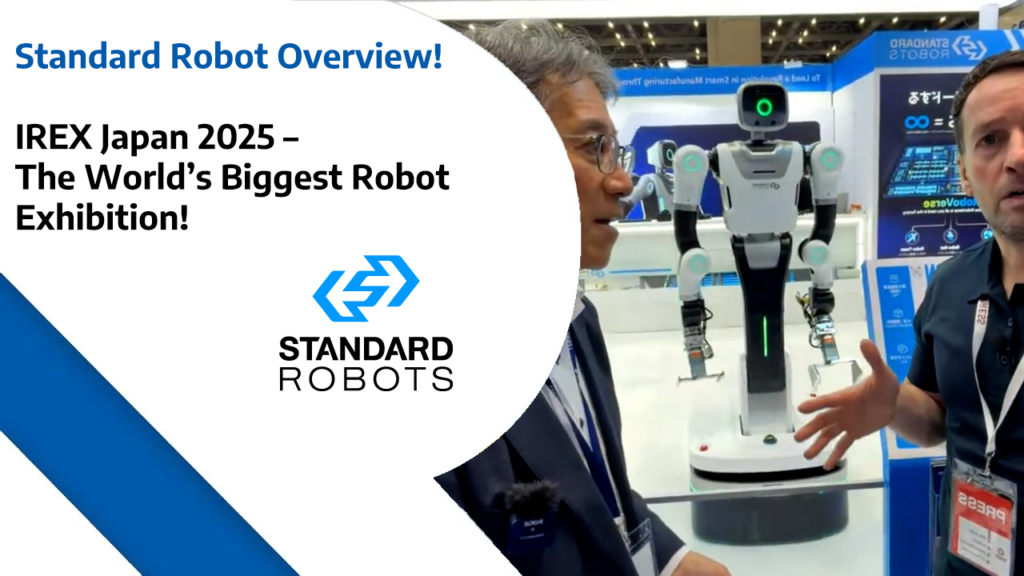
Standard Robot Overview – IREX Japan 2025
What the World’s Biggest Robot Exhibition Tells Us About Real-World Robotics
IREX Japan 2025 once again confirmed its position as the world’s most important robotics exhibition. While many tech events focus on speculative futures or headline-grabbing prototypes, IREX remains grounded in something far more valuable: robots that are actually being deployed.
This year’s exhibition wasn’t about wild humanoid concepts or moon-shot ideas. Instead, it showcased something more telling — maturity. Across halls filled with manufacturers, system integrators, and enterprise buyers, a clear theme emerged:
Robotics is moving from experimentation to infrastructure.
In this article, I’ll break down what a “standard robot” now looks like in 2025, based on what manufacturers are confident enough to present to the most serious robotics audience in the world.
Why IREX Japan Still Sets the Global Benchmark
Unlike many Western tech shows, IREX Japan is not designed for spectacle. It exists for one reason: deployment.
The exhibitors at IREX are typically:
Selling into live contracts
Supporting robots already operating at scale
Answerable to industrial buyers, not hype cycles
That makes IREX uniquely valuable for anyone trying to understand where robotics is actually ready, not just theoretically possible.
What you see at IREX tends to appear in real facilities within 12–36 months — often sooner.
The “Standard Robot” in 2025: What That Actually Means
A decade ago, the word “robot” still implied novelty. In 2025, the robots shown at IREX share a very different set of priorities.
1. Reliability Over Novelty
The most common robots on the show floor were not radical designs. They were:
Rugged
Predictable
Conservative in form
Designed for long operating hours
This reflects a major shift in buyer expectations. Organisations are no longer asking “What’s possible?”
They’re asking “What will still work in year three?”
2. Service Robots Designed for Boring Consistency
Service robots at IREX 2025 were clearly built for:
Hospitality
Retail
Healthcare
Commercial buildings
Public environments
But the emphasis wasn’t on personality or gimmicks. Instead, it was on:
Navigation reliability
Human-robot interaction safety
Simple interfaces
Easy fleet management
This is where platforms like Temi continue to succeed — not because they’re flashy, but because they’re dependable.
In service robotics, boring is good.
3. Inspection Robots Are No Longer Experimental
Inspection robots were one of the strongest categories at IREX Japan 2025.
These robots are now:
Actively deployed in energy, utilities, and infrastructure
Designed for outdoor and semi-structured environments
Focused on autonomy, data capture, and uptime
A clear example of this shift can be seen in platforms such as Capra Robotics, which reflect the growing demand for inspection robots that can operate where people shouldn’t or don’t want to.
Inspection robotics has crossed the line from “pilot project” to standard operational tool.
4. Security Robots Are Becoming Part of the Estate
Security robots at IREX were no longer positioned as replacements for guards, but as:
Patrol multipliers
Data collection platforms
Presence and deterrence systems
They are increasingly being sold as part of wider security ecosystems, integrated with cameras, access control, and monitoring software.
Again, the theme was clear:
Not disruption — augmentation.
5. AMRs Have Moved Past the Pilot Phase
Autonomous Mobile Robots (AMRs) were everywhere at IREX 2025.
But unlike previous years, the conversation was no longer about:
“Can they navigate?”
“Will people accept them?”
Instead, the focus was on:
Fleet coordination
Charging strategies
Maintenance cycles
Integration into existing workflows
AMRs are now assumed, not questioned.
The Quiet Shift: Robots as Infrastructure
Perhaps the most important takeaway from IREX Japan 2025 is this:
Robots are no longer special projects. They are becoming infrastructure.
This mirrors what happened with:
IT systems
Cloud computing
Access control
CCTV
Once technologies stop being exciting, they start being useful.
That’s exactly where robotics is heading.
What This Means for Businesses Right Now
If you’re a business leader, the implications are significant.
The question is no longer:
“Should we look at robots?”
It’s now:
“Where should robots already be working for us?”
This is why robotics consultancy and structured deployment has become essential.
The Role of Robotics Consultancy and RaaS
As robots become infrastructure, organisations need:
Better selection processes
Safer deployment frameworks
Clear ROI models
Ongoing support
This is where companies like Robot Center play a critical role.
Robot Center supports organisations with:
Robotics consultancy
Robot-as-a-Service (RaaS)
Commercial and industrial robot supply
Deployment, integration, and long-term support
Rather than selling robots as products, the focus is on outcomes.
Robots as a Service: Why Ownership Is Changing
One of the clearest trends reflected at IREX is the move away from outright robot ownership.
RaaS models allow organisations to:
Reduce upfront capital expenditure
Scale fleets flexibly
Include maintenance and upgrades
Align robots with operational budgets
This model mirrors what happened in IT — and it’s accelerating adoption across SMEs and enterprises alike.
Events, Exhibitions, and Public-Facing Robots
While IREX focuses on deployment, public perception still matters.
This is where robot hire and rental continues to play an important role.
Companies like Robots of London help brands and organisations:
Introduce robotics safely
Engage audiences
Build familiarity and trust
Test real-world interactions
Robots at events are no longer novelties — they’re education tools.
🔗 https://robotsoflondon.co.uk/
The Strategic Layer: Understanding Where Robots Create Value
Technology alone does not create impact.
Understanding where and why robots should be deployed requires strategic thinking — something that’s often missing in early adoption phases.
This is the focus of Robot Philosophy, founded by Philip English (RoboPhil).
Robot Philosophy connects:
Robotics insight
Practical deployment experience
Business strategy
Real-world ROI
Through content, workshops, and advisory services, it helps organisations move beyond experimentation into intentional adoption.
Why Industry Leaders Are Going Deeper, Not Wider
As robotics matures, leaders are no longer trying to “do everything with robots.”
Instead, they are:
Going deeper into specific use cases
Standardising platforms
Building long-term vendor relationships
Creating internal robotics capability
This is reflected in invitation-only forums like the Service Robotics Summit.
SRS brings together:
Founders
Investors
Enterprise buyers
Senior decision-makers
The focus is not marketing — it’s deal flow, partnerships, and deployment strategy.
🔗 https://serviceroboticsummit.com/
Final Thoughts: Why “Standard” Matters More Than Spectacular
IREX Japan 2025 didn’t show us a sci-fi future.
It showed us something more important:
A workable present.
The robots that matter now are:
Reliable
Understated
Integrated
Supported
And that’s a very good sign.
If robotics is becoming boring, it’s because it’s becoming useful — and that’s when real value is created.
Want to Go Deeper?
🎓 Join the robotics workshop waiting list or get in touch:
👉 https://robophil.com/
Sponsors & Partners
Robot Center – https://robotcenter.co.uk/
Robots of London – https://robotsoflondon.co.uk/
Robot Philosophy (RoboPhil) – https://robophil.com/
Service Robotics Summit – https://serviceroboticsummit.com/