
Inside Japan’s Robot Future: What RT Corporation Reveals at IREX 2025
Japan has long been seen as the spiritual home of robotics. From industrial automation to humanoids, service robots to research platforms, the country has consistently shaped how the world imagines robots. But beyond the headlines and viral videos, the real story of Japanese robotics is far more grounded, methodical, and long-term.
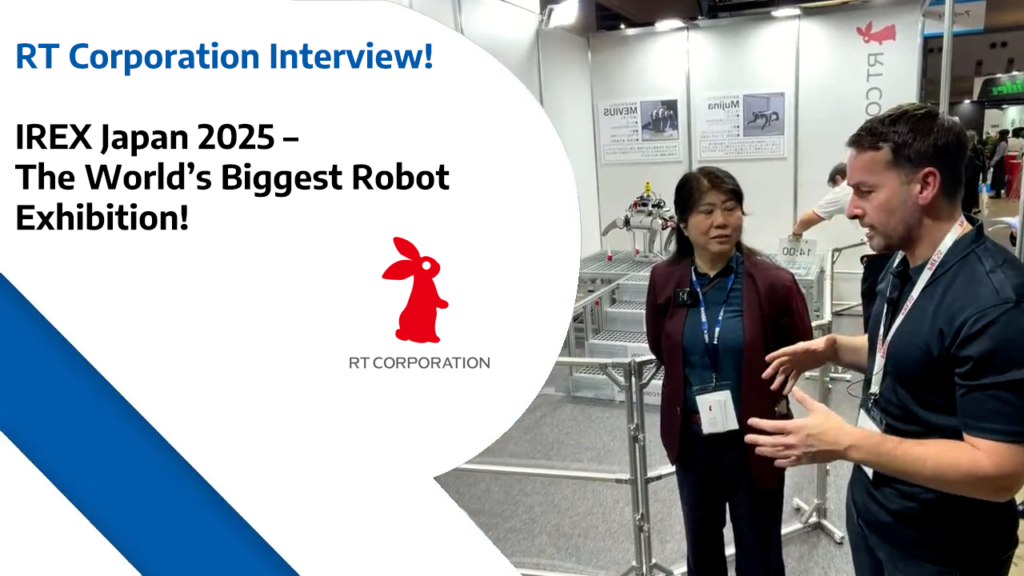
At IREX Japan 2025 — the International Robot Exhibition, and the largest robot exhibition in the world — I had the opportunity to sit down with RT Corporation, a company deeply embedded in Japan’s robotics ecosystem. Their work spans research, education, and real-world deployment, making them an ideal lens through which to understand where robotics is truly heading.
This article explores what that interview revealed — not just about RT Corporation, but about how Japan thinks about robots, why its approach is different from the West, and what businesses, engineers, and policymakers can learn from it.
IREX 2025: Where Robotics Reality Meets the Future
IREX is not a flashy tech show designed to chase headlines. It’s where working robots are displayed by companies that expect their machines to be used, maintained, and improved over decades.
Walking through IREX 2025, a few things immediately stand out:
Robots are designed for specific tasks, not vague promises
Reliability and safety are prioritised over novelty
Many robots on display are already deployed, not prototypes
Research institutions, universities, and manufacturers are deeply connected
This context matters, because RT Corporation sits right at the centre of this ecosystem.
Who Is RT Corporation?
RT Corporation is not a consumer-facing robotics brand. You won’t see their robots trending on social media. Instead, they focus on the less glamorous — but far more important — foundations of robotics:
Research platforms used by universities and labs
Educational robots for teaching robotics and control systems
Practical robotic systems designed to operate in real environments
Their robots are tools — not toys — and that distinction is critical.
In Japan, robotics is often treated as infrastructure, not entertainment. RT Corporation embodies this mindset.
Research, Education, and Deployment: The Missing Middle
One of the most interesting themes from the interview was RT Corporation’s role in connecting three worlds that are often disconnected elsewhere:
Academic research
Education and skills development
Commercial and real-world deployment
In many countries, robotics research stays in the lab. Startups then attempt to commercialise ideas without the long-term grounding that research provides. Education, meanwhile, struggles to keep up.
RT Corporation operates in the middle — ensuring that:
Research platforms are usable and practical
Students learn on systems similar to those used in industry
Real-world robots benefit from academic insight
This creates a continuous pipeline from idea to impact.
Why Japanese Robotics Feels Different
During the interview, a subtle but important difference became clear: Japanese robotics is not obsessed with disruption.
In the West, robotics is often framed as:
“Replacing humans”
“Scaling at all costs”
“Moving fast and breaking things”
In Japan, robotics is more often framed as:
Supporting an ageing population
Improving safety and working conditions
Solving specific labour shortages
Coexisting with humans over long periods
This leads to robots that are:
Less flashy, but more dependable
Slower to market, but longer-lasting
Designed for trust, not novelty
RT Corporation’s work reflects this philosophy.
From Lab to Real World: The Hardest Part of Robotics
One of the biggest challenges in robotics is not building a robot — it’s deploying it reliably outside controlled environments.
RT Corporation places heavy emphasis on:
Robust hardware design
Repeatable performance
Predictable behaviour
Ease of maintenance
This focus is often overlooked in startup culture, but it’s where most robotics projects fail.
A robot that works 95% of the time is not useful in the real world. Japanese companies understand this deeply, and it shows in how their robots are engineered.
Education as a Strategic Advantage
Another key insight from the interview was how seriously Japan treats robotics education.
RT Corporation’s educational platforms are not simplified toys. They are designed to:
Teach real control systems
Reflect industrial constraints
Prepare students for professional robotics careers
This creates engineers who:
Understand hardware limitations
Think in systems, not demos
Design with deployment in mind
In contrast, many Western education systems prioritise software simulations and rapid prototyping, sometimes at the expense of real-world understanding.
Humanoids, Service Robots, and the Bigger Picture
While humanoid robots attract most media attention, RT Corporation’s work highlights a more important truth:
Most valuable robots are not humanoids.
They are:
Mobile platforms
Manipulation systems
Research robots
Task-specific machines
Humanoids may play a role in the future, particularly in service and social contexts, but the backbone of robotics progress remains functional systems solving real problems.
IREX 2025 made this abundantly clear.
What Businesses Can Learn from RT Corporation
For companies looking to adopt robotics, the lessons from RT Corporation are highly relevant:
Start with the problem, not the robot
Plan for long-term operation, not short-term demos
Invest in training and education alongside hardware
Accept that reliability beats novelty
Robotics is not a plug-and-play solution. It’s a strategic capability.
Robotics and the Future of Work
The conversation with RT Corporation also touched on a critical topic: human–robot collaboration.
Rather than replacing workers, many Japanese robots are designed to:
Reduce physical strain
Improve consistency
Handle dangerous or repetitive tasks
Support skilled workers
This approach aligns with demographic realities in Japan, but it’s increasingly relevant worldwide.
As labour shortages grow globally, robotics will become less about cost-cutting and more about continuity and resilience.
Why IREX Still Matters in a Hype-Driven Industry
In an era dominated by AI headlines and startup hype, IREX remains refreshingly grounded.
It reminds us that:
Robotics is hardware + software + people
Deployment matters more than demos
The future is built incrementally
RT Corporation represents this mindset perfectly.
Final Thoughts: The Quiet Strength of Japanese Robotics
The interview with RT Corporation at IREX 2025 reinforced something I’ve seen repeatedly over the years:
Japan doesn’t rush robotics — it commits to it.
This long-term thinking may not generate viral clips, but it produces robots that:
Work reliably
Earn trust
Integrate into society
As robotics continues to mature globally, there is much to learn from this approach.
For anyone serious about robotics — whether you’re a business leader, engineer, educator, or policymaker — Japan remains a benchmark worth studying.
About the Author
Philip English (RoboPhil) is a robotics consultant, speaker, and founder working across robotics strategy, deployment, and events. He regularly attends global robotics exhibitions and works with businesses looking to adopt robotics in practical, commercially viable ways.
Sponsors & Partners
Robot Center – Industrial & service robotics consulting
https://robotcenter.co.uk/
Robots of London – Robots for events, exhibitions & brand activations
https://robotsoflondon.co.uk/
Robot Philosophy – Insights, workshops & talks on robotics
https://robophil.com/