
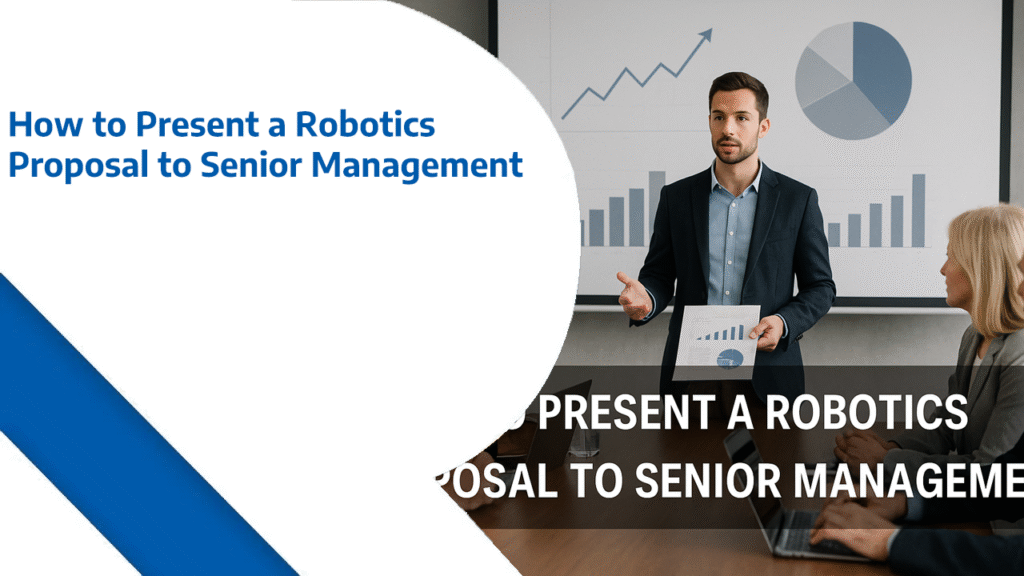
How to Present a Robotics Proposal to Senior Management
Presenting a robotics proposal to senior management can be the difference between transforming your operations and watching competitors surge ahead. Yet many brilliant automation initiatives fail not because of flawed technology, but because of ineffective presentations. This comprehensive guide will equip you with the strategies needed to secure buy-in for your robotics projects.
Understanding the Senior Management Mindset
Before diving into presentation techniques, it’s crucial to understand what keeps C-suite executives awake at night. Senior leaders aren’t primarily concerned with technical specifications or the latest robotic innovations—they’re focused on business outcomes, risk mitigation, and competitive positioning.
Your proposal must answer three fundamental questions:
- How will this impact the bottom line? (ROI, cost savings, revenue generation)
- What are the risks? (Implementation challenges, disruption, failure scenarios)
- Why now? (Market conditions, competitive pressure, opportunity cost of delay)
Preparing Your Robotics Business Case
1. Conduct Thorough Research and Analysis
Begin with a comprehensive assessment of your current operations. Document baseline metrics including cycle times, error rates, labour costs, and throughput capacity. This data becomes the foundation for demonstrating measurable improvements.
Key research elements:
- Current operational costs and inefficiencies
- Competitive landscape analysis
- Technology maturity and vendor stability
- Industry case studies and benchmarks
- Regulatory and compliance considerations
If you’re unsure where to start, expert robot consultancy services can provide objective assessments of your automation opportunities and help quantify potential benefits.
2. Build a Compelling Financial Model
Senior management speaks the language of numbers. Your financial model should include:
Initial Investment Breakdown:
- Capital expenditure (robot hardware, infrastructure)
- Integration and installation costs
- Training and change management
- Contingency reserves (typically 15-20%)
Ongoing Operational Costs:
- Maintenance and support contracts
- Energy consumption
- Software licensing and updates
- Staffing adjustments
Quantified Benefits:
- Direct labour cost reduction
- Productivity improvements (increased throughput)
- Quality improvements (reduced defect rates)
- Safety enhancements (reduced workplace incidents)
- Flexibility gains (faster changeovers, extended operating hours)
Calculate multiple scenarios: conservative, expected, and optimistic. Show break-even analysis and payback period—most robotics investments achieve payback within 18-36 months.
3. Address the Human Element
One of the biggest concerns senior management faces with robotics implementation is workforce impact. Address this proactively:
- Redeployment strategy: How will affected employees be retrained or reassigned?
- Upskilling opportunities: What new technical roles will be created?
- Change management plan: How will you manage the transition culturally?
- Communication approach: How will you maintain morale and transparency?
Organizations that handle the people side effectively see 40% higher success rates in automation projects.
Structuring Your Presentation
Opening: The Hook (2-3 minutes)
Start with impact. Use one of these approaches:
- The competitive threat: “Three of our main competitors have implemented similar automation and reduced costs by 30%”
- The opportunity cost: “Every month we delay costs us £X in inefficiency”
- The customer impact: “This technology will reduce delivery times by 40%, directly addressing our top customer complaint”
The Problem Statement (3-4 minutes)
Clearly articulate the business challenge you’re addressing. Use specific, quantified pain points:
- “Our manual packaging line operates at 60% capacity during peak periods”
- “Quality defects in assembly cost us £500K annually”
- “We’re losing skilled workers to competitors and struggling to recruit replacements”
The Solution Overview (5-7 minutes)
Present your robotics solution focusing on business outcomes rather than technical features. Use visual aids showing the robot in action, preferably in similar applications.
Key elements:
- What the robot will do (in business terms)
- How it integrates with existing operations
- Timeline from approval to full deployment
- Why this solution versus alternatives
For complex technical requirements, consider engaging robot recruitment services to ensure you have the right expertise to implement and maintain your chosen solution.
Financial Analysis (7-10 minutes)
This is the heart of your presentation. Present your financial model clearly:
Use visual dashboards showing:
- Payback period and ROI over 3-5 years
- Year-by-year cash flow
- Sensitivity analysis showing impact of key assumptions
- Comparison with “do nothing” scenario
Be prepared for scrutiny. Anticipate questions about your assumptions and have supporting data ready.
Risk Assessment and Mitigation (4-5 minutes)
Don’t shy away from risks—addressing them proactively builds credibility. Cover:
Technical risks:
- Integration complexity (mitigation: phased rollout, experienced integrator)
- Vendor reliability (mitigation: established supplier, service agreements)
Operational risks:
- Learning curve disruption (mitigation: comprehensive training, parallel operation)
- Unexpected downtime (mitigation: redundancy, preventive maintenance)
Strategic risks:
- Technology obsolescence (mitigation: modular design, upgrade paths)
- Changing business requirements (mitigation: flexible, reprogrammable systems)
Implementation Roadmap (3-4 minutes)
Present a clear, phased implementation plan:
Phase 1 – Foundation (Months 1-2)
- Final vendor selection and contracting
- Site preparation and infrastructure upgrades
- Team formation and initial training
Phase 2 – Installation (Months 3-4)
- Equipment delivery and installation
- System integration and testing
- Operator training programs
Phase 3 – Commissioning (Months 5-6)
- Parallel operations and refinement
- Performance validation
- Process documentation
Phase 4 – Optimization (Months 7-12)
- Full production transition
- Continuous improvement initiatives
- Expansion planning
The Call to Action (2 minutes)
Close with a clear ask and next steps:
- Specific approval you’re seeking
- Decision timeline and urgency
- Next milestone or meeting
- Resources needed to proceed
Advanced Presentation Techniques
Use Storytelling and Case Studies
Data convinces the mind, but stories convince the heart. Include:
- Real-world examples from similar companies
- Site visit opportunities to see robots in action
- Testimonials from operations managers who’ve implemented similar systems
- Video demonstrations of the robot handling your specific application
Leverage Visual Aids Effectively
Senior executives are time-constrained. Your visuals should communicate instantly:
- Use infographics over tables where possible
- Show before/after comparisons visually
- Include short video clips (30-60 seconds maximum)
- Use animations to show process flows
- Provide a one-page executive summary as a takeaway
Anticipate and Prepare for Objections
Common objections and how to address them:
“The upfront cost is too high” Response: “While the initial investment is significant, our analysis shows the total cost of ownership over five years is 40% lower than continuing with our current approach, and the payback period is just 24 months.”
“What if the technology doesn’t work as expected?” Response: “We’ve built in a phased approach with clear go/no-go decision points. Phase 1 is a low-risk pilot with limited investment that validates performance before full-scale commitment.”
“We don’t have the internal expertise” Response: “We’ve partnered with robot consulting experts who will guide implementation and train our team. Additionally, we’ll leverage specialist robot recruitment services to bring in targeted expertise where needed.”
“This will negatively impact our workforce” Response: “We’ve developed a comprehensive transition plan that prioritizes retraining and redeployment. In fact, this creates 12 new higher-skilled positions while eliminating only repetitive, ergonomically challenging tasks.”
Post-Presentation Follow-Up
Your work doesn’t end when the presentation concludes:
Immediate Actions (Within 24 hours)
- Send a thank-you email with key materials
- Provide the one-page executive summary
- Share any additional data requested during Q&A
- Schedule follow-up discussions with individual stakeholders
Short-term Follow-up (Within 1 week)
- Arrange site visits or vendor demonstrations
- Connect senior management with reference customers
- Provide supplementary analysis addressing concerns raised
- Refine financial models based on feedback
Maintaining Momentum
- Provide regular updates on project developments
- Share relevant industry news and competitor moves
- Be available for ongoing questions and discussions
- Propose pilot programs or proof-of-concept trials
Getting Expert Support
Presenting a robotics proposal successfully requires both business acumen and technical knowledge. If you need support developing your business case, evaluating robot technologies, or building your implementation team, professional guidance can dramatically improve your chances of success.
For expert robot consultancy and recruitment services, contact:
- Email: info@robophil.com
- Phone: 0845 528 0404
Book a consultation call to discuss how we can help you build a compelling robotics proposal and identify the right automation solutions for your operation.
Common Mistakes to Avoid
1. Being Too Technical
Senior management doesn’t need to understand PID controllers or inverse kinematics. Focus on what the robot accomplishes, not how it does it.
2. Underestimating Integration Complexity
The robot itself may cost £50K, but integration, programming, safety systems, and training might add another £100K. Be realistic about total costs.
3. Ignoring Change Management
Technology implementation is 30% technical and 70% people. Don’t gloss over the organizational change aspects.
4. Overpromising Results
Use conservative estimates in your base case. Exceeding expectations is better than falling short of aggressive projections.
5. Lacking Specific Details
Vague proposals get vague responses. Be specific about timelines, costs, responsibilities, and success metrics.
6. Not Addressing Competition
If you don’t know what competitors are doing with robotics, your senior management will question whether you’ve done your homework.
Measuring Success Post-Implementation
Once approved, establish clear metrics to track project success:
Performance Metrics:
- Throughput improvements (units per hour)
- Quality improvements (defect rates)
- Uptime and reliability (OEE – Overall Equipment Effectiveness)
- Cycle time reduction
Financial Metrics:
- Actual vs. projected ROI
- Cost per unit produced
- Labour cost reduction
- Total cost of ownership
Strategic Metrics:
- Customer satisfaction improvements
- Market share impact
- New capability development
- Employee skill enhancement
Regular reporting on these metrics validates your initial proposal and builds credibility for future automation initiatives.
Conclusion
Presenting a robotics proposal to senior management is as much about business strategy as it is about technology. By understanding executive priorities, building a compelling financial case, addressing risks proactively, and presenting with clarity and confidence, you dramatically increase your chances of securing approval.
Remember: senior leaders are looking for business solutions, not technology for its own sake. Frame your proposal in terms of competitive advantage, customer value, and financial returns, and you’ll be well-positioned for success.
The robotics revolution is transforming industries globally. Companies that move decisively gain competitive advantages that compound over time, while those that hesitate risk falling permanently behind. With thorough preparation and a well-structured proposal, you can lead your organization into this exciting future.
About the Article Sponsors
This article is brought to you by industry-leading robotics specialists:
Robot Center – Your destination for purchasing cutting-edge robotics solutions and accessing expert robotics consultancy services to guide your automation journey.
Robots of London – Specialists in robot hire and rental services for events, demonstrations, and short-term projects. Perfect for testing before investing or creating memorable robotic experiences.
Robot Philosophy (RoboPhil) – Led by Philip English, a leading Robot YouTuber, Influencer, Trainer, and Consultant. RoboPhil provides comprehensive robot consultancy and recruitment services, delivering expert advice, insights, and innovative ideas to businesses navigating their robotics transformation.
Ready to move forward with your robotics initiative?
Contact us today to schedule a consultation:
📧 info@robophil.com | 📞 0845 528 0404
https://www.youtube.com/watch?v=fHOlwBn2COk