Category: Interview

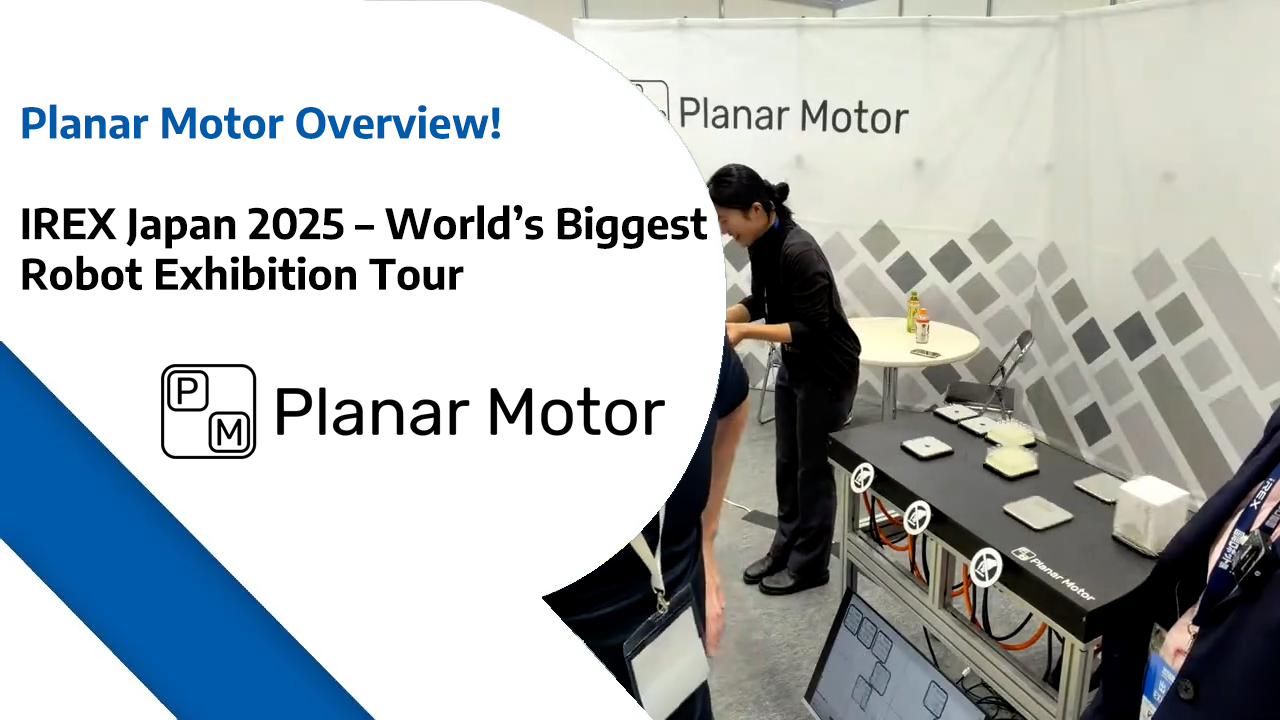
  • Planar Motor Overview! – IREX Japan 2025 – World’s Biggest Robot Exhibition Tour

    Planar Motor Overview! – IREX Japan 2025 – World’s Biggest Robot Exhibition Tour

    Planar Motor Overview! – IREX Japan 2025

    Planar Motor Overview – A Deep Dive from IREX Japan 2025

    The International Robot Exhibition (IREX) Japan 2025 once again proved why it is regarded as the world’s largest and most influential robotics and automation showcase. Held in Tokyo, the exhibition brought together the globe’s most advanced robot manufacturers, AI developers, automation integrators, and industrial innovators — all presenting their vision of the future.

    Among the many groundbreaking technologies on display, one system stood out as a true game-changer in motion and transport automation:

    The Planar Motor system.

    Filmed live during our IREX 2025 exhibition tour, this technology represents a fundamental shift in how factories, laboratories, and logistics facilities move products — replacing rigid conveyor infrastructure with fully flexible, programmable motion platforms.

    This article explores what Planar Motor is, how it works, its industrial applications, and why it signals the next evolution of Industry 4.0 manufacturing.


    What Is the Planar Motor?

    At its core, the Planar Motor is an intelligent transport system that eliminates the limitations of traditional conveyor belts and linear track systems.

    Instead of products being carried along fixed mechanical routes, Planar Motor uses independently controlled movers that float above a planar surface using electromagnetic force.

    Each mover can travel freely across the platform in multiple axes:

    • X axis (side to side)

    • Y axis (forward and backward)

    • Rotational movement

    • Independent or synchronised motion

    This creates a transport environment that is not mechanically defined — but software defined.

    In simple terms:

    Production flow is controlled by code, not hardware.


    How the Technology Works

    The system consists of two primary components:

    1. Planar Surface (Stator Platform)

    The surface contains embedded electromagnetic coils. These generate controlled magnetic fields that levitate and move the carriers above the platform.

    2. Intelligent Movers (Carriers)

    These movers float frictionlessly above the surface. Each is individually addressable and programmable through the system’s control software.

    Because there are no belts, gears, or chains, movement is:

    • Silent

    • Low wear

    • Highly precise

    • Infinitely reconfigurable

    This architecture allows manufacturers to redesign workflows instantly without mechanical retooling.


    Why This Matters: The Death of the Conveyor Belt

    For over 100 years, conveyor belts have defined factory layouts. While effective, they come with limitations:

    • Fixed routes

    • Mechanical wear

    • Maintenance downtime

    • Limited flexibility

    • Space inefficiency

    Planar Motor removes these constraints entirely.

    Instead of designing production around conveyor paths, manufacturers can design motion paths around production needs — dynamically.

    This is especially critical in high-mix, low-volume manufacturing environments where product variation is high.


    Key Benefits of Planar Motor Systems

    1. Total Layout Flexibility

    Movers can change routes instantly. Production lines can be reconfigured via software rather than mechanical rebuilds.

    2. Independent Product Control

    Each product carrier moves autonomously, allowing different process times without slowing the overall system.

    3. Ultra-High Precision

    Positioning accuracy is measured in microns — essential for semiconductor and electronics manufacturing.

    4. Reduced Maintenance

    No belts or chains mean fewer wear components and lower servicing costs.

    5. Cleanroom Compatibility

    Because there is minimal friction and particle generation, Planar Motor systems are ideal for sterile environments.

    6. Silent Operation

    Electromagnetic motion significantly reduces noise pollution in factories.


    Industry Applications

    One of the most impressive aspects of Planar Motor technology is its cross-industry relevance.

    Semiconductor Manufacturing

    Chip production requires extreme precision and contamination control. Planar Motor enables wafer transport with micron-level positioning in cleanroom conditions.

    Pharmaceutical Production

    Drug manufacturing often involves small batch processing with strict sterility requirements. Flexible routing allows dynamic quality control and inspection workflows.

    Electronics Assembly

    PCB and component assembly benefit from independent carrier control, allowing different assembly times per product.

    Laboratory Automation

    Diagnostic labs and research facilities use planar transport for sample handling, testing sequences, and robotic interfacing.

    Food Processing

    Cleanable surfaces and flexible routing make the system viable for hygienic production environments.

    Precision Logistics

    High-value goods can be transported safely with collision avoidance and route optimisation.


    Collision Avoidance and Intelligent Routing

    A major advantage of software-defined motion is traffic control.

    Each mover is monitored and controlled in real time. The system can:

    • Prevent collisions

    • Reroute traffic dynamically

    • Optimise flow rates

    • Prioritise urgent products

    This transforms production into something closer to air traffic control than traditional conveyor logistics.


    Integration with Robotics

    Planar Motor systems integrate seamlessly with robotic arms, inspection systems, and AI vision platforms.

    For example:

    • Robots can perform assembly tasks as movers stop precisely in work zones.

    • AI cameras can inspect products mid-route.

    • Cobots can interact safely with carriers.

    This creates modular robotic workcells connected by intelligent transport rather than fixed lines.


    Industry 4.0 and Digital Manufacturing

    Planar Motor is not just a transport system — it is a digital manufacturing enabler.

    Because every mover is software controlled, factories gain access to rich operational data:

    • Cycle times

    • Routing efficiency

    • Bottlenecks

    • Product tracking

    • Predictive maintenance insights

    This data feeds into MES, ERP, and AI optimisation platforms — enabling continuous improvement.


    Scalability and Modularity

    Another standout feature is scalability.

    Manufacturers can expand systems by adding more planar tiles and movers without redesigning the entire production line.

    This makes Planar Motor ideal for:

    • Growing factories

    • Pilot production lines

    • R&D facilities

    • Contract manufacturers


    Energy Efficiency Considerations

    While electromagnetic systems require power, they often offset energy consumption by:

    • Reducing mechanical friction

    • Eliminating pneumatic systems

    • Lowering maintenance energy costs

    • Optimising routing efficiency

    As factories move toward net-zero targets, intelligent transport systems will play a role in energy optimisation.


    Filmed Live at IREX Japan 2025

    Our coverage of Planar Motor took place during our wider tour of IREX Japan 2025 — an exhibition that featured:

    • Humanoid robots

    • AI service robots

    • Warehouse automation

    • Inspection robotics

    • Autonomous mobility platforms

    The exhibition continues to be the global benchmark for robotics innovation and future manufacturing technologies.


    The Future of Motion Platforms

    Planar Motor represents a broader trend:

    The shift from mechanical automation to software-defined automation.

    Just as cloud computing virtualised IT infrastructure, planar transport virtualises motion infrastructure.

    In the coming decade we can expect:

    • AI-optimised routing

    • Self-healing production flows

    • Digital twin integration

    • Autonomous factory orchestration

    Transport will no longer be a passive function — but an intelligent one.


    Sponsor & Partner Acknowledgements

    Our IREX 2025 exhibition coverage is proudly supported by companies driving real-world robotics deployment:

    Robot Center

    Robot Center specialises in industrial robotics, collaborative robots, and warehouse automation solutions — helping businesses deploy robots profitably and efficiently.

    🌐 https://robotcenter.co.uk/


    Robots of London

    Robots of London is the UK’s leading robot hire and event robotics company — delivering humanoids, service robots, and AI activations for exhibitions, brand experiences, and corporate events.

    🌐 https://robotsoflondon.co.uk/


    RoboPhil (Robot Philosophy)

    RoboPhil provides robotics consultancy, strategy, workshops, and advisory services — helping organisations identify where robots create the greatest ROI.

    🌐 https://robophil.com/


    Work With Us

    If you’re exploring robotics, automation, or intelligent transport systems like Planar Motor, our team can support with:

    • Consultancy & audits

    • Robot sourcing

    • Integration strategy

    • Event robotics

    • Lead generation campaigns

    📧 enquiries@robotsoflondon.co.uk
    📞 0845 528 0404


    Final Thoughts

    The Planar Motor system is more than an incremental improvement — it is a paradigm shift in industrial transport.

    By removing fixed mechanical constraints and replacing them with programmable motion intelligence, manufacturers gain flexibility, precision, and scalability never before possible.

    As Industry 4.0 accelerates, technologies like Planar Motor will form the backbone of autonomous, data-driven factories.

    From semiconductor fabs to pharmaceutical labs, the future of production is no longer linear.

    It’s planar.
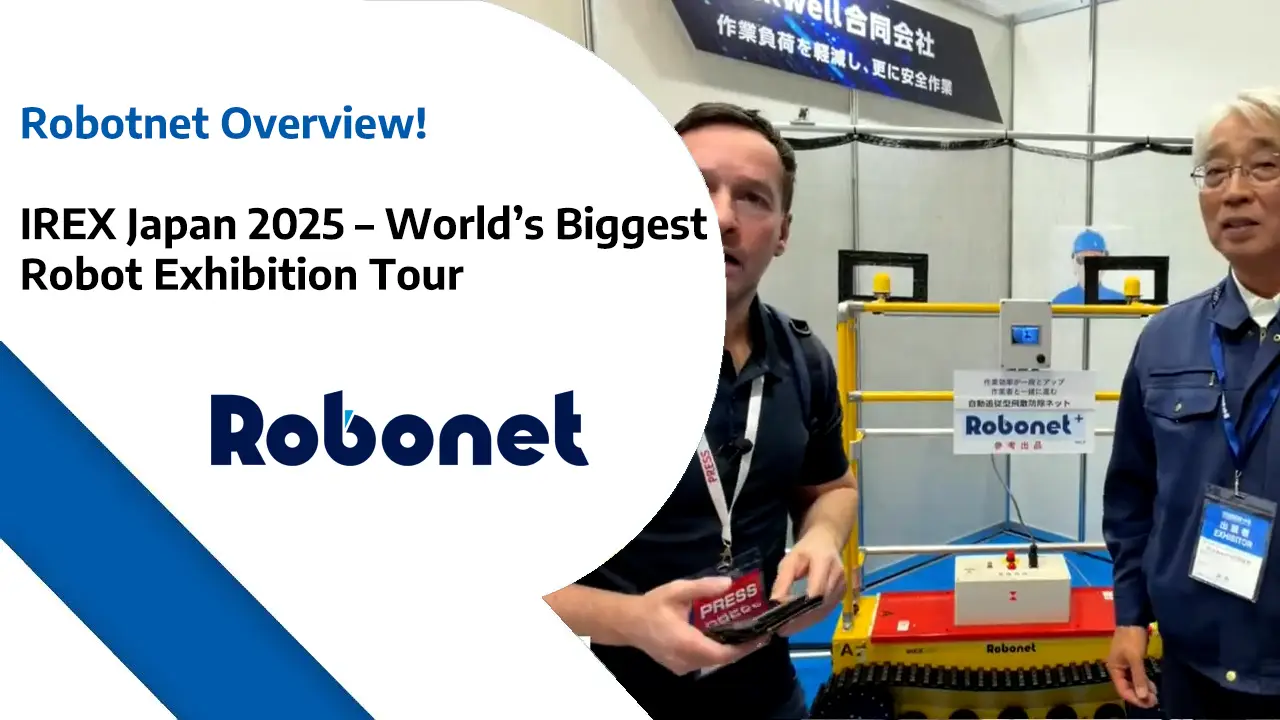
  • Robotnet Overview! – IREX Japan 2025 – World’s Biggest Robot Exhibition Tour

    Robotnet Overview! – IREX Japan 2025 – World’s Biggest Robot Exhibition Tour

    Robotnet Overview! – IREX Japan 2025 –

    Robotnet Overview – IREX Japan 2025

    Exploring the Connected Future of Robotics Networking

    The global robotics industry continues to accelerate at an extraordinary pace, and nowhere is that momentum more visible than at IREX Japan 2025 — widely recognised as the world’s largest robotics exhibition. Held at Tokyo Big Sight, IREX brings together the most advanced robotics manufacturers, AI developers, automation integrators, and industrial technology providers from across the globe.

    Among the hundreds of groundbreaking technologies showcased this year, one platform stood out not because of its physical presence — but because of the invisible infrastructure it provides behind the scenes.

    That platform is Robotnet by Rockwell Japan.

    While humanoids, service robots, and industrial arms often capture the headlines, the real future of robotics lies in connectivity — how robots communicate, collaborate, and integrate into wider operational ecosystems.

    Robotnet represents a major step forward in solving that challenge.


    The Shift from Standalone Robots to Connected Ecosystems

    Historically, robots were deployed as isolated automation units. A robotic arm on a production line, an AGV in a warehouse, or a service robot in a facility would operate largely within its own programmed environment.

    But as robotics adoption scales, this siloed model creates limitations:

    • Lack of centralised monitoring
    • Limited production visibility
    • Data fragmentation
    • Inefficient task coordination
    • Integration complexity
    • Scaling challenges across sites

    Modern automation demands more than individual robot performance — it requires orchestration.

    Factories, warehouses, and logistics hubs now deploy fleets of robots from multiple manufacturers, each performing different roles. Without a unifying network, managing these environments becomes operationally complex.

    This is the gap Robotnet is designed to fill.


    What Is Robotnet?

    Robotnet is an advanced robotics networking platform developed by Rockwell Japan to connect multi-brand robotic systems, factory infrastructure, and automation technologies into a single intelligent ecosystem.

    Rather than focusing on robot hardware, Robotnet focuses on the digital backbone that enables robots to operate cohesively within Industry 4.0 environments.

    Key capabilities include:

    • Multi-robot connectivity
    • Cross-brand interoperability
    • Real-time production monitoring
    • Centralised analytics dashboards
    • Operational performance tracking
    • Predictive maintenance insights
    • Scalable automation infrastructure

    In simple terms, Robotnet transforms disconnected robots into a unified workforce.


    Live Demonstration at IREX Japan 2025

    Seeing Robotnet live at IREX provided a clear view of its practical application.

    The exhibition demo showcased multiple robotic systems connected through a shared network interface, enabling operators to monitor performance, utilisation, and operational status in real time.

    Key demonstration highlights included:

    1. Centralised Robot Monitoring

    Operators could view multiple robots across different tasks through a single dashboard, removing the need to monitor individual systems separately.

    2. Production Visibility

    Live production data flowed into the network, offering instant insights into throughput, efficiency, and downtime.

    3. Predictive Maintenance

    Robotnet aggregated performance data to flag potential maintenance issues before failure occurred — a major cost-saving capability.

    4. Cross-System Communication

    Robots from different manufacturers could operate within coordinated workflows, improving operational synchronisation.


    Industry 4.0 Integration

    Robotnet is deeply aligned with Industry 4.0 principles — the shift toward smart, connected, data-driven industrial environments.

    Industry 4.0 is built on several foundational pillars:

    • Connectivity
    • Automation
    • Data analytics
    • Machine learning
    • Cloud infrastructure
    • Cyber-physical systems

    Robotnet sits at the intersection of these pillars, acting as the connective tissue between robotic hardware and digital intelligence systems.

    By networking robots into factory IT environments, businesses gain:

    • End-to-end production visibility
    • Data-driven decision making
    • Automation scalability
    • Workforce augmentation insights
    • Remote monitoring capability


    Why Robotics Networking Matters

    As robot adoption increases, networking platforms like Robotnet will become mission-critical infrastructure.

    Consider the trajectory:

    • More robots per facility
    • More facilities per company
    • More automation vendors involved
    • Greater need for data harmonisation

    Without networking platforms, automation scaling becomes fragmented and inefficient.

    With networking platforms, automation becomes orchestrated and optimised.

    This shift mirrors what happened in computing — standalone PCs evolved into networked systems, then into cloud ecosystems.

    Robotics is following the same path.


    Applications Across Industry

    Robotnet’s use cases span multiple sectors:

    Manufacturing

    • Production line robotics coordination
    • Assembly automation monitoring
    • Quality control integration

    Warehousing & Logistics

    • Fleet management for AMRs & AGVs
    • Order fulfilment analytics
    • Traffic optimisation

    Automotive

    • Multi-robot welding & assembly synchronisation
    • Production throughput tracking

    Electronics

    • Precision manufacturing automation networking

    Food Production

    • Hygiene-compliant robotic coordination


    The Data Advantage

    One of Robotnet’s most powerful capabilities lies in data aggregation.

    Connected robots generate enormous operational datasets, including:

    • Cycle times
    • Error rates
    • Utilisation levels
    • Energy consumption
    • Maintenance intervals

    When centralised, this data unlocks:

    • Process optimisation
    • Cost reduction
    • Downtime minimisation
    • Workforce planning insights
    • Automation ROI measurement

    Data transforms robotics from mechanical automation into intelligent automation.


    Japan’s Leadership in Robotics Infrastructure

    Japan has long been a global leader in robotics manufacturing — but platforms like Robotnet demonstrate leadership in robotics infrastructure as well.

    Rather than focusing solely on building robots, Japanese firms are investing in the ecosystems that enable robots to scale effectively across industries.

    This systems-level thinking is critical as robotics moves from novelty to necessity.


    Exhibition Reflections

    Walking the floors of IREX Japan 2025, it became clear that robotics is entering a new phase.

    The first wave was mechanical capability.
    The second wave was AI integration.
    The third wave — now emerging — is connectivity.

    Robotnet sits firmly within this third wave.

    The future factory will not be defined by how many robots it has — but by how intelligently they are connected.


    Sponsors & Partners

    This exhibition coverage and robotics insight content is proudly supported by organisations actively deploying and advancing robotics adoption across the UK and internationally.


    Robot Center

    Website: https://robotcenter.co.uk/

    Robot Center specialises in industrial robotics, warehouse automation, and collaborative robot (cobot) integration.

    Services include:

    • Industrial robot supply
    • Warehouse robotics deployment
    • Automation consultancy
    • System integration
    • Robotics maintenance & support

    Robot Center works with manufacturers and logistics providers to design, deploy, and optimise automation infrastructure tailored to operational needs.


    Robots of London

    Website: https://robotsoflondon.co.uk/

    Robots of London is the UK’s leading robot hire and event robotics company, providing cutting-edge robotic experiences for exhibitions, corporate events, brand activations, and live showcases.

    Offerings include:

    • Humanoid robot hire
    • Service robots
    • Reception robots
    • Exhibition robots
    • Promotional robotics
    • Interactive event automation

    The company helps brands and organisations create high-impact technology experiences through robotics engagement.


    Robot Philosophy (RoboPhil)

    Website: https://robophil.com/

    Robot Philosophy, founded by RoboPhil, focuses on robotics strategy, consultancy, workshops, and industry insights.

    Services include:

    • Robotics adoption strategy
    • Automation consultancy
    • Industry workshops
    • Speaking & keynote sessions
    • Robotics ROI frameworks

    The platform helps businesses understand not just how robotics works — but how to profit from it.


    Final Thoughts

    Robotnet may not be the most visually dramatic technology showcased at IREX Japan 2025 — but it may be one of the most important.

    Because as robotics scales globally, connectivity will determine success.

    The winners in automation will not simply deploy robots… they will network them, orchestrate them, and optimise them through intelligent infrastructure.

    Robotnet offers a glimpse into that connected future.

    And based on what was demonstrated at IREX, that future is arriving faster than many businesses expect.


    If your organisation is exploring robotics deployment, factory automation, or connected infrastructure strategy, now is the time to look beyond hardware — and toward the networks that will power the next generation of intelligent industry.

  • ROMS Robotics Overview! – IREX Japan 2025 – World’s Biggest Robot Exhibition Tour

    ROMS Robotics Overview! – IREX Japan 2025 – World’s Biggest Robot Exhibition Tour

    ROMS Robotics Overview! – IREX Japan 2025

    ROMS Robotics Overview – IREX Japan 2025

    Inside the World’s Largest Robot Exhibition

    The global robotics industry continues to accelerate at an extraordinary pace, and nowhere is that momentum more visible than at IREX Japan 2025 — the world’s largest and most influential robot exhibition, held in Tokyo.

    Every two years, IREX (International Robot Exhibition) becomes the epicentre of robotics innovation, bringing together the most advanced robot manufacturers, AI developers, automation integrators, and humanoid pioneers from across the globe.

    In this feature, we take a deep dive into one of the standout exhibitors from the show floor:

    ROMS Robotics

    Their presence at IREX 2025 demonstrated not only technological innovation — but real commercial readiness — with robotic systems designed for deployment across logistics, manufacturing, service environments, and smart infrastructure.


    First Impressions: A Robotics Company Focused on Deployment

    One of the biggest challenges in robotics today is the gap between prototype and deployment.

    Many robots look impressive on exhibition stands but lack real-world commercial readiness.

    ROMS Robotics stood out because their solutions were not conceptual — they were operational.

    Their booth focused heavily on practical automation, showcasing robots already working in:

    • Warehouses

    • Distribution centres

    • Manufacturing plants

    • Customer service environments

    • Security patrol applications

    This deployment-first mindset aligns closely with the growing demand from businesses seeking ROI-driven robotics rather than experimental technology.


    Autonomous Mobile Robots (AMRs)

    A major highlight from the ROMS Robotics stand was their range of Autonomous Mobile Robots (AMRs).

    These robots are designed to move goods, materials, and inventory across facilities without human intervention.

    Key capabilities included:

    • Dynamic route navigation

    • Obstacle avoidance

    • Fleet coordination

    • Warehouse management system integration

    • Real-time mapping

    AMRs are rapidly becoming the backbone of modern logistics operations, particularly as labour shortages continue to affect warehousing and fulfilment sectors globally.

    ROMS Robotics demonstrated how their AMR platforms could be deployed quickly without requiring major infrastructure changes — a critical factor for SMEs and enterprise clients alike.


    Logistics & Warehouse Automation

    Beyond standalone AMRs, ROMS Robotics presented integrated logistics ecosystems.

    These systems combined mobile robots with:

    • Automated storage systems

    • Conveyor integrations

    • Picking assistance robots

    • Inventory scanning technology

    The focus was on creating end-to-end automation workflows — reducing human handling while improving speed and accuracy.

    Warehouse automation is one of the fastest-growing robotics sectors worldwide, driven by e-commerce expansion and same-day delivery expectations.

    ROMS Robotics is positioning itself firmly within this growth curve.


    AI Service Robots

    Another key pillar of the ROMS Robotics portfolio is AI-powered service robotics.

    These robots are designed for front-of-house and customer-facing environments such as:

    • Hotels

    • Retail stores

    • Hospitals

    • Airports

    • Corporate receptions

    Capabilities demonstrated included:

    • AI voice interaction

    • Multilingual communication

    • Wayfinding & guidance

    • Customer check-in assistance

    • Promotional engagement

    Service robots are increasingly being adopted not just for novelty — but for operational augmentation — supporting staff while enhancing customer experience.


    Smart Factory Robotics

    Manufacturing remains one of the most mature robotics sectors, yet innovation continues to evolve through AI and mobility integration.

    ROMS Robotics showcased smart factory solutions including:

    • Robotic material transport

    • Production line feeding robots

    • Automated inspection units

    • Collaborative robotics integration

    These systems are designed to operate alongside human workers, improving productivity while maintaining safety.

    With Industry 4.0 initiatives accelerating worldwide, smart factory robotics is becoming less optional and more essential.


    Inspection & Security Robotics

    One of the most commercially interesting segments on display was ROMS Robotics’ inspection and patrol robotics platforms.

    These robots are designed to autonomously monitor environments such as:

    • Industrial facilities

    • Warehouses

    • Energy plants

    • Commercial buildings

    • Outdoor infrastructure

    Capabilities included:

    • Thermal imaging

    • CCTV monitoring

    • Intrusion detection

    • Environmental sensing

    • Remote reporting

    As security labour costs rise, autonomous patrol robots are becoming an attractive alternative or supplement to traditional guarding services.


    Designed for Scalability

    A consistent theme across the ROMS Robotics portfolio was scalability.

    Their systems are designed to grow with client operations — starting with pilot deployments and expanding into full robotic fleets.

    This modular approach reduces adoption risk and allows businesses to phase automation investments.

    From a consultancy standpoint, this is critical — as many organisations want robotics but need staged implementation.


    Why Exhibiting at IREX Matters

    Exhibiting at IREX is more than brand visibility — it’s global positioning.

    The exhibition attracts:

    • Distributors

    • Integrators

    • Government bodies

    • Enterprise buyers

    • Investors

    For ROMS Robotics, their presence signals international expansion ambitions and partnership readiness.

    For companies like ours operating in robot deployment, hire, and consultancy — these exhibitions are vital for identifying emerging technologies suitable for UK and European markets.


    The Bigger Picture: Robotics Adoption Is Accelerating

    Walking the halls of IREX 2025 reinforced several macro trends:

    1. Labour shortages are driving automation demand

    2. AI integration is becoming standard in robotics

    3. Mobile robotics is outpacing fixed automation growth

    4. Service robots are entering commercial mainstream

    5. Security & inspection robots are scaling rapidly

    ROMS Robotics sits across multiple intersecting growth sectors — making them a company to watch closely.


    Where ROMS Robotics Fits Commercially

    From a deployment perspective, ROMS solutions are highly relevant for:

    • 3PL logistics providers

    • Retail distribution centres

    • Manufacturing plants

    • Airports & hospitals

    • Facilities management firms

    Their robots are not replacing entire workforces — but augmenting operations where labour is scarce, costly, or inefficient.


    Final Thoughts

    IREX Japan continues to be the global benchmark for robotics innovation — and ROMS Robotics delivered a strong showcase of commercially deployable automation.

    Their strength lies not in experimental humanoids — but in practical robotics that businesses can implement today.

    As robotics adoption accelerates globally, companies focused on scalable deployment — like ROMS — will play a major role in shaping automation’s real-world impact.


    🤝 Sponsorship & Partner Acknowledgements

    This exhibition coverage is supported by the following robotics organisations:


    🔧 Robot Center

    Industrial & Warehouse Robotics Specialists

    Robot Center focuses on next-generation automation solutions for warehouses, logistics operators, and manufacturers.

    Services include:

    • Collaborative robot deployment

    • Warehouse robotics integration

    • Automation consultancy

    • ROI audits

    • Installation & maintenance

    Website: https://robotcenter.co.uk/


    🎪 Robots of London

    Robot Hire & Event Robotics

    Robots of London supplies robots for exhibitions, corporate events, brand activations, and hospitality environments.

    Robot solutions include:

    • Humanoid robots

    • Service robots

    • Digital signage robots

    • Robot arms (coffee, drinks & demos)

    • Meet-and-greet robots

    Website: https://robotsoflondon.co.uk/


    🧠 Robot Philosophy

    Robotics Consultancy & Strategy

    Robot Philosophy helps organisations understand, adopt, and monetise robotics through:

    • Consultancy

    • Workshops

    • ROI strategy

    • Robot audits

    • Speaking engagements

    Website: https://robophil.com/


    If you’re a robot manufacturer looking to launch into the UK or Europe — or a business exploring robotics adoption — partnership discussions are always open.

  • Doog Robotics Overview! | IREX Japan 2025 – World’s Biggest Robot Exhibition Tour

    Doog Robotics Overview! | IREX Japan 2025 – World’s Biggest Robot Exhibition Tour

    Doog Robotics Overview! | IREX Japan 2025

    Doog Robotics Overview! – IREX Japan 2025 World’s Biggest Robot Exhibition Tour

    The global robotics industry continues to accelerate at an extraordinary pace, and nowhere is this more evident than at IREX Japan 2025 (International Robot Exhibition) — widely recognised as the largest robotics trade show in the world.

    Held in Tokyo, IREX is where the future of robotics is not predicted — it is demonstrated live.

    From humanoids and industrial automation systems to AI-driven service robots, the exhibition gathers the most advanced robotics companies on the planet under one roof.

    During my latest exhibition tour, one company that stood out for its practical, real-world robotics applications was Doog Robotics — a Japan-based developer specialising in autonomous mobile service robots designed to work alongside humans in operational environments.

    This article provides a full overview of Doog Robotics, the technology showcased at IREX 2025, and why service robotics is rapidly becoming one of the most commercially impactful sectors in automation.


    The Rise of Service Robotics

    While industrial robots have dominated manufacturing for decades, service robots represent the next major wave of robotics adoption.

    Rather than operating in fenced industrial cells, service robots function in human environments — hotels, hospitals, warehouses, retail stores, airports, and office buildings.

    Their purpose is simple:

    Support staff
    Increase efficiency
    Reduce labour strain
    Improve customer experience

    With global labour shortages, rising operational costs, and increasing customer expectations, businesses are now actively seeking automation solutions that can integrate into everyday workflows without requiring infrastructure overhauls.

    This is precisely where Doog Robotics positions its technology.


    Who Are Doog Robotics?

    Doog Robotics is a Japan-based robotics manufacturer focused on developing autonomous mobile robots (AMRs) for service and support roles.

    Their design philosophy centres on three core pillars:

    Safety
    Practicality
    Human collaboration

    Rather than replacing humans, Doog robots are built to assist them — carrying loads, performing routine transport tasks, and supporting operational logistics.

    This collaborative approach makes deployment significantly easier, particularly in environments where human interaction is constant.


    Live from the IREX 2025 Show Floor

    Seeing robots in brochures is one thing — seeing them operate live in a busy exhibition environment is another.

    At IREX Japan 2025, Doog Robotics demonstrated their robots navigating crowded aisles, avoiding visitors, adjusting routes dynamically, and transporting goods seamlessly.

    Key live demo observations included:

    Smooth autonomous navigation
    Real-time obstacle avoidance
    Human detection and safety stopping
    Stable load carrying while in motion
    Quiet operational movement

    The robots moved confidently through complex environments — a critical requirement for commercial adoption.


    Core Capabilities of Doog Service Robots

    1. Autonomous Navigation

    Doog robots use advanced sensors and mapping systems to understand and move through their environment.

    They can:

    Map facilities
    Plan optimal routes
    Avoid obstacles
    Adapt to human traffic

    This allows them to function in dynamic, real-world locations rather than controlled factory settings.


    2. Load Carrying & Delivery

    One of their primary functions is internal logistics support.

    Use cases include:

    Hotel room service deliveries
    Hospital supply transport
    Warehouse item movement
    Office document delivery
    Retail stock transfers

    By automating internal transport, businesses free up staff to focus on higher-value work.


    3. Human-Robot Interaction Safety

    Operating in public spaces requires advanced safety protocols.

    Doog robots include:

    Collision avoidance sensors
    Emergency stop systems
    Speed regulation in crowded areas
    Human detection AI

    This ensures safe coexistence between robots and people.


    4. Multi-Industry Deployment

    What makes Doog particularly compelling is the breadth of industries they serve.

    Hospitality

    Room service delivery
    Luggage transport
    Guest assistance

    Healthcare

    Medical supply transport
    Pharmacy deliveries
    Linen movement

    Facilities Management

    Cleaning support logistics
    Equipment transport
    Security patrol assistance

    Logistics & Warehousing

    Last-mile internal delivery
    Inventory movement
    Picking support


    Why Service Robots Are Surging Globally

    From my perspective touring robotics exhibitions worldwide, service robotics is now at an inflection point.

    Key drivers include:

    Labour shortages
    Rising wages
    24/7 operational demands
    Health & safety requirements
    Customer experience expectations

    Businesses are no longer asking if they should deploy robots — but where they should deploy them first.

    Service robots offer one of the fastest ROI pathways because they automate repetitive, non-specialist tasks.


    Japan’s Leadership in Service Robotics

    Japan continues to lead the world in service robot innovation.

    Cultural acceptance of robots, combined with an aging population and labour gaps, has accelerated adoption.

    Exhibitions like IREX demonstrate how embedded robotics already is within Japanese infrastructure — from hotels to hospitals.

    Companies like Doog Robotics are now exporting this expertise globally.


    Real-World Business Impact

    Service robots are not novelty items — they are operational assets.

    Business benefits include:

    Reduced staffing pressure
    Lower operational costs
    Improved service speed
    Enhanced brand perception
    Data collection opportunities

    Robots also provide marketing value — particularly in customer-facing environments where innovation attracts attention.


    The Future Roadmap

    Based on what was showcased at IREX, the future evolution of service robots will include:

    AI voice interaction
    Elevator integration
    Fleet coordination
    Cloud analytics dashboards
    Predictive maintenance
    Cross-facility deployment scaling

    As software intelligence advances, robot hardware becomes exponentially more valuable.


    Exhibition Reflections

    What stood out most about Doog Robotics was not futuristic theatrics — but practical deployment readiness.

    Their robots are designed for:

    Existing buildings
    Live environments
    Human collaboration
    Immediate ROI

    This practicality is what will drive mass adoption.


    Full Video Walkthrough

    I filmed a full exhibition walkthrough covering Doog Robotics and many other global robotics innovators live from the IREX show floor.

    The video provides:

    Live robot demos
    Navigation footage
    Close-up hardware views
    My deployment insights
    Industry adoption commentary


    Sponsors & Ecosystem Partners

    This exhibition coverage — along with our wider robotics media and consultancy work — is supported by our ecosystem partners who are actively driving robotics adoption across the UK and Europe.


    Robots of London

    Website: https://robotsoflondon.co.uk/

    Robots of London specialises in robot hire, event robotics, and experiential automation.

    Services include:

    Humanoid robot hire
    Service robot rentals
    Exhibition robots
    Brand activations
    Lead generation robots
    Corporate event technology

    They help brands and event organisers create high-impact, tech-driven experiences using robotics.


    Robot Center

    Website: https://robotcenter.co.uk/

    Robot Center focuses on industrial and commercial robotics deployment.

    Core services include:

    Collaborative robots
    Warehouse automation
    Inspection robots
    Security robots
    Robotics consultancy
    Integration & support

    They help businesses identify, install, and optimise robotics for operational ROI.


    Robot Philosophy / RoboPhil

    Website: https://robophil.com/

    Robot Philosophy is a robotics media, education, and consultancy platform.

    Offerings include:

    Robotics workshops
    Consultancy audits
    Industry insights
    Speaking engagements
    Training & education

    The platform exists to help organisations understand, adopt, and monetise robotics technology.


    Final Thoughts

    Doog Robotics represents the direction service robotics is heading:

    Practical
    Deployable
    Collaborative
    ROI-driven

    As global industries continue to automate, autonomous mobile service robots will become as common as forklifts and elevators.

    Exhibitions like IREX Japan provide a glimpse into that near future — and companies like Doog are actively building it.


    Business & Robotics Deployment Enquiries

    sales@robotsoflondon.co.uk
    0845 528 0404

  • DeepTouch Overview – IREX Japan 2025 – World’s Biggest Robot Exhibition!

    DeepTouch Overview – IREX Japan 2025 – World’s Biggest Robot Exhibition!

    DeepTouch Overview

    DeepTouch Overview – IREX Japan 2025

    Inside the World’s Largest Robotics Exhibition

    The International Robot Exhibition (IREX) Japan 2025 once again proved why it is regarded as the world’s largest and most influential robotics trade show. Held in Tokyo, IREX brings together the most advanced robotics manufacturers, AI developers, integrators, and automation pioneers from across the globe.

    Among the standout innovators this year was DeepTouch, developed by Shanghai Xinfu Technology Pvt Ltd — a company focused on advancing tactile sensing and human-robot interaction technologies designed to make robots more responsive, safer, and commercially viable in real-world environments.

    In this deep-dive overview, we explore the technology behind DeepTouch, what we saw live at IREX Japan 2025, and why tactile robotics could be one of the most important enablers of the next robotics revolution.


    What Is DeepTouch?

    DeepTouch is an advanced tactile sensing technology platform designed to give robots a human-like sense of touch.

    While robotics has made enormous strides in vision systems, navigation, and AI decision-making, the sense of touch has historically lagged behind. Robots could see and calculate — but they couldn’t “feel.”

    DeepTouch changes that.

    By embedding high-resolution tactile sensors into robotic end effectors, grippers, and contact surfaces, DeepTouch allows robots to:

    • Detect pressure variations

    • Identify object texture

    • Adjust grip strength dynamically

    • Prevent slippage

    • Handle fragile items safely

    • Interact more naturally with humans

    This technology is critical for service robotics, healthcare automation, logistics handling, and collaborative robot (cobot) environments where safety and precision are paramount.


    Live From IREX Japan 2025

    Seeing DeepTouch live at IREX provided a real-world demonstration of how far tactile robotics has progressed.

    On the exhibition floor, DeepTouch was integrated into robotic manipulation systems capable of handling delicate objects with remarkable precision. Demonstrations included:

    • Soft object gripping

    • Precision component handling

    • Human-robot contact response

    • Adaptive grip adjustments in real time

    What stood out wasn’t just the sensing capability — it was the speed of response. The robot didn’t simply detect touch; it reacted instantly, adjusting force and positioning dynamically.

    This is a major step forward from traditional force-torque sensors, which often operate at lower resolution and slower response cycles.


    Why Tactile Sensing Matters in Robotics

    To understand DeepTouch’s importance, you have to look at the broader robotics landscape.

    Most robots today rely on three core sensing pillars:

    1. Vision (cameras, LiDAR, 3D mapping)

    2. Position (encoders, motion tracking)

    3. Force (basic resistance detection)

    But humans rely heavily on touch.

    We instinctively adjust grip when holding:

    • A glass of water

    • A smartphone

    • A piece of fruit

    • Medical instruments

    Without tactile feedback, robots must rely on pre-programmed force thresholds — which limits flexibility and increases risk.

    DeepTouch introduces:

    • Micro-pressure mapping

    • Surface contact awareness

    • Slip detection

    • Multi-point force sensing

    This transforms robotic handling from rigid automation into adaptive manipulation.


    Key Technology Features

    1. High-Resolution Sensor Arrays

    DeepTouch uses dense tactile sensor grids that create pressure maps across the contact surface. This allows robots to detect not just contact — but how contact is distributed.

    2. Real-Time Feedback Loops

    The system feeds tactile data directly into the robot’s control algorithms, enabling instantaneous grip adjustments.

    3. AI Integration

    Machine learning models interpret tactile data, improving object handling over time through experience.

    4. Modular Integration

    DeepTouch can be integrated into:

    • Robotic grippers

    • Humanoid hands

    • Service robot manipulators

    • Industrial cobots


    Applications Across Industries

    Logistics & Warehousing

    Handling parcels, packaging, and irregular goods requires adaptive gripping. DeepTouch allows robots to:

    • Lift soft packages safely

    • Prevent crushing damage

    • Adjust grip for different weights

    This is particularly relevant as e-commerce logistics scales globally.


    Healthcare & Medical Robotics

    Medical robotics demands extreme sensitivity.

    Applications include:

    • Surgical assistance

    • Patient handling

    • Rehabilitation robotics

    • Prosthetics

    Tactile sensing ensures safer human interaction and more precise instrument control.


    Service Robotics

    Hospitality, retail, and front-of-house robots increasingly interact with physical objects.

    DeepTouch enables:

    • Tray carrying

    • Drink serving

    • Product handling

    • Customer item exchange

    This enhances both safety and user experience.


    Industrial Automation

    Manufacturing environments often require handling:

    • Fragile components

    • Electronics

    • Glass

    • Precision assemblies

    DeepTouch reduces breakage risk while improving placement accuracy.


    Human-Robot Interaction: The Next Frontier

    One of the most exciting implications of DeepTouch is in collaborative robotics.

    As robots move closer to humans — working alongside staff rather than in cages — touch sensitivity becomes essential.

    DeepTouch supports:

    • Safe contact detection

    • Gentle human interaction

    • Responsive force limitation

    • Enhanced compliance control

    This is particularly important for humanoid and service robots operating in public environments.


    Shanghai Xinfu Technology Pvt Ltd – Company Overview

    Shanghai Xinfu Technology is positioning itself at the forefront of tactile robotics innovation.

    The company focuses on developing:

    • Advanced sensor hardware

    • AI tactile processing systems

    • Robotic integration platforms

    • Human-machine interface technologies

    Their presence at IREX Japan 2025 signals a strong push into global robotics markets, partnering with robot manufacturers and integrators seeking to enhance manipulation capabilities.

    As robotics adoption accelerates, tactile sensing providers like Xinfu are becoming critical enablers rather than optional add-ons.


    The Commercial Impact of Tactile Robotics

    From a business perspective, technologies like DeepTouch unlock entirely new deployment opportunities.

    Robots can move into sectors previously considered too delicate or unpredictable for automation.

    Commercial benefits include:

    • Reduced product damage

    • Increased automation scope

    • Improved safety compliance

    • Lower insurance risk

    • Higher operational precision

    For integrators and robotics consultancies, tactile sensing expands the ROI case for robotics adoption.


    IREX Japan – A Global Robotics Barometer

    IREX isn’t just an exhibition — it’s a forecast of where robotics is heading.

    Key themes from 2025 included:

    • Humanoid robotics acceleration

    • AI-driven autonomy

    • Inspection and security robots

    • Logistics automation

    • Human-robot collaboration

    DeepTouch fits squarely into this evolution — enabling robots to operate more naturally in human environments.


    Why This Matters for Businesses Today

    Many companies still view robotics through a traditional industrial lens — fixed automation performing repetitive tasks.

    But the reality is shifting toward:

    • Adaptive robotics

    • Mobile manipulation

    • AI-enhanced service robots

    • Human-interactive systems

    Tactile sensing is a foundational technology for this transition.

    Businesses investing early gain:

    • Operational efficiency

    • Brand innovation positioning

    • Labour augmentation

    • Customer experience differentiation


    How We Support Robotics Deployment

    If technologies like DeepTouch spark ideas for your organisation, the next step is understanding how robotics fits commercially and operationally.

    Our ecosystem supports businesses through the full robotics lifecycle:


    Robot Center

    Industrial & Service Robotics Integration

    We provide:

    • Robotics consultancy

    • Automation audits

    • Integration services

    • Deployment strategy

    • Technical support

    🌐 https://robotcenter.co.uk/


    Robots of London

    Robot Hire & Event Robotics

    Ideal for:

    • Exhibitions

    • Brand activations

    • Corporate events

    • Product launches

    🌐 https://robotsoflondon.co.uk/


    Robot Philosophy (RoboPhil)

    Robotics Insights & Strategy

    Through content, workshops, and advisory, we help organisations understand:

    • Robotics trends

    • Commercial opportunities

    • Industry adoption pathways

    🌐 https://robophil.com/


    Watch the Full Video

    You can watch our full DeepTouch overview from IREX Japan 2025 here:

    https://www.youtube.com/watch?v=DyHBcK4t6MI

    The video showcases the technology live on the exhibition floor, including tactile demonstrations and robotic handling capabilities.


    Final Thoughts

    DeepTouch represents a critical leap forward in robotics evolution.

    For decades, robots have excelled in strength, speed, and repetition — but lacked sensitivity.

    Tactile sensing bridges that gap.

    As robots move into healthcare, hospitality, logistics, and public environments, the ability to “feel” will be just as important as the ability to see or think.

    Shanghai Xinfu Technology’s DeepTouch platform is helping lead that transformation — enabling safer, smarter, and more commercially viable robotic systems.

    And if IREX Japan 2025 showed us anything, it’s this:

    The future of robotics isn’t just automation.

    It’s interaction.

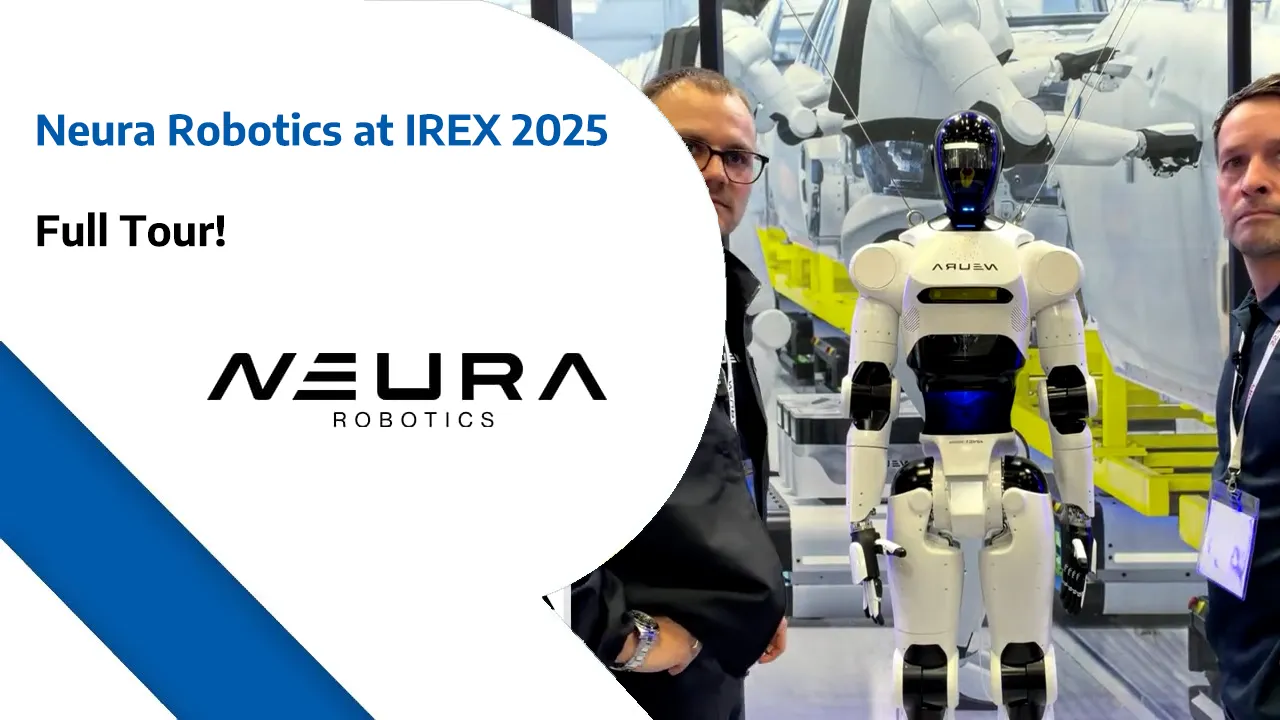
  • Neura Robotics at IREX 2025 | Full Tour

    Neura Robotics at IREX 2025 | Full Tour

    Neura Robotics at IREX 2025

    🤖 Neura Robotics at IREX Japan 2025 — Humanoids, Cognitive AI & The Future of Human-Robot Collaboration

    Introduction — Inside the World’s Biggest Robot Exhibition

    The International Robot Exhibition (IREX) Japan 2025 once again proved why it is regarded as the world’s most important robotics showcase.

    Held in Tokyo, IREX brings together the most advanced robotics manufacturers, AI developers, automation integrators, and humanoid pioneers from across the globe. It’s where future technologies move beyond concept and into real-world deployment.

    Among the many innovators exhibiting this year, one company stood out for its ambitious vision and rapidly advancing technology:

    Neura Robotics.

    Positioned at the intersection of cognitive AI, humanoid robotics, and collaborative automation, Neura Robotics is developing machines designed not just to work for humans — but alongside them.

    In this article, we explore what Neura Robotics showcased at IREX Japan 2025, the technology behind their robots, and what it means for the future of automation and embodied AI.


    About Neura Robotics — Building Cognitive Robots

    Neura Robotics is a European robotics company focused on what it calls cognitive robotics — robots that can perceive, interpret, and interact intelligently within human environments.

    Rather than building traditional industrial robots limited to repetitive factory tasks, Neura’s mission is to create machines that can:

    • See through advanced vision systems

    • Hear via integrated audio recognition

    • Sense surroundings using multimodal sensors

    • Make decisions powered by AI

    • Collaborate safely with humans

    This approach positions Neura Robotics firmly within the next wave of automation — often referred to as embodied AI.

    Embodied AI moves intelligence out of software and into physical machines operating in the real world.

    And at IREX 2025, that vision was on full display.


    Humanoid Robots — Designed for Human Environments

    One of the biggest attractions at the Neura Robotics stand was its humanoid robot development.

    Humanoid robots are gaining global momentum because they are designed to operate in spaces already built for humans — warehouses, hospitals, hotels, airports, and retail environments.

    Rather than redesigning infrastructure, humanoids adapt to it.

    Key humanoid capabilities on show included:

    • Bipedal mobility and balance

    • Advanced arm articulation

    • Object handling and manipulation

    • Human interaction gestures

    • Sensor-driven navigation

    The physical design emphasised both functionality and approachability — a critical factor as robots move into customer-facing and service roles.

    Neura’s humanoids are not conceptual prototypes — they are being engineered for commercial deployment across logistics, service, and industrial sectors.


    Cognitive Robotics — The Intelligence Layer

    Where Neura Robotics truly differentiates itself is in its cognitive technology stack.

    Traditional robots operate through pre-programmed instructions.

    Cognitive robots operate through perception and interpretation.

    At IREX, Neura demonstrated how its robots process real-world environments using layered AI systems.

    Cognitive capabilities included:

    Vision Systems
    Robots can recognise objects, people, and spatial layouts in real time.

    Audio Recognition
    Voice commands and environmental sound detection enable interaction and awareness.

    Sensor Fusion
    Combining LiDAR, cameras, and proximity sensors creates a unified environmental model.

    Decision AI
    Robots assess situations and adjust actions dynamically rather than following rigid scripts.

    This transforms robots from tools into collaborative agents.


    Human-Robot Collaboration — Safety Meets Productivity

    Collaboration — not replacement — is central to Neura Robotics’ philosophy.

    Its robots are designed to work safely in shared human spaces without cages or exclusion zones.

    At IREX, this was demonstrated through live interaction scenarios where robots operated fluidly around people.

    Collaboration features include:

    • Force-sensing arms

    • Collision avoidance

    • Predictive movement modelling

    • Human detection tracking

    • Safe object handovers

    This opens deployment across sectors where traditional robots struggled to integrate.


    Industrial & Commercial Applications

    Neura Robotics’ technology is not limited to laboratories or exhibitions — it is being engineered for real commercial use.

    Key sectors include:

    Logistics & Warehousing
    Picking, packing, and goods movement.

    Manufacturing
    Collaborative assembly and machine support.

    Healthcare
    Material transport and patient assistance.

    Hospitality & Service
    Front-of-house support and delivery.

    Retail
    Customer assistance and shelf operations.

    The flexibility of humanoid form factors combined with cognitive perception allows robots to transition across roles without extensive reprogramming.


    Why Humanoids Are Surging Now

    Humanoid robots have existed for decades — but three technological shifts are accelerating adoption:

    1️⃣ AI processing power
    2️⃣ Sensor cost reduction
    3️⃣ Battery efficiency improvements

    Neura Robotics is leveraging all three.

    This convergence enables robots that are:

    • Mobile for longer periods

    • More perceptive in real environments

    • Faster at interpreting data

    • Safer around humans

    Humanoids are no longer PR showcases — they are workforce tools.


    Exhibition Presence — Standing Out at IREX

    IREX Japan is not a small exhibition.

    Thousands of robots operate simultaneously across multiple halls.

    Yet Neura Robotics drew consistent crowds thanks to:

    • Live humanoid demos

    • Interactive cobot showcases

    • AI perception demonstrations

    • Hands-on engagement

    The stand balanced technical depth with visual accessibility — appealing to both engineers and commercial buyers.

    Industry delegates, integrators, and investors were all present — reinforcing Neura’s growing global profile.


    Market Position — Europe’s Humanoid Contender

    While much humanoid attention focuses on US and Asian companies, Neura Robotics represents a major European contender in the race toward embodied AI.

    Its positioning combines:

    • German engineering heritage

    • AI software development

    • Collaborative robotics expertise

    • Scalable commercial focus

    This integrated approach could allow Neura to compete strongly in sectors prioritising safety, compliance, and human collaboration.


    What This Means for the Future of Work

    The rise of cognitive and humanoid robotics signals a shift in how automation integrates into society.

    Rather than isolating robots in factories, the next wave brings robots into:

    • Public environments

    • Service industries

    • Healthcare facilities

    • Logistics centres

    • Commercial buildings

    Robots become co-workers rather than background machinery.

    Companies like Neura Robotics are accelerating this transition by building machines designed around human interaction first — productivity second.


    Watch the Full Video Tour

    To see Neura Robotics’ technology in action, watch the full exhibition walkthrough here:

    [Embed YouTube Video]

    This includes live demos, humanoid movement, and cognitive robotics showcases filmed directly from the IREX show floor.


    🤝 Sponsors & Industry Partners

    Robot Center

    Robot Center specialises in industrial robotics, warehouse automation, and commercial robot integration.

    From consultancy through to deployment, Robot Center helps organisations identify where robotics delivers operational impact — improving productivity, safety, and efficiency.

    🌐 https://robotcenter.co.uk/


    Robots of London

    Robots of London is the UK’s leading robot hire and event robotics company.

    Supplying humanoid robots, exhibition robots, and brand activation technologies, the company helps businesses create high-impact experiential marketing and live event engagement.

    🌐 https://robotsoflondon.co.uk/


    Robot Philosophy (RoboPhil)

    Robot Philosophy provides robotics consultancy, strategic advisory, and educational workshops — helping organisations understand where robots fit within their industry and how to commercialise automation opportunities.

    🌐 https://robophil.com/


    Final Thoughts

    Neura Robotics’ presence at IREX Japan 2025 reinforced one clear message:

    The era of cognitive, collaborative, and humanoid robotics is no longer theoretical — it is operational.

    As embodied AI continues to mature, robots will move beyond controlled environments and into everyday business operations.

    For companies exploring automation, the question is no longer if robots will integrate — but how soon.

    And innovators like Neura Robotics are helping define that timeline.

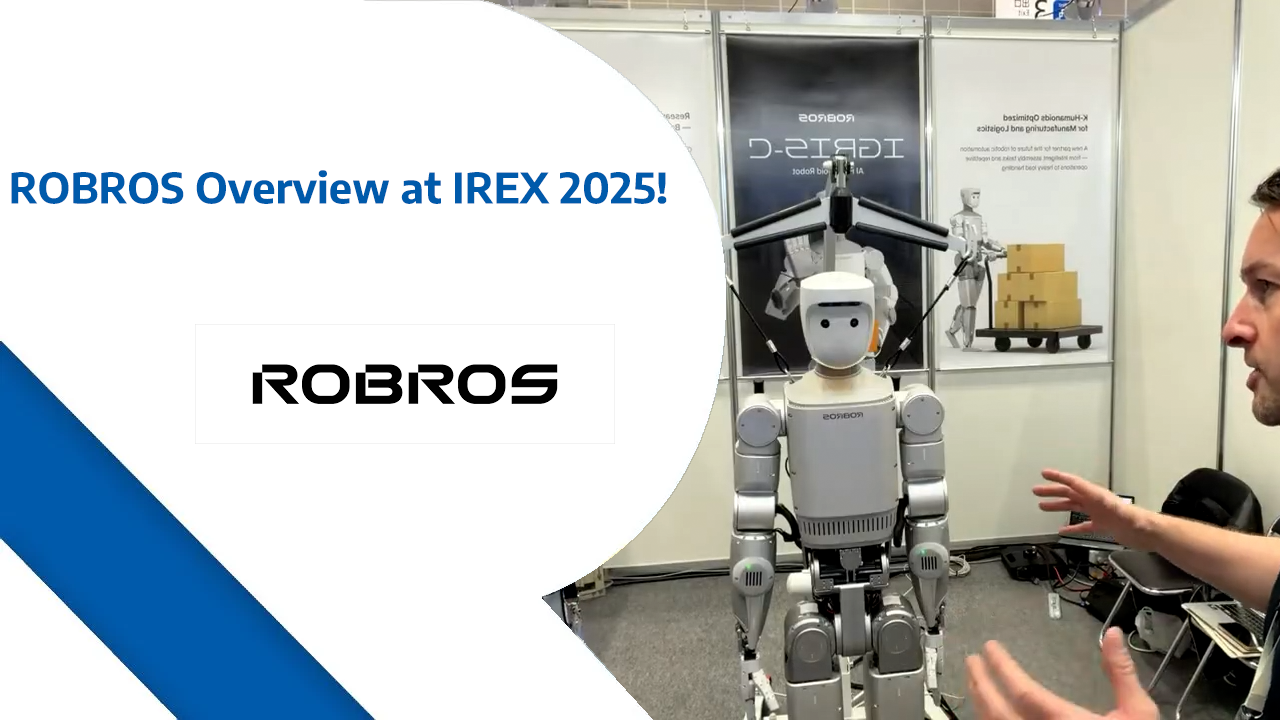
  • ROBROS Overview – IREX Japan 202

    ROBROS Overview – IREX Japan 202

    ROBROS Overview – IREX Japan 202

    Robros at IREX Japan 2025 – Inside the World’s Largest Robotics Exhibition

    The global robotics industry gathered once again in Tokyo for IREX Japan 2025 (International Robot Exhibition) — widely recognised as the largest and most influential robotics trade show in the world.

    For Robros, attending IREX isn’t just about filming robots — it’s about understanding where the market is heading, what technologies are maturing, and where the real commercial opportunities lie.

    This year’s exhibition did not disappoint.

    From humanoid robots and AI service machines to industrial cobots, inspection platforms, and autonomous logistics systems, IREX 2025 showcased a robotics ecosystem moving rapidly from prototype to deployment.

    In this article, we break down the key highlights, technology trends, and business insights captured by Robros on the ground in Japan.


    The Scale of IREX Japan

    IREX is not a typical tech expo.

    It’s a global convergence point for robotics manufacturers, AI developers, system integrators, research institutions, and enterprise buyers.

    Exhibition halls are filled with:

    • Industrial robot arms in live production cells

    • Collaborative robots working alongside humans

    • Service robots operating in hospitality environments

    • Autonomous security and inspection platforms

    • Humanoid robots demonstrating real-world tasks

    • Logistics robots navigating simulated warehouses

    The sheer diversity of robotics applications under one roof makes IREX one of the most important barometers for the future of automation.


    Humanoid Robots – From Concept to Commercialisation

    One of the biggest headline areas at IREX 2025 was humanoid robotics.

    While humanoids have historically lived in R&D labs and concept demonstrations, the shift toward commercial pilots is now clearly underway.

    Robros observed major advancements in:

    • Dexterity and grip precision

    • Walking stability and balance

    • Human interaction capabilities

    • Task repeatability

    • AI-driven object recognition

    Rather than simply waving or greeting visitors, many humanoids were performing functional tasks — carrying items, assisting staff, and supporting operational workflows.

    The direction is clear: humanoids are being positioned not as novelties, but as future labour augmentation platforms.


    Service Robots – Maturity in Hospitality & Retail

    Service robotics continues to be one of the fastest-growing sectors globally.

    At IREX Japan 2025, Robros captured service robots deployed across simulated environments including:

    • Hotels

    • Restaurants

    • Retail stores

    • Hospitals

    • Airports

    Key improvements include:

    Navigation & Mapping
    Robots are moving more fluidly through crowded environments using advanced SLAM and obstacle avoidance.

    Human Interaction
    Voice AI, multilingual communication, and facial recognition are becoming standard features.

    Payload & Functionality
    From food delivery to room service and retail assistance, robots are now designed for operational value — not just customer engagement.

    Service robots are no longer experimental — they are deployment-ready.


    Industrial & Collaborative Robots (Cobots)

    Industrial robotics remains the backbone of automation, but the evolution of collaborative robots is opening new markets.

    Cobots showcased at IREX demonstrated:

    • Easier programming interfaces

    • Vision-guided picking

    • AI quality inspection

    • Flexible end-effectors

    • SME-friendly deployment costs

    This is a major shift.

    Historically, industrial robotics required high capital investment and specialist integration. Cobots are lowering that barrier — enabling small and mid-sized businesses to automate processes without massive infrastructure changes.

    Robros sees this democratisation of robotics as one of the most important adoption drivers over the next decade.


    Inspection & Security Robotics

    Another major growth area at IREX 2025 was autonomous inspection and security robotics.

    These platforms are designed to operate in:

    • Industrial facilities

    • Warehouses

    • Energy plants

    • Construction sites

    • Public infrastructure

    • Commercial real estate

    Robots showcased included:

    • Quadruped patrol robots

    • Wheeled autonomous security units

    • Thermal inspection platforms

    • Gas detection robots

    • Infrastructure scanning systems

    With global labour shortages and increasing safety requirements, inspection robotics is becoming a critical automation layer for enterprise risk management.


    Logistics & Warehouse Automation

    The logistics sector continues to drive robotics adoption at scale.

    At IREX Japan 2025, Robros documented:

    • Autonomous Mobile Robots (AMRs)

    • Automated Guided Vehicles (AGVs)

    • Robotic picking systems

    • Pallet transport robots

    • Inventory scanning platforms

    AI orchestration software was a major highlight — coordinating fleets of robots to optimise warehouse efficiency in real time.

    As e-commerce demand continues to rise globally, warehouse robotics is no longer optional — it’s becoming infrastructure.


    AI Integration – The Intelligence Layer

    Across every category at IREX, one theme was consistent:

    AI is now embedded.

    Robots are no longer just mechanical systems — they are intelligent platforms capable of:

    • Learning from environments

    • Adapting to workflow changes

    • Recognising objects visually

    • Communicating naturally

    • Making autonomous decisions

    This convergence of robotics + AI is accelerating deployment because robots can now function in less structured environments.


    Real-World Business Applications

    For Robros, the most important lens is commercial viability.

    Key sectors actively adopting robotics include:

    • Hospitality

    • Healthcare

    • Retail

    • Security

    • Logistics

    • Manufacturing

    • Facilities management

    • Events & experiential marketing

    The question is no longer “Can robots do this?”
    It’s now “How fast can we deploy them?”


    Why Events Like IREX Matter

    Trade shows like IREX are more than exhibitions — they are market indicators.

    They reveal:

    • Investment trends

    • Technology maturity

    • Pricing direction

    • Deployment readiness

    • Partnership opportunities

    For businesses exploring robotics, attending (or following coverage via platforms like Robros) provides strategic insight into where automation can deliver ROI.


    About Robros

    Robros is a robotics media and insights platform dedicated to documenting the evolution of robots across industries.

    Our mission is to bridge the gap between robotics innovation and real-world business deployment through:

    • Exhibition coverage

    • Robot reviews

    • Industry analysis

    • Deployment case studies

    • Commercial robotics insights

    We don’t just showcase robots — we explore how they create operational impact.


    Sponsors & Robotics Partners

    Robros coverage of IREX Japan 2025 is proudly supported by leading UK robotics organisations:


    Robots of London

    Robot Hire • Events • Experiential Robotics

    Robots of London specialises in robot rentals for events, exhibitions, brand activations, and corporate experiences.

    🌐 https://robotsoflondon.co.uk/


    Robot Center

    Robotics Sales • Consultancy • Integration

    Robot Center provides end-to-end robotics solutions — from robot procurement to deployment strategy and integration.

    🌐 https://robotcenter.co.uk/


    RoboPhil

    Robotics Media • Strategy • Insights

    RoboPhil delivers robotics content, advisory, and thought leadership focused on the future of automation.

    🌐 https://robophil.com/


    Final Thoughts

    IREX Japan 2025 reinforced one clear message:

    Robotics is no longer future tense — it’s present reality.

    From humanoids and service robots to inspection platforms and logistics automation, the technology is ready, the use cases are proven, and the business demand is accelerating.

    Robros will continue documenting this transformation — exhibition by exhibition, deployment by deployment — as robots move into every sector of the global economy.


    If your organisation is exploring robotics deployment, partnerships, or market entry into the UK and Europe, Robros and its sponsors are ready to support that journey.

  • Kawasaki Robotics Overview!

    Kawasaki Robotics Overview!

    Kawasaki Robotics Overview!

    Kawasaki Robotics Overview at IREX Japan 2025 – The World’s Biggest Robot Exhibition

    If you want to know where the robotics industry is heading next, there’s one event that consistently gives the clearest signal: IREX Japan.

    The International Robot Exhibition (IREX) is widely recognised as the world’s biggest robotics exhibition, bringing together the most important players in industrial automation, AI-driven robotics, manufacturing innovation, and next-generation human–robot collaboration.

    And at IREX Japan 2025, one brand that stood out once again was Kawasaki Robotics.

    In this article, I’ll break down the key takeaways from Kawasaki’s presence at IREX 2025, what it means for businesses in the UK and Europe, and how industrial robotics is evolving right now — not in theory, but in real-world applications that companies can deploy today.


    Why IREX Japan 2025 Matters So Much

    Robotics is growing faster than most people realise, but what’s even more important is how it is growing.

    We’re not just seeing “more robots” in factories — we’re seeing new categories of robotics solutions emerging across:

    • Manufacturing and production lines

    • Packaging and palletising

    • Warehousing and logistics automation

    • Quality control and inspection

    • Human and collaborative workflows

    • Flexible production and mixed SKU environments

    IREX is one of the few exhibitions where you can get a clear look at the entire robotics ecosystem in one place — from component-level engineering through to full systems integration.

    For me, the value of IREX isn’t just the technology. It’s the direction.

    You can see what companies are prioritising.
    You can spot where investment is increasing.
    And you can understand where robotics is becoming commercially viable for more businesses — including SMEs.


    Who Are Kawasaki Robotics?

    Kawasaki is one of the most established names in industrial automation, and their robotics division is known globally for building robust, high-performance systems used in demanding environments.

    Kawasaki’s industrial robotics portfolio typically covers a wide range of use cases, such as:

    • High-speed pick and place

    • Material handling and transfer

    • Welding and heavy-duty production

    • Machine tending

    • Assembly operations

    • Factory automation integration

    They’re a company that has been in the industrial robotics space long enough to understand one critical truth:

    Robots don’t win because they look impressive.
    Robots win when they produce measurable results.

    That’s why Kawasaki’s presence at events like IREX is always worth paying attention to — they focus heavily on practical robotics that can actually be deployed at scale.


    What Kawasaki Showcased at IREX Japan 2025 (And Why It Matters)

    At IREX 2025, the theme across the exhibition was very clear:

    Robots are becoming more flexible, more integrated, and more business-ready than ever before.

    Kawasaki Robotics fit perfectly into that narrative.

    While every booth is different year to year, Kawasaki’s displays are usually designed to demonstrate three things:

    1) Industrial robotics that can work in the real world

    Not just a prototype, not just “concept automation”.

    Kawasaki tends to show solutions that can run in:

    • Busy environments

    • Heavy production settings

    • Repetitive cycles

    • Multi-shift operations

    • Demanding uptime expectations

    2) Automation that improves throughput and reduces downtime

    Speed matters. So does reliability.

    Businesses want automation that keeps production running without disruption, and industrial robots are increasingly judged on:

    • Overall equipment effectiveness (OEE)

    • Maintenance intervals

    • Reliability across long working cycles

    • Integration with existing processes

    3) Systems that can integrate into modern smart factories

    The “smart factory” conversation has matured a lot.

    A few years ago, companies discussed smart factories in abstract terms.

    Now, it’s about practical deployment:

    • How data is captured

    • How robots connect to line management systems

    • How production performance can be measured

    • How downtime can be predicted before it happens


    The Big Trend: Industrial Robotics Is Becoming More Accessible

    One of the biggest takeaways from IREX Japan 2025 is this:

    ✅ Industrial robotics is no longer reserved for enormous manufacturers.

    Yes, automotive giants still invest heavily in robots, but now we’re seeing adoption expand into:

    • Smaller manufacturers

    • Warehousing operations with seasonal demands

    • Food and beverage production environments

    • Packaging and distribution centres

    • Companies that need automation but don’t have internal robotics teams

    This matters because it changes the question businesses ask.

    It used to be:

    “Should we invest in robotics?”

    Now it’s becoming:

    “Where should we deploy robotics first for the fastest ROI?”

    That shift is massive.


    The Business Case: Why Companies Buy Industrial Robots

    Industrial robots aren’t purchased because they’re exciting. They’re purchased because they solve business problems.

    Here are some of the most common reasons companies start looking seriously at automation:

    ✅ 1) Labour availability is unreliable

    In many industries, recruiting stable labour is difficult.

    Even when companies can hire staff, retention can be unpredictable and training costs can rise quickly.

    Robots don’t replace people in a simplistic way — but they stabilise output when labour fluctuates.

    ✅ 2) Production targets keep increasing

    Customers expect faster turnaround times and consistent delivery.

    Robotics gives businesses the ability to run production more efficiently and increase throughput without expanding headcount at the same rate.

    ✅ 3) Quality control requirements are rising

    Consistency is becoming a bigger competitive advantage.

    Robots excel at repeatable performance, which supports:

    • Reduced defects

    • Less variation

    • Better product consistency

    • Better compliance

    ✅ 4) Warehousing and logistics are under pressure

    Whether it’s eCommerce, distribution, or internal supply chains, companies are under pressure to move products faster and more accurately.

    Robotics becomes attractive when businesses want:

    • Faster handling

    • Fewer picking errors

    • Reduced damage

    • Improved processing speed


    What UK and European Businesses Can Learn from Japan

    Japan has been one of the most advanced robotics markets in the world for a long time.

    The cultural approach to automation is different:

    • Robotics is viewed as normal, not disruptive

    • Industrial automation is integrated into planning early

    • Robotics deployment often happens proactively, not reactively

    That means IREX gives UK and European businesses something priceless:

    ✅ A look into what automation looks like when a country is truly ahead of the curve.

    For UK businesses especially, this is important because we’re now in a window where robotics adoption is accelerating.

    The companies who move early are going to win long-term.


    The Key Question Isn’t “Which Robot?” It’s “Which Job?”

    One of the biggest mistakes businesses make when exploring robotics is starting with the robot itself:

    “Which robot should we buy?”

    But the smarter approach is:

    Which job should a robot do first?

    That’s the difference between buying a robot because it’s impressive… and deploying robotics because it delivers ROI.

    Some of the best first robotics deployments include:

    • Repetitive material handling

    • Pick-and-place operations

    • Machine tending

    • Packaging and palletising

    • Basic assembly steps

    • Goods transfer between stations

    When businesses start with a clear task and measurable outcome, selecting the right robot becomes much easier.


    The Real Future: Human + Robot Workflows

    The best robotics deployments aren’t purely robotic environments.

    They’re hybrid environments.

    Robots handle the repetitive, high-volume, and physically demanding work.

    Humans handle:

    • Decision making

    • Exception handling

    • Setup changes

    • Quality interpretation

    • Flexible tasks that change daily

    IREX Japan 2025 made one thing very clear:

    ✅ Robotics is not just about replacing labour.
    It’s about increasing the capability of the workforce.

    That’s where the real competitive advantage is.


    Want Help Deploying Robotics in Your Business?

    If you’re currently exploring automation — or you’re trying to figure out whether robotics is viable for your business — my team can help you move faster with fewer mistakes.

    At Robot Center, we support companies with:

    ✅ Robotics audits and strategy
    ✅ Choosing the right robot for the right application
    ✅ Integration and deployment
    ✅ Service support and long-term optimisation
    ✅ Recruiting the right robotics professionals

    📩 Email: sales@robotcenter.co.uk
    📞 Call: 0845 528 0404


    Sponsors / Partners

    This article and video content are supported by:

    🤖 Robot Center – Industrial & next-generation robotics solutions
    https://robotcenter.co.uk/

    🎪 Robots of London – Robot hire for events, exhibitions & brand activation
    https://robotsoflondon.co.uk/

    🎙️ Robot Philosophy (RoboPhil) – Robotics insights, workshops, news & reviews
    https://robophil.com/


    Final Thoughts: Kawasaki Robotics at IREX 2025

    Kawasaki Robotics continues to represent what industrial automation is really about:

    ✅ Practical deployment
    ✅ High-performance engineering
    ✅ Reliable, scalable solutions
    ✅ Robotics that improves productivity and output

    IREX Japan 2025 was a reminder that robotics is not “coming someday”.

    It’s here right now — and the companies that learn from global leaders like Kawasaki will be in the best position to win in the next era of manufacturing and automation.

    If you’d like more content like this — including breakdowns of the best robots at IREX 2025 — make sure you follow along through Robot Philosophy (RoboPhil), and I’ll keep bringing you the best insights from inside the robotics industry.

  • IAI Overview! – IREX Japan 2025 – The World’s Biggest Robot Exhibition!

    IAI Overview! – IREX Japan 2025 – The World’s Biggest Robot Exhibition!

    Intelligent Actuator – IAI

    IAI Overview at IREX Japan 2025: The Actuator Technology Powering the Next Wave of Robotics and Automation

    If you’ve ever watched a robot move—whether it’s a high-speed pick-and-place system on a production line, a compact assembly robot in an electronics factory, or a precision mechanism positioning a part within fractions of a millimetre—you’ve witnessed the real “muscle” of automation in action.

    That muscle is motion control.

    And at IREX Japan 2025, one of the most important companies showcasing motion technology was IAI (Intelligent Actuator).

    In this blog, I’m going to give you a clear, practical overview of what IAI does, why actuator technology matters more than most people realise, and how IAI fits into the future of factory automation, robotics integration, and smarter manufacturing systems.

    Whether you’re a robotics engineer, a factory manager, a systems integrator, or simply someone tracking where industrial robotics is heading, this is a company worth paying attention to.

    🌍 IAI official website: https://www.intelligentactuator.com/


    IREX Japan 2025: Where the Real Robotics Industry Shows Up

    IREX (International Robot Exhibition) is often described as the world’s biggest robotics exhibition, and once you step onto the show floor, it becomes obvious why.

    This isn’t just “futuristic robot hype”.

    IREX is where you see:

    • Real industrial automation systems

    • Commercial robotics platforms being deployed today

    • Component manufacturers building the core tech inside robots

    • Machine builders and integrators showing full solutions

    • Companies competing on performance, cost, reliability, and scalability

    And while humanoid robots and AI demos often get the headlines, the reality is simple:

    The future of robotics will be defined by the companies building reliable motion systems that can run all day, every day.

    That’s where IAI comes in.


    Who Is IAI (Intelligent Actuator)?

    IAI (Intelligent Actuator) is a well-established manufacturer specialising in:

    Electric actuators
    Linear motion systems
    Motion control solutions
    Industrial automation components

    In simple terms: IAI develops the systems that create controlled movement inside machines.

    It’s not “just a motor”.

    It’s a fully engineered motion product—designed so manufacturers and engineers can build automation that is:

    • Faster

    • More accurate

    • Cleaner

    • Easier to control

    • Easier to maintain

    • Easier to scale across production

    This matters because modern factories increasingly demand flexibility.

    The old world of rigid, mechanical automation is being replaced with programmable, adaptable systems that can handle:

    • Shorter product cycles

    • More SKU variation

    • Higher quality demands

    • Labour shortages

    • Small batch manufacturing

    • Fast changeovers

    Electric actuators are at the centre of that shift.


    What Is an Electric Actuator (And Why It Matters)?

    An electric actuator converts electrical energy into physical movement.

    That movement could be:

    • Linear motion (in/out movement)

    • Rotary motion (rotation)

    • Lift movement (vertical motion)

    • Guided motion (precise controlled travel)

    But the real advantage isn’t simply “movement”—it’s control.

    Electric actuators allow you to program:

    • Speed

    • Position

    • Acceleration

    • Deceleration

    • Force limits

    • Repeatability parameters

    • Sequencing and motion profiles

    In modern automation, control is everything.

    Because once you can control the motion precisely, you can:

    ✅ Reduce waste
    ✅ Improve quality
    ✅ Increase output
    ✅ Lower downtime
    ✅ Improve safety
    ✅ Make automation more flexible


    Why Electric Actuators Are Replacing Pneumatics

    If you’ve worked in industrial automation, you’ve probably seen factories filled with pneumatic cylinders—air-driven systems that push, pull, clamp, and lift.

    Pneumatics can still work well in many scenarios, but the world is shifting.

    Electric actuators are increasingly preferred because they offer:

    1) Precision and Repeatability

    Pneumatics are often “good enough” but not always exact.

    Electric actuators can repeat movements precisely, which matters in:

    • electronics assembly

    • quality inspection stations

    • packaging systems

    • robotic handling

    2) Programmability

    Changing pneumatic behaviour often requires physical changes:

    • new air settings

    • different valves

    • new cylinder sizes

    Electric actuator behaviour can often be modified in software.

    3) Energy and Maintenance Efficiency

    Pneumatics require air systems:

    • compressors

    • air lines

    • filters

    • leaks and pressure drops

    Electric systems reduce dependency on compressed air and can lower maintenance burden in many facilities.

    4) Cleaner Automation

    For industries like:

    • food production

    • pharma

    • medical manufacturing

    • lab automation

    cleanliness and controllability are huge advantages.


    IAI at IREX 2025: Why Their Booth Matters

    At a show like IREX, it’s easy to walk past component manufacturers and focus only on full robots.

    But in reality, the components often define what a robot can actually do.

    IAI stands out because they are positioned in a category that affects almost every automation trend right now:

    • High-mix production

    • Compact manufacturing cells

    • Space-saving industrial design

    • Faster line speeds

    • Smarter integration

    • Robotics that can be maintained by smaller teams

    Their technology is not a “nice-to-have”.

    In many deployments, it’s a requirement.


    Where IAI Systems Are Used in the Real World

    When people think of robotics, they picture robots.

    But the automation world is broader than robots. Many factories use combinations of:

    • robotics arms

    • conveyors

    • actuators

    • lifting systems

    • feeders

    • inspection modules

    • sorting mechanisms

    • safety gates

    • guided motion systems

    IAI products often fit inside automation systems such as:

    ✅ Pick-and-Place Automation

    Automated selection and movement of products or components.

    ✅ Packaging Lines

    Fast and repeatable positioning systems are essential.

    ✅ Assembly Automation

    Especially for electronics, automotive components, and precision products.

    ✅ Test and Inspection Stations

    Actuator systems move parts into testing positions or present items to vision systems.

    ✅ Material Handling and Transfer

    Moving items between stations, loading/unloading modules, or indexing workflows.

    ✅ Compact Automation Cells

    Space is expensive. Compact motion designs become valuable.


    The “Hidden Robotics Industry”: Why Motion Control Is a Competitive Weapon

    One of the biggest misunderstandings in robotics today is thinking the robot itself is the value.

    In many industrial settings, the competitive advantage comes from:

    • cycle time improvements

    • reduced scrap rates

    • fewer maintenance callouts

    • easier changeovers

    • easier training

    • better reliability

    Those are achieved through motion control, integration design, and smart automation architecture.

    In other words:

    The best robots are useless if the automation system around them can’t keep up.

    This is why a motion control specialist like IAI is strategically important.

    As factories become more advanced, they need components that behave predictably, integrate easily, and deliver consistent performance.


    Smart Manufacturing: The Big Picture Trend

    Smart manufacturing gets talked about a lot, but in practical terms it’s about a few key goals:

    • real-time production monitoring

    • higher efficiency

    • better quality

    • better uptime

    • connected and data-driven operations

    Electric actuators fit naturally into smart manufacturing because they can be:

    • monitored

    • controlled

    • measured

    • optimised

    As automation becomes more connected, motion systems will increasingly become part of larger “factory intelligence” platforms.

    And the companies building reliable motion hardware will be the backbone of that evolution.


    Why Robotics Integrators Should Pay Attention to IAI

    If you are a robotics integrator (or you work with one), your success depends on building systems that meet the real-world requirements of your client.

    That means:

    • predictable motion

    • speed and accuracy

    • compact footprint

    • safety compliance

    • low downtime

    • easy maintenance

    • scalable architecture

    Motion components might not be the “headline” in a project, but they absolutely shape whether the deployment succeeds.

    The more integrators can standardise on reliable motion systems, the easier it becomes to deliver:

    • repeatable builds

    • faster installation timelines

    • predictable performance

    • better customer satisfaction


    Why This Matters for the UK, Europe, and Global Manufacturing

    Even though IREX is held in Japan, the insights are global.

    The same pressures exist everywhere:

    • labour shortages

    • cost pressure

    • higher customer expectations

    • tighter margins

    • rising energy costs

    • supply chain complexity

    Factories in the UK and Europe are being pushed toward automation—not because it’s trendy, but because it’s becoming necessary.

    Companies like IAI support this shift by enabling machine builders and engineers to deliver automation systems that are:

    ✅ more flexible
    ✅ more programmable
    ✅ more efficient
    ✅ more scalable

    For many businesses, automation isn’t about replacing people.

    It’s about ensuring continuity of production.


    The Bigger Robotics Future: Automation Isn’t Just Humanoids

    Humanoids get views. They go viral. They generate excitement.

    But the real robotics economy today is built on:

    • industrial automation

    • logistics automation

    • inspection systems

    • mobile robots

    • security and patrol robots

    • service robots

    • component manufacturing

    And inside all of those is motion.

    You can’t have robotics without movement.

    IAI is a motion company. That’s why they matter.


    Key Takeaways: What We Learn From IAI at IREX Japan 2025

    Here are the key lessons from looking at IAI in the context of the world’s biggest robotics show:

    ✅ 1) Motion control is the foundation of modern automation

    AI software is powerful, but robots need precision movement to deliver results.

    ✅ 2) Electric actuators unlock flexibility

    Factories are moving toward systems that can be reconfigured and updated.

    ✅ 3) Reliability matters more than hype

    Industrial customers buy systems that work daily, not just demos.

    ✅ 4) The future is compact and scalable

    Space-saving automation cells will become more common globally.

    ✅ 5) Companies like IAI power the silent majority of robotics deployments

    Not every company is building the robot—but many are building the systems inside it.


    Want Help Deploying Real Robotics?

    If you’re reading this and thinking:

    “Great — but how do I actually apply this in my own business?”

    That’s exactly what we do.

    Whether you’re selecting robotics platforms, automating workflows, or building robotics into your operations, the key is moving from curiosity to deployment.


    Sponsors

    Robot Center

    Robot Center is a UK-based robotics consultancy and Robot-as-a-Service (RaaS) provider, helping businesses deploy, manage, and scale real-world robotics solutions.

    We specialise in robot consultancy, Robotics as a Service, and the supply of commercial and industrial robots, including digital signage robots, inspection robots, security robots, and autonomous mobile robots. Robot Center supports businesses across the UK, Europe, and globally, from robot selection and purchase through to deployment, integration, and ongoing support.

    Robot Center works with leading platforms such as Capra Robotics and Temi, helping organisations buy robots, adopt robots as a service, and implement robotics safely and effectively.

    🔗 https://robotcenter.co.uk/


    Robots of London

    Robots of London is a leading robot hire and robot rental company, supplying interactive robots for events, exhibitions, trade shows, conferences, and brand activations in the UK, Europe, and worldwide.

    We specialise in robot hire in London and across the UK, with full coverage throughout Europe and global international events. Our range includes humanoid robots, AI robots, service robots, and promotional robots, all delivered as a fully managed service with logistics, setup, operation, and on-site technical support.

    If you’re looking to hire a robot for an event, rent a robot for an exhibition, or work with an experienced robotics hire company for international events, Robots of London delivers reliable, high-impact robotic experiences globally.

    🔗 https://robotsoflondon.co.uk/


    Robot Philosophy (RoboPhil)

    Robot Philosophy (RoboPhil) is a leading robotics insight and consultancy platform, founded by Philip English, also known as RoboPhil, one of the UK’s most established robot YouTubers and commentators.

    Robot Philosophy provides robot consultancy, robot recruitment insight, robotics advice, and strategic perspectives on real-world robotics adoption. The platform shares robot insights, ideas, trends, and analysis, helping businesses, professionals, and investors understand where robotics creates real value.

    Through videos, articles, workshops, and advisory services, RoboPhil connects robot strategy with practical deployment, supporting organisations across the UK, Europe, and globally.

    🔗 https://robophil.com/


    Service Robotics Summit (SRS)

    Service Robotics Summit (SRS) is a global, invitation-led conference series dedicated to the service robotics industry, bringing together founders, investors, enterprise buyers, and senior decision-makers shaping the future of robotics.

    Held annually in London, Singapore, Dubai, and the United States, SRS is a high-ticket, premium summit hosted in five-star hotels, designed for meaningful conversations, strategic partnerships, and high-value deal flow within the service robotics ecosystem.

    The summit focuses on real-world deployment of service robots, including hospitality, retail, healthcare, security, inspection, logistics, and smart environments. SRS offers a curated agenda of keynotes, closed-door panels, private networking, and executive roundtables, positioning it as the definitive meeting place for leaders in service robotics.

    🔗 https://serviceroboticsummit.com/


    Final Thoughts

    IREX Japan 2025 proves once again that robotics is not just about flashy demos.

    It’s about the technologies that make machines work reliably, repeatedly, and profitably.

    IAI is one of the companies shaping that reality.

    And as global manufacturing continues to modernise, motion control and actuator technology will be one of the biggest enablers behind scalable automation.

    If you want more breakdowns from IREX 2025 and the companies shaping the future of robotics, follow along on Robot Philosophy — and keep building.

    👋 Until the next one,
    Philip English (RoboPhil)

  • Sense Glove

    Sense Glove

    Sense Glove

    SenseGlove at IREX Japan 2025: Why Haptic VR Gloves Could Transform Robot Control, Training, and Human-Robot Interaction

    If you’ve ever watched a robot perform a task and thought, “That’s impressive… but how does a human actually control that safely?” — you’re asking one of the most important questions in robotics today.

    At IREX Japan 2025, widely recognised as the world’s biggest robot exhibition, I saw countless robotics innovations across industrial automation, service robotics, humanoids, autonomous mobile robots (AMRs), and AI-powered systems.

    But one of the most interesting technologies I saw wasn’t a robot at all.

    It was a haptic glove.

    Specifically: SenseGlove.

    This is a technology that sits at the intersection of virtual reality (VR), human-machine interfaces, training simulation, and robot teleoperation — and it could become a major piece of the puzzle for how robotics is deployed at scale in the real world.

    In this article, I’ll break down what SenseGlove is, why haptic gloves matter, and how this kind of interface could reshape robotics adoption across multiple industries.


    What Is SenseGlove?

    SenseGlove is a haptic VR glove designed to bring touch feedback into virtual environments.

    Most VR experiences focus on sight and sound. SenseGlove adds another layer:

    Resistance
    Tactile sensation / force feedback
    A more realistic “feel” when interacting with objects

    In practical terms, it means you can reach out and “grab” something in a digital environment and experience feedback that makes the interaction feel more real. That might sound like a small upgrade… until you think about the implications for robotics.

    Because robotics doesn’t just need better machines.

    Robotics needs better human interfaces.


    Why Human Interfaces Are the Hidden Bottleneck in Robotics Adoption

    When most people talk about robotics, they talk about:

    • speed

    • payload

    • AI vision

    • navigation

    • autonomy

    • battery life

    • sensors

    • cost per unit

    All important.

    But in real deployments, robotics adoption usually gets stuck on something less exciting:

    ❌ The human side

    • The robot is too hard to operate

    • Training takes too long

    • Staff don’t trust it

    • Teams can’t troubleshoot issues

    • It doesn’t fit into existing workflows

    • The interface is clunky or confusing

    • Operators make avoidable mistakes under pressure

    The problem is that we often judge robots by what they can do.

    But businesses judge robots by what teams will actually do with them, day after day.

    This is why technologies like SenseGlove matter.

    They make robotics more usable, more trainable, and more scalable.


    SenseGlove at IREX Japan 2025: Why It Stood Out

    IREX Japan is where you see the full map of global robotics progress in one place.

    And that’s exactly why SenseGlove stood out to me.

    Because while many companies were showcasing robots performing tasks, SenseGlove was tackling something deeper:

    How do humans develop skill and confidence in robotic environments without needing real robots, real risk, and real downtime?

    That matters for almost every robotics category — including:

    • industrial robots

    • collaborative robots (cobots)

    • AMRs

    • inspection robots

    • security robots

    • service robots

    • humanoid robots


    What Is Haptics (and Why Should Businesses Care)?

    Haptics is the technology of touch feedback.

    It allows a system to simulate physical sensations like:

    • contact

    • vibration

    • pressure

    • resistance

    • impact or boundaries

    In robotics and VR, this becomes incredibly valuable because it can bridge the gap between:

    digital training environments
    and
    real-world physical behaviour

    If your team can feel the interaction, they can build better skill faster.


    The Business Case: Where Haptic VR Gloves Create Real Value

    Let’s move beyond the “cool factor” and talk about impact.

    Here are some of the biggest real-world benefits of haptic gloves like SenseGlove.


    1) Faster Robotics Training (Without Stopping Operations)

    One of the biggest hidden costs in robotics deployment is training time.

    Every time you onboard someone new, you have to manage:

    • training schedule

    • supervision time

    • risk of errors

    • production disruption

    If teams can train in VR first, then transition into real robotics workflows faster, that reduces:

    ✅ training cost
    ✅ operational disruption
    ✅ mistakes and damage risk
    ✅ time-to-productivity

    For businesses scaling robotics across multiple sites, the savings multiply.


    2) Safer Operator Onboarding

    A huge reason companies delay robotics adoption is fear of accidents, errors, or liability.

    Haptic simulation improves safety because operators can practise:

    • movement patterns

    • sequences

    • timing

    • decision-making under pressure

    …without being near moving machinery.

    This matters especially in environments like:

    • warehousing

    • manufacturing

    • logistics

    • inspection sites

    • security patrol environments


    3) Skill and Muscle Memory Development

    Robotics isn’t only intellectual.

    Many robotic tasks are physical and procedural:

    • grasping

    • lifting

    • positioning

    • alignment

    • applying correct force

    • avoiding collisions

    Haptics creates a training environment where users develop muscle memory, not just software knowledge.

    It’s similar to how pilots train in simulators — because simulation builds competence without risk.


    4) Better Teleoperation (Remote Robot Control)

    Teleoperation is becoming more important as robots expand into:

    • inspection

    • hazardous environments

    • remote facilities

    • security operations

    • space-constrained industrial spaces

    Teleoperation is powerful, but it can be difficult because operators can’t feel what the robot is doing.

    Haptic feedback helps improve remote control performance because it brings back a missing sense:

    ✅ touch
    ✅ contact
    ✅ resistance

    This can lead to better task accuracy, fewer collisions, and improved operator confidence.


    5) Bridging Autonomy and Human Oversight

    Most robots today are not fully autonomous 100% of the time.

    The future is likely a hybrid model:

    • Robots handle routine tasks autonomously

    • Humans assist or intervene when needed

    • Systems learn from human guidance

    SenseGlove-style interfaces could become an ideal tool for “human-in-the-loop” robotics.


    Where This Could Go Next (and Why It Matters for Humanoids)

    Humanoid robots are one of the biggest trends in robotics right now.

    But humanoids have a problem:

    They’re incredibly complex to deploy because they’re expected to operate in unpredictable human spaces.

    That means they need:

    • more training

    • more human control options

    • better safety and usability

    Haptic interfaces could become one of the keys to making humanoids practical.

    Because the hardest part of humanoids isn’t walking.

    It’s working.

    And working requires:

    • dexterity

    • force control

    • safe manipulation

    • repeatable training


    The Real Future: Robotics Interfaces Will Decide Who Wins

    Here’s my honest view after spending time at IREX Japan 2025:

    In the next wave of robotics adoption, the winners won’t just be the companies building the best robots.

    They’ll be the companies building the best robot experience.

    That includes:

    ✅ interfaces
    ✅ training platforms
    ✅ workflow integration
    ✅ support models
    ✅ safety frameworks
    ✅ scalable deployment processes

    Because robotics success doesn’t come from a single robot purchase.

    It comes from deployment maturity.


    The Bigger Question: Are You Ready to Deploy Robots Properly?

    Seeing SenseGlove at IREX reminded me of the real question businesses should ask:

    “How do we build robotics into our operations as a system — not as a one-off project?”

    If you’re exploring robotics, the goal isn’t to buy a robot.

    The goal is to build robotics capability inside your business.

    And that’s exactly what we help organisations do across the UK and globally.


    Work With Us: Real-World Robotics Deployment Support

    If you want help selecting, deploying, and scaling robotics safely and effectively — whether you’re starting from scratch or improving an existing deployment — we support businesses through strategy, implementation, and ongoing support.

    📩 Join the workshop waiting list or get in touch:
    https://robophil.com/


    Sponsors (and How They Can Help You)

    Robot Center

    Robot Center is a UK-based robotics consultancy and Robot-as-a-Service (RaaS) provider, helping businesses deploy, manage, and scale real-world robotics solutions.

    We specialise in robot consultancy, Robotics as a Service, and the supply of commercial and industrial robots, including digital signage robots, inspection robots, security robots, and autonomous mobile robots. Robot Center supports businesses across the UK, Europe, and globally, from robot selection and purchase through to deployment, integration, and ongoing support.

    Robot Center works with leading platforms such as Capra Robotics and Temi, helping organisations buy robots, adopt robots as a service, and implement robotics safely and effectively.

    🔗 https://robotcenter.co.uk/


    Robots of London

    Robots of London is a leading robot hire and robot rental company, supplying interactive robots for events, exhibitions, trade shows, conferences, and brand activations in the UK, Europe, and worldwide.

    We specialise in robot hire in London and across the UK, with full coverage throughout Europe and global international events. Our range includes humanoid robots, AI robots, service robots, and promotional robots, all delivered as a fully managed service with logistics, setup, operation, and on-site technical support.

    If you’re looking to hire a robot for an event, rent a robot for an exhibition, or work with an experienced robotics hire company for international events, Robots of London delivers reliable, high-impact robotic experiences globally.

    🔗 https://robotsoflondon.co.uk/


    Robot Philosophy (RoboPhil)

    Robot Philosophy (RoboPhil) is a leading robotics insight and consultancy platform, founded by Philip English, also known as RoboPhil, one of the UK’s most established robot YouTubers and commentators.

    Robot Philosophy provides robot consultancy, robot recruitment insight, robotics advice, and strategic perspectives on real-world robotics adoption. The platform shares robot insights, ideas, trends, and analysis, helping businesses, professionals, and investors understand where robotics creates real value.

    Through videos, articles, workshops, and advisory services, RoboPhil connects robot strategy with practical deployment, supporting organisations across the UK, Europe, and globally.

    🔗 https://robophil.com/


    Service Robotics Summit (SRS)

    Service Robotics Summit (SRS) is a global, invitation-led conference series dedicated to the service robotics industry, bringing together founders, investors, enterprise buyers, and senior decision-makers shaping the future of robotics.

    Held annually in London, Singapore, Dubai, and the United States, SRS is a high-ticket, premium summit hosted in five-star hotels, designed for meaningful conversations, strategic partnerships, and high-value deal flow within the service robotics ecosystem.

    The summit focuses on real-world deployment of service robots, including hospitality, retail, healthcare, security, inspection, logistics, and smart environments. SRS offers a curated agenda of keynotes, closed-door panels, private networking, and executive roundtables, positioning it as the definitive meeting place for leaders in service robotics.

    🔗 https://serviceroboticsummit.com/


    Final Thoughts: Haptics Might Be Closer Than You Think

    SenseGlove is a reminder that the future of robotics isn’t just about robots doing more.

    It’s about humans becoming more capable through better interfaces.

    And as robotics scales into more industries, the gap between “robot demo” and “robot deployment” will be bridged by:

    • training

    • interface design

    • workflow integration

    • support systems

    • confidence and adoption

    Haptic gloves are part of that bridge.

    And after seeing SenseGlove at IREX Japan 2025, I can tell you — this technology is one to watch.

    If you’re building, buying, deploying, or investing in robotics…

    Start paying attention to how humans will actually operate them.

    Because that’s where robotics becomes real.