
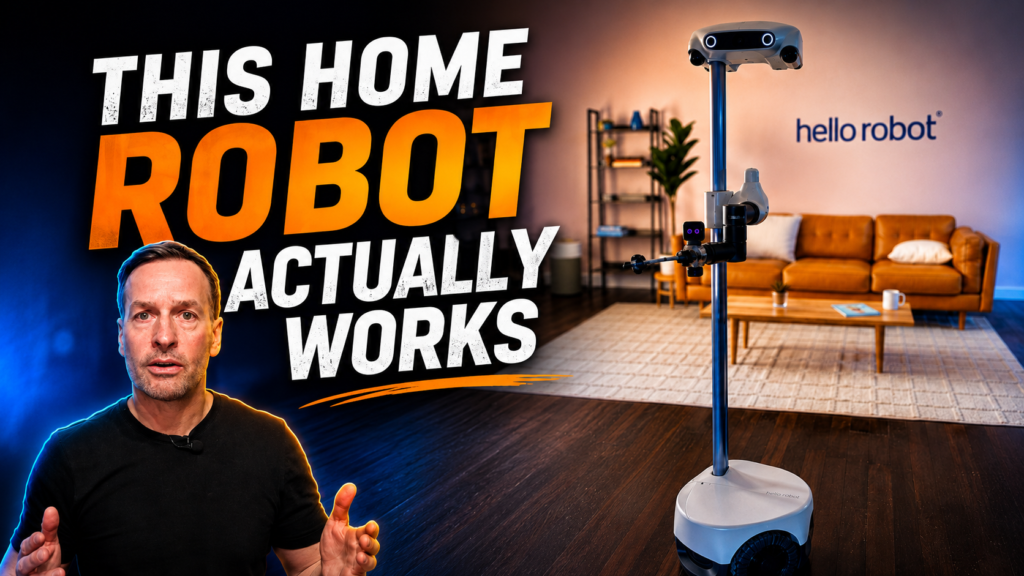
Stretch 4 and the Future of Practical Home Robots: Why Useful Robots May Beat Humanoids to Market
Introduction: The Home Robot Dream Is Changing Shape
For decades, the dream of the home robot has looked roughly the same.
A humanoid machine walks into the kitchen, tidies the house, makes a cup of coffee, folds the laundry, and perhaps gives a polite little nod on the way out.
It is a powerful image. It is also one of the reasons humanoid robots attract so much attention. They look familiar. They feel futuristic. They are easy to understand in a video clip.
But the future of robotics may not arrive in the shape most people expect.
Hello Robot’s Stretch 4 is a strong example of a different path. Instead of copying the human body, Stretch 4 focuses on what a useful home robot actually needs to do: move safely, navigate indoor spaces, reach objects, assist people, recharge itself, and operate in real environments.
It does not need legs.
It does not need a face.
It does not need to look like a person.
It needs to be useful.
That distinction matters enormously for the robotics industry, because the race is not simply about who can build the most impressive-looking robot. The real race is about who can build robots that solve practical problems, create commercial value, and can be deployed safely and reliably in homes, workplaces, healthcare environments, and service industries.
Stretch 4 is interesting because it challenges one of the biggest assumptions in robotics: that the future of home robotics must be humanoid.
The real future may be more practical, more focused, and much closer than many people think.
What Is Stretch 4?
Stretch 4 is a mobile manipulator robot from Hello Robot. In simple terms, that means it is a wheeled robot with an arm.
That may sound less glamorous than a humanoid robot, but from a practical robotics perspective, it is extremely important.
Stretch 4 is designed for real-world indoor use. It uses a wheeled omnidirectional base, allowing it to move around in tight spaces without needing to turn like a traditional vehicle. This is particularly valuable in homes, care environments, apartments, bedrooms, kitchens, and other indoor spaces where every inch of movement matters.
It also includes an extendable arm that can reach for objects, interact with the environment, and support everyday tasks. This combination of mobility and manipulation is one of the most important areas in robotics technology.
A robot that can move but cannot manipulate objects is limited.
A robot arm that can manipulate objects but cannot move is also limited.
A mobile manipulator brings those two capabilities together.
Stretch 4 also includes cameras, lidar, mapping, navigation, self-charging, autonomous grasping, and onboard computing for AI and visual processing. In practical language, it is designed to move, see, understand its surroundings, recharge itself, and physically interact with objects.
That is why it matters.
Home robots do not need to be theatrical. They need to be useful.
Why Stretch 4 Matters in the Robotics Industry
The robotics industry is currently full of excitement around humanoid robots. Companies are demonstrating walking robots, warehouse robots, factory robots, and AI-powered machines that appear increasingly capable.
This is an exciting time for robotics. There is no question that humanoid robots will play an important role in the future of automation.
However, Stretch 4 highlights a crucial point: not every robotics problem requires a humanoid solution.
In fact, many of the most commercially practical robots are not humanoid at all.
Warehouse robots use wheels.
Delivery robots use wheels.
Robot vacuums use wheels.
Autonomous mobile robots in factories use wheels.
Inspection robots often use wheels, tracks, or specialized mobility platforms.
The reason is simple: wheels are stable, efficient, affordable, and proven.
Legged robots are impressive, but they introduce complexity. They require advanced balance, powerful actuators, sophisticated control systems, and much more engineering work to achieve safe, reliable movement.
In a home environment, that complexity becomes even more important. Homes are full of furniture, pets, cables, rugs, tight spaces, fragile objects, and unpredictable human behavior.
A robot falling over in a warehouse is a technical problem.
A robot falling over in a home next to an elderly or disabled person is a serious safety concern.
Stretch 4 is important because it prioritizes safety, simplicity, and usefulness over appearance.
That is a commercial lesson many businesses should understand.
The best robot is not always the most futuristic-looking robot.
The best robot is the one that solves the problem.
The Problem Stretch 4 Is Trying to Solve
One of the most promising use cases for Stretch 4 is assistive care.
This includes helping people with severe mobility impairments, supporting independent living, assisting caregivers, and enabling people to interact with their homes more easily.
For someone with limited mobility, simple daily tasks can become major challenges.
Picking up a dropped item.
Fetching a drink.
Moving something from a table.
Opening or interacting with objects.
Reaching across a room.
These are not science-fiction tasks. They are everyday human needs.
This is where robotics can create meaningful value.
A robot like Stretch 4 does not need to replace a human caregiver. Instead, it can support independence, reduce repetitive strain, improve quality of life, and provide assistance between human care visits.
This is a very different vision from the “robot butler” fantasy.
The goal is not luxury.
The goal is practical assistance.
That makes the business case much more compelling.
Healthcare systems, senior care providers, disability support organizations, insurers, robotics startups, and assistive technology companies should all be paying attention to this category.
As populations age and care systems come under pressure, assistive robots may become one of the most important areas of service robotics.
Why Wheels May Beat Legs in the Home
The humanoid robot argument is easy to understand.
Homes are built for humans, so robots should be shaped like humans.
At first, that sounds logical.
But it is not always true.
Many indoor environments have already been adapted for wheels. Wheelchairs, mobility scooters, hospital carts, cleaning machines, delivery trolleys, and domestic appliances all operate successfully without legs.
A home designed for someone with mobility challenges may already be optimized for wheeled movement. Doorways, ramps, clear pathways, and reachable surfaces are often more relevant than stairs or uneven terrain.
For many assistive care applications, legs may not provide enough benefit to justify their complexity.
Wheels are simpler.
Wheels are stable.
Wheels are easier to control.
Wheels are more energy efficient.
Wheels are less likely to collapse onto a person or object.
This does not mean humanoid robots have no future. They absolutely do.
But it does mean that the first wave of useful home robots may not be humanoid.
They may be wheeled mobile manipulators.
That is why Stretch 4 is such an interesting signal for the future of robotics.
It suggests that practical deployment may happen before the humanoid dream fully matures.
AI Robots Do Not Always Need Human Bodies
Another important point is the relationship between AI and robot design.
There is a common assumption that advanced AI robots should look like people. The thinking is that if a robot has artificial intelligence, it should also have a human-like body.
But intelligence and body shape are separate questions.
An AI robot can be wheeled.
An AI robot can be a robotic arm.
An AI robot can be a warehouse vehicle.
An AI robot can be an inspection platform.
An AI robot can be a mobile manipulator like Stretch 4.
The key question is not whether the robot looks intelligent.
The key question is whether it can sense, decide, and act usefully in the real world.
Stretch 4 appears to follow this logic. It provides a physical platform that can move and manipulate objects, while also supporting AI and visual processing.
This is where the future of robotics becomes especially interesting.
As AI models improve, the value of practical robot platforms increases. A robot that already has safe mobility, manipulation, sensors, and compute can become a powerful platform for future AI capabilities.
In other words, the physical robot does not need to do everything on day one.
It needs to be a reliable foundation.
The AI can improve over time.
Commercial Implications for Businesses
For business leaders, Stretch 4 provides a useful lesson about robotics adoption.
Do not start with the robot.
Start with the problem.
Too many companies look at robotics through the lens of excitement. They see a humanoid robot online and ask, “How can we use that?”
A better question is: “Where are the expensive, repetitive, unsafe, difficult, or high-friction tasks in our business?”
That is where robotics consulting becomes valuable.
Robots can be used in many different commercial environments, including:
Healthcare and care homes.
Warehouses and logistics.
Retail and customer service.
Events and exhibitions.
Manufacturing and inspection.
Food service and hospitality.
Security and facilities management.
Education and training.
But the right robot depends on the task, the environment, the budget, the staff, the operating model, and the expected return on investment.
Stretch 4 is a reminder that useful robotics does not always look glamorous.
A robot that quietly solves a real business problem may be far more valuable than a robot that looks amazing in a demo but is difficult to deploy.
Businesses that understand this will have an advantage.
The Rise of Practical Service Robots
Service robots are one of the most important categories in the robotics industry.
Unlike traditional industrial robots, which are often fixed in factories, service robots are designed to operate in human-facing or semi-structured environments.
This includes robots for hospitality, healthcare, cleaning, delivery, retail, events, education, and domestic assistance.
The challenge with service robots is that the real world is messy.
Factories can be highly structured. Homes and commercial environments are not.
A service robot may need to deal with people walking around unpredictably, furniture being moved, lighting changes, narrow spaces, clutter, and different floor surfaces.
This makes service robotics difficult.
But it also makes the opportunity enormous.
If robots can become reliable in these environments, they can create huge value across the economy.
Stretch 4 fits into this wider shift. It is not just a home robot. It is part of a larger movement toward robots that can operate around people in real-world spaces.
That is where robotics technology is heading.
Not just robots in cages.
Not just robots in factories.
Robots in everyday environments.
Humanoid Robots vs Practical Robots
The robotics industry does not need to choose only one path.
Humanoid robots and practical non-humanoid robots can both succeed.
The mistake is assuming one form factor will dominate everything.
Humanoid robots may eventually be extremely valuable in environments where human-like mobility and manipulation are essential. They may be useful in warehouses, manufacturing, disaster response, construction, logistics, and certain service applications.
But humanoid robots also face major challenges.
They need to become safer.
They need to become more affordable.
They need better battery life.
They need robust manipulation.
They need reliable autonomy.
They need to prove commercial return on investment.
Practical robots such as Stretch 4 may reach meaningful deployment sooner because they reduce some of that complexity.
They are not trying to solve every robotics problem at once.
They are focused on specific capabilities.
That focus matters.
In business, the winning solution is often not the most general solution. It is the one that creates measurable value in a specific use case.
Stretch 4 is a good example of this principle.
Robotics Investment and Market Opportunity
Robotics investment is increasing because investors can see that automation is moving from software into the physical world.
The last decade was dominated by digital transformation, cloud computing, software platforms, and AI tools.
The next major wave may be physical AI.
Physical AI means artificial intelligence connected to machines that can act in the real world. Robots are one of the most important expressions of that idea.
This is why AI robots are attracting attention from investors, manufacturers, startups, and large technology companies.
However, the investment opportunity is not limited to humanoid robots.
There will be opportunities in:
Robot hardware.
Robot software.
Autonomy systems.
Navigation.
Manipulation.
Robot safety.
Fleet management.
Robotics data.
Deployment services.
Maintenance and support.
Robotics consulting.
Robot training.
Robotics recruitment.
The ecosystem around robots may become just as important as the robots themselves.
Businesses will need help selecting, testing, deploying, managing, and improving robotic systems.
That creates opportunities for robotics consultants, integrators, trainers, service providers, and specialist recruitment companies.
Stretch 4 is a useful case study because it shows how a focused robot platform can become part of a much wider commercial ecosystem.
Challenges Slowing Home Robot Adoption
Despite the excitement, home robotics remains difficult.
There are several reasons why useful home robots have taken so long to arrive.
First, homes are unstructured. Every home is different. Furniture, layouts, lighting, flooring, clutter, pets, and people vary dramatically.
Second, safety requirements are extremely high. A robot in the home may operate near children, elderly people, disabled people, pets, and fragile objects.
Third, manipulation is hard. Picking up random objects in the real world is still one of the biggest challenges in robotics.
Fourth, cost matters. Consumers are used to buying appliances, not expensive robotic systems. A home robot must justify its price with real value.
Fifth, reliability is essential. A robot that works well in a demo but fails daily in the home will not succeed commercially.
This is why assistive care may be one of the strongest early markets.
The value of assistance is higher.
The use case is clearer.
The need is real.
The buyer may be an organization, healthcare provider, insurer, or support service rather than a general consumer.
That could make the commercial pathway more realistic.
Why Businesses Should Pay Attention Now
Even if your business is not in home robotics, Stretch 4 is still relevant.
It represents a wider trend: robots are becoming more practical, more specialized, and more commercially focused.
Business leaders should not wait until robots are perfect.
They should start learning now.
This does not mean every company should immediately buy a robot. It means companies should begin understanding where robotics could affect their industry.
Which tasks are repetitive?
Where are labor shortages appearing?
Where could automation improve safety?
Where could robots support staff?
Where could robots create customer engagement?
Where could robotics create a competitive advantage?
The businesses that ask these questions early will be better prepared.
Robotics adoption is not just a technology decision. It is an operational, commercial, cultural, and strategic decision.
The companies that succeed will be the ones that understand how robots fit into the bigger business model.
RoboPhil Perspective: Practical Robotics Over Hype
Philip English, known as RoboPhil, works across the robotics industry through Robot Center, Robots of London, and Robot Philosophy.
This includes helping businesses explore robotics adoption, understand robot deployment, source commercial robots, use robots at events, and develop robotics strategies.
From a RoboPhil perspective, Stretch 4 is important because it represents a practical side of robotics that is often overlooked.
The robotics industry can sometimes become distracted by viral videos and futuristic promises. These are useful for generating excitement, but real adoption depends on solving real problems.
A robot does not need to impress the internet to be commercially valuable.
It needs to work.
It needs to be safe.
It needs to create value.
It needs to fit the environment.
It needs to support people rather than simply replace them.
That is the difference between robotics hype and robotics strategy.
Stretch 4 is not interesting because it looks like the future imagined in films.
It is interesting because it looks like a robot that could actually help people.
The Future of Home Robotics
The future of home robotics is likely to develop in stages.
The first stage is not likely to be a fully autonomous humanoid robot doing every household task perfectly.
Instead, we may see specialized robots solving specific problems.
Robots for cleaning.
Robots for mobility support.
Robots for medication delivery.
Robots for telepresence.
Robots for companionship.
Robots for object retrieval.
Robots for monitoring and safety.
Robots for care assistance.
Over time, these capabilities may combine.
The home robot of the future may eventually become more general-purpose. But the path to that future will likely be built through practical, focused applications.
Stretch 4 points toward that pathway.
It is not trying to be everything.
It is trying to be useful.
That may be exactly what the home robotics market needs.
What This Means for Robotics Startups
For robotics startups, Stretch 4 offers an important lesson.
Do not build for science fiction.
Build for deployment.
The robotics startups that succeed will likely be the ones that understand their use case deeply. They will know the customer, the environment, the pain point, the budget, the safety requirements, and the business model.
A technically impressive robot is not enough.
A commercially successful robot needs a clear reason to exist.
It must answer the question: why would someone pay for this?
For Stretch 4, the answer appears to be practical assistance in real homes, especially for people with mobility impairments.
That is a meaningful problem.
That is a real market.
That is a strong foundation.
The broader robotics startup ecosystem should pay attention to this kind of thinking.
The Bigger Shift: From Robot Demos to Robot Deployment
The robotics industry is moving from demonstration to deployment.
This is a major shift.
For years, many robots were judged by what they could do in controlled environments. Now the real test is whether they can operate reliably in daily use.
This requires a different mindset.
Deployment involves training, support, maintenance, safety, user experience, integration, financing, and long-term value creation.
It is not just about the robot.
It is about the whole system around the robot.
This is where many companies underestimate the challenge.
Buying a robot is easy compared with deploying it properly.
Businesses need to think about staff training, workflow design, customer expectations, data, insurance, servicing, and return on investment.
The future of robotics will not only belong to the companies that build great robots.
It will also belong to the companies that know how to deploy them.
Conclusion: The Future May Roll In Before It Walks
Stretch 4 challenges the assumption that the future of home robotics must be humanoid.
It shows that practical robots may reach real-world usefulness before more complex humanoid systems become affordable, safe, and reliable at scale.
This does not mean humanoid robots are unimportant. They are one of the most exciting areas in robotics technology.
But the first commercially successful home robots may not look like people.
They may be wheeled.
They may be simple.
They may be focused.
They may be designed around real human needs rather than science-fiction expectations.
That is why Stretch 4 matters.
It represents a practical vision of robotics: robots that assist, support, navigate, manipulate, and create value in real environments.
For businesses, investors, robotics companies, and technology leaders, the message is clear.
The future of robotics is not just about building robots that look impressive.
It is about building robots that work.
And sometimes, the robot that changes the market is not the one that walks into the room.
It is the one that rolls in quietly and starts solving problems.
Work With RoboPhil
If your business is exploring robotics, automation, AI robots, robot sourcing, robot deployment, robotics consulting, or robotics industry strategy, RoboPhil can help you understand the opportunities and make better decisions.
Robotics services and partners:
Robot Center
https://robotcenter.co.uk/
Robots of London
https://robotsoflondon.co.uk/
Robot Philosophy
https://robophil.com/
Business enquiries
sales@robotcenter.co.uk