
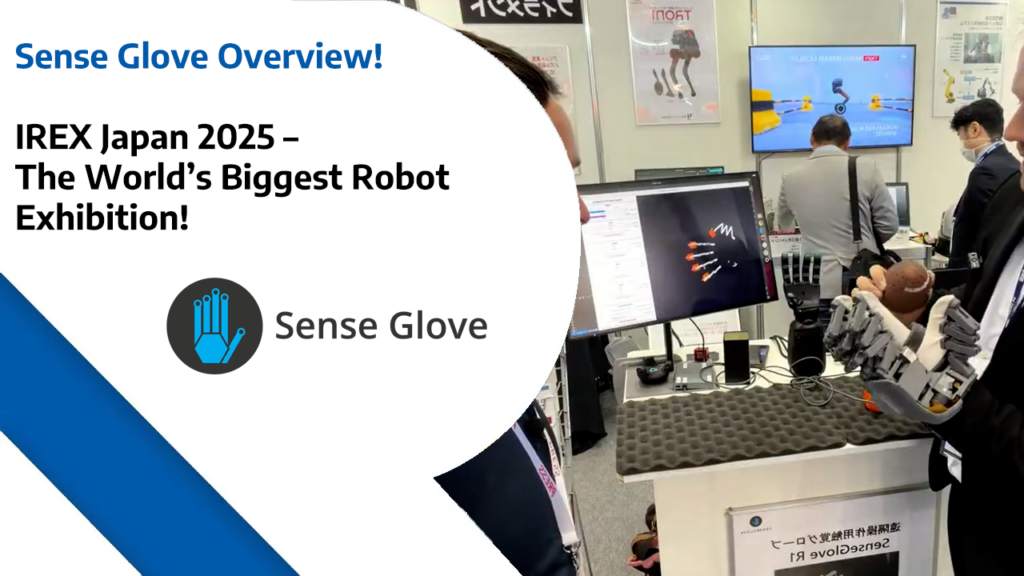
Sense Glove
SenseGlove at IREX Japan 2025: Why Haptic VR Gloves Could Transform Robot Control, Training, and Human-Robot Interaction
If you’ve ever watched a robot perform a task and thought, “That’s impressive… but how does a human actually control that safely?” — you’re asking one of the most important questions in robotics today.
At IREX Japan 2025, widely recognised as the world’s biggest robot exhibition, I saw countless robotics innovations across industrial automation, service robotics, humanoids, autonomous mobile robots (AMRs), and AI-powered systems.
But one of the most interesting technologies I saw wasn’t a robot at all.
It was a haptic glove.
Specifically: SenseGlove.
This is a technology that sits at the intersection of virtual reality (VR), human-machine interfaces, training simulation, and robot teleoperation — and it could become a major piece of the puzzle for how robotics is deployed at scale in the real world.
In this article, I’ll break down what SenseGlove is, why haptic gloves matter, and how this kind of interface could reshape robotics adoption across multiple industries.
What Is SenseGlove?
SenseGlove is a haptic VR glove designed to bring touch feedback into virtual environments.
Most VR experiences focus on sight and sound. SenseGlove adds another layer:
✅ Resistance
✅ Tactile sensation / force feedback
✅ A more realistic “feel” when interacting with objects
In practical terms, it means you can reach out and “grab” something in a digital environment and experience feedback that makes the interaction feel more real. That might sound like a small upgrade… until you think about the implications for robotics.
Because robotics doesn’t just need better machines.
Robotics needs better human interfaces.
Why Human Interfaces Are the Hidden Bottleneck in Robotics Adoption
When most people talk about robotics, they talk about:
speed
payload
AI vision
navigation
autonomy
battery life
sensors
cost per unit
All important.
But in real deployments, robotics adoption usually gets stuck on something less exciting:
❌ The human side
The robot is too hard to operate
Training takes too long
Staff don’t trust it
Teams can’t troubleshoot issues
It doesn’t fit into existing workflows
The interface is clunky or confusing
Operators make avoidable mistakes under pressure
The problem is that we often judge robots by what they can do.
But businesses judge robots by what teams will actually do with them, day after day.
This is why technologies like SenseGlove matter.
They make robotics more usable, more trainable, and more scalable.
SenseGlove at IREX Japan 2025: Why It Stood Out
IREX Japan is where you see the full map of global robotics progress in one place.
And that’s exactly why SenseGlove stood out to me.
Because while many companies were showcasing robots performing tasks, SenseGlove was tackling something deeper:
How do humans develop skill and confidence in robotic environments without needing real robots, real risk, and real downtime?
That matters for almost every robotics category — including:
industrial robots
collaborative robots (cobots)
AMRs
inspection robots
security robots
service robots
humanoid robots
What Is Haptics (and Why Should Businesses Care)?
Haptics is the technology of touch feedback.
It allows a system to simulate physical sensations like:
contact
vibration
pressure
resistance
impact or boundaries
In robotics and VR, this becomes incredibly valuable because it can bridge the gap between:
digital training environments
and
real-world physical behaviour
If your team can feel the interaction, they can build better skill faster.
The Business Case: Where Haptic VR Gloves Create Real Value
Let’s move beyond the “cool factor” and talk about impact.
Here are some of the biggest real-world benefits of haptic gloves like SenseGlove.
1) Faster Robotics Training (Without Stopping Operations)
One of the biggest hidden costs in robotics deployment is training time.
Every time you onboard someone new, you have to manage:
training schedule
supervision time
risk of errors
production disruption
If teams can train in VR first, then transition into real robotics workflows faster, that reduces:
✅ training cost
✅ operational disruption
✅ mistakes and damage risk
✅ time-to-productivity
For businesses scaling robotics across multiple sites, the savings multiply.
2) Safer Operator Onboarding
A huge reason companies delay robotics adoption is fear of accidents, errors, or liability.
Haptic simulation improves safety because operators can practise:
movement patterns
sequences
timing
decision-making under pressure
…without being near moving machinery.
This matters especially in environments like:
warehousing
manufacturing
logistics
inspection sites
security patrol environments
3) Skill and Muscle Memory Development
Robotics isn’t only intellectual.
Many robotic tasks are physical and procedural:
grasping
lifting
positioning
alignment
applying correct force
avoiding collisions
Haptics creates a training environment where users develop muscle memory, not just software knowledge.
It’s similar to how pilots train in simulators — because simulation builds competence without risk.
4) Better Teleoperation (Remote Robot Control)
Teleoperation is becoming more important as robots expand into:
inspection
hazardous environments
remote facilities
security operations
space-constrained industrial spaces
Teleoperation is powerful, but it can be difficult because operators can’t feel what the robot is doing.
Haptic feedback helps improve remote control performance because it brings back a missing sense:
✅ touch
✅ contact
✅ resistance
This can lead to better task accuracy, fewer collisions, and improved operator confidence.
5) Bridging Autonomy and Human Oversight
Most robots today are not fully autonomous 100% of the time.
The future is likely a hybrid model:
Robots handle routine tasks autonomously
Humans assist or intervene when needed
Systems learn from human guidance
SenseGlove-style interfaces could become an ideal tool for “human-in-the-loop” robotics.
Where This Could Go Next (and Why It Matters for Humanoids)
Humanoid robots are one of the biggest trends in robotics right now.
But humanoids have a problem:
They’re incredibly complex to deploy because they’re expected to operate in unpredictable human spaces.
That means they need:
more training
more human control options
better safety and usability
Haptic interfaces could become one of the keys to making humanoids practical.
Because the hardest part of humanoids isn’t walking.
It’s working.
And working requires:
dexterity
force control
safe manipulation
repeatable training
The Real Future: Robotics Interfaces Will Decide Who Wins
Here’s my honest view after spending time at IREX Japan 2025:
In the next wave of robotics adoption, the winners won’t just be the companies building the best robots.
They’ll be the companies building the best robot experience.
That includes:
✅ interfaces
✅ training platforms
✅ workflow integration
✅ support models
✅ safety frameworks
✅ scalable deployment processes
Because robotics success doesn’t come from a single robot purchase.
It comes from deployment maturity.
The Bigger Question: Are You Ready to Deploy Robots Properly?
Seeing SenseGlove at IREX reminded me of the real question businesses should ask:
“How do we build robotics into our operations as a system — not as a one-off project?”
If you’re exploring robotics, the goal isn’t to buy a robot.
The goal is to build robotics capability inside your business.
And that’s exactly what we help organisations do across the UK and globally.
Work With Us: Real-World Robotics Deployment Support
If you want help selecting, deploying, and scaling robotics safely and effectively — whether you’re starting from scratch or improving an existing deployment — we support businesses through strategy, implementation, and ongoing support.
📩 Join the workshop waiting list or get in touch:
https://robophil.com/
Sponsors (and How They Can Help You)
Robot Center
Robot Center is a UK-based robotics consultancy and Robot-as-a-Service (RaaS) provider, helping businesses deploy, manage, and scale real-world robotics solutions.
We specialise in robot consultancy, Robotics as a Service, and the supply of commercial and industrial robots, including digital signage robots, inspection robots, security robots, and autonomous mobile robots. Robot Center supports businesses across the UK, Europe, and globally, from robot selection and purchase through to deployment, integration, and ongoing support.
Robot Center works with leading platforms such as Capra Robotics and Temi, helping organisations buy robots, adopt robots as a service, and implement robotics safely and effectively.
Robots of London
Robots of London is a leading robot hire and robot rental company, supplying interactive robots for events, exhibitions, trade shows, conferences, and brand activations in the UK, Europe, and worldwide.
We specialise in robot hire in London and across the UK, with full coverage throughout Europe and global international events. Our range includes humanoid robots, AI robots, service robots, and promotional robots, all delivered as a fully managed service with logistics, setup, operation, and on-site technical support.
If you’re looking to hire a robot for an event, rent a robot for an exhibition, or work with an experienced robotics hire company for international events, Robots of London delivers reliable, high-impact robotic experiences globally.
🔗 https://robotsoflondon.co.uk/
Robot Philosophy (RoboPhil)
Robot Philosophy (RoboPhil) is a leading robotics insight and consultancy platform, founded by Philip English, also known as RoboPhil, one of the UK’s most established robot YouTubers and commentators.
Robot Philosophy provides robot consultancy, robot recruitment insight, robotics advice, and strategic perspectives on real-world robotics adoption. The platform shares robot insights, ideas, trends, and analysis, helping businesses, professionals, and investors understand where robotics creates real value.
Through videos, articles, workshops, and advisory services, RoboPhil connects robot strategy with practical deployment, supporting organisations across the UK, Europe, and globally.
Service Robotics Summit (SRS)
Service Robotics Summit (SRS) is a global, invitation-led conference series dedicated to the service robotics industry, bringing together founders, investors, enterprise buyers, and senior decision-makers shaping the future of robotics.
Held annually in London, Singapore, Dubai, and the United States, SRS is a high-ticket, premium summit hosted in five-star hotels, designed for meaningful conversations, strategic partnerships, and high-value deal flow within the service robotics ecosystem.
The summit focuses on real-world deployment of service robots, including hospitality, retail, healthcare, security, inspection, logistics, and smart environments. SRS offers a curated agenda of keynotes, closed-door panels, private networking, and executive roundtables, positioning it as the definitive meeting place for leaders in service robotics.
🔗 https://serviceroboticsummit.com/
Final Thoughts: Haptics Might Be Closer Than You Think
SenseGlove is a reminder that the future of robotics isn’t just about robots doing more.
It’s about humans becoming more capable through better interfaces.
And as robotics scales into more industries, the gap between “robot demo” and “robot deployment” will be bridged by:
training
interface design
workflow integration
support systems
confidence and adoption
Haptic gloves are part of that bridge.
And after seeing SenseGlove at IREX Japan 2025, I can tell you — this technology is one to watch.
If you’re building, buying, deploying, or investing in robotics…
Start paying attention to how humans will actually operate them.
Because that’s where robotics becomes real.