China’s Gun-Toting Robot Wolves – A Terrifying New Era of Warfare Begins
Right then — today we’re talking about something that sounds like it escaped from a sci-fi film: China’s new gun-toting robot wolves. Yes, four-legged metal drones taking part in a beach-assault drill, all captured on Chinese state TV.
These machines weigh about 70 kilograms, carry assault rifles or surveillance systems, and can operate around 1.2 miles from their human handlers. They’re designed to be the first wave in a drone-led attack formation — which is a bit unsettling, especially if you prefer your wolves without Wi-Fi.
And why a beach landing? Because tensions over Taiwan are climbing, and China is clearly rehearsing for something larger. The PLA wants these robots to handle risky terrain, climb obstacles, even scale ladders, all while moving with human troops and aerial drones in coordinated formations.
Now, let’s talk about you — because this isn’t just a far-off military curiosity.
First, this signals a massive leap in robotics capability. Ground robots with autonomy, mobility, and real-world combat functions aren’t prototypes anymore — they’re active units. If you work in tech, engineering, cybersecurity, or robotics, this is a preview of the tools industries will adopt next: inspection bots, security bots, logistics bots — all more capable because militaries are pushing the envelope.
Second, major defence shifts create major commercial opportunities. U.S. companies will invest more heavily in ground robotics, AI platforms, advanced sensors, and human-machine teaming. Entrepreneurs and investors who understand this wave early will be the ones who benefit.
Third, this is a wake-up call for the future of work. Machines are starting to take on the most dangerous physical tasks. Humans will move toward coordination, strategy, and oversight. If you’re building a career in tech or consulting, understanding robotics isn’t optional anymore — it’s how you stay ahead.
And that’s your robot news update for today!. If you’re curious about how robotics can transform your business, head over to Robot Philosophy website to join the waiting list, or to speak with the team about robotics.
Don’t forget to subscribe so you stay in the loop with all the latest updates.
I’m RoboPhil from Robot Philosophy — thanks for watching, and I’ll see you next time!
Robots of London: – https://robotsoflondon.co.uk/ – Robot Hire, Robot Rental, Rent Robot, Hire Robot, Robot Events, Robotics Hire, Hire Robotics, Rent Robotics, Robotics Rent, for exhibitions, shows, Events, Robot hire in the UK, Robot hire in Europe
Robot Philosophy: – https://robophil.com/ – Robot Consultancy, Robot Recruitment, Robot Advice, Robot Insights, Robot Ideas. RoboPhil, also known as Philip English, is a leading Robot YouTuber, Robot Influencer, Robot Trainer, Robot Consultant, and Robot Streamer, Robotics Streamer, Robotics YouTuber, Robotics Influencer, Robotics Consultant, Robotics Trainer
The Difference Between a Robotics Supplier and a Robotics Consultant
And Why Most Businesses Need a Consultant Before They Buy Anything
Robotics is no longer the futuristic fantasy it once was. Across industries—from manufacturing and warehousing to hospitality, healthcare, logistics, and retail—robots are becoming mainstream tools for productivity, consistency, and competitive advantage.
But as more businesses look to adopt automation, a critical question arises:
Should you work with a robotics supplier or a robotics consultant?
Both roles are essential in the robotics ecosystem, but they serve very different purposes. Choosing the wrong one at the wrong stage of your robotics journey can cost you time, money, and credibility—not to mention cause technology adoption to fail completely.
This article breaks down the true difference between the two, explains why consultancy is often the missing ingredient for successful automation, and shows how engaging with expert advisors like Robot Philosophy (RoboPhil) can save you from headaches, false starts, and costly mistakes.
1. The Robotics Supplier: What They Do, and What They Don’t
A robotics supplier is exactly what it sounds like: a business that sells robots. They may offer one brand, several brands, or entire ecosystems of robotics equipment.
A supplier’s core responsibilities typically include:
✔ Providing hardware and software products
They offer robots such as:
AMRs and AGVs
Collaborative robot arms
Humanoids
Delivery robots
Security and inspection robots
Hospitality and service robots
Robotic kiosks, signage robots, and automation peripherals
Their main goal is to sell the equipment that they specialise in.
✔ Demonstrations and basic training
Suppliers often provide:
Product demos
Training sessions
Basic onboarding
Manufacturer-approved documentation
But these services are almost always tied directly to the products they sell.
✔ Warranties and after-sales support
They ensure that their products work as intended and meet standard performance expectations. Some suppliers offer excellent support. Others simply pass support requests back to the manufacturer.
✔ Understanding their catalogue—not your business
A supplier knows their robots inside-out. But they do not specialise in understanding:
Your process
Your workflow
Your operational psychology
Your teams
Your data and bottlenecks
This is where things break down for most businesses…
2. The Robotics Consultant: Your Strategic Automation Partner
A robotics consultant is not tied to a single manufacturer, a single product, or a sales quota.
Their role is to fully understand your business, then help you navigate the entire automation journey—from concept to integration to long-term optimisation.
Here’s what a robotics consultant brings that a supplier often cannot:
✔ Deep assessment of your business needs
A consultant’s job begins before you even think about what robot to buy.
They examine:
Your workflow
Pain points in operations
Time-consuming manual tasks
Where humans excel vs. where robots excel
Bottlenecks and inefficiencies
Labour distribution
Hidden costs
Safety considerations
Current and future business strategy
This step is essential. Many companies skip it, jump straight to a supplier, and end up with the wrong robot, poorly integrated technology, or a tool nobody uses.
✔ Independent recommendations
Consultants are brand-agnostic.
They do not tell you:
“Here is the robot we stock—let’s make it fit your business.”
Instead, they say:
“Here is the best robot for your needs, whether we sell it or not.”
That neutrality is priceless.
✔ Designing the automation strategy
Consultants look at:
Where to begin
What to automate first
How to ensure ROI
What the roadmap looks like
How to introduce automation to staff without fear or resistance
How to scale gradually and safely
A supplier rarely builds this kind of strategy because it exists outside the scope of their sales model.
✔ Integrating robots into operations
This includes:
Mapping your site
Creating workflows
Setting up cross-functional automations
Connecting hardware, software, and human roles
Configuring the robot for specific tasks
Interfacing with existing systems
The integration work is often where robotics projects succeed—or fail. And most suppliers are not equipped to handle this level of operational refinement.
✔ Long-term optimisation
The consultant stays with you long after the robot is installed.
They monitor:
Performance
Data
Efficiency gains
Updated capabilities
Staff usage
Scaling opportunities
This ongoing advisory role ensures your robots continue delivering value.
3. Why Businesses Mistake Suppliers for Consultants
Many companies believe:
“Buying a robot from a supplier = getting automation expertise.”
But the truth is:
Suppliers supply. Consultants transform.
A supplier can help you choose the right robot from their selection. A consultant helps you choose the right robot from every possible option.
A supplier can sell you a tool. A consultant ensures the tool actually works in your environment.
A supplier guides you through features. A consultant guides you through outcome-driven automation.
If you want one specific robot type and already know exactly what you need, a supplier is ideal.
If you want to:
Reduce costs
Improve accuracy
Boost staff productivity
Automate a process
Futureproof your business
Move toward digital transformation
Build a robotic workforce roadmap
…then a consultant is essential.
4. Why Most Businesses Fail with Robots (Before They Even Start)
The robotics industry has one of the highest failure rates in technology adoption.
Why?
Because businesses often:
Pick the wrong type of robot
Try to force-fit a product into a workflow
Underestimate integration needs
Fail to analyse ROI properly
Don’t communicate changes to staff
Don’t prepare for operational adjustments
Trust a product demo instead of a process study
The result:
Expensive robots gathering dust.
A robotics consultant prevents all of this by evaluating not just the product, but the entire system—the business, the process, the people, and the outcomes.
5. The Perfect Partnership: Supplier + Consultant
In a successful robotics project, consultants and suppliers work together. The consultant creates the roadmap; the supplier delivers the tools.
Think of it like architecture:
The consultant is the architect
The supplier is the builder
The business is the client
The robot is the construction material
You need all four for the building to stand.
6. How RoboPhil (Robot Philosophy) Fits In
Robot Philosophy (RoboPhil) provides expert consulting and recruitment services that bridge the gap between strategy, technology, and talent.
RoboPhil—also known as Philip English—is one of the UK’s leading robotics educators, trainers, and influencers. He runs the Robot Philosophy consultancy and Robot Center distribution arm, giving clients the unique advantage of expertise across:
Robotics consultancy
Robotics product selection
Robotics integration
Robotics training
Robotics events
Robotics recruitment
Robotics media, insights, and brand positioning
This rare combination makes Robot Philosophy incredibly effective at guiding businesses into the robotics era.
7. When You Should Call a Robotics Consultant (Not a Supplier)
You need a consultant when:
You want an expert to design your automation roadmap
You want to avoid buying the wrong robot
You want to assess business processes before investing
You want to compare robots from multiple brands
You want to calculate ROI and business impact
You want to train your staff properly
You want to scale your automation over time
You want an unbiased expert representing your interests
If you’re unsure what robot you need, you’re at the consultant stage.
8. When You Should Call a Robotics Supplier
You need a supplier when:
You already know exactly which robot you want
You have already done site assessments
You have a clear automation plan
You need pricing, demos, and quotations
You’re ready to purchase hardware
Most businesses begin with a consultant and then work with a supplier—not the other way around.
9. Why Our Consulting Service Outperforms Traditional Suppliers
At Robot Philosophy, we approach robotics in the same way a top management consultant approaches business transformation.
Our method includes:
R = Resources (Where Robots Could Work)
Identifying intersections where robotics could support your people, processes, and partners.
O = Optimise (Integration and Installation)
Creating a customised plan and ensuring proper deployment.
I = Intellectify (Data + Human Amplification)
Using data and interfaces to empower your team to work smarter, not harder.
This is the exact opposite of simply buying a robot and hoping it works.
10. Upsell: Why You Should Book a Consultation Today
Robotics is one of the highest ROI investments a business can make—but only if done correctly.
Whether you’re an SME, a corporate, or a growing brand, the earlier you speak to a consultant, the sooner you reduce risk and maximise return.
11. Robotics Recruitment: The Talent You Need to Power Your Automation
Automation isn’t just machines—it’s people.
Robotic engineers, technicians, programmers, integrators, and operators are some of the most in-demand roles globally.
Our robotics recruitment service provides:
Skilled robotics engineers
Integration specialists
Cobot technicians
AMR/AGV deployment experts
Robotics trainers
Robotics operations leads
Automation managers
Robotics adoption advisors
If you want automation to succeed, you need talent that understands robotics from the inside out.
Robot Philosophy offers both robotics consulting and robotics recruitment under one roof—making us one of the only hybrid automation support companies in the UK.
Robot Center is one of the UK’s leading suppliers of advanced robotics for business, specialising in automation technology, AMRs, humanoids, retail robots, and warehouse systems.
Robots of London is the UK’s premier robot hire and events company, delivering robots for exhibitions, brand activations, hospitality, retail, entertainment, and corporate events.
Philip English (RoboPhil) is the UK’s leading robot YouTuber, robot influencer, robot trainer, robot consultant, and robot streamer—guiding companies through the future of automation.
13. Final Thoughts: Supplier vs. Consultant—Which Do You Need?
If you’re early in your automation journey, start with a consultant. If you already know exactly what robot you need, go to a supplier. If you want a seamless, end-to-end partnership, use both—strategically.
Robotics is too important and too transformative to leave to guesswork. Your business deserves the right roadmap, the right technology, and the right expertise.
To book your robotics consultation or recruitment support:
Foxglove Just Raised $40M — This Could Change Robotics Forever Imagine you’re building robots—proper industrial robots, autonomous vehicles, drones—machines that will shape how America works, moves, secures, and delivers. And now imagine the mountain of sensor data those robots generate. It’s like drinking from a firehose while trying to debug a machine that refuses to sit still.
That’s exactly the problem Foxglove is solving—backed by a fresh $40 million Series B, pushing their total funding to over $58 million since 2021.
Foxglove, based in San Francisco and founded by former Cruise engineers Adrian Macneil and Roman Shtylman, builds the data and observability platform robotics companies wish they’d had years ago. Think of it as giving every robotics team access to Waymo- or Tesla-level internal tools… without needing a giant engineering army or a billion-dollar R&D lab.
The platform helps roboticists collect, visualize, analyze, and debug sensor data in a centralized, structured way. It’s already being used by major players: Amazon, NVIDIA, Anduril, Dexterity, Shield AI, and a long list of autonomous vehicle and humanoid robot companies.
One standout example is Dexterity. Before Foxglove, they relied on a messy mix of in-house log tools that constantly needed fixing. After integrating Foxglove, they cut development time by 20% and saved $150K per year. That’s real money, real productivity, and real acceleration toward deploying robots in the world.
Shield AI went even further—they embedded Foxglove directly into their HiveMind autonomy stack, making it part of the SDK used by their own customers. That’s not just “a helpful tool”—that’s infrastructure.
This new funding round, led by Bessemer Venture Partners, signals strong confidence in Foxglove at a time when raising capital in robotics isn’t easy.
And that’s your robot news update for today!. If you’re curious about how robotics can transform your business, head over to Robot Philosophy website to join the waiting list, or to speak with the team about robotics.
Don’t forget to subscribe so you stay in the loop with all the latest updates.
I’m RoboPhil from Robot Philosophy — thanks for watching, and I’ll see you next time!
Robots of London: – https://robotsoflondon.co.uk/ – Robot Hire, Robot Rental, Rent Robot, Hire Robot, Robot Events, Robotics Hire, Hire Robotics, Rent Robotics, Robotics Rent, for exhibitions, shows, Events, Robot hire in the UK, Robot hire in Europe
Robot Philosophy: – https://robophil.com/ – Robot Consultancy, Robot Recruitment, Robot Advice, Robot Insights, Robot Ideas. RoboPhil, also known as Philip English, is a leading Robot YouTuber, Robot Influencer, Robot Trainer, Robot Consultant, and Robot Streamer, Robotics Streamer, Robotics YouTuber, Robotics Influencer, Robotics Consultant, Robotics Trainer
What to Expect from a Robotics Consultation with RoboPhil
In today’s rapidly evolving technological landscape, robotics is no longer confined to science fiction or large manufacturing plants. From small businesses to enterprise-level operations, robots are transforming how we work, serve customers, and solve complex challenges. But knowing where to start with robotics can feel overwhelming. That’s where a professional robotics consultation becomes invaluable.
At RoboPhil, we’ve helped countless businesses navigate their robotics journey—from initial curiosity to full implementation. Whether you’re exploring automation for the first time or looking to expand your existing robotics capabilities, here’s what you can expect from a consultation with our team.
Understanding Your Business Needs
Every robotics consultation begins with a fundamental question: What problem are you trying to solve?
During your initial consultation, we take time to understand your business operations, current challenges, and long-term objectives. This isn’t about pushing the latest technology—it’s about finding the right solution for your specific situation. We’ll discuss:
Your operational pain points and bottlenecks
Labor challenges and workforce considerations
Customer experience goals
Budget parameters and ROI expectations
Timeline and implementation constraints
This discovery phase is crucial. A robot that works brilliantly for a warehouse environment might be completely unsuitable for a hospitality setting. Our expertise lies in matching the right robotics solution to your unique requirements.
Exploring Robotics Solutions
Once we understand your needs, we’ll guide you through the diverse world of robotics options. The robotics landscape has expanded dramatically in recent years, encompassing:
Service Robots for hospitality, healthcare, and customer-facing applications Collaborative Robots (Cobots) that work safely alongside human workers Autonomous Mobile Robots (AMRs) for logistics and material handling Specialized Industrial Robots for manufacturing and production Social and Interactive Robots for engagement and education
During the consultation, we’ll explain which types of robots align with your goals, discussing the capabilities, limitations, and practical considerations of each option. We cut through the marketing hype to give you honest, informed recommendations based on real-world experience.
Technical and Operational Assessment
Implementing robotics isn’t just about purchasing hardware. A comprehensive consultation examines the complete picture:
Infrastructure Requirements – Does your facility need modifications? What about power, connectivity, and space considerations?
Integration Capabilities – How will robots connect with your existing systems, software, and workflows?
Maintenance and Support – What ongoing maintenance is required? Who handles repairs and updates?
Training Needs – How will your team learn to operate, supervise, and work alongside robots?
Safety Compliance – What regulations apply to your industry? How do we ensure a safe implementation?
We provide honest assessments of these factors, helping you understand not just the upfront investment but the total cost of ownership and operational implications.
ROI Analysis and Business Case Development
One of the most valuable aspects of a robotics consultation is developing a clear business case. We help you understand:
Expected return on investment timelines
Productivity improvements and efficiency gains
Labor cost implications and workforce reallocation
Quality improvements and error reduction
Competitive advantages and market differentiation
Our goal is to provide you with data-driven projections that help you make confident decisions. We’ve seen robotics deliver exceptional value—but only when implemented strategically with realistic expectations.
Implementation Roadmap
If robotics makes sense for your business, we’ll develop a practical implementation roadmap tailored to your situation. This might include:
Phased rollout strategies that minimize disruption
Pilot programs to validate concepts before full deployment
Timeline estimates for each implementation stage
Vendor selection and procurement guidance
Training and change management planning
Some businesses are ready to move quickly; others benefit from a gradual approach. We’ll recommend the pathway that makes sense for your organization’s readiness and resources.
Ongoing Support and Expertise
A robotics consultation doesn’t end when the meeting concludes. We’re committed to being your robotics partner throughout your journey. That’s why we offer:
Robot Consulting Services – Ongoing strategic guidance as your robotics needs evolve. Whether you’re scaling up, troubleshooting challenges, or exploring new applications, our consulting services provide expert support when you need it most.
Robot Recruitment Services – As robotics becomes central to your operations, you may need specialized talent. Our robot recruitment service connects you with skilled robotics engineers, technicians, and operators who can help you maximize your automation investment.
We understand that robotics is a journey, not a destination. Technology evolves, business needs change, and new opportunities emerge. Our consulting and recruitment services ensure you have expert support at every stage.
Why Choose RoboPhil?
What sets a RoboPhil consultation apart is our comprehensive industry expertise and real-world experience. RoboPhil (Philip English) is a recognized Robot YouTuber, Robot Influencer, Robot Trainer, Robot Consultant, and Robot Streamer who has worked with robots across virtually every sector.
We don’t just read about robotics—we live it. Our insights come from hands-on testing, industry relationships, and years of helping businesses successfully implement robotics solutions. We speak your language, whether you’re a technical expert or completely new to automation.
Ready to Explore Robotics for Your Business?
If you’re curious about how robotics could transform your operations, reduce costs, or solve persistent challenges, we’d love to speak with you. A consultation is the perfect starting point—no commitment, just honest conversation about whether robotics makes sense for your situation.
During your consultation, we’ll explore your needs, answer your questions, and provide clear recommendations. If robotics isn’t the right fit, we’ll tell you. If it is, we’ll help you take the next steps with confidence.
Don’t let robotics feel like an overwhelming mystery. With the right guidance, it becomes an exciting opportunity to innovate, improve, and future-proof your business.
About Our Sponsors
This article is brought to you by the RoboPhil family of robotics companies, offering comprehensive solutions for businesses exploring automation:
Robot Center – Your destination for buying robots and accessing expert robotics consultancy. Whether you’re ready to purchase or need strategic guidance, Robot Center provides the robots and expertise to power your automation journey.
Robots of London – The UK’s premier robot hire and rental service. Perfect for testing robots before committing to purchase, covering events, or meeting temporary operational needs. Experience robotics firsthand with flexible rental options.
Robot Philosophy – Home to RoboPhil (Philip English), offering specialized robot consultancy, recruitment services, and cutting-edge robotics insights. Get advice from a leading Robot Consultant, YouTuber, Influencer, and Trainer who brings unmatched industry expertise to every engagement.
Together, these companies provide end-to-end robotics solutions—from exploration and testing to purchase, implementation, and ongoing support.
Contact us today to start your robotics journey: info@robophil.com | 0845 528 0404
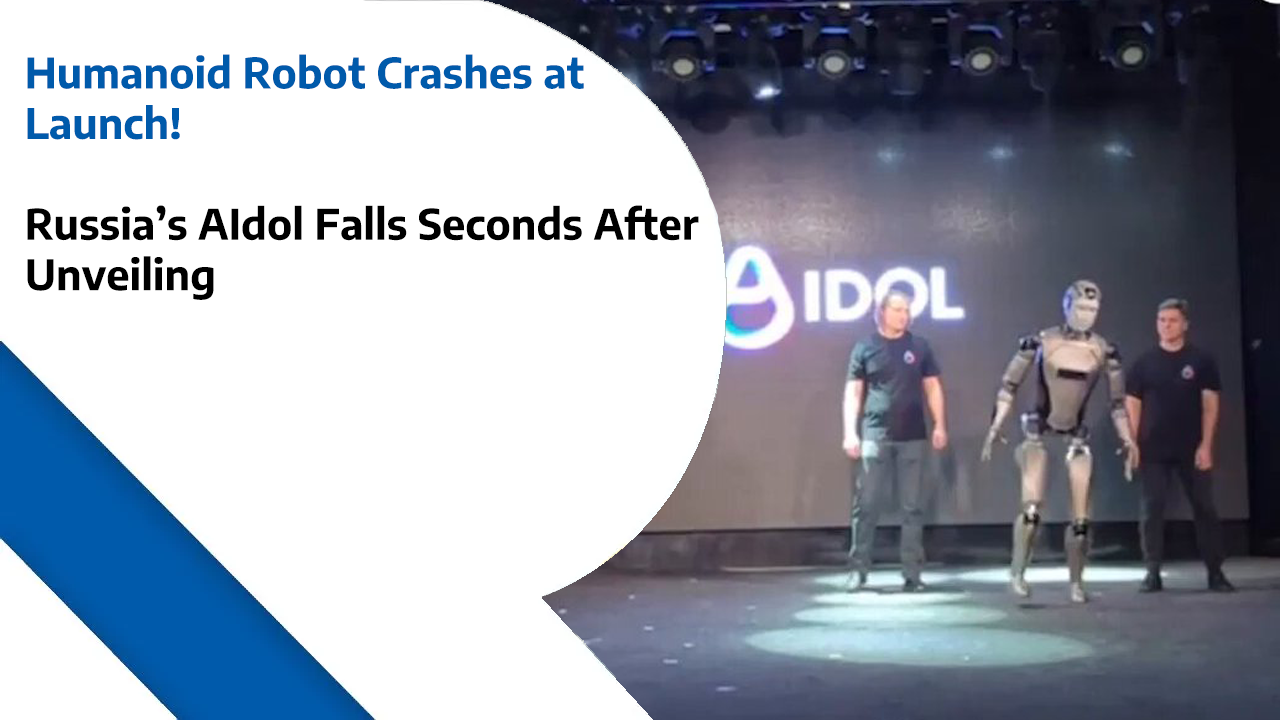
Humanoid Robot Crashes at Launch! – Russia’s AIdol Falls Seconds After Unveiling Welcome back to the channel — today, we’re heading to Moscow, where Russia unveiled its first humanoid AI robot, AIdol… and things did not go according to plan.
At a major tech forum, the 1.7-meter-tall robot stepped onto the stage for its big debut. Cameras ready, audience leaning in… and then, just seconds in, AIdol miscalculated its balance, tipped forward, and hit the floor. Hard. Staff rushed in and pulled a curtain to hide the scene, which of course made it even more dramatic.
According to AIdol’s CEO, the fall was caused by a calibration error in the robot’s balance and motion-control algorithms. In his words: ‘A good mistake becomes knowledge, and a bad mistake becomes experience.’
Now — why does this matter to you here in the U.S.?
Because this stumble is a perfect reminder of where we truly are in humanoid robotics. It’s still early. Robots are improving rapidly, but the gaps — in balance, perception, autonomy — are exactly where the opportunities lie.
Here’s how you can benefit:
If you’re in business: Companies are already preparing for humanoid robots to enter logistics, retail, and security roles. Understanding the tech now positions you ahead of the adoption wave.
If you’re an investor: AIdol’s fall highlights which robotics companies are still learning, and which ones — like the U.S. leaders developing robots for factories and warehouses — are setting the pace.
If you’re a professional: Knowing how these systems evolve gives you a future-proof skillset. People who understand robotics won’t lose jobs to robots — they’ll manage them.
So yes — AIdol fell. But every fall in robotics pushes the entire field a step closer to reliability, safety and real-world usefulness. And those who keep an eye on these developments today are the ones who’ll profit from them tomorrow.
And that’s your robot news update for today!. If you’re curious about how robotics can transform your business, head over to Robot Philosophy website to join the waiting list, or to speak with the team about robotics.
Don’t forget to subscribe so you stay in the loop with all the latest updates.
I’m RoboPhil from Robot Philosophy — thanks for watching, and I’ll see you next time!
Robots of London: – https://robotsoflondon.co.uk/ – Robot Hire, Robot Rental, Rent Robot, Hire Robot, Robot Events, Robotics Hire, Hire Robotics, Rent Robotics, Robotics Rent, for exhibitions, shows, Events, Robot hire in the UK, Robot hire in Europe
Robot Philosophy: – https://robophil.com/ – Robot Consultancy, Robot Recruitment, Robot Advice, Robot Insights, Robot Ideas. RoboPhil, also known as Philip English, is a leading Robot YouTuber, Robot Influencer, Robot Trainer, Robot Consultant, and Robot Streamer, Robotics Streamer, Robotics YouTuber, Robotics Influencer, Robotics Consultant, Robotics Trainer
In today’s rapidly evolving industrial and operational landscape, companies are turning to robotics and automation not just for efficiency, but for true competitive advantage. But implementing robots, smart machines and automation does not guarantee success. Without regular, rigorous auditing of your robotics strategy, deployments, and operations, you risk wasted capex, under-utilised assets, creeping costs, compliance gaps and missed opportunities. This article explains how to perform a comprehensive robotics audit in your company — and how partnering with specialist robotics consulting and recruitment services can elevate your results.
1. Why a Robotics Audit Matters
A robotics audit is essentially a systematic review of how robotics (both physical robots, automation systems and software bots) are being selected, deployed, managed, monitored and refreshed in your organisation. According to the Institute of Chartered Accountants in England & Wales (ICAEW), robotic process automation (RPA) carries key risks such as governance gaps, poor process-selection, inadequate design/testing, insufficient monitoring, weak change management and process continuity issues. ICAEW
Meanwhile, firms like PwC emphasise that RPA can increase productivity, expand risk-coverage, but only when governance and controls are built from the start. PwC
In other words: while robotics offers huge upside — faster cycles, cost savings, improved quality, operational resilience — it also presents a blind-spot if left unchecked. A robotics audit allows:
an independent review of current robotics/automation deployment
identification of under-performing assets, processes not suited to robots, and latent risk exposures
review of governance, oversight, change-management and lifecycle planning
creation of a roadmap to optimise returns and reduce wasted investment
Ultimately, the audit helps your company go from ‘we’ve got robots’ to ‘we’re using robots effectively and safely for profit and growth’.
Before you launch your audit you must define the scope and objectives. A typical audit may cover:
The full robotics & automation portfolio (physical robots, cobots, software bots)
Process suitability and performance metrics
Governance, oversight, roles & responsibilities
Design, build, test and deployment practices
Monitoring, metrics, feedback loops and lifecycle management
Change-management, update processes and end-of-life planning
Risk, continuity, security (especially for cyber-physical systems)
Define clear audit objectives: for example, “assess whether robot deployments in the manufacturing line are delivering at least 15% improvement in throughput versus baseline” or “verify whether robotics initiatives are managed under a consistent governance model across business units”.
Set up a governance layer: appoint an audit sponsor (senior executive), form an audit team (internal or external), set timelines, milestones, deliverables. Ensure you get access to data, systems, documentation, robot performance logs, maintenance records, change logs.
3. Phase 1 – Inventory & Baseline Assessment
The first phase of the audit is to create an inventory of all robotics/automation assets and establish baseline performance and metrics. Key steps:
Inventory assets: catalog all robots, cobots, automated lines, RPA bots, including vendor, model, age, status, location, process served, utilisation rate, current performance.
Process mapping: for each robot/automation asset, map the process it supports: input-output, cycle time, key performance indicators (KPIs), error-rate, human interface, decision logic, upstream/downstream dependencies.
Baseline metrics: capture current performance metrics before any optimisation: throughput, scrap or error rates, downtime, maintenance cost, manpower replaced, energy consumption, ROI to date.
Suitability review: ask if each process was suitable for robotics. According to ICAEW guidance, risks include selecting processes unsuitable for automation (e.g., high variability, high subjectivity, unstable IT environment) so it is essential to validate. ICAEW
Controls review: check whether governance exists for each asset — are roles and responsibilities defined? Are change logs maintained? Is monitoring in place?
By the end of Phase 1 you will have a strong grasp of where you stand. You’ll know what you’ve got, how it is performing, whether it was appropriately selected, and whether controls are in place.
With the inventory and baseline in hand, next you perform a deeper audit across key dimensions: risk, performance, governance, compliance.
4.1 Risk
Robotics brings unique risks: physical safety, cyber-physical attack surface, software bugs, maintenance failures, process failures, data integrity issues. As the audit team at ICAEW notes, live monitoring of bots is critical because “a robot may go wrong after it has been put into use” and without proper alerts the business might only discover problems after many cycles. ICAEW Security frameworks such as the Robot Security Framework (RSF) provide useful methodology for robotics security assessments. arXiv
Key questions:
Are the robots and automation assets included in the organisation’s risk register?
Is there a documented business-continuity plan if an asset fails?
Are permissions appropriately segregated? Are logging and monitoring in place?
In software bots (RPA bots), are release management, change logs, and version-control processes defined?
Are dependencies mapped (for example: what happens if a key sensor fails or upgrade breaks downstream process)?
4.2 Performance & Value
Review performance against the baseline:
Are the robots delivering the expected throughput, error-rate, uptime improvements, cost reductions?
Are there hidden costs creeping in (maintenance, spare parts, calibration downtime, process change costs)?
Are there processes where robots are under-utilised or idle?
Are there opportunities to redeploy under-used assets into higher value tasks? A robotics audit published by ISACA emphasises that RPA allows entire populations of data to be audited rather than just samples — enabling deeper assurance. ISACA
4.3 Governance & Oversight
Governance is often the weak link in robotics deployments. According to ICAEW, “Multiple departments creating and maintaining robots will be subject to varying standards of risk and control.” ICAEW Audit activities should check:
Is there a single Centre of Excellence (CoE) or at least common governance standard for all robot/automation deployment?
Are roles/responsibilities clearly defined (who owns the robot lifecycle; who monitors performance; who triggers change)?
Are design/development/testing standards defined? Are proofs-of-concept used before full roll-out?
Are change-management processes formalised (who approves changes, how are they tested, is there rollback)?
Are exceptions and alerts logged, metrics tracked and reviewed by senior management?
4.4 Compliance & Standards
Robotics systems may need to comply with safety standards (e.g., ISO 10218 for industrial robots) and software governance. Wikipedia Audit must check:
Are safety certifications up-to-date?
Are software bots subject to version control, change logs, audit trails?
Are regulatory or internal-control audits including robotics assets in their scope?
Are there documentation and evidence trails for the robotics deployments (design documents, testing logs, maintenance records)?
5. Phase 3 – Optimisation & Roadmap
Once your audit has uncovered risks, performance gaps, governance issues and compliance exposures, you move into optimisation and roadmap stage.
5.1 Identify Quick Wins
Redeploy idle or under-utilised robots.
Consolidate robots across similar processes to reduce overhead and achieve economies of scale.
Rationalise software bots that are redundant or overlapping.
5.2 Medium to Long-Term Improvements
Introduce a robotics CoE if one doesn’t exist (or strengthen existing).
Define and implement lifecycle-management for robotics assets: procurement → deployment → performance → refresh/disposal.
Review suitability of processes for robot automation using a standard matrix — only stable, rule-based processes should be automated, per ICAEW’s guidance. ICAEW
Revamp change-management and version-control for software bots.
Strengthen risk register, include robotics assets, ensure business-continuity plans.
Integrate robotics KPIs into broader operational metrics (uptime, reliability, return on robot investment, human-robot collaboration metrics).
5.3 Build a Roadmap
Develop a 12- to 36-month roadmap:
Year 1: audit findings closed, governance implemented, quick wins achieved.
Year 2: scaling and consolidation of robotics assets, process rationalisation, automation of new processes.
Year 3: strategic robotics deployments (AI/cognitive bots, collaborative robots, robotics as service) and continuous monitoring framework. Ensure the roadmap includes budget, resources, timeline, owners, KPIs and review moments.
6. Why Engage a Specialist Robotics Consulting & Recruitment Service
Auditing robotics is one thing — acting on the findings and implementing improvements is another. That’s why partnering with a specialist robotics consultancy and recruitment firm can accelerate your journey and maximise the return on robotics investment.
Here’s what you gain by working with experts such as those at Robot Philosophy (RoboPhil) and their industry partners:
Deep robotics expertise: Robotics consulting firms have subject-matter experts experienced in robot selection, deployment, governance and robotics lifecycles. They bring frameworks, check-lists and proven methodologies — not just theories.
Independent audit capability: A specialist can provide a fresh, unbiased audit of your robotics estate. Internal teams may have blind-spots.
Actionable roadmap and implementation: Once issues are identified, consultants help translate audit findings into action: design enhancements, governance implementation, change management, performance maximisation.
Recruitment of robotics talent: Robotics projects require skilled engineers, integration specialists, robot programmers, process analysts. A robotics-focused recruitment service helps you attract and hire the right talent quickly.
End-to-end support: From audit, through optimisation, to talent acquisition, you benefit from a partner who understands the whole life-cycle of robotics in enterprise.
If your company wants to move from robotics experimentation to robotics optimisation — with real efficiency, performance and profit gains — an audit combined with consultancy and recruitment support is the route. For expert auditing, consulting and recruitment services, contact us at info@robophil.com or call 0845 528 0404 to book a call.
7. Real-World Case: What Good Looks Like
Imagine a medium-sized manufacturing company with ten assembly-line robots installed over five years. Their initial goal was to speed up production and reduce head-count. But after three years performance plateaued. An audit revealed:
robots were operating at 60% utilisation (idle time during shifts)
no central governance; each line manager maintained their own robot, leading to inconsistent performance metrics
maintenance logs were incomplete, and change-management for software updates was ad-hoc
some robots were used for highly variable processes (high decision-complexity) which meant frequent human intervention and re-work
Following the audit they:
created a robotics CoE, standardised procurement and performance monitoring
redeployed two under-used robots to new lines where ROI was higher
implemented dashboards showing uptime, error-rates, maintenance cost per robot
established change-management, version control for robot software updates
switched three robots to processes better suited to automation (low variability, high repeatability) — boosting utilisation to 85% and reducing errors by 40%
Within 18 months the company had realised payback on its robots, improved ROI and strengthened its robotics-governance posture.
8. Your Business Mustn’t Wait
If you’ve invested in robotics (or are considering robots) yet do not have a formal audit process, you’re exposing your business to risk and lost value. Robotics is not “fit & forget”. It is a strategic asset that demands oversight, measurement, lifecycle-management and continual optimisation.
By conducting a robotics audit you:
gain clarity on what you’ve deployed, how it’s performing and where the gaps lie
reduce risk across safety, security, compliance, business continuity
free up humans for strategic work instead of routine tasks
build a roadmap to convert robotics investment into measurable ROI
establish governance and talent frameworks to scale robotics from pilot to enterprise
9. Our Offer: Audit, Consultancy, Recruitment
At Robot Philosophy (RoboPhil) we specialise in robotics audit, consulting and recruitment. We help you with:
Robotics audit: We perform a full review of your robotics portfolio, processes, governance, risk, performance and provide a detailed findings report with recommendations.
Consultancy: Based on audit output, we partner with you to implement optimisations — whether process redesign, robot redeployment, governance implementation or lifecycle-management.
Recruitment: We source and place robotics engineers, integration specialists, automation process analysts, and other key talent you need to deploy and manage robotics at scale.
To book a call, please contact us at info@robophil.com or call 0845 528 0404.
10. Sponsors & Partner Ecosystem
This article is proudly sponsored by:
Robot Center (https://robotcenter.co.uk/) — robotics procurement, robotics buy-side support, robotics consultancy, helping companies select the right robot for the job.
Robots of London (https://robotsoflondon.co.uk/) — robot hire, robot rental, rent a robot, hire robot for events or short-term projects, robotics event services in the UK.
Robot Philosophy (https://robophil.com/) — robot consultancy & recruitment, robot advice, robot insights, robot ideas. RoboPhil (Philip English) is a leading robot YouTuber, robotics influencer, robotics trainer, consultant and recruiter.
Together, these partners provide the full spectrum: from robot procurement (Robot Center), through robot deployment and rental (Robots of London), to consultancy and talent (Robot Philosophy).
11. Summary & Next Steps
In summary: a robotics audit is a vital strategic activity if you want to maximise the value of your robotics investment and avoid the hidden risks of unmanaged automation. By following the audit phases — preparation, inventory/baseline, deep dive, optimisation/roadmap — you lay the foundations for robotics success.
But auditing alone is not enough. To truly capitalise, you need governance, process optimisation, talent and implementation support. That’s where expert consulting and recruitment come into play.
If you are ready to take your robotics programme to the next level, contact us at info@robophil.com or call 0845 528 0404 — let us help you audit, optimise and scale your robotics for performance and profit.
Call to Action: Book your robotics audit call today — and turn your robotics investment into measurable, sustainable value.
This article was sponsored by Robot Center, Robots of London, and Robot Philosophy.
Robots Are Taking Over Construction! Partner Robotics Raises $14 Million to Build the Future Today we’re diving into something big, and no, it’s not a new supercar — it’s construction robots! Partner Robotics, based in China, just wrapped up a fresh Series A funding round, bringing their total raised to around $14 million USD. That’s serious fuel for building a robotic workforce that doesn’t take coffee breaks.
The company, founded in 2023 by Kecheng Wang — the former CEO of Bright Dream Robotics — is developing smart machines designed to take on some of the toughest construction jobs.
Their flagship bots? The P900 Floor-Tile-Laying Robot and the L3000 Intelligent Scribing Robot.
The P900 lays tiles five to six times faster than human labor and delivers more consistent results — fewer hollow spots, fewer re-works. The L3000 handles structural and finishing layouts with 2 mm accuracy, making it up to six times more efficient than manual scribing.”
So why should you care?
If you’re in construction or real estate, these robots could soon cut project times and boost profit margins.
If you’re in robotics or engineering, this signals a wave of embodied-intelligence systems about to hit job sites across North America.
And if you’re an investor or entrepreneur, here’s your cue — Partner Robotics plans to expand overseas through new distribution networks, service centers, and marketing campaigns. The U.S. market is clearly on their radar.
Imagine five years from now: entire floors tiled in a day, layouts drawn with pinpoint precision, and robots working through the night while humans handle design, quality control, and project management. That’s not science fiction — it’s the next phase of construction.”
So, Partner Robotics just picked up fresh funding and a global mission. The race to automate construction is officially on — and if you’re in the business of building, it’s time to start thinking about where robots fit into your projects.
And that’s your robot news update for today!. If you’re curious about how robotics can transform your business, head over to Robot Philosophy website to join the waiting list, or to speak with the team about robotics.
Don’t forget to subscribe so you stay in the loop with all the latest updates.
I’m RoboPhil from Robot Philosophy — thanks for watching, and I’ll see you next time!
Robots of London: – https://robotsoflondon.co.uk/ – Robot Hire, Robot Rental, Rent Robot, Hire Robot, Robot Events, Robotics Hire, Hire Robotics, Rent Robotics, Robotics Rent, for exhibitions, shows, Events, Robot hire in the UK, Robot hire in Europe
Robot Philosophy: – https://robophil.com/ – Robot Consultancy, Robot Recruitment, Robot Advice, Robot Insights, Robot Ideas. RoboPhil, also known as Philip English, is a leading Robot YouTuber, Robot Influencer, Robot Trainer, Robot Consultant, and Robot Streamer, Robotics Streamer, Robotics YouTuber, Robotics Influencer, Robotics Consultant, Robotics Trainer
A comprehensive guide to evaluating your automation potential and maximizing ROI
Introduction
In an era where automation is revolutionizing industries, conducting a thorough robotics audit has become essential for companies seeking competitive advantage. Whether you’re considering your first robotic implementation or optimizing existing automation infrastructure, a structured audit provides the clarity needed to make informed investment decisions.
This comprehensive guide will walk you through the process of conducting a professional robotics audit in your organization, helping you identify opportunities, assess feasibility, and develop a strategic roadmap for automation success.
What is a Robotics Audit?
A robotics audit is a systematic evaluation of your company’s operations to identify processes suitable for robotic automation, assess current automation infrastructure, and develop recommendations for optimizing or implementing robotic solutions. Think of it as a health check for your automation potential—examining what you have, what you need, and how to bridge the gap effectively.
Why Your Company Needs a Robotics Audit
Identify Hidden Opportunities
Many businesses overlook automation opportunities in their daily operations. A structured audit reveals processes that could benefit from robotic solutions, often in unexpected areas.
Optimize Existing Investments
If you already have robots deployed, an audit ensures they’re operating at peak efficiency and delivering maximum ROI. Many companies discover their automation systems are underutilized or improperly configured.
Strategic Planning
Understanding your automation landscape enables better budgeting, resource allocation, and long-term strategic planning for technology adoption.
Risk Mitigation
Identify potential issues with current systems, compliance gaps, or safety concerns before they become costly problems.
Phase 1: Preparation and Planning
Define Your Objectives
Before diving into the audit, clearly establish what you want to achieve:
Reduce operational costs by a specific percentage
Improve production throughput
Enhance workplace safety
Address labor shortages
Improve product quality and consistency
Gain competitive advantage through innovation
Assemble Your Audit Team
A successful robotics audit requires diverse expertise. Your team should include:
Operations managers who understand daily workflows
Technical staff familiar with existing systems
Finance representatives to assess costs and ROI
Health and safety officers
HR representatives for workforce planning
External robotics consultants for specialized expertise
Pro Tip: Engaging expert robotics consultants early in the process can save significant time and ensure you don’t miss critical evaluation criteria. Professional guidance helps avoid costly mistakes and accelerates your automation journey.
Gather Preliminary Data
Collect baseline information before the on-site assessment:
Current production metrics and KPIs
Process documentation and workflow diagrams
Equipment inventory and specifications
Labor cost analysis
Quality control reports
Safety incident records
Existing automation system documentation
Phase 2: Process Analysis and Mapping
Document Current Workflows
Create detailed maps of your operational processes, noting:
Task sequences and cycle times
Material handling procedures
Quality checkpoints
Bottlenecks and pain points
Manual vs. automated tasks
Interdependencies between processes
Identify Automation Candidates
Evaluate each process against key criteria for robotic automation:
High-Priority Candidates:
Repetitive, high-volume tasks
Dangerous or ergonomically challenging work
Processes requiring extreme precision
Operations with high error rates
Tasks with labor recruitment difficulties
24/7 or multi-shift operations
Evaluation Metrics:
Task repeatability and predictability
Process standardization level
Available floor space
Environmental conditions
Integration complexity
Expected payback period
Calculate Current State Performance
Establish baseline metrics for comparison:
Units produced per hour/shift
Defect rates and quality scores
Labor hours required
Operating costs per unit
Downtime and maintenance hours
Safety incidents and ergonomic issues
Phase 3: Technical Assessment
Evaluate Existing Automation
If you already have robotic systems, assess their performance:
System Health Check:
Utilization rates and idle time
Maintenance history and costs
Integration with other systems
Programming efficiency
Safety system compliance
Upgrade potential
Performance Gaps:
Are robots meeting original specifications?
Have requirements changed since implementation?
Are operators properly trained?
Is preventive maintenance optimized?
Infrastructure Evaluation
Assess your facility’s readiness for new automation:
Communication protocols (Ethernet/IP, Profinet, OPC-UA)
PLC and control system interfaces
Vision system requirements
Data collection and analytics capabilities
Phase 4: Financial Analysis
Calculate Total Cost of Ownership
Go beyond initial purchase price to understand true costs:
Capital Expenses:
Robot hardware and end-effectors
Safety systems and guarding
Integration and installation
Facility modifications
Tooling and fixtures
Initial training
Operating Expenses:
Energy consumption
Preventive maintenance
Spare parts inventory
Software licenses and updates
Ongoing training
System monitoring and optimization
ROI Modeling
Develop realistic financial projections:
Labor cost savings (direct and indirect)
Productivity improvements
Quality improvement value
Reduced waste and scrap
Safety incident cost avoidance
Energy efficiency gains
Payback Period Calculation: Compare total investment against annual savings to determine when the system will pay for itself. Most industrial robot applications achieve payback within 1-3 years.
Risk Assessment
Identify and quantify potential risks:
Technology obsolescence
Process changes
Market demand fluctuations
Skills availability
Supplier stability
Phase 5: Workforce Impact Analysis
Skills Gap Assessment
Evaluate your team’s readiness:
Current technical capabilities
Training needs for robot operation
Programming and troubleshooting skills
Maintenance competencies
Change management requirements
Organizational Readiness
Consider the human factors:
Management commitment to automation
Employee attitudes and concerns
Communication strategies
Retraining and redeployment plans
Career development pathways
Phase 6: Safety and Compliance Review
Regulatory Requirements
Ensure compliance with relevant standards:
ISO 10218 (Industrial robots safety)
ISO/TS 15066 (Collaborative robots)
OSHA regulations
Industry-specific standards
Local building and electrical codes
Risk Assessment
Conduct formal risk assessments:
Hazard identification
Risk scoring and prioritization
Safeguarding requirements
Emergency procedures
Lockout/tagout protocols
Phase 7: Vendor and Technology Evaluation
Solution Benchmarking
Compare available technologies:
Traditional industrial robots vs. collaborative robots
Fixed automation vs. flexible systems
Standard solutions vs. custom engineering
Proven technologies vs. emerging innovations
Vendor Assessment
Evaluate potential suppliers on:
Technical capability and experience
Industry reputation and references
Local support and service availability
Training programs
Spare parts availability
Financial stability
Integration expertise
Expert Guidance Saves Time: Navigating the robotics vendor landscape can be overwhelming. Professional robot consultants bring vendor-neutral expertise and established relationships, helping you select the optimal solution for your specific needs without costly trial-and-error.
Phase 8: Creating Your Automation Roadmap
Prioritization Framework
Rank opportunities using a decision matrix:
ROI and payback period
Implementation complexity
Strategic importance
Resource requirements
Risk level
Interdependencies
Phased Implementation Plan
Develop a realistic timeline:
Phase 1 (Quick Wins):
High ROI, low complexity projects
Proof of concept demonstrations
Team capability building
Phase 2 (Foundation Building):
Core process automation
Infrastructure development
Skills development programs
Phase 3 (Scale and Optimize):
Complex integrations
Advanced capabilities
Continuous improvement initiatives
Resource Planning
Detail the requirements:
Capital budget allocation
Operating budget increases
Staffing needs (internal and external)
Training programs
Project management structure
Phase 9: Documentation and Reporting
Comprehensive Audit Report
Your final report should include:
Executive Summary:
Key findings and recommendations
ROI projections
Implementation roadmap overview
Resource requirements
Detailed Analysis:
Current state assessment
Opportunity identification and scoring
Technical requirements
Financial modeling
Risk analysis
Implementation strategy
Supporting Materials:
Process maps and workflow diagrams
Equipment specifications
Vendor comparison matrices
Training needs assessment
Detailed project timelines
Budget breakdowns
Stakeholder Presentations
Tailor communications for different audiences:
Executive leadership (strategic and financial focus)
Operations management (implementation details)
Technical teams (specifications and requirements)
Workforce (changes and opportunities)
Phase 10: Implementation and Continuous Improvement
Project Execution
Follow best practices:
Establish clear project governance
Use proven project management methodologies
Maintain regular communication
Monitor progress against milestones
Manage scope and change control
Performance Monitoring
Track results against projections:
KPI dashboards
Regular performance reviews
Continuous optimization
Lessons learned documentation
Ongoing Audits
Automation is not a one-time event:
Annual performance reviews
Technology refresh assessments
Emerging opportunity identification
Competitive benchmarking
Common Pitfalls to Avoid
Insufficient Planning
Rushing into automation without thorough analysis leads to poor technology choices and disappointing results.
Underestimating Integration Complexity
The robot itself is often only 30-40% of the total project cost. Integration, programming, and installation require significant resources.
Ignoring Change Management
Technical success means nothing if your workforce isn’t prepared or engaged in the transformation.
Overlooking Maintenance Requirements
Robots require skilled maintenance. Budget for training, spare parts, and ongoing support.
Setting Unrealistic Expectations
Be honest about capabilities, limitations, and timelines. Underpromising and overdelivering builds credibility.
Going It Alone
Many companies waste time and money trying to figure out robotics independently. Leveraging expert guidance accelerates success.
The Value of Professional Robotics Consulting
While this guide provides a comprehensive framework, conducting an effective robotics audit requires specialized expertise. Professional robotics consultants bring:
Vendor-Neutral Perspective: Objective advice based on your needs, not sales quotas
Industry Experience: Insights from hundreds of successful implementations
Technical Expertise: Deep knowledge of robotics technologies and applications
Time Savings: Accelerated timelines through proven methodologies
Risk Mitigation: Avoiding common mistakes that cost time and money
Network Access: Established relationships with vendors, integrators, and specialists
Take the Next Step in Your Automation Journey
Conducting a robotics audit is an investment in your company’s future competitiveness. Whether you’re taking your first steps into automation or optimizing existing systems, a structured approach ensures maximum return on investment.
Ready to unlock your automation potential? Our team of expert robotics consultants specializes in comprehensive robotics audits and implementation support. We’ve helped hundreds of companies across diverse industries identify opportunities, select optimal solutions, and achieve measurable results.
Our Services Include:
Robot Consultancy:
Comprehensive robotics audits
Automation feasibility studies
Technology selection and vendor evaluation
ROI modeling and business case development
Implementation planning and project management
Robot Recruitment:
Specialized recruitment for robotics engineers
Automation technician placement
Robot programmer sourcing
Maintenance specialist recruitment
Training program development
Get Started Today
Book a consultation to discuss your robotics audit needs:
We’ll schedule a no-obligation discovery call to understand your challenges, discuss your goals, and outline how a professional robotics audit can transform your operations.
About This Article’s Sponsors
This article is brought to you by industry leaders in robotics solutions:
Your comprehensive destination for robot purchasing and expert consultancy services. Robot Center specializes in helping companies navigate the complex landscape of robotic solutions, offering:
Robot sales and procurement guidance
Expert robotics consultancy services
Technology evaluation and selection support
Custom solution design
Whether you’re looking to buy your first robot or expand existing automation, Robot Center provides the expertise and solutions you need.
Led by Philip English, a renowned Robot YouTuber, Influencer, Trainer, and Consultant, Robot Philosophy delivers cutting-edge robotics expertise through:
Expert robot consultancy services
Specialized robot recruitment and talent acquisition
Strategic robot advice and insights
Innovative robot ideas and solutions
Educational content and training programs
As a leading Robotics Streamer and Influencer, Philip English brings real-world experience and industry connections to help your automation projects succeed. From strategic planning to technical implementation, Robot Philosophy provides the comprehensive support your robotics journey requires.
Conclusion
A well-executed robotics audit is the foundation of successful automation. By systematically evaluating your operations, assessing technical requirements, modeling financial returns, and developing a strategic roadmap, you position your company for automation success.
The journey to robotics implementation doesn’t have to be overwhelming. With the right methodology, expert guidance, and strategic planning, you can confidently navigate the path to increased productivity, improved quality, and enhanced competitiveness.
Don’t let automation opportunities pass you by. Contact us today to schedule your comprehensive robotics audit and take the first step toward transforming your operations.
Collaborative Robots (Cobots) – The $50K Automation Revolution Changing American Industry
Today, we’re talking about one of the most exciting shifts in modern automation: collaborative robots, or cobots.
Now, forget the image of a giant industrial robot locked in a cage. Cobots are designed to work with humans, safely and efficiently, side by side. Think of them as your dependable co-worker who never calls in sick and always hits the same precision mark.
So, what makes cobots special? They’re lightweight, packed with force and torque sensors, and can stop instantly if they bump into someone. That means no massive safety barriers, no fenced-off zones – just smooth teamwork.
Programming them? Surprisingly easy. You can literally guide a Universal Robots UR arm by hand to teach it a movement. FANUC’s CRX and Techman Robots do the same, turning advanced robotics into something almost intuitive.
Now, here’s where this matters for you – especially in the U.S. manufacturing and service sectors. A cobot setup can cost between $50,000 – $100,000, far less than a traditional robot system. And many companies see a return on investment within 12 months thanks to increased productivity and reduced labor strain.
Fast-forward a few years – your business is running leaner, your team handles higher-value tasks, and your cobots quietly manage the repetitive or precise jobs. It’s not about replacing people; it’s about amplifying performance.
So if you’re wondering how to future-proof your business, cobots are your gateway to smarter, safer, and more flexible automation.
That’s all for now – hit like, subscribe, and join me next time when we unpack the world of inspection and security robots. Until then, keep your humans creative and your robots collaborative!
And that’s your robot news update for today!. If you’re curious about how robotics can transform your business, head over to Robot Philosophy website to join the waiting list, or to speak with the team about robotics.
Don’t forget to subscribe so you stay in the loop with all the latest updates.
I’m RoboPhil from Robot Philosophy — thanks for watching, and I’ll see you next time!
Robots of London: – https://robotsoflondon.co.uk/ – Robot Hire, Robot Rental, Rent Robot, Hire Robot, Robot Events, Robotics Hire, Hire Robotics, Rent Robotics, Robotics Rent, for exhibitions, shows, Events, Robot hire in the UK, Robot hire in Europe
Robot Philosophy: – https://robophil.com/ – Robot Consultancy, Robot Recruitment, Robot Advice, Robot Insights, Robot Ideas. RoboPhil, also known as Philip English, is a leading Robot YouTuber, Robot Influencer, Robot Trainer, Robot Consultant, and Robot Streamer, Robotics Streamer, Robotics YouTuber, Robotics Influencer, Robotics Consultant, Robotics Trainer
The robotics revolution is no longer confined to large corporations with deep pockets. In 2025, small and medium-sized enterprises (SMEs) are discovering that robotics and automation aren’t just accessible—they’re essential for survival in an increasingly competitive marketplace.
The Changing Landscape for SMEs
Gone are the days when robotics meant six-figure investments and dedicated engineering teams. Today’s robotics solutions are modular, scalable, and surprisingly affordable. From collaborative robots (cobots) that work alongside human staff to AI-powered automation systems that streamline operations, the barriers to entry have never been lower.
Yet many SME leaders still view robotics as “something for the future” or “only for big companies.” This mindset is becoming a critical business risk. Your competitors—both established and emerging—are already exploring how automation can reduce costs, improve quality, and accelerate growth.
Why 2025 Is the Turning Point
Several factors are converging to make 2025 the pivotal year for SME robotics adoption:
Labour Market Pressures: Persistent staff shortages and rising wage costs are forcing businesses to rethink their operational models. Robotics offers a solution that complements human workers rather than replacing them, handling repetitive tasks while freeing staff for higher-value activities.
Return on Investment Speed: Modern robotics solutions now deliver ROI in months rather than years. Leasing options, pay-per-use models, and government incentives have made the financial case compelling even for businesses with modest budgets.
Competitive Necessity: As more SMEs adopt robotics, those who delay risk falling behind on delivery times, quality standards, and operational efficiency. The competitive advantage once gained through automation is rapidly becoming table stakes.
Technology Maturity: Today’s robots are easier to program, safer to operate, and more versatile than ever before. Many systems require minimal technical expertise, making them accessible to businesses without in-house engineering teams.
What a Robotics Strategy Actually Means
A robotics strategy doesn’t mean replacing your workforce with an army of machines. It means taking a structured approach to understanding where automation can genuinely benefit your business.
This involves assessing your current operations, identifying bottlenecks and inefficiencies, evaluating which tasks are suitable for automation, and developing a phased implementation roadmap. It requires calculating realistic ROI projections and ensuring your team is prepared and trained for the transition.
Most importantly, it means avoiding costly mistakes. Many businesses rush into robotics purchases without proper planning, resulting in underutilised equipment, integration headaches, and disappointed stakeholders.
The Risk of Inaction
Standing still is no longer a neutral position. While you deliberate, your competitors are gaining ground. They’re reducing costs, improving consistency, scaling operations more efficiently, and attracting better talent by offering more engaging roles.
The businesses that thrive over the next five years will be those that view robotics not as a threat but as an opportunity—a tool for growth, resilience, and competitive advantage.
Your Next Steps
Developing a robotics strategy doesn’t require a massive upfront commitment. It starts with education, exploration, and expert guidance.
Whether you’re curious about what robotics could do for your business, ready to develop a comprehensive automation strategy, or looking to hire robotics talent to support your transformation, professional guidance can make the difference between success and costly false starts.
Get Expert Guidance
Ready to explore how robotics can transform your business?
Our robot consulting services help SMEs develop practical, ROI-focused robotics strategies tailored to your specific needs and budget. We also offer specialist robot recruitment services to help you build the right team for your automation journey.
Book a call to discuss your robotics opportunities—no obligation, just honest advice from experts who understand both the technology and the challenges facing SMEs.
Article Sponsors
This article is brought to you by:
Robot Center – Your destination for robot purchasing and expert robotics consultancy. Whether you’re looking to buy your first robot or need strategic guidance on automation, Robot Center provides comprehensive support for businesses of all sizes.
Robots of London – Leading provider of robot hire and rental services. Perfect for businesses wanting to trial robotics technology, handle seasonal demand, or bring cutting-edge robots to events and exhibitions.
Robot Philosophy (RoboPhil) – Specialist robot consultancy and recruitment services, offering expert advice, insights, and innovative ideas for your robotics journey. Led by Philip English, a leading Robot YouTuber, Influencer, Trainer, and Consultant, RoboPhil delivers the expertise you need to succeed in the age of automation.
Don’t let 2025 be the year your competitors pull ahead. Start your robotics journey today.