Palletising Robots: Automating the End of the Production Line
Sponsored by Robot Center, Robots of London, and Robot Philosophy
Introduction: The Final Frontier of Manufacturing Automation
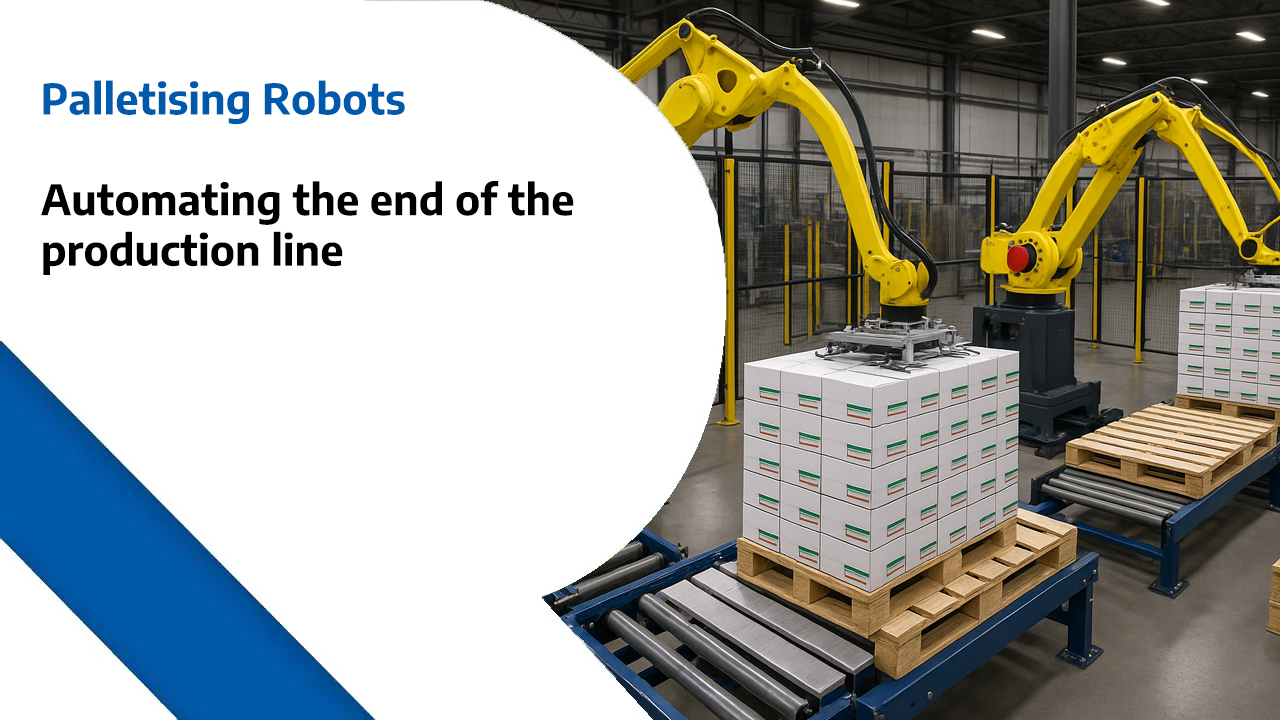
In today’s rapidly evolving manufacturing landscape, efficiency and precision have become the cornerstones of competitive advantage. While automation has revolutionized many aspects of production, one critical area that has traditionally remained labour-intensive is palletising – the process of loading finished products onto pallets for storage and distribution. However, the emergence of sophisticated palletising robots is transforming this final stage of the production line, delivering unprecedented levels of efficiency, consistency, and cost-effectiveness.
Palletising represents far more than simply stacking boxes. It’s the crucial bridge between manufacturing and distribution, where products must be organized, secured, and prepared for their journey to customers. The quality of palletising directly impacts storage efficiency, transportation costs, product integrity during shipping, and ultimately, customer satisfaction. As such, automating this process has become a strategic imperative for manufacturers seeking to optimize their entire supply chain.
The integration of robotic palletising systems marks a paradigm shift from traditional manual or semi-automated approaches. These advanced systems combine cutting-edge robotics technology with sophisticated software algorithms to create solutions that not only match human performance but often exceed it in terms of speed, accuracy, and consistency. Moreover, they operate continuously without fatigue, breaks, or the variability inherent in human performance, making them invaluable assets for modern manufacturing operations.
The Evolution of Palletising Technology
The journey from manual palletising to today’s sophisticated robotic systems reflects the broader evolution of manufacturing technology. In the early days of industrial production, palletising was entirely manual, requiring teams of workers to carefully stack products according to predetermined patterns. While this approach offered flexibility in handling various product types and sizes, it was labour-intensive, prone to inconsistencies, and limited by human physical capabilities and endurance.
The first wave of automation introduced mechanical palletising systems, which used conveyor belts, pushers, and basic mechanical devices to assist in the stacking process. These systems improved speed and reduced the physical demands on workers but remained relatively inflexible and required significant manual oversight. The patterns were fixed, and any deviation from standard product dimensions or packaging often required manual intervention.
The advent of industrial robotics in the 1970s and 1980s opened new possibilities for palletising automation. Early robotic palletisers were primarily articulated arm robots that could be programmed to follow specific pick-and-place patterns. While these systems offered greater flexibility than their mechanical predecessors, they were expensive, complex to program, and required extensive safety infrastructure due to their size and power.
The true revolution in palletising robotics has occurred in recent decades with advances in sensor technology, artificial intelligence, machine vision, and collaborative robotics. Modern palletising robots can adapt to different product types, sizes, and packaging configurations in real-time. They incorporate advanced vision systems that can identify products, assess their orientation, and determine optimal placement strategies on the fly. Machine learning algorithms enable these systems to continuously improve their performance, learning from each palletising operation to optimize future tasks.
Understanding Modern Palletising Robot Technology
Contemporary palletising robots represent a convergence of multiple advanced technologies working in harmony to achieve unprecedented levels of performance and flexibility. At their core, these systems typically consist of several key components: the robotic manipulator, end-of-arm tooling, vision and sensing systems, control software, and safety systems.
The robotic manipulator serves as the physical foundation of the system. Modern palletising robots come in various configurations, including articulated arm robots, delta robots, and gantry systems. Articulated arm robots, with their multiple joints and degrees of freedom, offer exceptional flexibility in reaching different positions and orientations, making them ideal for complex palletising patterns and confined spaces. Delta robots excel in high-speed applications where rapid, precise movements are required, particularly for lighter products. Gantry systems provide excellent reach and payload capacity, making them suitable for heavy-duty applications and large palletising areas.
End-of-arm tooling represents another critical component that directly impacts the robot’s ability to handle different products effectively. Modern palletising robots employ sophisticated grippers and suction systems that can adapt to various package shapes, sizes, and materials. Vacuum grippers are particularly effective for smooth, flat surfaces like cardboard boxes, while mechanical grippers can handle irregularly shaped items or products with limited surface area for vacuum attachment. Advanced systems may incorporate multiple gripper types or adaptive grippers that can automatically adjust to different product characteristics.
Vision and sensing systems have become increasingly sophisticated, enabling robots to operate with minimal pre-programming and adapt to varying conditions. High-resolution cameras, combined with advanced image processing algorithms, allow robots to identify products, assess their condition, and determine optimal handling strategies. These systems can detect damaged packages, verify proper labeling, and even read barcodes or QR codes for inventory tracking purposes.
The control software represents the brain of the palletising system, coordinating all components and making real-time decisions based on input from various sensors and systems. Modern palletising software incorporates artificial intelligence and machine learning capabilities, allowing systems to optimize palletising patterns for stability, space utilization, and handling efficiency. These systems can automatically generate palletising patterns based on product dimensions, weight distribution requirements, and pallet specifications.
Key Benefits of Robotic Palletising
The adoption of robotic palletising systems delivers a comprehensive range of benefits that extend far beyond simple labour replacement. Understanding these advantages is crucial for manufacturers considering automation investments and helps explain why robotic palletising has become increasingly prevalent across diverse industries.
Enhanced Productivity and Throughput
Robotic palletising systems operate continuously without fatigue, breaks, or performance degradation over time. While human workers may experience decreased efficiency during long shifts or repetitive tasks, robots maintain consistent performance throughout their operating cycles. Many modern palletising robots can handle 800-1,200 cases per hour, significantly exceeding typical manual palletising rates of 200-400 cases per hour. This increased throughput directly translates to enhanced overall production capacity and the ability to meet growing demand without proportional increases in labour costs.
Improved Consistency and Quality
Consistency represents one of the most significant advantages of robotic palletising. Human workers, despite their best efforts, introduce variability in placement accuracy, stacking patterns, and handling care. Robots execute each palletising operation with identical precision, ensuring that every pallet meets the same high standards. This consistency extends to packaging integrity, with robots applying consistent pressure and handling techniques that minimize product damage during the palletising process.
Cost Reduction and ROI
While the initial investment in robotic palletising systems can be substantial, the long-term cost benefits are compelling. Labour cost reduction represents the most obvious benefit, but the total cost savings extend to reduced product damage, improved space utilization, decreased insurance costs due to fewer workplace injuries, and reduced overtime expenses. Many organizations report return on investment periods of 18-36 months for robotic palletising systems, making them attractive investments from a financial perspective.
Enhanced Safety
Palletising operations involve repetitive heavy lifting, awkward postures, and potential exposure to falling objects – all factors that contribute to workplace injuries. Robotic palletising systems eliminate these risks for human workers, significantly reducing the likelihood of musculoskeletal injuries, back problems, and accident-related injuries. This improved safety profile not only protects employees but also reduces workers’ compensation costs, insurance premiums, and productivity losses associated with workplace injuries.
Flexibility and Adaptability
Modern palletising robots offer remarkable flexibility in handling different product types, sizes, and palletising patterns. Unlike fixed mechanical systems, robotic palletisers can be quickly reprogrammed to accommodate new products or changed palletising requirements. This adaptability is particularly valuable for manufacturers producing diverse product lines or those operating in dynamic markets where product specifications change frequently.
Data Collection and Analytics
Robotic palletising systems generate valuable data about production processes, including cycle times, throughput rates, error frequencies, and maintenance requirements. This data enables manufacturers to identify optimization opportunities, predict maintenance needs, and make data-driven decisions about production planning and resource allocation. The integration with manufacturing execution systems and enterprise resource planning software provides comprehensive visibility into end-of-line operations.
Types of Palletising Robots and Applications
The diversity of products, packaging formats, and operational requirements across different industries has driven the development of various palletising robot configurations, each optimized for specific applications and performance requirements. Understanding these different types and their optimal applications is essential for selecting the most appropriate solution for specific manufacturing environments.
Articulated Arm Palletising Robots
Articulated arm robots represent the most versatile category of palletising robots, featuring multiple rotary joints that provide exceptional flexibility in movement and positioning. These systems typically offer six degrees of freedom, enabling them to reach virtually any position within their work envelope and orient products in any desired angle. This flexibility makes articulated arm palletisers ideal for complex palletising patterns, mixed product lines, and applications where space constraints require creative approaches to pallet building.
The payload capacity of articulated arm palletising robots varies significantly, with models available for handling everything from lightweight consumer goods to heavy industrial products weighing hundreds of pounds. Advanced models incorporate force sensing capabilities that enable them to handle fragile products with appropriate care while maintaining the strength necessary for heavy-duty applications.
These robots excel in applications requiring frequent changeovers between different product types or palletising patterns. Their programmability allows for quick adaptation to new requirements without mechanical modifications, making them particularly valuable for contract manufacturers or facilities producing diverse product portfolios.
Delta Palletising Robots
Delta robots, characterized by their parallel kinematic structure with three arms connected to a common base, are engineered for high-speed applications where rapid cycle times are paramount. Their unique design provides exceptional speed and acceleration capabilities while maintaining high precision, making them ideal for palletising lightweight to medium-weight products in high-volume production environments.
The parallel structure of delta robots offers inherent advantages in terms of structural rigidity and dynamic performance. The distributed load across multiple arms enables high-speed movements without the oscillations or deflections that might occur with serial kinematic structures like articulated arms. This translates to faster cycle times and the ability to maintain precision even at maximum operating speeds.
Delta palletising robots are particularly well-suited for food and beverage applications, pharmaceutical packaging, and consumer goods manufacturing where high throughput and precise placement are critical requirements. Their compact footprint and overhead mounting capability make them excellent choices for facilities with limited floor space.
Gantry Palletising Systems
Gantry palletising systems employ a Cartesian coordinate system with linear actuators providing movement along X, Y, and Z axes. This configuration offers several distinct advantages, including exceptional reach, high payload capacity, and precise positioning accuracy. Gantry systems can cover large work areas and handle multiple pallets simultaneously, making them ideal for high-volume operations or facilities requiring palletising of multiple product lines.
The linear motion characteristics of gantry systems provide predictable and repeatable positioning, which is particularly beneficial for applications requiring precise layer formation or complex interlocking patterns. The overhead structure maximizes floor space utilization while providing excellent access to the entire palletising area.
Gantry palletising systems are commonly employed in heavy industry applications, including automotive parts, building materials, and industrial chemicals, where their high payload capacity and robust construction are essential. They also excel in applications requiring palletising of multiple SKUs simultaneously or operations where the palletising area must accommodate various pallet sizes and configurations.
Collaborative Palletising Robots
The emergence of collaborative robots (cobots) has introduced new possibilities for palletising automation, particularly in smaller-scale operations or environments where human-robot collaboration is desired. Collaborative palletising robots are designed with inherent safety features that enable them to operate alongside human workers without traditional safety caging, providing flexibility in layout and operation.
While cobots typically offer lower payload capacities and speeds compared to traditional industrial robots, they excel in applications requiring flexibility, easy programming, and integration into existing manual operations. Their user-friendly programming interfaces enable non-expert operators to quickly teach new palletising patterns or modify existing ones, reducing the dependence on specialized programming expertise.
Collaborative palletising robots are particularly well-suited for small to medium-sized operations, specialty packaging applications, and environments where frequent product changeovers require rapid reprogramming. Their ability to work safely alongside humans also makes them valuable for hybrid operations where some tasks remain manual while others are automated.
Integration Challenges and Solutions
While the benefits of robotic palletising are substantial, successful implementation requires careful attention to various integration challenges that can impact system performance, reliability, and return on investment. Understanding these challenges and their solutions is crucial for organizations considering palletising automation.
System Integration Complexity
Modern manufacturing facilities typically employ multiple systems that must work together seamlessly, including conveyor systems, warehouse management systems, manufacturing execution systems, and quality control equipment. Integrating palletising robots into this complex ecosystem requires careful planning and coordination to ensure proper communication and data flow between all components.
Successful integration typically involves standardizing communication protocols, implementing robust data management systems, and ensuring that the palletising system can adapt to variations in upstream processes. This may require custom software development, modification of existing systems, or implementation of middleware solutions that facilitate communication between disparate systems.
Product Handling Variability
Real-world manufacturing environments often involve significant variability in product characteristics, including size tolerances, packaging quality, and surface conditions. Palletising robots must be capable of handling this variability while maintaining performance and avoiding damage to products or equipment.
Advanced vision systems and adaptive control algorithms help address these challenges by enabling robots to assess each product individually and adjust handling strategies accordingly. Machine learning capabilities allow systems to continuously improve their handling techniques based on experience with different product variations.
Layout and Space Constraints
Existing manufacturing facilities often have space constraints that complicate robot installation. Palletising systems must be designed to fit within available space while maintaining adequate access for maintenance, product flow, and safety considerations. This may require creative approaches to robot placement, custom end-effector design, or modification of existing facility infrastructure.
Three-dimensional modeling and simulation tools are invaluable for optimizing layout design and identifying potential interference issues before installation. These tools enable engineers to test different configurations and ensure that the selected solution will operate effectively within the constraints of the existing facility.
Maintenance and Support Requirements
Robotic palletising systems require ongoing maintenance and support to ensure continued reliable operation. Organizations must develop maintenance capabilities, either internally or through service agreements with suppliers. This includes training maintenance personnel, establishing spare parts inventory, and implementing preventive maintenance programs.
Predictive maintenance technologies, including vibration monitoring, thermal imaging, and performance analytics, can help identify potential issues before they result in equipment failures. Remote diagnostic capabilities enable suppliers to provide support and troubleshooting assistance without requiring on-site visits, reducing downtime and support costs.
Industry Applications and Case Studies
The versatility of palletising robots has enabled their adoption across a diverse range of industries, each with unique requirements and challenges. Examining specific applications and case studies provides valuable insights into how different organizations have successfully implemented palletising automation.
Food and Beverage Industry
The food and beverage industry represents one of the largest markets for palletising robots, driven by high-volume production requirements, stringent hygiene standards, and the need for gentle product handling. Palletising robots in this sector must meet food-grade requirements, including stainless steel construction, washdown capabilities, and compliance with relevant food safety regulations.
A major beverage manufacturer implemented articulated arm palletising robots to handle multiple bottle and can formats across several production lines. The system includes adaptive grippers that automatically adjust to different package sizes and vision systems that verify proper case orientation and labeling. The implementation resulted in a 40% increase in palletising throughput while reducing product damage by 60% compared to the previous manual operation.
In frozen food applications, palletising robots must operate in low-temperature environments while handling products that may have frost buildup or irregular surfaces. Specialized gripping systems and cold-weather lubricants ensure reliable operation in these challenging conditions.
Pharmaceutical and Healthcare
The pharmaceutical industry demands exceptional precision, traceability, and contamination control in palletising operations. Robotic palletising systems in this sector often incorporate advanced vision systems for 100% case verification, serialization tracking, and contamination detection. Clean room compatibility and validation documentation requirements add complexity to pharmaceutical palletising installations.
A pharmaceutical manufacturer specializing in sterile injectable products implemented a gantry-style palletising system with integrated vision inspection and serialization tracking. The system verifies that each case contains the correct products, proper labeling, and intact tamper-evident seals before placement on the pallet. Full traceability documentation is generated for each pallet, supporting regulatory compliance and product recall capabilities.
Consumer Packaged Goods
Consumer packaged goods manufacturers often deal with diverse product portfolios, frequent promotional packaging changes, and seasonal demand variations. Palletising robots in this sector must provide exceptional flexibility while maintaining high throughput rates. Quick changeover capabilities and intuitive programming interfaces are essential for adapting to frequent product and pattern changes.
A personal care products manufacturer implemented delta-style palletising robots to handle over 200 different SKUs across multiple production lines. The system includes an automated pattern generation algorithm that creates optimal palletising patterns based on product dimensions and stability requirements. Changeover times between different products average less than five minutes, enabling efficient short-run production.
Building Materials and Construction
The building materials industry presents unique challenges for palletising automation, including heavy products, abrasive materials, and harsh operating environments. Palletising robots in this sector require robust construction, high payload capacity, and protection against dust and debris.
A roofing materials manufacturer implemented a heavy-duty gantry palletising system to handle bundles of asphalt shingles weighing up to 80 pounds each. The system includes specialized gripping technology designed to handle the flexible packaging without damage and pattern generation software that ensures stable pallet configuration for transportation and storage.
Future Trends and Technological Advances
The field of palletising robotics continues to evolve rapidly, driven by advances in artificial intelligence, sensor technology, and collaborative robotics. Understanding these emerging trends is crucial for organizations planning long-term automation strategies and investment decisions.
Artificial Intelligence and Machine Learning Integration
The integration of AI and machine learning technologies is transforming palletising robots from programmed systems into intelligent, adaptive solutions. Modern systems can learn from experience, optimizing palletising patterns for stability, efficiency, and space utilization. Machine learning algorithms analyze successful palletising operations and failure modes to continuously improve system performance.
Predictive analytics capabilities enable systems to anticipate potential issues and adjust operations proactively. For example, if vision systems detect variations in incoming product quality, the robot can automatically adjust its handling technique to accommodate these variations without manual intervention.
Future developments in AI will likely include more sophisticated decision-making capabilities, enabling robots to handle complex scenarios that currently require human judgment. This includes optimizing palletising strategies for mixed-product pallets, adapting to temporary equipment limitations, and coordinating with other automated systems to optimize overall facility performance.
Advanced Vision and Sensing Technologies
Vision system capabilities continue to advance, with higher resolution cameras, improved lighting systems, and more sophisticated image processing algorithms. Future vision systems will likely incorporate multispectral imaging, enabling robots to assess product characteristics beyond what is visible to the human eye. This could include detecting internal defects, verifying contents, or assessing structural integrity.
Three-dimensional vision systems are becoming more common, providing robots with detailed spatial information about products and enabling more sophisticated handling strategies. LiDAR and other depth-sensing technologies may also find applications in palletising robots, particularly for handling irregularly shaped or deformable products.
Tactile sensing technologies are emerging that could provide robots with the ability to assess product characteristics through touch, similar to how human workers can detect damaged packaging or improperly sealed cases. This capability could significantly enhance quality control capabilities integrated into the palletising process.
Collaborative and Flexible Robotics
The collaborative robotics trend is likely to continue expanding into palletising applications, with systems designed to work alongside human operators in shared workspaces. These systems will incorporate advanced safety technologies, including proximity sensors, force limiting, and predictive collision avoidance.
Modular robot designs may become more prevalent, enabling organizations to quickly reconfigure systems for different applications or scale capacity up or down based on demand. This flexibility could be particularly valuable for facilities with seasonal variations or those serving multiple customers with different requirements.
Sustainability and Energy Efficiency
Environmental considerations are becoming increasingly important in manufacturing equipment selection, and palletising robots are no exception. Future systems will likely incorporate more energy-efficient actuators, regenerative braking systems, and optimized motion planning algorithms that minimize energy consumption.
Lightweight materials and design optimization may reduce the overall environmental footprint of palletising systems while maintaining or improving performance. Integration with renewable energy systems and smart grid technologies could further enhance the sustainability profile of automated palletising operations.
Implementation Best Practices
Successful implementation of robotic palletising systems requires careful planning, stakeholder engagement, and attention to both technical and operational considerations. Organizations that follow proven best practices are more likely to achieve their automation objectives while minimizing risks and implementation challenges.
Comprehensive Needs Assessment
The foundation of successful palletising automation lies in conducting a thorough assessment of current operations, future requirements, and organizational capabilities. This assessment should examine current palletising volumes, product characteristics, quality requirements, and operational constraints. Understanding seasonal variations, growth projections, and potential changes in product portfolio is essential for selecting systems that will remain effective over their operational lifetime.
Stakeholder engagement throughout the assessment process ensures that all relevant perspectives are considered and helps build organizational support for the automation initiative. This includes input from operations personnel, maintenance teams, safety managers, and financial decision-makers.
System Specification and Vendor Selection
Developing detailed system specifications based on the needs assessment provides a foundation for vendor evaluation and selection. Specifications should address performance requirements, integration needs, safety requirements, and support expectations. Clear specifications help ensure that all potential vendors are evaluating the same requirements and enable meaningful comparison of proposed solutions.
Vendor evaluation should consider not only the technical capabilities and cost of proposed systems but also the vendor’s experience, support capabilities, and financial stability. Site visits to existing installations and discussions with reference customers provide valuable insights into vendor performance and system reliability.
Pilot Testing and Phased Implementation
For organizations new to robotic palletising, pilot testing or phased implementation approaches can reduce risks and provide valuable learning opportunities. Starting with a single production line or product type allows organizations to gain experience with the technology while limiting potential disruption to overall operations.
Pilot implementations provide opportunities to refine operational procedures, train personnel, and identify optimization opportunities before expanding to additional applications. This approach also enables organizations to demonstrate success and build confidence in the technology throughout the organization.
Training and Change Management
Successful automation implementation requires comprehensive training programs for all personnel who will interact with the new systems. This includes operators, maintenance technicians, supervisors, and support staff. Training should cover system operation, troubleshooting, maintenance procedures, and safety requirements.
Change management considerations are equally important, as automation implementation often involves significant changes to established work patterns and responsibilities. Clear communication about the reasons for automation, expected benefits, and impact on personnel helps build acceptance and support for the new systems.
Continuous Improvement and Optimization
The implementation of palletising robots should be viewed as the beginning of a continuous improvement process rather than a one-time project. Regular performance monitoring, data analysis, and system optimization help ensure that systems continue to meet performance expectations and identify opportunities for further improvement.
Establishing key performance indicators and regular review processes provides a framework for measuring success and identifying areas for enhancement. This includes monitoring throughput rates, quality metrics, maintenance requirements, and overall equipment effectiveness.
Cost Considerations and ROI Analysis
Understanding the complete cost structure and return on investment potential of robotic palletising systems is crucial for making informed investment decisions. While the initial capital investment may be substantial, the comprehensive financial benefits often justify the investment within reasonable timeframes.
Capital Investment Components
The total capital investment for robotic palletising systems includes several components beyond the robot itself. The robot and associated control systems typically represent 40-60% of the total investment, with the remainder comprising end-effector tooling, vision systems, safety equipment, installation costs, and facility modifications.
Integration costs can vary significantly depending on the complexity of the existing facility and the level of customization required. Simple installations with minimal integration requirements may have integration costs equal to 20-30% of the equipment cost, while complex installations requiring significant custom engineering may see integration costs equal to or exceeding equipment costs.
Training costs, spare parts inventory, and commissioning expenses should also be factored into the total investment calculation. While these costs may seem minor compared to the equipment investment, adequate budgeting for these items is essential for successful implementation.
Operational Cost Benefits
Labour cost reduction typically represents the most significant operational benefit of robotic palletising systems. While direct labour elimination is the most obvious benefit, indirect labour savings may also be substantial. This includes reduced supervision requirements, decreased need for temporary labour during peak periods, and elimination of overtime costs associated with manual palletising operations.
Product damage reduction can provide significant cost savings, particularly for high-value products or operations with historically high damage rates. Robotic systems typically reduce product damage by 50-80% compared to manual operations, translating directly to improved margins and reduced waste disposal costs.
Improved palletising consistency can reduce transportation costs through better space utilization and reduced load shifting during transit. More consistent pallet configuration also reduces storage space requirements and improves warehouse efficiency.
Productivity and Capacity Benefits
Increased throughput capability provided by robotic palletising systems can enable organizations to meet growing demand without proportional increases in labour costs or facility space. This capacity expansion capability may defer or eliminate the need for additional production facilities or third-party logistics services.
Improved operational flexibility enables more efficient production scheduling and reduced changeover times between different products. This flexibility can translate to improved customer service levels and the ability to respond more quickly to market demands.
Return on Investment Calculation
Typical return on investment periods for robotic palletising systems range from 18 to 48 months, depending on the specific application, labour rates, and operational characteristics. Organizations with high labour costs, multiple shifts, or high product damage rates typically see shorter payback periods.
The ROI calculation should consider both quantifiable benefits, such as labour cost reduction and damage prevention, and qualitative benefits, such as improved safety and operational flexibility. While qualitative benefits may be difficult to quantify precisely, they often provide substantial long-term value to the organization.
Selecting the Right Partner for Your Palletising Automation Journey
The complexity of modern palletising robot systems and the critical importance of successful implementation make partner selection one of the most crucial decisions in the automation process. The right partner brings not only technical expertise but also industry knowledge, project management capabilities, and ongoing support commitment that ensures long-term success.
Technical Expertise and Experience
Successful palletising automation requires deep understanding of both robotics technology and specific industry requirements. Look for partners with proven experience in your industry and with similar applications. This experience translates to better system design, more accurate performance predictions, and fewer implementation challenges.
Technical expertise should encompass not only robot programming and integration but also vision systems, safety systems, and integration with existing manufacturing systems. Partners should demonstrate capability in all aspects of system design, from initial concept through commissioning and ongoing support.
Comprehensive Service Offerings
The most valuable partners offer comprehensive services that span the entire project lifecycle, from initial assessment and system design through installation, commissioning, training, and ongoing support. This integrated approach ensures consistency and accountability throughout the project while simplifying vendor management.
Look for partners who can provide system simulation and validation services that verify system performance before installation. This capability reduces implementation risks and helps ensure that systems will meet performance expectations from day one.
Industry Knowledge and Application Expertise
Generic robotics knowledge, while valuable, is not sufficient for successful palletising automation. Partners should demonstrate deep understanding of your specific industry requirements, including regulatory compliance, quality standards, and operational challenges unique to your sector.
Application-specific expertise is equally important. Palletising applications vary significantly even within the same industry, and partners should understand the nuances of your specific products, packaging formats, and operational requirements.
Support and Service Capabilities
Ongoing support and service capabilities are crucial for maintaining system performance and minimizing downtime. Evaluate potential partners’ service organization, including geographic coverage, response times, spare parts availability, and remote support capabilities.
Consider the partner’s ability to provide training and knowledge transfer that enables your organization to maximize the value of the investment. This includes not only initial operator training but also ongoing support for optimization and continuous improvement activities.
Getting Started: Your Path to Palletising Automation Success
Embarking on a palletising automation journey can seem daunting, but with the right approach and expert guidance, organizations can successfully implement systems that deliver substantial benefits for years to come. The key is taking a systematic approach that thoroughly evaluates requirements, carefully selects appropriate technology, and ensures proper implementation and support.
Initial Assessment and Planning
The first step in any palletising automation project is conducting a comprehensive assessment of current operations and future requirements. This assessment should examine current palletising volumes, product characteristics, quality requirements, space constraints, and integration needs. Understanding the total cost of current operations, including direct and indirect labour costs, product damage expenses, and safety-related costs, provides a baseline for evaluating automation benefits.
Future requirements planning is equally important, as palletising systems typically have operational lives of 10-15 years. Consider anticipated volume growth, new product introductions, changes in packaging formats, and evolving regulatory requirements that might impact system requirements.
Technology Selection and System Design
Based on the assessment results, appropriate technology selection involves evaluating different robot types, vision systems, end-effector options, and integration approaches. This evaluation should consider not only current requirements but also future flexibility needs and expansion possibilities.
System design should optimize performance while maintaining appropriate safety margins and provision for future modifications. Simulation and modeling tools help validate design decisions and identify potential issues before implementation begins.
Implementation Planning and Execution
Successful implementation requires detailed project planning that addresses all aspects of system installation, integration, testing, and commissioning. This planning should include contingencies for potential delays or complications and ensure minimal disruption to ongoing operations.
Training programs should begin early in the implementation process and continue through commissioning and initial operation. Comprehensive training ensures that personnel are prepared to operate and maintain the new systems effectively from the start of operations.
Continuous Improvement and Optimization
System implementation represents the beginning of a continuous improvement journey rather than an endpoint. Regular performance monitoring, data analysis, and optimization activities help ensure that systems continue to meet performance expectations and identify opportunities for further improvement.
Establishing relationships with technology partners who can provide ongoing support, system updates, and expansion assistance ensures that palletising systems continue to provide value throughout their operational life.
Expert Consultation and Support Services
At Robot Philosophy, we understand that successful palletising automation requires more than just selecting the right technology – it demands comprehensive expertise in system design, integration, implementation, and ongoing optimization. Our team of robotics experts brings decades of combined experience in palletising automation across diverse industries, providing the knowledge and support necessary for successful automation projects.
Comprehensive Consulting Services
Our consulting services begin with thorough operational assessments that examine every aspect of your current palletising operations. We analyze throughput requirements, product characteristics, quality standards, space constraints, and integration needs to develop comprehensive system specifications that align with both current requirements and future growth plans.
Our industry expertise spans food and beverage, pharmaceutical, consumer goods, building materials, and numerous other sectors. This broad experience enables us to apply best practices from across industries while addressing the specific requirements and challenges unique to your application.
System selection and vendor evaluation services help ensure that you select the optimal technology solution for your specific requirements. Our vendor-neutral approach provides objective analysis of different options, helping you make informed decisions based on technical capability, cost-effectiveness, and long-term value.
Implementation Support and Project Management
Our implementation support services help ensure successful project execution from initial planning through final commissioning. We provide project management expertise that coordinates all aspects of system installation, integration, and testing while minimizing disruption to ongoing operations.
Integration planning services address the critical challenge of connecting new palletising systems with existing manufacturing infrastructure. Our experts work with your team to develop integration strategies that ensure seamless communication between systems while maintaining operational flexibility.
Commissioning support ensures that new systems meet performance specifications and operate reliably from the start of production. Our systematic approach to system validation and performance verification provides confidence that your investment will deliver expected returns.
Training and Knowledge Transfer
Comprehensive training programs ensure that your personnel have the knowledge and skills necessary to operate, maintain, and optimize palletising systems effectively. Our training services cover system operation, troubleshooting, routine maintenance, and performance optimization techniques.
We believe in knowledge transfer that builds internal capabilities rather than creating dependency on external support. Our training programs are designed to develop internal expertise that enables continuous improvement and system optimization over the long term.
Ongoing Support and Optimization Services
Our relationship with clients extends well beyond system implementation through ongoing support services that help maximize system performance and return on investment. Performance monitoring and optimization services identify opportunities for throughput improvement, efficiency enhancement, and cost reduction.
Predictive maintenance programs help prevent unexpected downtime while optimizing maintenance costs. Our data analysis services identify trends and patterns that enable proactive maintenance planning and system optimization.
Recruitment and Staffing Services
Successful automation implementation often requires specialized personnel with robotics and automation expertise. Our recruitment services help organizations identify and hire qualified candidates with the technical skills necessary for supporting automated palletising operations.
We maintain an extensive network of qualified robotics professionals, including system integrators, maintenance technicians, programmers, and project managers. Our recruitment services match candidates with specific skill sets to your organization’s needs and culture.
Our temporary staffing services provide access to specialized expertise for specific projects or during peak periods. This flexible approach enables organizations to access required skills without long-term commitments or the challenges of permanent hiring in specialized technical areas.
Take the Next Step Toward Automation Success
The transformation of palletising operations through robotic automation represents one of the most impactful investments manufacturing organizations can make. The benefits – increased productivity, improved consistency, enhanced safety, and substantial cost savings – are well-documented across numerous industries and applications.
However, success in palletising automation depends on making informed decisions throughout the evaluation, selection, and implementation process. The complexity of modern manufacturing environments and the critical importance of end-of-line operations demand expertise and experience that extends beyond basic robotics knowledge.
Robot Philosophy stands ready to guide your organization through every step of the palletising automation journey. Our comprehensive services, from initial assessment through ongoing optimization, provide the expertise and support necessary for successful implementation and long-term value realization.
Whether you’re just beginning to explore palletising automation possibilities or are ready to move forward with system implementation, our team of experts can provide the guidance and support you need. We invite you to contact us to discuss your specific requirements and learn how palletising automation can transform your operations.
Contact Robot Philosophy today to schedule your consultation:
📧 Email: info@robophil.com 📞 Phone: 0845 528 0404
Don’t let manual palletising operations limit your manufacturing potential. Take the first step toward automation success and discover how robotic palletising can revolutionize your end-of-line operations.
About Our Sponsors
Robot Center
Robot Center is your premier destination for comprehensive robotics solutions. Whether you’re looking to buy robots, seeking expert robot consultancy, or need specialized robotics consultancy services, Robot Center provides the expertise and technology solutions to meet your automation needs. Their extensive experience across diverse industries ensures that you receive the most appropriate robotics solutions for your specific applications.
Robots of London
Robots of London specializes in flexible robotics solutions through their comprehensive robot hire and robot rental services. Whether you need to rent robots for short-term projects, hire robots for events, or require robotic solutions for temporary applications, Robots of London provides access to cutting-edge robotics technology without the capital investment of permanent purchases.
Robot Philosophy