Nexus NX1 – The Full-Body Motion Capture System That Will Transform Humanoid Robots
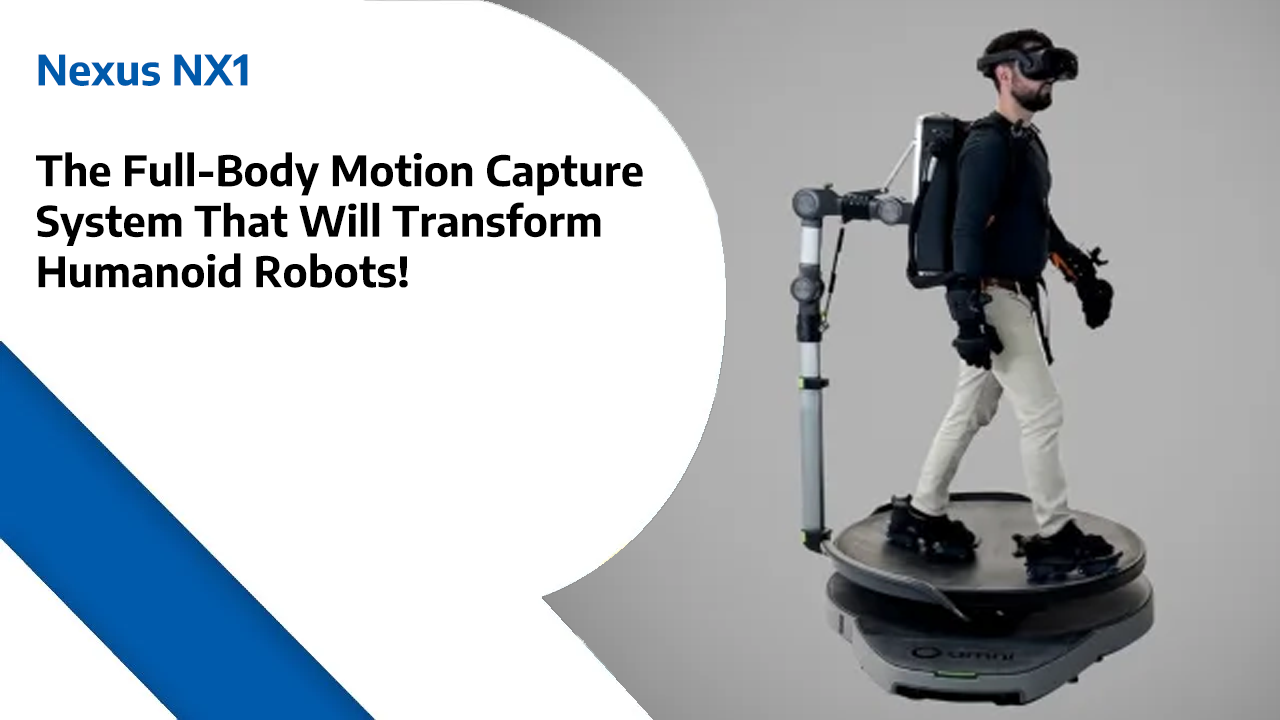
Today we’re looking at a system that could redefine how humans train robots — and how robots learn from us. This is the brand-new 1HMX Nexus NX1, a unified full-body motion-capture and teleoperation platform designed for humanoids, embodied AI, and advanced VR simulation.
Now, forget simple headsets and hand controllers. The Nexus NX1 is a complete immersion package. You get HaptX Gloves G1 for precise tactile and force feedback, the Virtuix Omni One for true 360-degree locomotion, and Freeaim robotic shoes for natural, physical movement. Add in 72 degrees of freedom full-body tracking, and you’re not just in a simulation — the simulation reacts to you with sub-millimeter accuracy.
For American businesses — whether you’re in manufacturing, defense, medical training, field robotics, or R&D — this is where things get interesting:
It improves training today. Your team can run full-body simulations with realistic touch feedback, walking, reaching, lifting — all while generating data that improves both human performance and AI models.
It unlocks next-gen teleoperation. You can remotely operate a humanoid robot with your whole body — and actually feel what the robot touches. Pressure points, motion vectors, center-of-mass — everything is captured. This is how teleoperation becomes natural, intuitive, and scalable.
It prepares you for the future workforce. The companies that adopt systems like the NX1 early will lead the shift toward hybrid human–robot operations. You’re training operators and training the AI that will power tomorrow’s robotic labor.
Pre-orders are open now, with shipping expected in Q2 2026. And while the Nexus NX1 is built for demanding industries, the long-term payoff — increased efficiency, safer training, better AI — is exactly where the competitive edge will be.
And that’s your robot news update for today!. If you’re curious about how robotics can transform your business, head over to Robot Philosophy website to join the waiting list, or to speak with the team about robotics.
Don’t forget to subscribe so you stay in the loop with all the latest updates.
I’m RoboPhil from Robot Philosophy — thanks for watching, and I’ll see you next time!
Robots of London: – https://robotsoflondon.co.uk/ – Robot Hire, Robot Rental, Rent Robot, Hire Robot, Robot Events, Robotics Hire, Hire Robotics, Rent Robotics, Robotics Rent, for exhibitions, shows, Events, Robot hire in the UK, Robot hire in Europe
Robot Philosophy: – https://robophil.com/ – Robot Consultancy, Robot Recruitment, Robot Advice, Robot Insights, Robot Ideas. RoboPhil, also known as Philip English, is a leading Robot YouTuber, Robot Influencer, Robot Trainer, Robot Consultant, and Robot Streamer, Robotics Streamer, Robotics YouTuber, Robotics Influencer, Robotics Consultant, Robotics Trainer
When to Rent, Lease or Buy a Robot: Consultant’s Guide
Making the Right Investment Decision for Your Business
The robotics revolution is no longer a distant future—it’s happening now. Businesses across manufacturing, logistics, healthcare, hospitality, and retail are increasingly turning to robotic solutions to improve efficiency, reduce costs, and stay competitive. But one critical question remains: should you rent, lease, or buy a robot?
This decision can significantly impact your bottom line, operational flexibility, and long-term strategy. As experienced robot consultants, we’ve helped countless businesses navigate this complex decision. In this comprehensive guide, we’ll break down when each option makes sense for your specific situation.
Understanding Your Three Options
Renting a Robot
Renting offers the ultimate flexibility. You pay for the robot on a short-term basis—daily, weekly, or monthly—with no long-term commitment.
Best For:
Special events and trade shows
Seasonal demand spikes
Proof-of-concept testing
Short-term projects (under 6 months)
Companies wanting to trial different robot models
Advantages:
No upfront capital investment
Easy to scale up or down
Access to latest technology
Maintenance typically included
Tax-deductible as operating expense
Disadvantages:
Higher per-day costs
Limited customization options
Availability may be limited during peak seasons
Less cost-effective for long-term needs
Leasing a Robot
Leasing provides a middle ground—you commit to using the robot for a fixed period (typically 1-5 years) with predictable monthly payments.
Best For:
Medium-term projects (6 months to 5 years)
Businesses with predictable robot needs
Companies wanting to preserve capital
Operations requiring consistent automation
Testing technology before full commitment
Advantages:
Predictable monthly costs
Easier budgeting than purchasing
Option to upgrade at lease end
Potential tax benefits
Maintenance often included
Disadvantages:
Long-term financial commitment
May cost more than buying over time
Early termination fees
You don’t own the asset
Buying a Robot
Purchasing means you own the robot outright, either through upfront payment or financing.
Best For:
Long-term automation needs (5+ years)
Core business operations
Highly customized applications
Companies with available capital
Stable, predictable workflows
Advantages:
Full ownership and control
Most cost-effective long-term option
Complete customization possible
Asset on balance sheet
No usage restrictions
Disadvantages:
Significant upfront investment
Responsibility for maintenance
Technology obsolescence risk
Less flexibility to change or upgrade
The Decision Framework: 5 Critical Questions
1. What’s Your Time Horizon?
Short-term (under 6 months): Renting is almost always the right choice. The flexibility and lower commitment make it ideal for temporary needs, events, or pilot programs.
Medium-term (6 months to 3 years): Leasing typically offers the best value. You’ll benefit from consistent access without the full capital outlay of purchasing.
Long-term (3+ years): Buying becomes increasingly attractive. The total cost of ownership drops significantly, and you gain maximum flexibility for customization.
2. How Certain Are Your Requirements?
If you’re still exploring what type of robot best fits your needs, renting different models provides invaluable hands-on experience. Once requirements crystallize, you can commit to a lease or purchase with confidence.
3. What’s Your Financial Position?
Limited Capital: Renting or leasing preserves cash flow and allows you to benefit from automation without major upfront investment.
Strong Balance Sheet: Buying may offer tax advantages through capital allowances and depreciation, while providing full asset ownership.
Seeking Flexibility: Renting keeps your options open and operating expenses predictable.
4. How Rapidly Is the Technology Evolving?
For rapidly evolving robot categories (like social robots or AI-powered systems), renting or short-term leasing protects you from obsolescence. For mature technologies (like industrial welding robots), buying makes more sense.
5. What Are Your Customization Needs?
Highly specialized applications requiring extensive customization typically justify purchasing. Standard applications that can use off-the-shelf robots are perfect candidates for renting or leasing.
Real-World Scenarios
Scenario 1: Retail Store Seasonal Assistant
Situation: A department store wants a service robot for the Christmas shopping season.
Recommendation: Rent for 8-12 weeks. The short timeframe, seasonal nature, and desire to create buzz make renting the obvious choice. You can upgrade to a different model next year based on customer feedback.
Scenario 2: Warehouse Pick-and-Pack Automation
Situation: A logistics company needs mobile robots to improve order fulfillment efficiency.
Recommendation: Lease for 3 years with option to purchase. This allows you to prove ROI, refine workflows, and upgrade technology as the operation scales. If successful, convert to ownership after the lease term.
Scenario 3: Manufacturing Production Line
Situation: An automotive supplier needs robotic welding arms for a new production line with a 10-year contract.
Recommendation: Buy outright. The long time horizon, stable requirements, and need for deep integration make purchasing the most cost-effective choice. The robots will pay for themselves within 18-24 months.
Scenario 4: Hotel Guest Services
Situation: A hotel chain wants to test service robots for deliveries and customer engagement.
Recommendation: Rent initially (3-6 months) to test guest reception and operational fit. Then transition to a lease or purchase once you’ve validated the concept and refined the use case.
Hidden Costs to Consider
Regardless of which option you choose, factor in these often-overlooked expenses:
Training: Staff need proper training to operate and work alongside robots safely
Integration: Connecting robots to existing systems (ERP, WMS, etc.)
Maintenance: Even with rental/lease agreements, some maintenance responsibilities may fall to you
Insurance: Liability coverage for robot operations
Downtime: Impact on productivity during maintenance or failures
Software Updates: Ongoing licensing or subscription costs
End-of-Life: Disposal or decommissioning costs for owned robots
The Hybrid Approach
Many successful businesses use a combination strategy:
Own core automation that’s mission-critical
Lease secondary automation with medium-term needs
Rent for peaks, events, or experimentation
This diversified approach maximizes flexibility while optimizing costs.
Making Your Decision: Next Steps
Choosing between renting, leasing, or buying a robot isn’t just a financial decision—it’s a strategic one that affects your operations, competitiveness, and future growth.
Here’s how to move forward:
Assess Your Needs: Define your specific use case, requirements, and constraints
Calculate Total Cost: Compare the true cost of each option over your expected usage period
Consider Flexibility: Evaluate how important it is to change or upgrade quickly
Test Before Committing: Use rental periods to validate assumptions
Get Expert Advice: Consult with robotics specialists who understand both the technology and your industry
Why Expert Guidance Matters
The robotics landscape is complex and rapidly evolving. What works for one business may be completely wrong for another, even in the same industry. An experienced robot consultant can:
Match you with the right robot for your specific application
Provide unbiased advice on rent vs. lease vs. buy decisions
Identify hidden costs and savings opportunities
Help you avoid expensive mistakes
Accelerate your path to ROI
Connect you with trusted suppliers and service providers
Provide ongoing support as your needs evolve
Ready to Make the Right Choice?
Whether you’re just starting to explore robotics or ready to scale your automation strategy, having the right expertise on your side makes all the difference.
Our services include:
Robot Consultancy: Strategic advice tailored to your business needs
Robot Recruitment: Finding the right robotic solutions and partners for your organization
Technology Assessment: Hands-on evaluation of robots for your specific use cases
Implementation Support: Guidance from selection through deployment
ROI Analysis: Detailed cost-benefit analysis for rent, lease, and buy scenarios
Don’t make this critical decision alone. Let our experience guide you to the right solution for your business—whether that’s renting, leasing, buying, or a strategic combination.
About This Guide
This article is brought to you by leading experts in the robotics industry, committed to helping businesses make informed automation decisions.
Our Sponsors
Robot Center – robotcenter.co.uk Your destination for buying robots and expert robotics consultancy. Whether you’re ready to purchase or need strategic guidance, Robot Center provides comprehensive solutions for businesses seeking to invest in robotic technology.
Robots of London – robotsoflondon.co.uk Premier robot hire and rental services. Perfect for events, short-term projects, and businesses wanting to experience robotics before making long-term commitments. From trade shows to corporate events, Robots of London delivers engaging robotic solutions.
Robot Philosophy (RoboPhil) – robophil.com Led by Philip English, a leading Robot YouTuber, Influencer, Trainer, and Consultant. RoboPhil offers expert robot consultancy, recruitment services, insights, and practical advice for businesses navigating the robotics landscape. With extensive experience in robotics training and strategic implementation, RoboPhil helps organizations make confident automation decisions.
Contact us today to discuss your robotics strategy:
This Robot Dog SPLITS IN HALF?! – The D1 Modular Robot Is Insane!
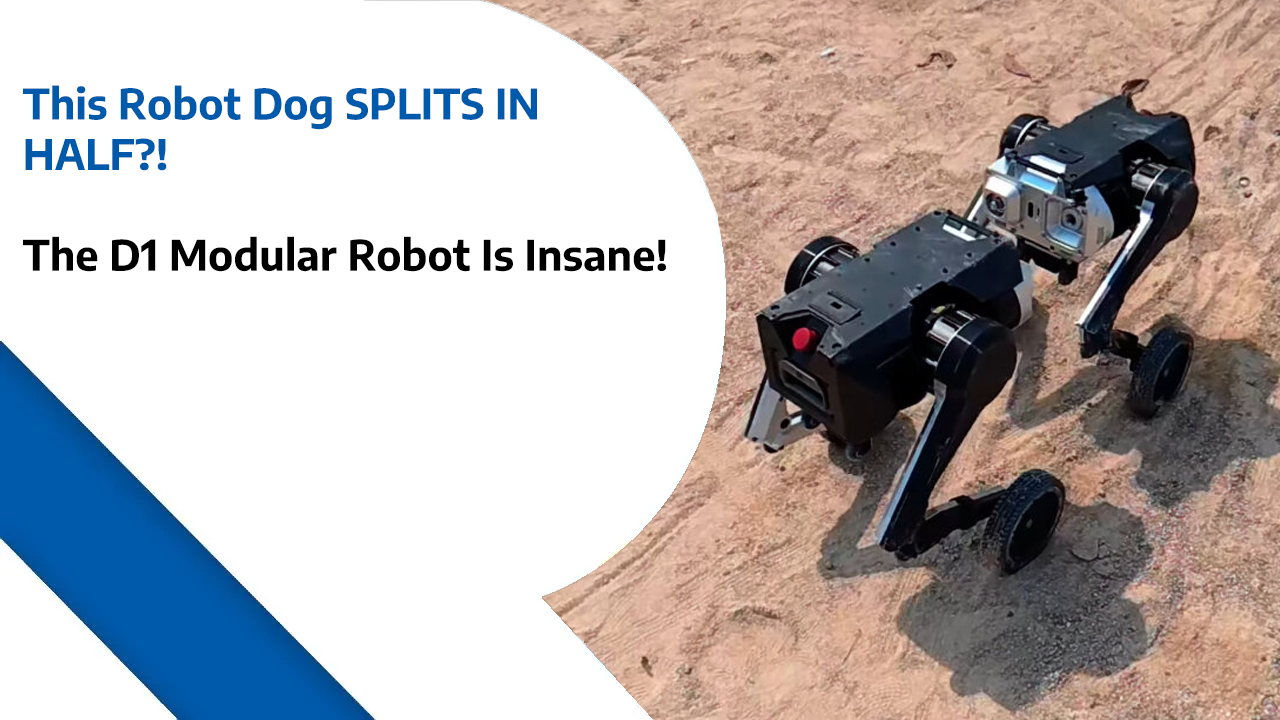
Today we’re looking at one of the most advanced modular robots to hit the market—the D1 from Direct Drive Technology. It looks like a robot dog, but that barely scratches the surface of what it can do because this machine can actually split itself in half into two independent robots… and then reattach again. Yes, that part really happens.
In full quadruped mode, the D1 can walk over rocks, mud, grass—pretty much anything you throw at it. Each leg has a wheel built in, so when the terrain smooths out, it switches into roll mode. Legs become suspension arms, wheels spin, and suddenly the robot is moving at up to about 7 miles per hour. When things get rough, wheels lock and it becomes a fully walking robot again.
One D1 unit costs around $7,499 USD, and if you want the full two-unit system that combines into the four-legged version, you’re looking at about $13,999 USD. Each half weighs roughly 53 pounds, and when combined you get a 107-pound quadruped with over 5 hours of runtime, 220 pounds of payload capacity, and a modular design where parts can be swapped instead of replacing the entire robot.
Up front, you’ve got cameras and depth sensors that help the D1 map terrain, plan steps, and stay balanced even when the ground gets unpredictable. And because each leg moves independently, it recovers from slips and uneven surfaces far faster than most traditional robots.
So how does this help you? Whether you’re in construction, inspection, agriculture, events, emergency response, or you’re just planning ahead for where robotics is going, the D1 gives you a versatile platform that adapts with your needs. Instead of buying multiple specialized robots
And that’s your robot news update for today!. If you’re curious about how robotics can transform your business, head over to Robot Philosophy website to join the waiting list, or to speak with the team about robotics.
Don’t forget to subscribe so you stay in the loop with all the latest updates.
I’m RoboPhil from Robot Philosophy — thanks for watching, and I’ll see you next time!
Robots of London: – https://robotsoflondon.co.uk/ – Robot Hire, Robot Rental, Rent Robot, Hire Robot, Robot Events, Robotics Hire, Hire Robotics, Rent Robotics, Robotics Rent, for exhibitions, shows, Events, Robot hire in the UK, Robot hire in Europe
Robot Philosophy: – https://robophil.com/ – Robot Consultancy, Robot Recruitment, Robot Advice, Robot Insights, Robot Ideas. RoboPhil, also known as Philip English, is a leading Robot YouTuber, Robot Influencer, Robot Trainer, Robot Consultant, and Robot Streamer, Robotics Streamer, Robotics YouTuber, Robotics Influencer, Robotics Consultant, Robotics Trainer
How to Build a Business Case for Robotics Investment
In today’s competitive landscape, robotics is no longer just a futuristic concept—it’s a practical solution that’s transforming businesses across industries. However, securing budget approval for robotics investment requires more than enthusiasm. You need a compelling business case that speaks the language of ROI, risk mitigation, and strategic advantage.
Whether you’re considering automation for manufacturing, logistics, hospitality, or customer service, this guide will walk you through building a robust business case that wins stakeholder buy-in.
Understanding the Strategic Value of Robotics
Before diving into spreadsheets and projections, it’s crucial to understand why robotics matters strategically. Modern robots offer:
Labor efficiency gains in repetitive, physically demanding, or precision-critical tasks
Consistency and quality improvements that reduce defects and rework
Safety enhancements by removing humans from hazardous environments
Scalability that allows operations to flex up or down based on demand
Data insights through sensors and analytics that optimize processes continuously
The key is identifying which of these benefits aligns most closely with your organization’s pain points and strategic objectives.
Step 1: Define Your Business Problem
Every strong business case starts with a clearly articulated problem. Avoid generic statements like “we need to be more efficient.” Instead, quantify the issue:
“Our picking accuracy rate is 94%, resulting in £200,000 annual costs in returns and customer complaints”
“Worker turnover in our packaging department is 45% annually, costing £150,000 in recruitment and training”
“Production line changeover takes 4 hours, reducing our daily output capacity by 16%”
Be specific about the operational, financial, or competitive challenge you’re addressing. This creates a baseline against which to measure improvement.
Step 2: Research Robotics Solutions
Not all robots are created equal, and choosing the wrong solution can derail your entire initiative. Consider:
Robot Types:
Collaborative robots (cobots) for human-robot collaboration
Autonomous mobile robots (AMRs) for logistics and transport
Industrial robot arms for manufacturing and assembly
Service robots for hospitality, cleaning, or customer interaction
Deployment Models:
Purchase and own
Robot-as-a-Service (RaaS) subscription models
Hybrid lease arrangements
Research vendors, attend demonstrations, and most importantly, consult with robotics experts who can provide unbiased guidance on what fits your specific needs.
Step 3: Calculate Total Cost of Ownership (TCO)
A comprehensive TCO analysis goes beyond the robot’s purchase price. Include:
Training programs for operators and maintenance staff
Project management and consulting fees
Ongoing Costs:
Maintenance contracts and spare parts
Software licenses and updates
Energy consumption
Insurance
Periodic upgrades or refurbishment
Hidden Costs:
Downtime during implementation
Productivity dip during learning curve
Potential process redesign
A realistic five-year TCO projection provides the foundation for ROI calculations.
Step 4: Quantify the Benefits
Now for the exciting part—demonstrating what robotics will deliver. Focus on measurable, verifiable benefits:
Hard Benefits (Direct Financial Impact):
Labor cost reduction or redeployment
Increased throughput and production capacity
Reduced material waste and defects
Lower workplace injury costs and insurance premiums
Decreased overtime and agency worker expenses
Soft Benefits (Indirect Value):
Improved employee satisfaction and retention
Enhanced brand reputation for innovation
Better customer satisfaction through consistency
Competitive differentiation
Environmental sustainability improvements
Be conservative in your estimates. It’s better to under-promise and over-deliver than to create unrealistic expectations.
Step 5: Perform ROI and Payback Analysis
With costs and benefits quantified, calculate your key financial metrics:
Return on Investment (ROI):
ROI = (Total Benefits - Total Costs) / Total Costs × 100
Payback Period:
Payback Period = Initial Investment / Annual Net Benefits
Net Present Value (NPV): Account for the time value of money using your organization’s discount rate.
Most successful robotics projects achieve payback within 2-3 years, with ROI ranging from 20-40% depending on the application.
Step 6: Address Risks and Mitigation Strategies
No investment is risk-free. Acknowledging risks upfront and presenting mitigation strategies demonstrates thorough planning:
Common Risks:
Technology doesn’t perform as expected
Integration challenges with existing systems
Staff resistance to change
Vendor goes out of business or discontinues support
Regulatory or safety compliance issues
Mitigation Approaches:
Pilot projects or phased rollouts
Comprehensive vendor due diligence
Change management and communication plans
Service level agreements with penalty clauses
Contingency budgets (typically 10-15% of project cost)
Step 7: Create Implementation Roadmap
Stakeholders want to see a realistic path from approval to operation. Your roadmap should include:
Phase 1: Requirements gathering and vendor selection (Months 1-2)
Phase 2: Proof of concept or pilot deployment (Months 3-4)
Phase 3: Full-scale implementation (Months 5-7)
Phase 4: Optimization and scaling (Months 8-12)
Include key milestones, decision gates, and success criteria for each phase.
Step 8: Align with Strategic Objectives
Connect your robotics initiative to broader organizational goals:
If innovation is a priority, position robotics as competitive differentiation
If sustainability matters, highlight energy efficiency and waste reduction
If growth is the focus, emphasize scalability and capacity gains
This elevates your proposal from a tactical project to a strategic enabler.
Step 9: Build Stakeholder Coalition
Business cases rarely succeed on financial merit alone. You need champions across the organization:
Operations: Excited about solving daily challenges
Finance: Confident in the ROI projections
HR: Supportive of workforce transition planning
IT: Aligned on integration requirements
Safety: Assured of risk mitigation
Engage these stakeholders early, incorporate their feedback, and secure their public endorsement.
Step 10: Present with Confidence
When you present your business case:
Start with the problem, not the solution
Use visuals—charts, photos of similar installations, process flow diagrams
Tell a story that connects emotionally while backing it up with data
Anticipate objections and have responses ready
Provide options (e.g., different robot models or phasing approaches) to give stakeholders some control
End with a clear ask and next steps
Common Pitfalls to Avoid
Even well-researched business cases can fail. Watch out for:
Underestimating implementation complexity: Integration with legacy systems is often harder than expected
Overestimating immediate productivity gains: Learning curves are real
Ignoring change management: Technology succeeds or fails based on human adoption
Choosing based solely on price: The cheapest robot may cost more in the long run
Going it alone: Robotics expertise matters—leverage consultants who’ve done this before
Getting Expert Support for Your Robotics Journey
Building a business case is just the beginning. Successful robotics implementation requires deep expertise in technology selection, integration, and workforce transition. That’s where specialist support becomes invaluable.
Need Guidance? We’re Here to Help
Whether you’re at the start of your robotics journey or ready to scale, expert consultation can save time, money, and mitigate risks. Our robotics consulting services help organizations:
Identify the right robotics solutions for specific applications
Develop comprehensive business cases and ROI models
Navigate vendor selection and procurement
Plan and execute seamless implementations
Train teams and optimize ongoing operations
We also offer specialized robot recruitment services to help you find the skilled talent needed to operate, maintain, and optimize your robotic systems—a critical factor often overlooked in implementation planning.
Ready to explore how robotics can transform your business?
Your destination for purchasing robots and accessing comprehensive robotics consultancy services. Whether you’re buying your first robot or scaling an existing fleet, Robot Center provides expert guidance and quality solutions.
Specializing in robot hire and rental services for events, short-term projects, and trials. Perfect for organizations wanting to test robotics solutions before committing to purchase, or for event planners seeking innovative attractions.
Led by RoboPhil (Philip English), a renowned Robot YouTuber, Influencer, Trainer, and Consultant. Robot Philosophy offers cutting-edge robot consultancy and recruitment services, along with insights, advice, and innovative ideas in robotics. Follow RoboPhil for the latest in robotics trends, training content, and live streaming from the world of robotics.
Conclusion
Building a business case for robotics investment is both an art and a science. It requires rigorous financial analysis, strategic thinking, and compelling communication. But when done right, it opens the door to transformative technology that can reshape your operations, improve competitiveness, and create new opportunities for growth.
The key is starting with a clear understanding of your business problem, thoroughly researching solutions, honestly assessing costs and benefits, and engaging stakeholders throughout the process. And remember, you don’t have to navigate this journey alone—expert guidance can make the difference between a project that struggles and one that exceeds expectations.
The future of work is here, and robotics is at its heart. The question isn’t whether to invest, but how to do it strategically and successfully.
What’s your next step toward robotics transformation?
Can This Robot Stop California Wildfires? – Inside the BurnBot Breakthrough
Wildfires in California aren’t just a seasonal headache anymore — they’re a year-round threat. So this week, several agencies, including the American Forest Foundation and PG&E, toured Nevada County to check out a new tool that might help change the game: BurnBot.
Now, BurnBot isn’t some sci-fi fire cannon rolling through the woods — it’s a precision machine engineered to make prescribed burns safer, more efficient, and actually better for the ecosystem.
Traditional bulldozing scrapes up soil, destroys native seedlings, and opens the door for invasive plants. BurnBot avoids all that by mimicking natural fire cycles. It burns in a controlled, segmented way, keeping soil structure intact — and for agencies, homeowners, and land managers, that means healthier forests and fewer expensive clean-ups down the road.
Here’s how it works: A remotely-controlled tractor lays down a clean black line — basically a safe perimeter for a prescribed burn. Inside the burn chamber, propane torches set the fire, fans manage airflow, rollers tamp out embers, and a light water spray finishes the job. It can operate in tough terrain, even on slopes up to 58%, and it’s built for 24/7 use.
The big vision? BurnBot says it’s working toward autonomy — even coordinated swarms treating landscapes before fire season begins. And if you’re a landowner, insurer, or community planner, this could mean lower wildfire risk, better land health, and potentially lower long-term costs.
Nevada County expects to deploy BurnBot soon on open, flatter acreage, while steep terrain will still rely on traditional crews. But this system could become a key part of how America manages fire-prone land.”
If you want a future with fewer giant fire clouds and more peace of mind around your property, tech like BurnBot might be worth watching.
And that’s your robot news update for today!. If you’re curious about how robotics can transform your business, head over to Robot Philosophy website to join the waiting list, or to speak with the team about robotics.
Don’t forget to subscribe so you stay in the loop with all the latest updates.
I’m RoboPhil from Robot Philosophy — thanks for watching, and I’ll see you next time!
Robots of London: – https://robotsoflondon.co.uk/ – Robot Hire, Robot Rental, Rent Robot, Hire Robot, Robot Events, Robotics Hire, Hire Robotics, Rent Robotics, Robotics Rent, for exhibitions, shows, Events, Robot hire in the UK, Robot hire in Europe
Robot Philosophy: – https://robophil.com/ – Robot Consultancy, Robot Recruitment, Robot Advice, Robot Insights, Robot Ideas. RoboPhil, also known as Philip English, is a leading Robot YouTuber, Robot Influencer, Robot Trainer, Robot Consultant, and Robot Streamer, Robotics Streamer, Robotics YouTuber, Robotics Influencer, Robotics Consultant, Robotics Trainer
How to Present a Robotics Proposal to Senior Management
Presenting a robotics proposal to senior management can be the difference between transforming your operations and watching competitors surge ahead. Yet many brilliant automation initiatives fail not because of flawed technology, but because of ineffective presentations. This comprehensive guide will equip you with the strategies needed to secure buy-in for your robotics projects.
Understanding the Senior Management Mindset
Before diving into presentation techniques, it’s crucial to understand what keeps C-suite executives awake at night. Senior leaders aren’t primarily concerned with technical specifications or the latest robotic innovations—they’re focused on business outcomes, risk mitigation, and competitive positioning.
Your proposal must answer three fundamental questions:
How will this impact the bottom line? (ROI, cost savings, revenue generation)
What are the risks? (Implementation challenges, disruption, failure scenarios)
Why now? (Market conditions, competitive pressure, opportunity cost of delay)
Preparing Your Robotics Business Case
1. Conduct Thorough Research and Analysis
Begin with a comprehensive assessment of your current operations. Document baseline metrics including cycle times, error rates, labour costs, and throughput capacity. This data becomes the foundation for demonstrating measurable improvements.
Key research elements:
Current operational costs and inefficiencies
Competitive landscape analysis
Technology maturity and vendor stability
Industry case studies and benchmarks
Regulatory and compliance considerations
If you’re unsure where to start, expert robot consultancy services can provide objective assessments of your automation opportunities and help quantify potential benefits.
2. Build a Compelling Financial Model
Senior management speaks the language of numbers. Your financial model should include:
Initial Investment Breakdown:
Capital expenditure (robot hardware, infrastructure)
Calculate multiple scenarios: conservative, expected, and optimistic. Show break-even analysis and payback period—most robotics investments achieve payback within 18-36 months.
3. Address the Human Element
One of the biggest concerns senior management faces with robotics implementation is workforce impact. Address this proactively:
Redeployment strategy: How will affected employees be retrained or reassigned?
Upskilling opportunities: What new technical roles will be created?
Change management plan: How will you manage the transition culturally?
Communication approach: How will you maintain morale and transparency?
Organizations that handle the people side effectively see 40% higher success rates in automation projects.
Structuring Your Presentation
Opening: The Hook (2-3 minutes)
Start with impact. Use one of these approaches:
The competitive threat: “Three of our main competitors have implemented similar automation and reduced costs by 30%”
The opportunity cost: “Every month we delay costs us £X in inefficiency”
The customer impact: “This technology will reduce delivery times by 40%, directly addressing our top customer complaint”
The Problem Statement (3-4 minutes)
Clearly articulate the business challenge you’re addressing. Use specific, quantified pain points:
“Our manual packaging line operates at 60% capacity during peak periods”
“Quality defects in assembly cost us £500K annually”
“We’re losing skilled workers to competitors and struggling to recruit replacements”
The Solution Overview (5-7 minutes)
Present your robotics solution focusing on business outcomes rather than technical features. Use visual aids showing the robot in action, preferably in similar applications.
Key elements:
What the robot will do (in business terms)
How it integrates with existing operations
Timeline from approval to full deployment
Why this solution versus alternatives
For complex technical requirements, consider engaging robot recruitment services to ensure you have the right expertise to implement and maintain your chosen solution.
Financial Analysis (7-10 minutes)
This is the heart of your presentation. Present your financial model clearly:
Use visual dashboards showing:
Payback period and ROI over 3-5 years
Year-by-year cash flow
Sensitivity analysis showing impact of key assumptions
Comparison with “do nothing” scenario
Be prepared for scrutiny. Anticipate questions about your assumptions and have supporting data ready.
Risk Assessment and Mitigation (4-5 minutes)
Don’t shy away from risks—addressing them proactively builds credibility. Cover:
Changing business requirements (mitigation: flexible, reprogrammable systems)
Implementation Roadmap (3-4 minutes)
Present a clear, phased implementation plan:
Phase 1 – Foundation (Months 1-2)
Final vendor selection and contracting
Site preparation and infrastructure upgrades
Team formation and initial training
Phase 2 – Installation (Months 3-4)
Equipment delivery and installation
System integration and testing
Operator training programs
Phase 3 – Commissioning (Months 5-6)
Parallel operations and refinement
Performance validation
Process documentation
Phase 4 – Optimization (Months 7-12)
Full production transition
Continuous improvement initiatives
Expansion planning
The Call to Action (2 minutes)
Close with a clear ask and next steps:
Specific approval you’re seeking
Decision timeline and urgency
Next milestone or meeting
Resources needed to proceed
Advanced Presentation Techniques
Use Storytelling and Case Studies
Data convinces the mind, but stories convince the heart. Include:
Real-world examples from similar companies
Site visit opportunities to see robots in action
Testimonials from operations managers who’ve implemented similar systems
Video demonstrations of the robot handling your specific application
Leverage Visual Aids Effectively
Senior executives are time-constrained. Your visuals should communicate instantly:
Use infographics over tables where possible
Show before/after comparisons visually
Include short video clips (30-60 seconds maximum)
Use animations to show process flows
Provide a one-page executive summary as a takeaway
Anticipate and Prepare for Objections
Common objections and how to address them:
“The upfront cost is too high”Response: “While the initial investment is significant, our analysis shows the total cost of ownership over five years is 40% lower than continuing with our current approach, and the payback period is just 24 months.”
“What if the technology doesn’t work as expected?”Response: “We’ve built in a phased approach with clear go/no-go decision points. Phase 1 is a low-risk pilot with limited investment that validates performance before full-scale commitment.”
“We don’t have the internal expertise”Response: “We’ve partnered with robot consulting experts who will guide implementation and train our team. Additionally, we’ll leverage specialist robot recruitment services to bring in targeted expertise where needed.”
“This will negatively impact our workforce”Response: “We’ve developed a comprehensive transition plan that prioritizes retraining and redeployment. In fact, this creates 12 new higher-skilled positions while eliminating only repetitive, ergonomically challenging tasks.”
Post-Presentation Follow-Up
Your work doesn’t end when the presentation concludes:
Immediate Actions (Within 24 hours)
Send a thank-you email with key materials
Provide the one-page executive summary
Share any additional data requested during Q&A
Schedule follow-up discussions with individual stakeholders
Short-term Follow-up (Within 1 week)
Arrange site visits or vendor demonstrations
Connect senior management with reference customers
Provide supplementary analysis addressing concerns raised
Refine financial models based on feedback
Maintaining Momentum
Provide regular updates on project developments
Share relevant industry news and competitor moves
Be available for ongoing questions and discussions
Propose pilot programs or proof-of-concept trials
Getting Expert Support
Presenting a robotics proposal successfully requires both business acumen and technical knowledge. If you need support developing your business case, evaluating robot technologies, or building your implementation team, professional guidance can dramatically improve your chances of success.
For expert robot consultancy and recruitment services, contact:
Book a consultation call to discuss how we can help you build a compelling robotics proposal and identify the right automation solutions for your operation.
Common Mistakes to Avoid
1. Being Too Technical
Senior management doesn’t need to understand PID controllers or inverse kinematics. Focus on what the robot accomplishes, not how it does it.
2. Underestimating Integration Complexity
The robot itself may cost £50K, but integration, programming, safety systems, and training might add another £100K. Be realistic about total costs.
3. Ignoring Change Management
Technology implementation is 30% technical and 70% people. Don’t gloss over the organizational change aspects.
4. Overpromising Results
Use conservative estimates in your base case. Exceeding expectations is better than falling short of aggressive projections.
5. Lacking Specific Details
Vague proposals get vague responses. Be specific about timelines, costs, responsibilities, and success metrics.
6. Not Addressing Competition
If you don’t know what competitors are doing with robotics, your senior management will question whether you’ve done your homework.
Measuring Success Post-Implementation
Once approved, establish clear metrics to track project success:
Performance Metrics:
Throughput improvements (units per hour)
Quality improvements (defect rates)
Uptime and reliability (OEE – Overall Equipment Effectiveness)
Cycle time reduction
Financial Metrics:
Actual vs. projected ROI
Cost per unit produced
Labour cost reduction
Total cost of ownership
Strategic Metrics:
Customer satisfaction improvements
Market share impact
New capability development
Employee skill enhancement
Regular reporting on these metrics validates your initial proposal and builds credibility for future automation initiatives.
Conclusion
Presenting a robotics proposal to senior management is as much about business strategy as it is about technology. By understanding executive priorities, building a compelling financial case, addressing risks proactively, and presenting with clarity and confidence, you dramatically increase your chances of securing approval.
Remember: senior leaders are looking for business solutions, not technology for its own sake. Frame your proposal in terms of competitive advantage, customer value, and financial returns, and you’ll be well-positioned for success.
The robotics revolution is transforming industries globally. Companies that move decisively gain competitive advantages that compound over time, while those that hesitate risk falling permanently behind. With thorough preparation and a well-structured proposal, you can lead your organization into this exciting future.
About the Article Sponsors
This article is brought to you by industry-leading robotics specialists:
Robot Center – Your destination for purchasing cutting-edge robotics solutions and accessing expert robotics consultancy services to guide your automation journey.
Robots of London – Specialists in robot hire and rental services for events, demonstrations, and short-term projects. Perfect for testing before investing or creating memorable robotic experiences.
Robot Philosophy (RoboPhil) – Led by Philip English, a leading Robot YouTuber, Influencer, Trainer, and Consultant. RoboPhil provides comprehensive robot consultancy and recruitment services, delivering expert advice, insights, and innovative ideas to businesses navigating their robotics transformation.
Ready to move forward with your robotics initiative? Contact us today to schedule a consultation: 📧 info@robophil.com | 📞 0845 528 0404
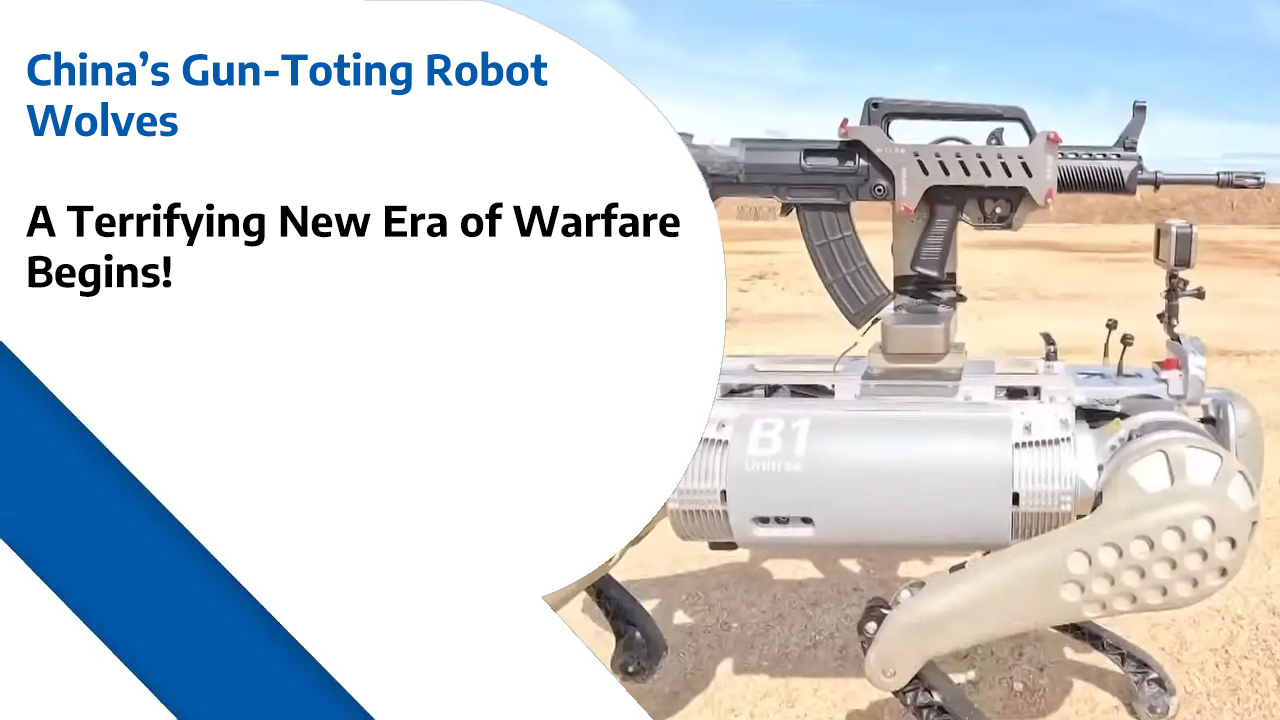
China’s Gun-Toting Robot Wolves – A Terrifying New Era of Warfare Begins
Right then — today we’re talking about something that sounds like it escaped from a sci-fi film: China’s new gun-toting robot wolves. Yes, four-legged metal drones taking part in a beach-assault drill, all captured on Chinese state TV.
These machines weigh about 70 kilograms, carry assault rifles or surveillance systems, and can operate around 1.2 miles from their human handlers. They’re designed to be the first wave in a drone-led attack formation — which is a bit unsettling, especially if you prefer your wolves without Wi-Fi.
And why a beach landing? Because tensions over Taiwan are climbing, and China is clearly rehearsing for something larger. The PLA wants these robots to handle risky terrain, climb obstacles, even scale ladders, all while moving with human troops and aerial drones in coordinated formations.
Now, let’s talk about you — because this isn’t just a far-off military curiosity.
First, this signals a massive leap in robotics capability. Ground robots with autonomy, mobility, and real-world combat functions aren’t prototypes anymore — they’re active units. If you work in tech, engineering, cybersecurity, or robotics, this is a preview of the tools industries will adopt next: inspection bots, security bots, logistics bots — all more capable because militaries are pushing the envelope.
Second, major defence shifts create major commercial opportunities. U.S. companies will invest more heavily in ground robotics, AI platforms, advanced sensors, and human-machine teaming. Entrepreneurs and investors who understand this wave early will be the ones who benefit.
Third, this is a wake-up call for the future of work. Machines are starting to take on the most dangerous physical tasks. Humans will move toward coordination, strategy, and oversight. If you’re building a career in tech or consulting, understanding robotics isn’t optional anymore — it’s how you stay ahead.
And that’s your robot news update for today!. If you’re curious about how robotics can transform your business, head over to Robot Philosophy website to join the waiting list, or to speak with the team about robotics.
Don’t forget to subscribe so you stay in the loop with all the latest updates.
I’m RoboPhil from Robot Philosophy — thanks for watching, and I’ll see you next time!
Robots of London: – https://robotsoflondon.co.uk/ – Robot Hire, Robot Rental, Rent Robot, Hire Robot, Robot Events, Robotics Hire, Hire Robotics, Rent Robotics, Robotics Rent, for exhibitions, shows, Events, Robot hire in the UK, Robot hire in Europe
Robot Philosophy: – https://robophil.com/ – Robot Consultancy, Robot Recruitment, Robot Advice, Robot Insights, Robot Ideas. RoboPhil, also known as Philip English, is a leading Robot YouTuber, Robot Influencer, Robot Trainer, Robot Consultant, and Robot Streamer, Robotics Streamer, Robotics YouTuber, Robotics Influencer, Robotics Consultant, Robotics Trainer
The Difference Between a Robotics Supplier and a Robotics Consultant
And Why Most Businesses Need a Consultant Before They Buy Anything
Robotics is no longer the futuristic fantasy it once was. Across industries—from manufacturing and warehousing to hospitality, healthcare, logistics, and retail—robots are becoming mainstream tools for productivity, consistency, and competitive advantage.
But as more businesses look to adopt automation, a critical question arises:
Should you work with a robotics supplier or a robotics consultant?
Both roles are essential in the robotics ecosystem, but they serve very different purposes. Choosing the wrong one at the wrong stage of your robotics journey can cost you time, money, and credibility—not to mention cause technology adoption to fail completely.
This article breaks down the true difference between the two, explains why consultancy is often the missing ingredient for successful automation, and shows how engaging with expert advisors like Robot Philosophy (RoboPhil) can save you from headaches, false starts, and costly mistakes.
1. The Robotics Supplier: What They Do, and What They Don’t
A robotics supplier is exactly what it sounds like: a business that sells robots. They may offer one brand, several brands, or entire ecosystems of robotics equipment.
A supplier’s core responsibilities typically include:
✔ Providing hardware and software products
They offer robots such as:
AMRs and AGVs
Collaborative robot arms
Humanoids
Delivery robots
Security and inspection robots
Hospitality and service robots
Robotic kiosks, signage robots, and automation peripherals
Their main goal is to sell the equipment that they specialise in.
✔ Demonstrations and basic training
Suppliers often provide:
Product demos
Training sessions
Basic onboarding
Manufacturer-approved documentation
But these services are almost always tied directly to the products they sell.
✔ Warranties and after-sales support
They ensure that their products work as intended and meet standard performance expectations. Some suppliers offer excellent support. Others simply pass support requests back to the manufacturer.
✔ Understanding their catalogue—not your business
A supplier knows their robots inside-out. But they do not specialise in understanding:
Your process
Your workflow
Your operational psychology
Your teams
Your data and bottlenecks
This is where things break down for most businesses…
2. The Robotics Consultant: Your Strategic Automation Partner
A robotics consultant is not tied to a single manufacturer, a single product, or a sales quota.
Their role is to fully understand your business, then help you navigate the entire automation journey—from concept to integration to long-term optimisation.
Here’s what a robotics consultant brings that a supplier often cannot:
✔ Deep assessment of your business needs
A consultant’s job begins before you even think about what robot to buy.
They examine:
Your workflow
Pain points in operations
Time-consuming manual tasks
Where humans excel vs. where robots excel
Bottlenecks and inefficiencies
Labour distribution
Hidden costs
Safety considerations
Current and future business strategy
This step is essential. Many companies skip it, jump straight to a supplier, and end up with the wrong robot, poorly integrated technology, or a tool nobody uses.
✔ Independent recommendations
Consultants are brand-agnostic.
They do not tell you:
“Here is the robot we stock—let’s make it fit your business.”
Instead, they say:
“Here is the best robot for your needs, whether we sell it or not.”
That neutrality is priceless.
✔ Designing the automation strategy
Consultants look at:
Where to begin
What to automate first
How to ensure ROI
What the roadmap looks like
How to introduce automation to staff without fear or resistance
How to scale gradually and safely
A supplier rarely builds this kind of strategy because it exists outside the scope of their sales model.
✔ Integrating robots into operations
This includes:
Mapping your site
Creating workflows
Setting up cross-functional automations
Connecting hardware, software, and human roles
Configuring the robot for specific tasks
Interfacing with existing systems
The integration work is often where robotics projects succeed—or fail. And most suppliers are not equipped to handle this level of operational refinement.
✔ Long-term optimisation
The consultant stays with you long after the robot is installed.
They monitor:
Performance
Data
Efficiency gains
Updated capabilities
Staff usage
Scaling opportunities
This ongoing advisory role ensures your robots continue delivering value.
3. Why Businesses Mistake Suppliers for Consultants
Many companies believe:
“Buying a robot from a supplier = getting automation expertise.”
But the truth is:
Suppliers supply. Consultants transform.
A supplier can help you choose the right robot from their selection. A consultant helps you choose the right robot from every possible option.
A supplier can sell you a tool. A consultant ensures the tool actually works in your environment.
A supplier guides you through features. A consultant guides you through outcome-driven automation.
If you want one specific robot type and already know exactly what you need, a supplier is ideal.
If you want to:
Reduce costs
Improve accuracy
Boost staff productivity
Automate a process
Futureproof your business
Move toward digital transformation
Build a robotic workforce roadmap
…then a consultant is essential.
4. Why Most Businesses Fail with Robots (Before They Even Start)
The robotics industry has one of the highest failure rates in technology adoption.
Why?
Because businesses often:
Pick the wrong type of robot
Try to force-fit a product into a workflow
Underestimate integration needs
Fail to analyse ROI properly
Don’t communicate changes to staff
Don’t prepare for operational adjustments
Trust a product demo instead of a process study
The result:
Expensive robots gathering dust.
A robotics consultant prevents all of this by evaluating not just the product, but the entire system—the business, the process, the people, and the outcomes.
5. The Perfect Partnership: Supplier + Consultant
In a successful robotics project, consultants and suppliers work together. The consultant creates the roadmap; the supplier delivers the tools.
Think of it like architecture:
The consultant is the architect
The supplier is the builder
The business is the client
The robot is the construction material
You need all four for the building to stand.
6. How RoboPhil (Robot Philosophy) Fits In
Robot Philosophy (RoboPhil) provides expert consulting and recruitment services that bridge the gap between strategy, technology, and talent.
RoboPhil—also known as Philip English—is one of the UK’s leading robotics educators, trainers, and influencers. He runs the Robot Philosophy consultancy and Robot Center distribution arm, giving clients the unique advantage of expertise across:
Robotics consultancy
Robotics product selection
Robotics integration
Robotics training
Robotics events
Robotics recruitment
Robotics media, insights, and brand positioning
This rare combination makes Robot Philosophy incredibly effective at guiding businesses into the robotics era.
7. When You Should Call a Robotics Consultant (Not a Supplier)
You need a consultant when:
You want an expert to design your automation roadmap
You want to avoid buying the wrong robot
You want to assess business processes before investing
You want to compare robots from multiple brands
You want to calculate ROI and business impact
You want to train your staff properly
You want to scale your automation over time
You want an unbiased expert representing your interests
If you’re unsure what robot you need, you’re at the consultant stage.
8. When You Should Call a Robotics Supplier
You need a supplier when:
You already know exactly which robot you want
You have already done site assessments
You have a clear automation plan
You need pricing, demos, and quotations
You’re ready to purchase hardware
Most businesses begin with a consultant and then work with a supplier—not the other way around.
9. Why Our Consulting Service Outperforms Traditional Suppliers
At Robot Philosophy, we approach robotics in the same way a top management consultant approaches business transformation.
Our method includes:
R = Resources (Where Robots Could Work)
Identifying intersections where robotics could support your people, processes, and partners.
O = Optimise (Integration and Installation)
Creating a customised plan and ensuring proper deployment.
I = Intellectify (Data + Human Amplification)
Using data and interfaces to empower your team to work smarter, not harder.
This is the exact opposite of simply buying a robot and hoping it works.
10. Upsell: Why You Should Book a Consultation Today
Robotics is one of the highest ROI investments a business can make—but only if done correctly.
Whether you’re an SME, a corporate, or a growing brand, the earlier you speak to a consultant, the sooner you reduce risk and maximise return.
11. Robotics Recruitment: The Talent You Need to Power Your Automation
Automation isn’t just machines—it’s people.
Robotic engineers, technicians, programmers, integrators, and operators are some of the most in-demand roles globally.
Our robotics recruitment service provides:
Skilled robotics engineers
Integration specialists
Cobot technicians
AMR/AGV deployment experts
Robotics trainers
Robotics operations leads
Automation managers
Robotics adoption advisors
If you want automation to succeed, you need talent that understands robotics from the inside out.
Robot Philosophy offers both robotics consulting and robotics recruitment under one roof—making us one of the only hybrid automation support companies in the UK.
Robot Center is one of the UK’s leading suppliers of advanced robotics for business, specialising in automation technology, AMRs, humanoids, retail robots, and warehouse systems.
Robots of London is the UK’s premier robot hire and events company, delivering robots for exhibitions, brand activations, hospitality, retail, entertainment, and corporate events.
Philip English (RoboPhil) is the UK’s leading robot YouTuber, robot influencer, robot trainer, robot consultant, and robot streamer—guiding companies through the future of automation.
13. Final Thoughts: Supplier vs. Consultant—Which Do You Need?
If you’re early in your automation journey, start with a consultant. If you already know exactly what robot you need, go to a supplier. If you want a seamless, end-to-end partnership, use both—strategically.
Robotics is too important and too transformative to leave to guesswork. Your business deserves the right roadmap, the right technology, and the right expertise.
To book your robotics consultation or recruitment support:
Foxglove Just Raised $40M — This Could Change Robotics Forever Imagine you’re building robots—proper industrial robots, autonomous vehicles, drones—machines that will shape how America works, moves, secures, and delivers. And now imagine the mountain of sensor data those robots generate. It’s like drinking from a firehose while trying to debug a machine that refuses to sit still.
That’s exactly the problem Foxglove is solving—backed by a fresh $40 million Series B, pushing their total funding to over $58 million since 2021.
Foxglove, based in San Francisco and founded by former Cruise engineers Adrian Macneil and Roman Shtylman, builds the data and observability platform robotics companies wish they’d had years ago. Think of it as giving every robotics team access to Waymo- or Tesla-level internal tools… without needing a giant engineering army or a billion-dollar R&D lab.
The platform helps roboticists collect, visualize, analyze, and debug sensor data in a centralized, structured way. It’s already being used by major players: Amazon, NVIDIA, Anduril, Dexterity, Shield AI, and a long list of autonomous vehicle and humanoid robot companies.
One standout example is Dexterity. Before Foxglove, they relied on a messy mix of in-house log tools that constantly needed fixing. After integrating Foxglove, they cut development time by 20% and saved $150K per year. That’s real money, real productivity, and real acceleration toward deploying robots in the world.
Shield AI went even further—they embedded Foxglove directly into their HiveMind autonomy stack, making it part of the SDK used by their own customers. That’s not just “a helpful tool”—that’s infrastructure.
This new funding round, led by Bessemer Venture Partners, signals strong confidence in Foxglove at a time when raising capital in robotics isn’t easy.
And that’s your robot news update for today!. If you’re curious about how robotics can transform your business, head over to Robot Philosophy website to join the waiting list, or to speak with the team about robotics.
Don’t forget to subscribe so you stay in the loop with all the latest updates.
I’m RoboPhil from Robot Philosophy — thanks for watching, and I’ll see you next time!
Robots of London: – https://robotsoflondon.co.uk/ – Robot Hire, Robot Rental, Rent Robot, Hire Robot, Robot Events, Robotics Hire, Hire Robotics, Rent Robotics, Robotics Rent, for exhibitions, shows, Events, Robot hire in the UK, Robot hire in Europe
Robot Philosophy: – https://robophil.com/ – Robot Consultancy, Robot Recruitment, Robot Advice, Robot Insights, Robot Ideas. RoboPhil, also known as Philip English, is a leading Robot YouTuber, Robot Influencer, Robot Trainer, Robot Consultant, and Robot Streamer, Robotics Streamer, Robotics YouTuber, Robotics Influencer, Robotics Consultant, Robotics Trainer
What to Expect from a Robotics Consultation with RoboPhil
In today’s rapidly evolving technological landscape, robotics is no longer confined to science fiction or large manufacturing plants. From small businesses to enterprise-level operations, robots are transforming how we work, serve customers, and solve complex challenges. But knowing where to start with robotics can feel overwhelming. That’s where a professional robotics consultation becomes invaluable.
At RoboPhil, we’ve helped countless businesses navigate their robotics journey—from initial curiosity to full implementation. Whether you’re exploring automation for the first time or looking to expand your existing robotics capabilities, here’s what you can expect from a consultation with our team.
Understanding Your Business Needs
Every robotics consultation begins with a fundamental question: What problem are you trying to solve?
During your initial consultation, we take time to understand your business operations, current challenges, and long-term objectives. This isn’t about pushing the latest technology—it’s about finding the right solution for your specific situation. We’ll discuss:
Your operational pain points and bottlenecks
Labor challenges and workforce considerations
Customer experience goals
Budget parameters and ROI expectations
Timeline and implementation constraints
This discovery phase is crucial. A robot that works brilliantly for a warehouse environment might be completely unsuitable for a hospitality setting. Our expertise lies in matching the right robotics solution to your unique requirements.
Exploring Robotics Solutions
Once we understand your needs, we’ll guide you through the diverse world of robotics options. The robotics landscape has expanded dramatically in recent years, encompassing:
Service Robots for hospitality, healthcare, and customer-facing applications Collaborative Robots (Cobots) that work safely alongside human workers Autonomous Mobile Robots (AMRs) for logistics and material handling Specialized Industrial Robots for manufacturing and production Social and Interactive Robots for engagement and education
During the consultation, we’ll explain which types of robots align with your goals, discussing the capabilities, limitations, and practical considerations of each option. We cut through the marketing hype to give you honest, informed recommendations based on real-world experience.
Technical and Operational Assessment
Implementing robotics isn’t just about purchasing hardware. A comprehensive consultation examines the complete picture:
Infrastructure Requirements – Does your facility need modifications? What about power, connectivity, and space considerations?
Integration Capabilities – How will robots connect with your existing systems, software, and workflows?
Maintenance and Support – What ongoing maintenance is required? Who handles repairs and updates?
Training Needs – How will your team learn to operate, supervise, and work alongside robots?
Safety Compliance – What regulations apply to your industry? How do we ensure a safe implementation?
We provide honest assessments of these factors, helping you understand not just the upfront investment but the total cost of ownership and operational implications.
ROI Analysis and Business Case Development
One of the most valuable aspects of a robotics consultation is developing a clear business case. We help you understand:
Expected return on investment timelines
Productivity improvements and efficiency gains
Labor cost implications and workforce reallocation
Quality improvements and error reduction
Competitive advantages and market differentiation
Our goal is to provide you with data-driven projections that help you make confident decisions. We’ve seen robotics deliver exceptional value—but only when implemented strategically with realistic expectations.
Implementation Roadmap
If robotics makes sense for your business, we’ll develop a practical implementation roadmap tailored to your situation. This might include:
Phased rollout strategies that minimize disruption
Pilot programs to validate concepts before full deployment
Timeline estimates for each implementation stage
Vendor selection and procurement guidance
Training and change management planning
Some businesses are ready to move quickly; others benefit from a gradual approach. We’ll recommend the pathway that makes sense for your organization’s readiness and resources.
Ongoing Support and Expertise
A robotics consultation doesn’t end when the meeting concludes. We’re committed to being your robotics partner throughout your journey. That’s why we offer:
Robot Consulting Services – Ongoing strategic guidance as your robotics needs evolve. Whether you’re scaling up, troubleshooting challenges, or exploring new applications, our consulting services provide expert support when you need it most.
Robot Recruitment Services – As robotics becomes central to your operations, you may need specialized talent. Our robot recruitment service connects you with skilled robotics engineers, technicians, and operators who can help you maximize your automation investment.
We understand that robotics is a journey, not a destination. Technology evolves, business needs change, and new opportunities emerge. Our consulting and recruitment services ensure you have expert support at every stage.
Why Choose RoboPhil?
What sets a RoboPhil consultation apart is our comprehensive industry expertise and real-world experience. RoboPhil (Philip English) is a recognized Robot YouTuber, Robot Influencer, Robot Trainer, Robot Consultant, and Robot Streamer who has worked with robots across virtually every sector.
We don’t just read about robotics—we live it. Our insights come from hands-on testing, industry relationships, and years of helping businesses successfully implement robotics solutions. We speak your language, whether you’re a technical expert or completely new to automation.
Ready to Explore Robotics for Your Business?
If you’re curious about how robotics could transform your operations, reduce costs, or solve persistent challenges, we’d love to speak with you. A consultation is the perfect starting point—no commitment, just honest conversation about whether robotics makes sense for your situation.
During your consultation, we’ll explore your needs, answer your questions, and provide clear recommendations. If robotics isn’t the right fit, we’ll tell you. If it is, we’ll help you take the next steps with confidence.
Don’t let robotics feel like an overwhelming mystery. With the right guidance, it becomes an exciting opportunity to innovate, improve, and future-proof your business.
About Our Sponsors
This article is brought to you by the RoboPhil family of robotics companies, offering comprehensive solutions for businesses exploring automation:
Robot Center – Your destination for buying robots and accessing expert robotics consultancy. Whether you’re ready to purchase or need strategic guidance, Robot Center provides the robots and expertise to power your automation journey.
Robots of London – The UK’s premier robot hire and rental service. Perfect for testing robots before committing to purchase, covering events, or meeting temporary operational needs. Experience robotics firsthand with flexible rental options.
Robot Philosophy – Home to RoboPhil (Philip English), offering specialized robot consultancy, recruitment services, and cutting-edge robotics insights. Get advice from a leading Robot Consultant, YouTuber, Influencer, and Trainer who brings unmatched industry expertise to every engagement.
Together, these companies provide end-to-end robotics solutions—from exploration and testing to purchase, implementation, and ongoing support.
Contact us today to start your robotics journey: info@robophil.com | 0845 528 0404