
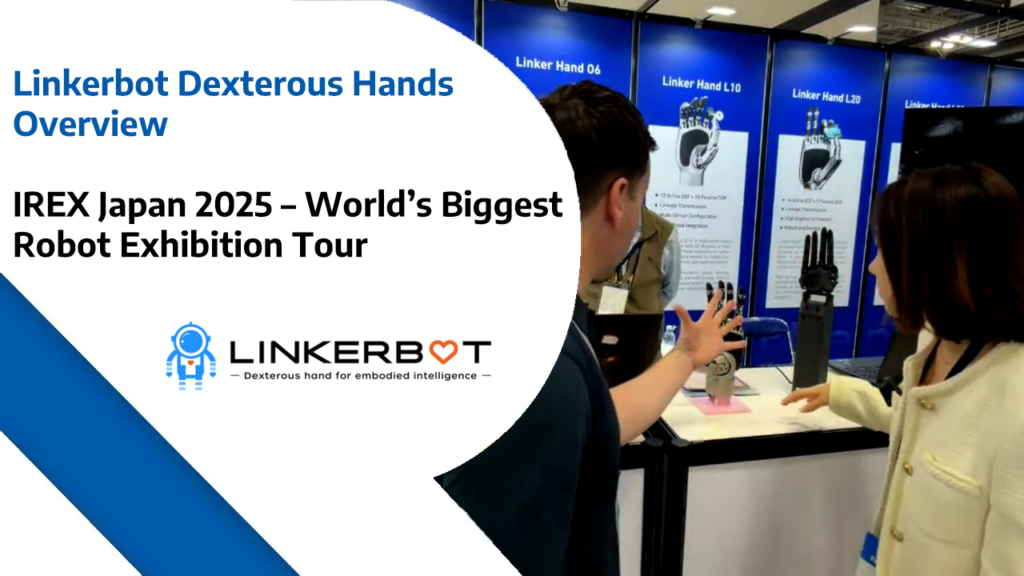
Linkerbot Dexterous Hands Overview -IREX Japan 2025 – World’s Biggest Robotics Exhibition Tour
Linkerbot Dexterous Hands at IREX Japan 2025
Why Robotic Manipulation Is the Real Frontier of Humanoids
At IREX Japan 2025 — the world’s largest robotics exhibition — the energy around humanoid robots was unmistakable. Walking platforms are improving. AI systems are maturing. Hardware is becoming more refined.
But after touring the exhibition floor and analysing the most commercially relevant technologies, one conclusion stood out clearly:
The humanoid race will not be won by legs.
It will be won by hands.
One of the most interesting systems I encountered was the Linkerbot Dexterous Hands platform — a highly articulated robotic hand system focused on advanced manipulation. While many companies showcase full humanoid bodies, it’s component-level innovation like this that may ultimately determine which robots succeed in real-world deployment.
The Real Bottleneck in Robotics
Mobility has historically been seen as the great challenge in humanoid robotics. And yes, stable bipedal locomotion is complex.
But commercially, mobility is rarely the core revenue driver.
Most work environments are already designed around human hands. Our infrastructure — from machinery and tools to packaging and controls — assumes dexterity.
A robot that can walk into a warehouse but cannot reliably pick up irregular objects has limited value.
A robot that can stand in one place but manipulate precisely can transform entire workflows.
Dexterity is the multiplier.
What Makes Dexterous Hands So Difficult?
Human hands are extraordinary biological systems. Each hand contains:
Multiple joints per finger
Fine motor control
Sensory feedback
Adaptive grip strength
Continuous micro-adjustments
We perform complex manipulation subconsciously — threading cables, adjusting grip pressure, rotating objects in-hand.
Replicating that mechanically requires:
Multiple degrees of freedom
Compact actuator placement
Force and tactile sensing
Coordinated motor control
AI-driven grasp planning
Durable mechanical architecture
The engineering challenge is not simply adding more joints. It is integrating mechanical complexity with intelligent control — at a cost that allows scale.
Linkerbot’s Approach
At IREX 2025, the Linkerbot Dexterous Hands appeared to prioritise high articulation density while maintaining structural robustness.
From observation, the platform demonstrates:
Individually controlled finger segments
Multiple grip styles (pinch, power, lateral)
Compact mechanical packaging
Industrial-grade design potential
This balance is important. Many research hands are impressive but fragile. Many industrial grippers are robust but simplistic.
The future belongs to systems that combine both.
Where Dexterity Creates ROI
The key question is not “Is this impressive technology?”
The question is: “Where does it generate return?”
Manufacturing
Small-part assembly, cable routing, tool handling, inspection tasks — areas where variability limits traditional automation.
Warehousing
Handling irregular items, damaged packaging, mixed-object picking. Dexterity reduces reliance on highly structured storage systems.
Healthcare
Assisting with daily living tasks, handling equipment, supporting rehabilitation — particularly in ageing populations.
Laboratories
Precision handling of instruments, sample placement, controlled manipulation.
Retail & Hospitality
Shelf restocking, product handling, cleaning and support tasks.
In each case, manipulation — not mobility — determines economic viability.
Hardware Is Only Half the Story
Mechanical capability alone does not solve the problem.
Future-ready dexterous hands must integrate with:
Computer vision systems
Real-time force feedback
Reinforcement learning models
Simulation-based training environments
The hands must be AI-ready.
The companies that solve the hardware-software integration loop will unlock scalable humanoid deployment.
What IREX 2025 Confirmed
Three clear industry signals emerged:
Humanoids are transitioning from research to commercial pilots.
Investors are shifting focus toward practical application.
Manipulation remains the primary technical and commercial barrier.
Linkerbot’s dexterous hands represent a serious attempt to address that barrier at the component level.
And component-level innovation is often where durable competitive advantage is built.
What Businesses Should Be Doing Now
If you run a business in manufacturing, logistics, food production, healthcare, or retail, the conversation should not start with:
“Should we buy a humanoid robot?”
Instead, ask:
Where are our manipulation-heavy tasks?
Where do labour shortages create friction?
Where does variability prevent traditional automation?
What processes are repetitive but still require human hands?
Humanoids may not yet be mass deployed — but preparation determines speed of adoption.
The companies that audit early, experiment strategically, and build robot-ready processes will scale faster than those who wait.
Final Thought
Hands were humanity’s original tools. They allowed us to build civilisation.
Robotic hands may become the next great multiplier — extending human capability into environments where labour is constrained, dangerous, or inefficient.
The humanoid conversation is accelerating.
But dexterity will decide who wins.
The shift from demonstration to deployment has begun.
The only question is: will you be prepared?