
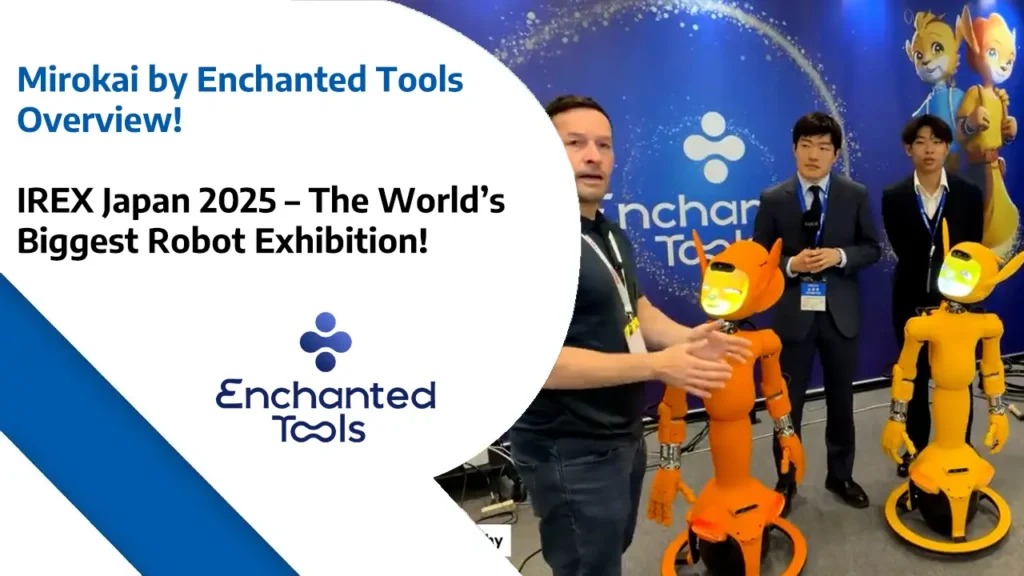
Mirokai by Enchanted Tools Overview!
Mirokai by Enchanted Tools – Full Overview from IREX Japan 2025
The global robotics industry gathered once again in Tokyo for IREX Japan 2025, the world’s largest and most influential robot exhibition. Known for unveiling the next generation of automation, AI, and humanoid technologies, IREX is where manufacturers, integrators, investors, and futurists come to witness what’s coming next.
Among the many groundbreaking robots on display, one humanoid platform stood out — not because of industrial strength or security capabilities, but because of its emotional design, expressive movement, and character-driven presence.
That robot is Mirokai, developed by the Paris-based robotics company Enchanted Tools.
In this article, we’ll explore Mirokai in depth — from its design philosophy and technical capabilities to its real-world applications and what it signals about the future of human-robot interaction.
A New Philosophy of Robotics Design
Most service robots today are built around function first. They are designed to deliver items, guide visitors, clean floors, or patrol environments. While efficient, many lack emotional connection or personality.
Enchanted Tools has taken a radically different approach.
Mirokai is built on the belief that robots working in human environments should not feel like machines — they should feel like characters.
This philosophy is heavily inspired by animation, storytelling, and cinematic robotics. The design team drew influence from Pixar-style character development, focusing on how posture, eye movement, and body language create emotional engagement.
The result is a robot that feels less like equipment and more like a presence.
First Impressions at IREX Japan
Seeing Mirokai in person at IREX Japan 2025 immediately sets it apart from traditional humanoid robots.
Where many robots feel rigid or mechanical, Mirokai feels fluid and alive.
Key visual impressions include:
A stylised humanoid form with softened features
Large, expressive illuminated eyes
Smooth head tracking and gaze engagement
Subtle body posture adjustments
Character-like proportions rather than industrial anatomy
Crowds were naturally drawn to the robot — not because it was performing complex industrial tasks, but because people felt comfortable approaching it.
This is a critical shift in robotics design: approachability as a feature.
Emotional AI and Expressive Interaction
One of Mirokai’s defining features is its emotional AI framework.
Rather than simply responding with pre-programmed voice lines, the robot uses a blend of visual expression, motion, and interaction cues to simulate emotional responses.
Examples demonstrated at IREX included:
Eye animations that track human faces
Head tilts to show curiosity or listening
Posture changes to signal engagement
Idle animations that prevent “robot freeze”
Expressive lighting integrated into the face
These micro-interactions create the illusion of personality.
In customer-facing environments, this is powerful. People are more likely to engage, ask questions, and remember their interaction.
This moves robotics beyond utility into experience design.
Mobility and Physical Capabilities
While Mirokai is heavily focused on expression, it is still a functional service robot platform.
Its mobility system is designed for smooth navigation across commercial environments such as:
Hotels
Airports
Retail spaces
Healthcare facilities
Exhibitions
Museums
The robot uses autonomous navigation technology to move safely among people, avoiding obstacles while maintaining graceful motion.
Unlike industrial robots that prioritise speed or payload capacity, Mirokai prioritises elegance and safety in movement — aligning with its public-facing role.
Voice, AI, and Communication
Mirokai integrates conversational AI to support real-time interaction.
Capabilities include:
Greeting visitors
Answering frequently asked questions
Providing directions
Delivering brand messaging
Supporting multilingual communication
In hospitality or retail environments, this allows Mirokai to function as:
A reception assistant
A brand ambassador
A guest engagement host
A promotional guide
When combined with its expressive design, conversations feel less transactional and more experiential.
Real-World Use Cases
Mirokai is purpose-built for environments where customer experience matters as much as operational efficiency.
Hospitality
Hotels can deploy Mirokai in reception areas to greet guests, provide check-in guidance, and answer service questions.
Retail
Retailers can use the robot for brand storytelling, promotions, and directing customers to products or departments.
Healthcare
Hospitals and clinics can use Mirokai to welcome patients, provide wayfinding support, and reduce staff workload at reception desks.
Events & Exhibitions
Trade shows and corporate events benefit from robots that attract footfall — Mirokai’s design makes it a natural crowd magnet.
Museums & Attractions
Educational storytelling becomes more immersive when delivered through an expressive humanoid platform.
Why Character Matters in Robotics
One of the biggest takeaways from Mirokai is the importance of character in automation.
Historically, robots were designed to replace labour.
Now, many robots are designed to represent brands.
This requires:
Emotional relatability
Visual memorability
Social comfort
Engagement longevity
A robot that people enjoy interacting with generates more value than one that simply performs tasks.
This is especially true in marketing, events, and customer experience sectors.
Engineering Meets Storytelling
Enchanted Tools refers to its robots as part of a broader “robot character universe.”
This means Mirokai is not just a machine — it is a narrative platform.
Future developments may include:
Additional robot characters
Expanded emotional behaviours
Story-driven interaction modes
Branded personality overlays
This opens doors for themed deployments in entertainment, retail, and hospitality environments.
Imagine a hotel robot with a unique backstory or a retail robot aligned with a brand mascot.
Market Positioning
Mirokai sits within the premium humanoid service robot category.
It is not designed to compete with delivery robots or security patrol units.
Instead, it occupies a niche focused on:
Customer engagement
Brand representation
Experiential robotics
Public interaction
This positioning makes it particularly attractive for luxury brands, flagship stores, and high-end venues.
IREX Japan 2025 – Industry Context
IREX showcased thousands of robots across industrial, service, logistics, and AI sectors.
Key macro trends included:
Growth in humanoid robotics
Increased emotional AI integration
Service robot adoption in hospitality
Autonomous inspection platforms
Human-robot workforce collaboration
Mirokai fits squarely within the emotional humanoid trend — where robots are designed to work with people socially, not just operationally.
Deployment Considerations
Organisations exploring Mirokai or similar humanoid robots should consider:
Environment layout and navigation mapping
Interaction сценарios and scripting
Integration with business systems
Staff training and adoption
ROI through engagement metrics
Unlike industrial robots, success is measured not just in productivity — but in customer satisfaction and brand impact.
The Future of Expressive Humanoids
Mirokai represents an early but significant step toward emotionally intelligent robotics in public spaces.
As AI, sensors, and actuation systems advance, we can expect:
More lifelike expressions
Deeper conversational AI
Adaptive personalities
Emotion recognition
Personalised guest interaction
In the long term, humanoid robots may become standard in customer-facing industries — not as novelties, but as expected infrastructure.
Final Thoughts
Mirokai by Enchanted Tools is one of the most visually and emotionally compelling humanoid robots currently on the global stage.
By blending robotics engineering with character design and emotional AI, it pushes the industry beyond function into experience.
From hospitality to exhibitions, the robot demonstrates how engagement-driven automation can elevate customer environments rather than simply optimise operations.
IREX Japan 2025 made one thing clear:
The future of robotics isn’t just intelligent.
It’s expressive.
Sponsors & Partners
Robot Center
Robotics consultancy, sales, and integration specialists helping businesses deploy service, security, and industrial robots.
https://robotcenter.co.uk
sales@robotcenter.co.uk
+44 (0)845 528 0404
Robots of London
The UK’s leading robot hire and event robotics company providing humanoids, robot dogs, and interactive experiences.
https://robotsoflondon.co.uk
sales@robotsoflondon.co.uk
RoboPhil (Robot Philosophy)
Robotics news, insights, workshops, and consulting focused on real-world robot adoption.
https://robophil.com
info@robophil.com
For consultancy, partnerships, or robot deployment support, get in touch with the sponsors listed above.