
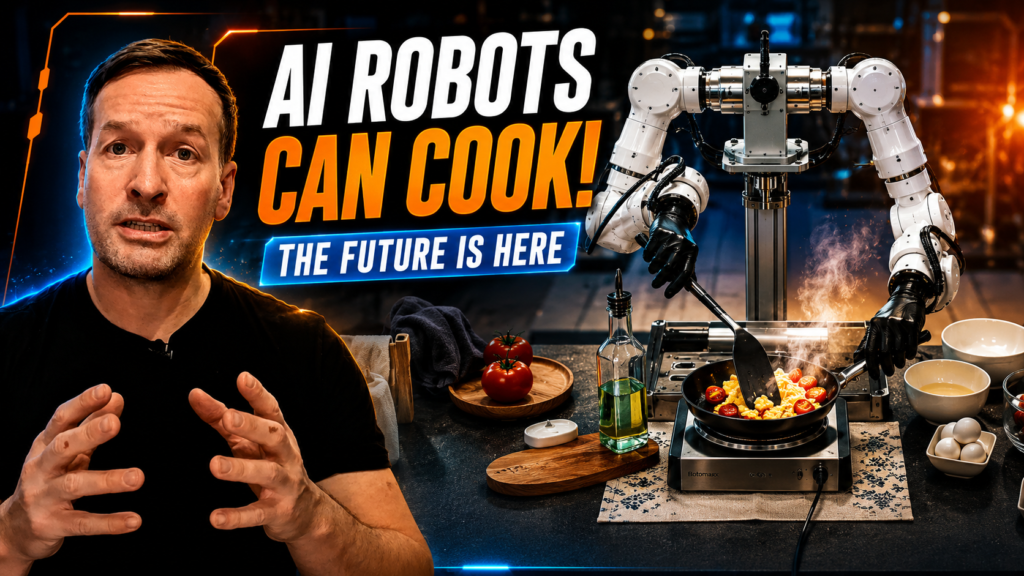
The Rise of AI Humanoid Robots: Why Robotics Is Entering a Completely New Era
For decades, robots have fascinated people with promises of futuristic automation, intelligent machines, and science-fiction-style capabilities. Yet despite enormous progress in industrial automation, most robots have remained limited to repetitive, predictable environments.
That is now starting to change.
A new wave of AI robots and humanoid robotics is pushing the industry into entirely new territory. These machines are no longer simply lifting boxes inside fenced-off factories or welding car frames in carefully controlled production lines. They are beginning to interact with the world in ways that look surprisingly human.
Recent breakthroughs from companies such as Genesis AI demonstrate just how quickly robotics technology is evolving. Robots are now capable of cooking meals, handling delicate laboratory instruments, wiring electronics, solving Rubik’s Cubes, and manipulating objects with a level of dexterity that once seemed impossible.
The implications for business, industry, and society are enormous.
The future of robotics is no longer about machines performing one repetitive task. It is increasingly about adaptable AI robots capable of learning, assisting humans, and eventually operating in dynamic environments across multiple industries.
For businesses, investors, and technology leaders, this shift represents one of the biggest industrial transformations of the coming decade.
The Current State of Robotics
The robotics industry has already transformed manufacturing, warehousing, logistics, and industrial automation. Companies across the world use robots for tasks such as palletizing, picking, welding, packaging, sorting, and inspection.
Industrial robots have become essential tools for improving productivity, reducing operational costs, and addressing labor shortages.
However, traditional robotics systems have significant limitations.
Most robots still require highly structured environments. They perform best when every object is in the same place, every movement is predictable, and every process is carefully engineered.
Humans, on the other hand, excel in unstructured environments.
We can adapt instantly to new situations, handle fragile or awkward objects, learn new physical tasks quickly, and make subtle adjustments without thinking about them consciously.
This “human dexterity gap” has been one of the biggest challenges in robotics technology.
That gap is now starting to close.
Why AI Robots Are Improving So Quickly
Several major technology trends are accelerating robotics development at an extraordinary pace.
Artificial Intelligence
AI is fundamentally changing robotics.
Traditional robots relied heavily on fixed programming and predefined instructions. Modern AI robots increasingly use machine learning, computer vision, neural networks, and foundation models to understand environments and adapt in real time.
This allows robots to learn skills rather than simply execute pre-programmed movements.
AI enables robots to recognize objects, predict outcomes, improve through repetition, and operate with greater flexibility.
The result is a new generation of robots that appear far more intelligent and capable.
Better Data Collection
One of the biggest bottlenecks in robotics has always been training data.
Humans learn physical tasks naturally through observation and repetition. Robots require enormous amounts of high-quality data to replicate similar capabilities.
Companies such as Genesis AI are solving this problem by creating systems that directly transfer human movements into robotic training models.
Using wearable gloves, tactile sensors, motion tracking, and AI data engines, humans can effectively “teach” robots by performing tasks naturally.
This dramatically accelerates robotics learning.
Instead of manually programming every tiny motion, robots can now observe and replicate human behavior at scale.
Simulation Technology
Another major breakthrough is simulation.
Robotics companies are increasingly training AI robots in hyper-realistic virtual environments before deploying them in the real world.
This reduces development costs, accelerates testing, and improves scalability.
Simulation allows robots to practice millions of interactions rapidly without damaging equipment or risking safety issues.
The combination of AI, simulation, and large-scale data collection is transforming robotics development speeds.
The Rise of Humanoid Robots
Humanoid robots represent one of the most exciting areas of the robotics industry.
These machines are designed to operate in environments built for humans. Rather than redesigning workplaces entirely around robots, humanoid systems can theoretically work within existing infrastructure.
That has enormous implications.
Factories, warehouses, retail stores, hospitals, restaurants, hotels, airports, and offices are already designed for human workers. A humanoid robot capable of navigating these environments could potentially perform thousands of different tasks.
This is why companies worldwide are investing billions into humanoid robotics.
Major technology companies, startups, investors, and robotics manufacturers are racing to develop systems capable of human-like mobility and dexterity.
The reason is simple.
The commercial opportunity is massive.
Why Businesses Are Investing in Robotics
Businesses are increasingly viewing robotics as a strategic necessity rather than an experimental technology.
Several factors are driving adoption.
Labor Shortages
Many industries are struggling to recruit workers for repetitive, physically demanding, or highly specialized roles.
Manufacturing, logistics, food production, warehousing, agriculture, and healthcare are all facing workforce pressures.
Robots offer businesses a way to reduce dependency on difficult hiring markets.
Productivity
Robots can operate continuously without fatigue.
This enables higher throughput, greater consistency, and increased production capacity.
For businesses operating on tight margins, automation can significantly improve profitability.
Scalability
Scaling human labor can be difficult and expensive.
Scaling robotics systems often becomes easier over time once deployment processes are established.
This makes robotics highly attractive for companies seeking rapid expansion.
Consistency and Quality
Robots deliver highly repeatable results.
In industries where precision matters, robotics can reduce errors, improve quality control, and minimize waste.
Competitive Advantage
Companies adopting robotics early may gain significant long-term advantages.
Faster production, reduced labor costs, operational resilience, and improved efficiency can create major competitive differentiation.
Real-World Applications of AI Robots
The future of robotics is not limited to factories.
AI robots are beginning to impact a wide range of industries.
Food Robotics
Food production is increasingly adopting automation.
Robots can now assist with food preparation, packaging, cooking, sorting, and quality inspection.
Advances in dexterous robotic manipulation could dramatically expand food robotics capabilities in the coming years.
Warehouse Robotics
Warehouse robotics continues to grow rapidly due to e-commerce demand and supply chain pressures.
Autonomous mobile robots, robotic picking systems, and AI-powered logistics automation are becoming standard in modern fulfillment operations.
Healthcare Robotics
Healthcare robots are assisting with surgery, laboratory automation, rehabilitation, sanitation, and patient support.
AI-driven dexterity improvements may allow robots to handle more delicate healthcare tasks in the future.
Service Robotics
Hotels, restaurants, retail stores, airports, and entertainment venues are increasingly experimenting with service robots.
These systems improve customer engagement while reducing operational pressures.
Industrial Automation
Industrial robotics remains one of the largest segments of the robotics industry.
Collaborative robots, AI inspection systems, autonomous logistics robots, and robotic assembly systems continue to reshape manufacturing operations worldwide.
The Business Opportunity Around Robotics Consulting
As robotics technology becomes more accessible, businesses increasingly require guidance on adoption strategies.
This creates growing opportunities for robotics consulting.
Many companies understand that robotics and automation are important but lack internal expertise regarding deployment, ROI analysis, robot sourcing, integration planning, or operational implementation.
That gap creates significant demand for robotics consultants capable of translating robotics technology into practical business outcomes.
The robotics ecosystem now includes:
- Robot manufacturers
- AI software companies
- Integrators
- Automation specialists
- Robotics consultants
- Recruitment firms
- Training providers
- Event robotics companies
- Robotics-as-a-Service providers
Businesses exploring robotics adoption often require support across multiple stages of implementation.
Challenges Slowing Robotics Adoption
Despite rapid progress, several challenges remain.
Cost
Advanced robotics systems can still require significant investment.
Although prices are falling, many SMEs remain cautious about large-scale deployment.
Integration Complexity
Deploying robots successfully often requires changes to workflows, infrastructure, software systems, and operational processes.
Robotics adoption is rarely as simple as “plug and play.”
Technical Limitations
While AI robots are improving rapidly, many systems still struggle in highly unpredictable environments.
Human-level dexterity remains extremely difficult to replicate consistently.
Public Perception
Concerns regarding job displacement, safety, ethics, and AI continue to shape public discussion around robotics.
Businesses deploying robots must often manage employee concerns carefully.
Skills Gaps
The robotics industry still faces shortages of skilled engineers, integrators, developers, and automation specialists.
This creates growing opportunities for robotics recruitment and training services.
Robotics Investment and Startup Growth
Investment into robotics startups has accelerated dramatically.
Venture capital firms increasingly view robotics as one of the most important long-term technology sectors.
The combination of AI, automation, labor shortages, and industrial digitization is creating enormous market opportunities.
Humanoid robotics alone could become a multi-trillion-dollar industry over the coming decades.
Investors are particularly interested in:
- AI robotics
- Physical AI
- Autonomous systems
- Warehouse robotics
- Logistics automation
- Humanoid robots
- Industrial automation
- Robotics software platforms
- Robotics data infrastructure
The next generation of robotics companies could eventually rival the scale of major technology giants.
Why Dexterity Changes Everything
One of the most important developments in robotics today is improved dexterity.
This is where many recent breakthroughs become commercially significant.
Historically, robots excelled in highly repetitive environments with limited variation.
However, many real-world jobs require:
- Fine manipulation
- Tool use
- Adaptability
- Coordination
- Multi-step reasoning
- Delicate handling
If AI robots can reliably perform these tasks, the potential market for robotics expands dramatically.
This could unlock entirely new categories of automation.
Industries that previously seemed impossible to automate may become viable targets for robotics deployment.
The RoboPhil Perspective
Philip English, also known as RoboPhil, has spent years working across multiple areas of the robotics industry through Robot Center, Robots of London, and Robot Philosophy.
This includes working with robot manufacturers, businesses exploring robotics adoption, event agencies using robots for engagement, and companies launching robotics products into commercial markets.
One of the most noticeable shifts in recent years is how business attitudes toward robotics have changed.
The conversation is no longer:
“Will robots eventually become important?”
Instead, businesses increasingly ask:
“How quickly should we adopt robotics?”
Companies are beginning to recognize that robotics is not simply about replacing labor. It is about scalability, operational resilience, customer engagement, efficiency, and long-term competitiveness.
Robot Philosophy focuses heavily on helping businesses understand where robotics creates real commercial value rather than simply following technology trends.
That practical business-focused approach is becoming increasingly important as the robotics industry evolves.
What the Future of Robotics Looks Like
The next decade could fundamentally reshape how humans work alongside machines.
AI robots are likely to become increasingly common across:
- Warehouses
- Factories
- Hospitals
- Retail stores
- Restaurants
- Hotels
- Airports
- Construction sites
- Laboratories
- Homes
Humanoid robots may eventually become general-purpose labor platforms capable of performing a wide variety of physical tasks.
At the same time, robotics technology will continue becoming cheaper, smarter, and more scalable.
Businesses that adopt robotics early may gain enormous advantages through:
- Reduced operational costs
- Improved productivity
- Faster scalability
- Better customer experiences
- Greater resilience
- Enhanced efficiency
Meanwhile, companies that ignore robotics risk falling behind competitors embracing automation and AI.
The future of robotics is not about machines replacing humans entirely.
It is about humans and robots working together in increasingly intelligent and productive ways.
Conclusion
Robotics is entering a completely new era.
Advances in AI robots, humanoid robots, dexterous manipulation, simulation technology, and robotics data systems are accelerating the industry faster than ever before.
What once seemed futuristic is rapidly becoming commercially practical.
The businesses, investors, and entrepreneurs paying attention today may gain significant advantages tomorrow.
As robotics technology continues improving, the industries transformed by automation will expand dramatically.
The future of robotics will impact nearly every sector of the global economy.
For companies exploring robotics adoption, the time to start learning, experimenting, and planning is now.
For robotics consulting, automation strategy, robot sourcing, robotics insights, and robotics deployment support, contact:
Business enquiries
sales@robotcenter.co.uk