
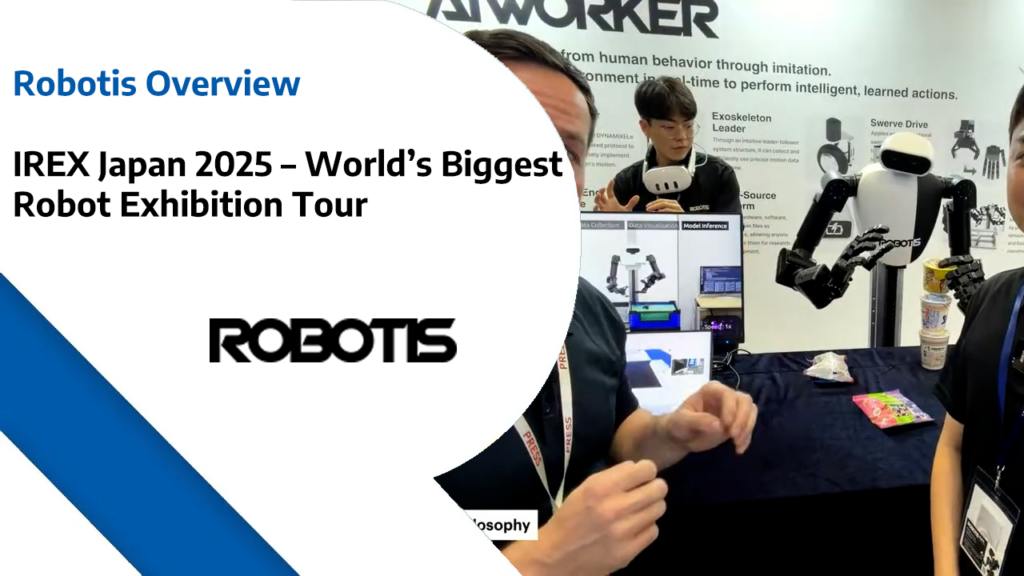
Robotis Overview – IREX Japan 2025 World’s Biggest Robotics Exhibition Tour
Robotis at IREX Japan 2025 – The Hardware Powering the Humanoid Acceleration Era
The global robotics industry has entered a decisive phase.
Humanoids are no longer confined to research laboratories, viral demo videos, or speculative investor decks. They are moving steadily toward commercial reality. And if you want to understand where this transition is truly happening, you have to look beyond the finished robots — and focus on the hardware infrastructure that makes them possible.
That is exactly why the presence of Robotis at the International Robot Exhibition (IREX) 2025 in Tokyo matters so much.
While many exhibitors showcased impressive humanoid demonstrations, Robotis demonstrated something arguably more important: the foundational components that power the next generation of intelligent machines.
This article explores what we saw at IREX Japan 2025, why Robotis is strategically significant, and what this means for businesses, startups, and investors entering the humanoid robotics era.
IREX Japan – Where Robotics Futures Are Previewed
IREX is widely recognised as the largest robotics exhibition in the world. Held at Tokyo Big Sight, it gathers:
Industrial automation leaders
AI robotics innovators
Humanoid robot manufacturers
Component suppliers
Research institutions
Venture investors
If you want to see robotics three to five years before it reaches mainstream markets, IREX is where you go.
In 2025, the atmosphere was notably different from previous years. There was less emphasis on novelty and more emphasis on commercial readiness.
Humanoids are no longer being built just to prove they can walk.
They are being engineered to work.
Why Robotis Matters More Than You Think
When people think about robotics, they often think about the finished product:
A humanoid robot serving drinks
A warehouse robot moving pallets
A robotic arm assembling electronics
But behind every robot is a stack of core technologies:
Actuators
Control systems
Firmware
Modular mechanical structures
Communication protocols
This is where Robotis operates.
Robotis is best known globally for its DYNAMIXEL smart actuators, modular robotic platforms, and OpenManipulator robotic arms. Their technology is deeply embedded in research labs, robotics startups, and emerging humanoid companies worldwide.
If you are building a humanoid robot prototype today, there is a strong probability you are either using Robotis hardware or benchmarking against it.
That is strategic positioning.
DYNAMIXEL – The Quiet Power Behind Motion
At IREX 2025, DYNAMIXEL actuator systems were front and centre.
Why?
Because in humanoid robotics, motion control is everything.
A humanoid robot is essentially a system of coordinated actuators. The quality of its movement, stability, and responsiveness is determined by:
Torque density
Feedback precision
Latency
Heat management
Power efficiency
DYNAMIXEL actuators integrate motors, drivers, controllers, and feedback sensors into compact smart units. This reduces complexity for robotics developers and accelerates prototyping.
In 2025, we’re seeing:
Higher torque-to-weight ratios
Improved positional accuracy
Better thermal management
Faster communication protocols
This is critical for humanoids attempting real-world tasks such as lifting, manipulation, and dynamic walking.
In short: better actuators mean more capable humanoids.
Modular Robotics – Accelerating Innovation
One of Robotis’ greatest strengths is modularity.
Instead of forcing robotics developers to design everything from scratch, Robotis provides modular building blocks that can be rapidly assembled, tested, and iterated.
This approach has several advantages:
1. Faster Prototyping
Startups can move from concept to working demo in months instead of years.
2. Lower Capital Risk
Developers can test commercial viability before investing heavily in custom manufacturing.
3. Educational Ecosystem Growth
Universities and research labs worldwide train engineers using Robotis platforms — meaning the next generation of roboticists is already familiar with their systems.
This creates ecosystem lock-in.
And ecosystem positioning is far more powerful than simply selling products.
The OpenManipulator Strategy
Robotis’ OpenManipulator robotic arm systems continue to serve as accessible entry points for robotics experimentation.
At IREX 2025, we saw improved integration with:
ROS2
AI computer vision systems
Edge AI processing
Reinforcement learning frameworks
This reflects a broader industry shift: robotics hardware must now be AI-ready by default.
In previous cycles, hardware and AI were separate innovation tracks.
In 2025, they are converging.
The Humanoid Acceleration Phase
The biggest takeaway from IREX Japan 2025 was not a single robot.
It was momentum.
Across the exhibition floor, we saw:
Increased actuator density in humanoids
Better balance control algorithms
Improved battery efficiency
More practical demonstration tasks
Clearer commercial use cases
Humanoids are shifting from research projects to revenue experiments.
And this is where companies like Robotis play a foundational role.
They are not necessarily the headline brand on stage.
But they are often the hardware supplier behind the scenes.
Infrastructure Companies Often Win
In technology cycles, infrastructure companies frequently outperform end-product manufacturers.
Think about:
Semiconductor suppliers in the smartphone boom
Cloud providers in the SaaS explosion
GPU manufacturers in the AI revolution
Robotis occupies a similar strategic layer in robotics.
By providing core motion infrastructure and modular systems, they benefit from growth across multiple robotics companies — rather than relying on a single finished robot product.
This reduces exposure to consumer adoption risk.
It is a powerful position.
What This Means for Businesses
If you are a business leader watching robotics evolve, here are three key takeaways:
1. Robotics Is Becoming Component-Driven
Understanding component suppliers is as important as understanding finished robots.
2. The Barrier to Entry Is Falling
Modular systems are enabling faster experimentation and deployment.
3. Humanoids Are Entering Commercial Testing
Not widespread deployment yet — but meaningful commercial trials are underway.
Businesses that begin exploring robotics integration now will be significantly better positioned than those who wait for mass adoption headlines.
What This Means for Startups
For robotics startups, the message is clear:
You no longer need to build everything from zero.
Leverage modular ecosystems.
Focus on application differentiation.
Move fast.
Speed now matters more than perfection.
What This Means for Investors
Investors should be watching:
Actuator density improvements
AI-hardware integration
Battery breakthroughs
Ecosystem adoption metrics
The humanoid space is capital-intensive. But the supporting infrastructure layer — like actuators and modular robotics systems — offers exposure to multiple downstream winners.
The Bigger Question: Who Owns the Stack?
In 2025, robotics is no longer just about mechanical engineering.
It is about owning layers of the stack:
Hardware
Firmware
Control systems
AI integration
Application software
Robotis has positioned itself strongly in the motion control and modular hardware layer.
The companies that win the humanoid era will either control multiple layers — or integrate seamlessly across them.
The Transition from Demo to Deployment
The most exciting aspect of IREX 2025 was the seriousness.
Fewer gimmicks.
More practical demonstrations.
Clearer commercial conversations.
Humanoids are still early.
But they are no longer hypothetical.
The industry has shifted from “Can we build this?”
To “How do we scale this?”
That is a profound transition.
Final Thoughts
Robotis at IREX Japan 2025 was not about spectacle.
It was about infrastructure.
In technology revolutions, infrastructure is often underestimated — until it becomes indispensable.
If you want to understand where robotics is heading over the next five years, pay attention to:
Actuator performance
Modular system adoption
AI-ready hardware platforms
Ecosystem growth
The humanoid acceleration era has begun.
And companies like Robotis are quietly powering it from underneath.
The robots may take centre stage.
But the actuators make them move.
If you’re exploring robotics implementation, commercial deployment, or strategic positioning in this rapidly evolving landscape, now is the time to move — not watch.
The future of robotics will not belong to the curious.
It will belong to the prepared.