

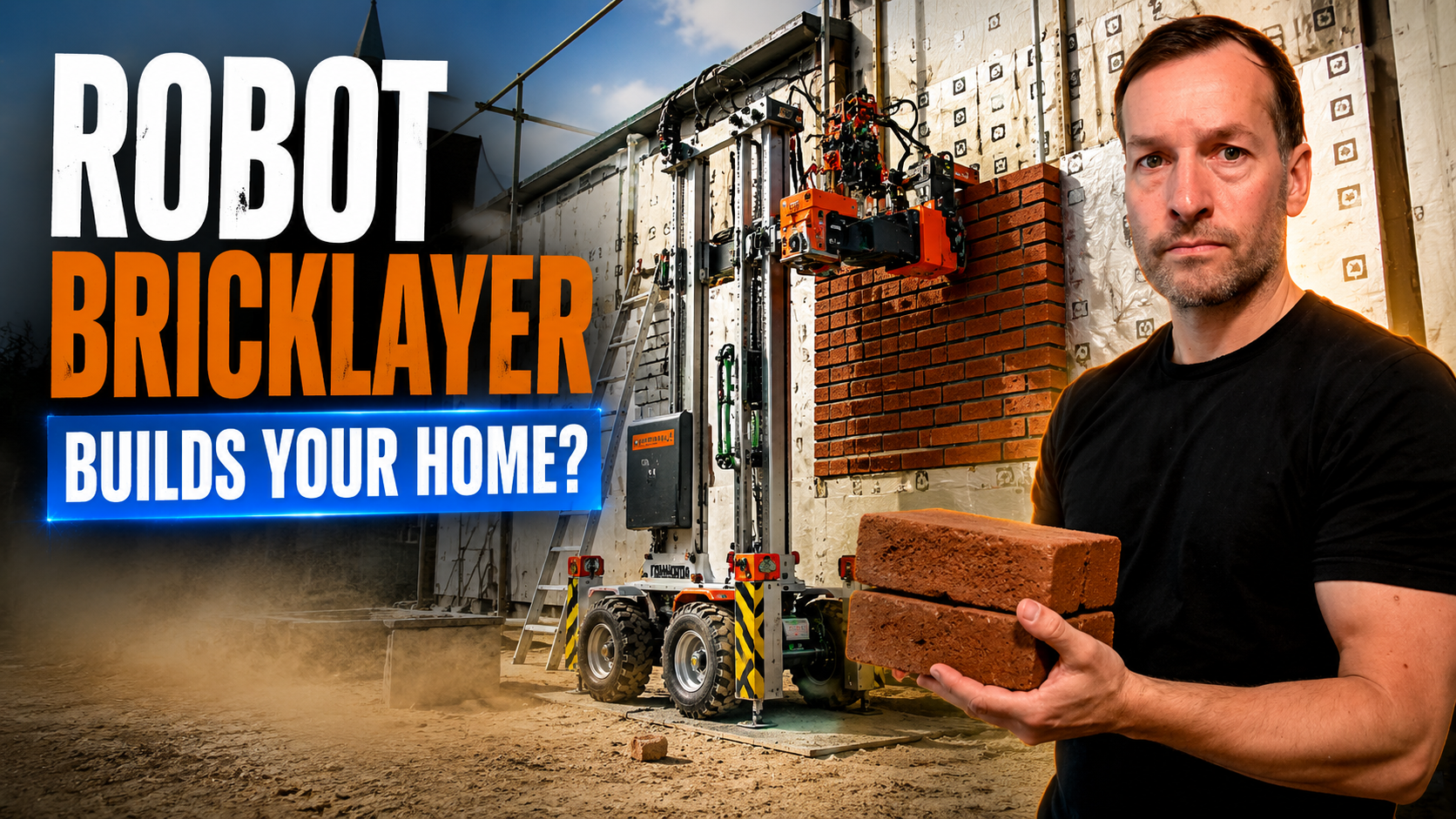
The Netherlands needs 100,000 new homes a year — but the country’s construction workforce is ageing out faster than it’s being replaced, leaving a critical shortage of skilled bricklayers. One Amsterdam startup thinks robots are the answer.
Quick Facts: Monumental’s Robot Bricklayers
- Company: Monumental, based in Amsterdam
- The robot crew: Pisa (lays bricks & mortar), Petra (feeds bricks), Panama (feeds mortar)
- Funding: $32 million raised, led by Khosla Ventures — over $60 million total
- Built so far: walls for 100+ homes, plus a school, a hotel, a community centre, and stretches of Amsterdam’s canal walls
- Business model: the robots work as subcontractors, not as a one-off product sale
Meet the Robot Bricklayers: Pisa, Petra & Panama
Monumental, an Amsterdam-based robotics company, has built a fleet of autonomous bricklaying robots designed to ease the country’s housing crisis by taking on repetitive masonry work. The company recently raised $32 million in a round led by US firm Khosla Ventures, bringing its total investment past $60 million.
The fleet consists of three named robots, each with a distinct role: Pisa places bricks and applies mortar, Petra supplies bricks to Pisa, and Panama supplies the mortar. Guided by cranes, grippers, sensors, and computer vision, the trio moves autonomously around a construction site alongside human workers.
How Atrium Software Plans Every Brick
Before a single brick is laid, the entire wall is planned digitally through Monumental’s software, Atrium, which takes an architect’s drawings and calculates every brick and mortar joint in advance, translating the design into a build-ready plan for the robots to execute.
A Subcontractor Model, Not a Robot Sale
What sets Monumental apart is its business model. Rather than selling the robots outright, the company operates them as subcontractors — meaning if a wall isn’t built correctly, that responsibility falls on Monumental to fix, not the construction firm. This structure removes much of the financial risk that typically slows automation adoption, while giving Monumental a continuous stream of real-world data. Every site — whether it presents difficult weather, an awkward corner, or a batch of bricks that behaves differently — feeds back into Atrium, making the system more predictable on the next job.
100+ Homes Built — And Scaling Fast
So far, Monumental has built the walls for more than 100 homes, plus a school, a hotel, a community centre, and stretches of Amsterdam’s canal walls — a small fraction of the 69,000 homes built in the Netherlands in 2025, against a national target of 100,000 new homes per year. But CEO Salar al Khafaji is clear about the scaling logic: rather than making one robot work harder, the answer is deploying more of them in parallel — something a shrinking human workforce simply cannot do.
What Robot Bricklayers Mean for the Future of Construction
As labour shortages continue to constrain construction industries well beyond the Netherlands, expect to see more companies experimenting with robot fleets as subcontractors rather than one-off tools — a model that could reshape how housing gets built across Europe and beyond.
If you’re evaluating automation like this for your own business, RoboPhil’s robotics consultancy services can help you find the right fit.
Frequently Asked Questions About Robot Bricklayers
Who makes the robot bricklayers Pisa, Petra and Panama?
Monumental, an Amsterdam-based robotics company, designs, builds and operates the three-robot bricklaying crew, and takes responsibility for the quality of the finished walls.
How do Pisa, Petra and Panama work together?
Pisa places bricks and applies mortar, Petra keeps Pisa supplied with bricks, and Panama supplies the mortar. All three move autonomously around the site using cranes, grippers, sensors and computer vision.
What makes Monumental’s business model different from other construction robots?
Instead of selling the robots outright, Monumental operates them as a subcontractor, so it carries the responsibility — and the risk — for the finished work.
How many homes have Monumental’s robot bricklayers built?
As of 2026, the robots have laid the walls for more than 100 homes, plus a school, a hotel, a community centre and stretches of Amsterdam’s canal walls.
Why is the Netherlands turning to bricklaying robots?
The country needs around 100,000 new homes a year, but its construction workforce is ageing out faster than it can be replaced, leaving a shortage of skilled bricklayers that robots like Pisa, Petra and Panama are designed to help fill.
Watch the full breakdown in the video above.
This channel is proudly sponsored by Robot Center — robot sales, deployment & consulting, and Robots of London — robot hire for events.