

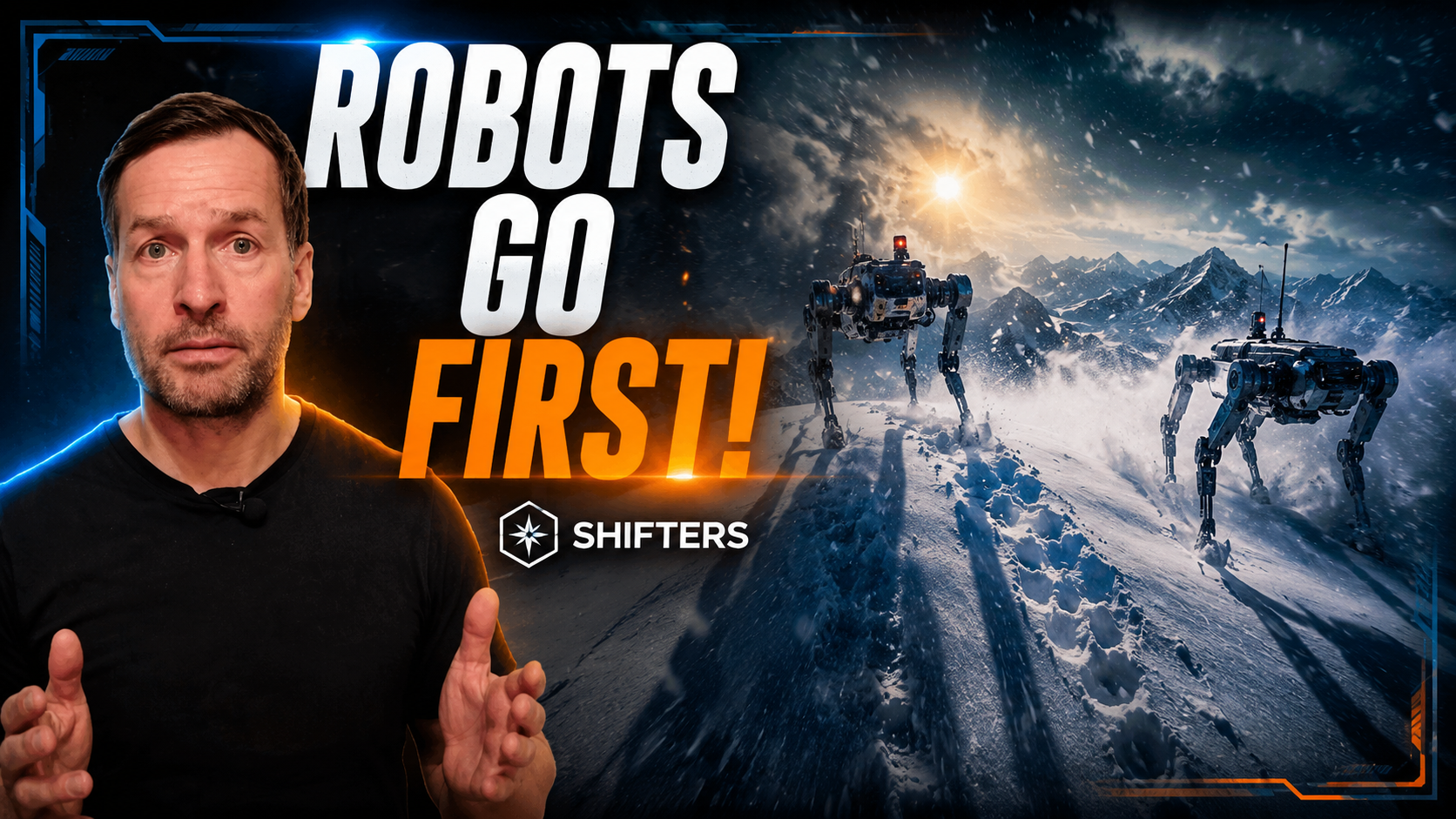
Robots Go First: How AI Ground Robots Could Transform Defence, Security and Dangerous Work
The phrase “robots go first” captures one of the most important shifts happening in robotics today. For decades, robots have been used in factories, warehouses, hospitals, laboratories and events. But a new generation of AI ground robots is now being designed for a more urgent purpose: entering dangerous environments before human beings do.
This is no longer science fiction. AI robots are becoming more mobile, more intelligent and more useful in the real world. Ground robots can now move through rough terrain, collect data, inspect hazardous areas, support security teams and potentially assist in military operations where the risk to human life is high.
The recent announcement that Shifters has raised $10.2 million in seed funding to advance AI-native ground robotics highlights a wider trend in the robotics industry: investors, defence organisations and technology companies are taking ground autonomy seriously. The company says its mission is to develop supervised autonomous ground robotic systems that can improve situational awareness and help preserve human life in dangerous environments.
The big question is no longer whether robots will be used in dangerous missions. They already are. The bigger question is how far this technology will go, how quickly businesses and governments will adopt it, and what role human operators should play when AI robots enter the field.
The Rise of AI Ground Robots
Ground robots are not new. Bomb disposal robots, inspection crawlers and remote-controlled machines have been used for years. What is changing now is the intelligence, autonomy and flexibility of these systems.
Older robots often required constant manual control. They were useful, but limited. A human operator needed to drive them, manage the camera, interpret the environment and make every movement decision. New AI ground robots are being designed to work more like robotic teammates. They can navigate more independently, gather useful information, adapt to changing conditions and support human decision-making.
This shift is being driven by several technologies coming together at the same time. Artificial intelligence allows robots to interpret sensor data and make better decisions. Advanced cameras, lidar, thermal imaging and radar help robots understand the world around them. Better batteries and motors improve endurance and mobility. Cloud computing and edge computing allow robots to process data faster. Improvements in robotics software make it easier to coordinate multiple machines as a team.
The result is a new category of robotics technology: AI-native ground robots built not just as machines, but as intelligent systems.
Why “Robots Go First” Matters
The idea behind “robots go first” is simple. In any environment where human life may be at risk, a robot should be sent in first to inspect, sense, map and report.
This could apply to military missions, collapsed buildings, chemical spills, nuclear sites, burning warehouses, underground tunnels, disaster zones, oil and gas facilities, ports, airports, construction sites and critical infrastructure.
In defence and security, the value is obvious. If a robot can move ahead of a team and provide live intelligence, soldiers or security personnel can make better decisions before entering a dangerous area. A robot can reveal hidden threats, unstable structures, blocked routes or hostile activity. It can also operate in places that are too contaminated, dark, confined or exposed for humans.
In business and industrial settings, the same principle applies. A company operating a large warehouse, energy site, rail depot, factory or data centre may use robots to inspect areas that are difficult or risky for staff. These robots may not be military machines, but the core benefit is similar: reducing risk, improving visibility and increasing operational efficiency.
This is why the future of robotics is not only about replacing labour. It is also about protecting people.
From Drones in the Air to Robots on the Ground
Drones have already transformed how organisations think about remote inspection, surveillance and situational awareness. A drone can fly over a site, gather images, inspect a roof, monitor a crowd or provide a tactical view from above.
Ground robots are the next major step.
The challenge is that the ground is much harder than the air. A drone can avoid many obstacles by flying over them. A ground robot must deal with rubble, stairs, mud, doors, debris, narrow corridors, slopes, cables, uneven surfaces and unpredictable terrain. It must physically interact with the environment in a much more complex way.
This is one reason why AI ground robots are such an important area of robotics investment. If companies can solve mobility, autonomy and coordination on the ground, they unlock a huge range of use cases across defence, security, inspection, logistics, construction and emergency response.
In many industries, aerial drones provide the overview. Ground robots provide the close-up. Together, they could form multi-layered robotic systems that collect data from the air and the ground, giving human teams a much clearer understanding of complex environments.
Why Businesses Are Investing in Robotics
Robotics adoption is being driven by several business pressures at once.
First, companies are facing labour shortages. Many industries are struggling to recruit people for repetitive, dangerous or physically demanding work. Robots can help fill gaps in cleaning, logistics, inspection, delivery, security and manufacturing.
Second, businesses are under pressure to improve productivity. Automation allows organisations to operate more consistently, reduce downtime and gather better data. A robot does not just perform a task; it can also become a mobile data collection platform.
Third, safety is becoming a major driver of robotics adoption. If a robot can inspect a confined space, patrol a remote site or enter a hazardous area, it can reduce the need to expose people to danger.
Fourth, AI is making robots more useful. In the past, many robots were impressive demonstrations but difficult to deploy commercially. Today, AI robots are becoming better at perception, navigation, communication and task execution. This makes the return on investment more realistic for businesses.
Finally, robotics is becoming part of the wider digital transformation strategy. Companies are not only asking, “Can a robot do this job?” They are asking, “How can robotics connect with our data, people, processes and systems?”
That is where robotics consulting becomes important. Businesses need help identifying the right opportunities, selecting the right robot, building the business case and integrating the technology into their operations.
The Role of AI in Modern Robotics
Artificial intelligence is one of the biggest reasons robotics is accelerating.
A robot without AI may follow a fixed route or respond only to simple commands. An AI robot can interpret information, recognise objects, understand patterns, adapt to changing environments and support more complex decisions.
In ground robotics, AI can help with mapping, obstacle avoidance, object detection, mission planning, route optimisation and multi-robot coordination. For example, a robot entering a hazardous building could build a map, identify blocked passages, detect heat signatures, flag suspicious objects and send useful information back to a human operator.
However, AI does not remove the need for human control. In high-risk environments, supervised autonomy is often more realistic and responsible than full autonomy. This means the robot can perform certain tasks independently, but a human remains in the decision loop.
This is especially important in defence, security and public safety. The goal should not be to create uncontrolled machines making critical decisions alone. The goal should be to use robotics technology to extend human capability, improve awareness and reduce exposure to danger.
Real-World Applications of AI Ground Robots
The potential applications of AI ground robots are wide-ranging.
Defence and Military Operations
In defence, ground robots can be used for reconnaissance, surveillance, route clearance, logistics support, explosive ordnance disposal and operating in denied or dangerous environments. They can provide intelligence before soldiers enter an area and help reduce risk during complex missions.
The most valuable role may be information gathering. A robot that can move ahead of a team and send back reliable data can change the way decisions are made in the field.
Security and Patrol
Security robots can patrol warehouses, campuses, airports, car parks, industrial sites and public spaces. They can act as mobile sensors, moving around a site and reporting unusual activity.
Unlike fixed CCTV cameras, a mobile robot can reposition itself, inspect blind spots and provide a visible presence. When combined with AI, it can help security teams focus attention where it is needed most.
Inspection and Maintenance
Inspection robots are already being used in energy, utilities, manufacturing and infrastructure. They can inspect pipes, tunnels, substations, factories, construction sites, rail environments and offshore facilities.
The benefit is not just safety. Robots can collect consistent data over time, helping businesses predict faults, reduce downtime and improve maintenance planning.
Disaster Response
After fires, earthquakes, floods or building collapses, robots can enter unstable or dangerous areas before rescue teams. They can search for survivors, map damage and detect hazards such as gas leaks, heat, smoke or structural weakness.
This is one of the clearest examples of robots being used to protect human life.
Logistics and Field Support
Ground robots can also move supplies, tools, medical equipment or spare parts across sites. In defence, this could mean reducing the physical burden on soldiers. In industry, it could mean improving material movement across factories, warehouses or large outdoor facilities.
Humanoid Robots and Ground Robots: Different Paths, Same Direction
Humanoid robots often receive the most attention because they look like people and are easy to imagine in human environments. They are being developed for factories, warehouses, care settings, customer service and general-purpose work.
Ground robots, however, may become commercially useful faster in certain environments because they do not need to look human. A rugged tracked robot, wheeled robot or quadruped robot can be designed specifically for the task. It does not need a face or human-like movement. It needs reliability, mobility, sensing and useful software.
That said, humanoid robots and ground robots are part of the same wider movement. The robotics industry is moving from fixed machines in controlled environments to intelligent mobile robots operating in the real world.
This is the future of robotics: robots that can move, sense, learn, communicate and work alongside people.
Robotics Startups and Investment Trends
The growth of robotics startups shows that investors see automation as a long-term opportunity. Robotics is difficult, capital-intensive and hardware-heavy, but it also has the potential to reshape entire industries.
Defence technology, AI robots, humanoid robots, warehouse automation, healthcare robotics, agriculture robotics and inspection robots are all attracting serious attention. Investors are looking for companies that can solve real problems, not just build impressive prototypes.
The Shifters funding round reflects this broader trend. The market is interested in robotic systems that can operate in dangerous or high-value environments where the benefit is clear. If a robot can reduce risk, improve mission success or unlock a new operational capability, the business case becomes stronger.
For robotics companies, this creates an opportunity but also a challenge. The industry must move beyond hype. Customers want reliable systems, strong support, clear use cases and measurable outcomes.
Challenges Slowing Robotics Adoption
Despite the excitement, robotics adoption is not always easy.
Cost remains a major barrier. Robots require hardware, software, maintenance, training, integration and support. Businesses need to understand not only the purchase price, but the total cost of ownership.
Reliability is another challenge. Real-world environments are messy and unpredictable. A robot that works well in a demonstration may struggle in a busy warehouse, outdoor site or hazardous location.
Integration is also important. Robots need to fit into existing workflows. They may need to connect with building systems, security platforms, enterprise software, data dashboards or human teams.
There are also cultural challenges. Staff may worry that robots will replace jobs. Managers may not fully understand what robots can and cannot do. Decision-makers may be unsure where to start.
In defence and security, there are additional concerns around ethics, accountability, cybersecurity, control and rules of engagement. These issues must be taken seriously as AI robots become more capable.
This is why successful robotics adoption requires strategy, not just technology.
The Business Opportunity in Robotics Consulting
As robots become more advanced, many organisations will need help making sense of the market.
There are now robots for cleaning, delivery, reception, telepresence, warehouse operations, inspection, security, education, healthcare, entertainment, agriculture and more. Choosing the right robot is not always straightforward.
A robotics consultant can help a business identify where automation makes sense, assess the return on investment, compare suppliers, plan a pilot, manage deployment and train teams.
The best robotics consulting is not about forcing robots into a business. It is about finding the intersection between business needs, available technology and measurable value.
For example, a company may think it needs a humanoid robot, but the better solution may be a mobile inspection robot. Another company may want automation, but first needs to improve its process, data and site layout. A good consultant helps businesses avoid expensive mistakes and focus on practical outcomes.
The RoboPhil Perspective
Philip English, known as RoboPhil, works across the robotics ecosystem through Robot Center, Robots of London and Robot Philosophy. His work focuses on helping businesses understand robotics, explore automation opportunities and connect with the right robot technologies.
Robot Center supports businesses looking at robotics, automation, robot sourcing and practical deployment. Robots of London focuses on robot hire, events and public-facing robot experiences. Robot Philosophy shares robotics news, insights, interviews and education for people who want to understand where the industry is heading.
This combination gives RoboPhil a practical view of the robotics industry. It is not just about talking about future technology. It is about seeing how robots perform in real environments, how businesses respond to them, and what needs to happen for robotics adoption to succeed.
For companies exploring AI robots, humanoid robots, service robots, inspection robots or automation strategy, the key message is simple: start with the problem, not the robot. The right robotics solution should improve safety, save time, generate data, reduce costs or create a better customer experience.
What the Future of Robotics Looks Like
The future of robotics will not be one single type of machine. It will be a connected ecosystem of robots, AI systems, sensors, software platforms and human operators.
In the workplace, robots will take on more repetitive, physically demanding and dangerous tasks. In public spaces, service robots will help with guidance, delivery, cleaning and customer interaction. In industry, inspection robots will become part of predictive maintenance systems. In defence and emergency response, ground robots may increasingly go first into dangerous environments.
Humanoid robots will continue to attract attention, especially as they become more capable. But many of the most valuable robots may not look human at all. They may be wheeled, tracked, four-legged, modular or task-specific.
The most successful organisations will be those that understand robotics as a strategic tool. They will not wait until the technology is everywhere. They will experiment early, run pilots, develop internal knowledge and build partnerships with robotics experts.
Conclusion: Robots Are Becoming the First Line of Exploration
The idea that robots should go first is powerful because it speaks to the best use of robotics technology. Robots should go where humans should not have to go. They should inspect dangerous places, gather intelligence, reduce uncertainty and help people make better decisions.
AI ground robots represent a major step in that direction. They combine mobility, sensing, autonomy and human supervision to create new possibilities across defence, security, inspection, logistics and disaster response.
The robotics industry is still developing, and there are real challenges around cost, reliability, ethics and integration. But the direction is clear. Robots are moving out of controlled environments and into the real world.
For business leaders, entrepreneurs, engineers and investors, this is the moment to pay attention. The future of robotics will not only change how work is done. It will change where humans need to go, what risks they need to take and how organisations think about safety, productivity and intelligence.
Robots going first may become one of the defining principles of the next era of automation.
For robotics consulting, robot sourcing, robotics industry insights or automation strategy, contact RoboPhil and the team:
Robot Center
https://robotcenter.co.uk/
Robots of London
https://robotsoflondon.co.uk/
Robot Philosophy
https://robophil.com/
Business enquiries
sales@robotcenter.co.uk