

The Rise of Humanoid Robots: How AI Robots Will Transform the Future of Work
Humanoid robots are moving from science fiction into serious business conversation.
For decades, robots were mostly hidden inside factories, bolted to the floor, repeating the same task thousands of times. They welded car frames, moved boxes, assembled electronics, packed goods, and helped manufacturers increase speed, accuracy, and output. These machines were powerful, but they were not flexible in the way humans are flexible.
Now the robotics industry is entering a new phase.
AI robots, humanoid robots, mobile service robots, and intelligent automation systems are beginning to combine physical movement with artificial intelligence. Instead of robots simply following fixed instructions, the next generation of robotics technology is being designed to understand environments, learn tasks, process sensor data, and interact with the physical world in more adaptable ways.
This is why humanoid robots are attracting so much attention.
They are not just another machine. They represent a possible new interface between AI and the real world. If artificial intelligence has already changed how we write, search, code, design, plan, and communicate, humanoid robots could eventually change how physical work gets done.
That does not mean every business will have a humanoid robot tomorrow. It does not mean human workers disappear overnight. But it does mean business leaders, entrepreneurs, investors, and automation professionals need to pay attention.
The future of robotics is no longer a distant idea.
It is becoming a practical business question.
Why Humanoid Robots Matter Now
The interest in humanoid robots has grown because several technologies are maturing at the same time.
Artificial intelligence has improved rapidly. Computer vision is more capable. Sensors are cheaper and more accurate. Batteries are improving. Simulation tools are more powerful. Robotic hands are becoming more dexterous. Edge computing allows robots to process more information onboard. Cloud infrastructure makes it easier to train, update, and manage robotic systems.
All of these developments are helping to move robots beyond traditional industrial automation.
A humanoid robot is especially interesting because it is designed to work in environments built for humans. Offices, warehouses, hospitals, shops, hotels, factories, care homes, laboratories, and event spaces were not designed for machines. They were designed for people.
That creates a major challenge for automation.
Traditional robots often require the environment to be changed around them. A factory cell might need guarding, fixed positioning, safety barriers, conveyors, specialist grippers, and custom programming. This can work extremely well for repeatable tasks, but it can be expensive and inflexible.
Humanoid robots take a different approach.
Instead of rebuilding the world for the robot, the ambition is to build robots that can operate in the world we already have.
That is the powerful idea behind humanoid robotics.
If a robot has arms, legs, hands, cameras, balance, mobility, and AI reasoning, it could potentially perform a much wider range of tasks in human environments. It could carry items, open doors, press buttons, inspect facilities, support logistics, assist staff, interact with customers, and eventually handle more complex workflows.
This is why the robotics industry is excited.
Humanoid robots are not just about appearance. They are about compatibility with the human world.
The Shift From Automation to Physical AI
For many years, automation meant machines completing fixed tasks.
A robot arm would move from point A to point B. A conveyor would move goods through a production line. A warehouse robot would follow routes across a floor. A kiosk would process a customer interaction. These systems were valuable, but they were usually narrow in function.
Physical AI is different.
Physical AI refers to artificial intelligence operating through machines in the real world. It is not just software generating text or images. It is AI connected to sensors, motors, cameras, manipulators, mobility systems, and physical decision-making.
This matters because the real world is messy.
A robot in a warehouse may encounter people, pallets, trolleys, doors, uneven lighting, unexpected obstacles, missing items, unusual packaging, or changing layouts. A robot in a hospital may need to navigate corridors, avoid patients, move safely near staff, and operate in a sensitive environment. A robot at an event may need to interact with people in a natural and engaging way.
Traditional programming struggles with every possible variation.
AI gives robots the potential to adapt.
This is one of the biggest trends in robotics technology. The industry is moving from fixed automation toward intelligent, flexible systems that can perceive, reason, and act.
Humanoid robots are one of the most visible examples of this shift.
They are effectively a test platform for physical AI.
NVIDIA, Robot Platforms, and the Importance of a Shared Blueprint
One of the most interesting developments in humanoid robotics is the move toward shared development platforms.
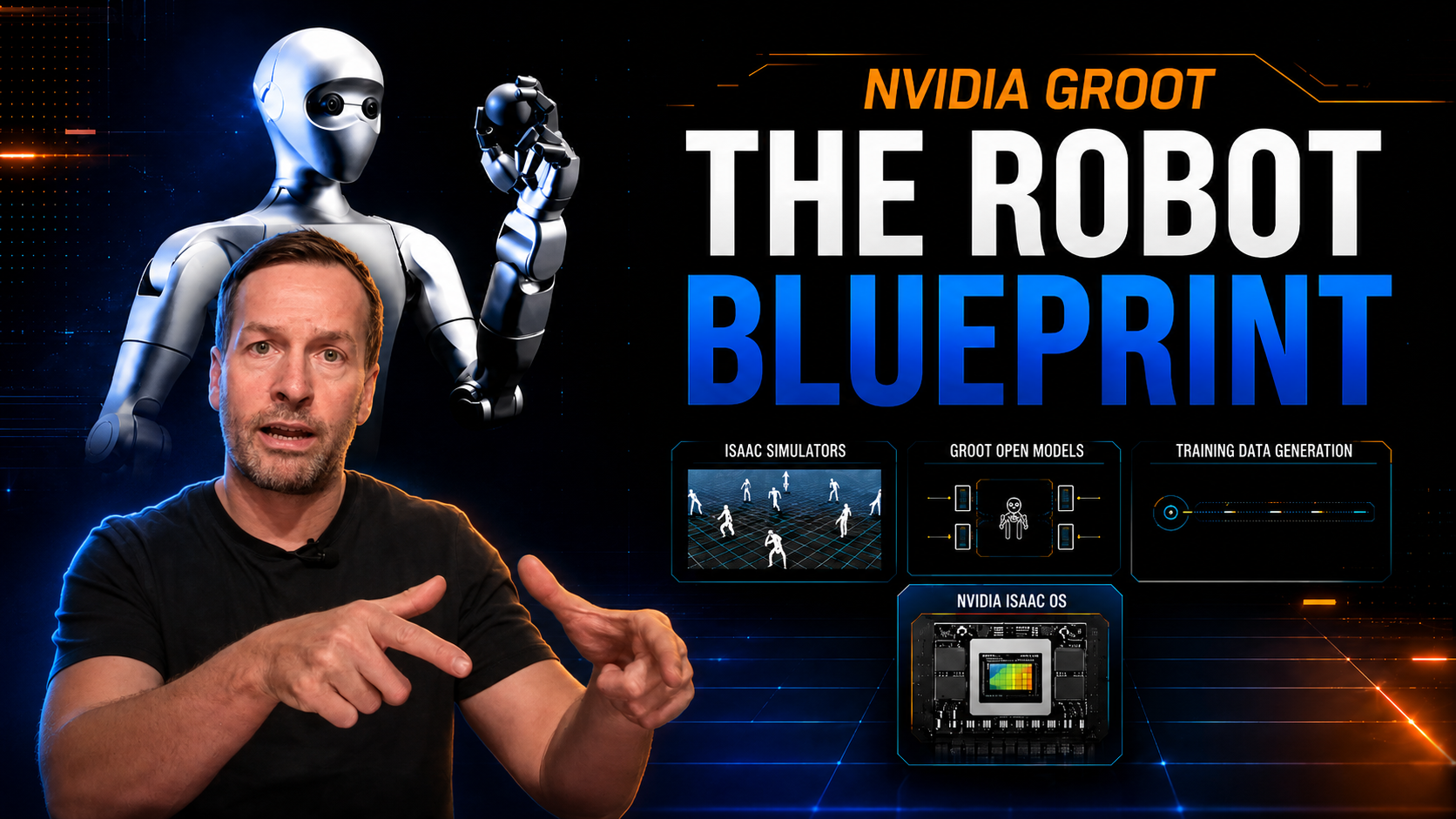
NVIDIA’s Isaac GR00T Reference Humanoid Robot is a good example of this trend. It combines a humanoid body, dexterous hands, onboard AI compute, sensors, simulation tools, open models, and robotics development workflows into a more unified reference design.
The commercial significance is not just that another humanoid robot exists.
The important point is that the robotics industry needs platforms.
At the moment, robotics development can be fragmented. One team works on hardware. Another works on control systems. Another works on simulation. Another focuses on training data. Another works on manipulation. Another handles deployment. Each project can become a custom engineering challenge.
That slows adoption.
If the industry develops stronger reference platforms, common toolchains, open models, simulation workflows, and repeatable deployment processes, humanoid robotics can move faster.
This is similar to what happened in other technology sectors.
The computer industry grew faster when hardware, operating systems, development tools, and software ecosystems became more standardized. The smartphone industry accelerated when developers had platforms to build on. Cloud computing expanded because businesses could access flexible infrastructure instead of building everything from scratch.
Robotics may be heading in a similar direction.
The future of robotics will not be built by one robot company alone. It will be built by ecosystems of hardware manufacturers, AI companies, software developers, integrators, consultants, researchers, investors, and businesses willing to test real-world use cases.
A robot blueprint matters because it reduces friction.
And in robotics, reducing friction is essential.
Why Businesses Are Investing in Robots
Businesses are not investing in robots simply because robots are exciting.
They are investing because of pressure.
Labor shortages are affecting many industries. Wage costs are rising. Customers expect faster service. Supply chains need more resilience. Warehouses need to process more orders. Manufacturers need consistency. Healthcare providers need support. Facilities teams need better monitoring. Retailers need new customer experiences. Event companies need memorable engagement.
Robots can help address some of these challenges.
Industrial robots improve precision and productivity. Service robots can support front-of-house operations, deliveries, cleaning, and customer engagement. Inspection robots can collect data in difficult or hazardous environments. Security robots can monitor facilities. Collaborative robots can work near human teams. Humanoid robots may eventually bring more flexibility into environments where traditional automation is difficult.
The business case for robotics usually comes down to several core benefits.
Robots can improve consistency. They can complete repetitive tasks without fatigue. They can operate in environments that may be dull, dirty, dangerous, or difficult for people. They can collect useful data. They can improve customer experience. They can help companies scale operations. They can reduce downtime. They can support staff rather than replace them entirely.
However, successful robotics adoption is not just about buying a robot.
It is about choosing the right robot for the right job.
This is where many companies make mistakes. They see an impressive demo, buy a robot, and then struggle to integrate it into the business properly. The robot may not fit the workflow. Staff may not be trained. The environment may not be suitable. The return on investment may not be clear.
Robotics consulting is becoming important because businesses need guidance.
The question is not simply, “Which robot should we buy?”
The better question is, “Where can robotics create measurable value in our business?”
Real-World Applications of AI Robots and Humanoid Robots
The first major use cases for humanoid robots are likely to appear where labor is expensive, repetitive, physically demanding, or difficult to recruit for.
Warehousing and logistics are obvious examples.
A humanoid robot could eventually help move goods, sort items, load and unload objects, inspect shelves, or work alongside human teams. Warehouses are already using mobile robots and automated systems, but humanoid robots could add more flexibility because they can potentially interact with existing tools, doors, shelves, carts, and workstations.
Manufacturing is another major opportunity.
Factories already use industrial robots, but humanoid robots could help with tasks that are not easy to automate using fixed systems. This might include machine tending, parts movement, quality checks, tool handling, or flexible assembly tasks.
Healthcare and care environments may also benefit from AI robots.
Robots may help transport items, guide visitors, support staff, deliver supplies, monitor environments, or provide basic interaction. In care settings, the challenge is not only technical. Safety, trust, empathy, and regulation all matter. But the pressure on healthcare systems means robotics will continue to be explored.
Retail is another area to watch.
Robots can support customer engagement, inventory checks, product guidance, digital signage, and brand experiences. The robot does not need to replace staff to be useful. It can attract attention, collect data, answer common questions, and improve the customer journey.
Events and exhibitions are already a strong use case for robots.
At events, robots create attention. They start conversations. They help brands stand out. They can deliver messages, guide visitors, entertain guests, and create shareable moments. In a crowded exhibition hall, a robot can become a magnet for engagement.
This is one reason event robotics has become a practical commercial application rather than just a novelty.
Robots are useful when they solve a real problem.
Sometimes that problem is operational efficiency.
Sometimes it is customer experience.
Sometimes it is data collection.
Sometimes it is attention.
The key is understanding the job the robot is being hired to do.
The Robotics Startup Explosion
The robotics startup market is becoming increasingly active.
Investors are looking at humanoid robots, warehouse automation, agricultural robotics, healthcare robotics, inspection robots, defense robotics, service robots, construction robotics, and AI-powered automation platforms.
The reason is simple.
Robotics sits at the intersection of several powerful trends: AI, labor shortages, supply chain pressure, aging populations, advanced manufacturing, and digital transformation.
However, robotics startups are not easy to build.
Hardware is hard. Deployment is hard. Safety is hard. Support is hard. Sales cycles can be long. Customers often need education. Robots must work reliably in the real world, not just in a demo video.
This is why the most successful robotics companies will not only build impressive machines. They will build practical solutions.
The winners will understand use cases, integration, maintenance, service models, customer training, financing, and return on investment.
Robotics as a Service is likely to play a major role here.
Instead of buying robots outright, many businesses may prefer subscription models, rental models, leasing, managed deployment, or outcome-based pricing. This lowers risk and makes robotics adoption easier for companies that do not want large upfront costs.
The robotics industry will grow fastest when adoption becomes simpler.
Challenges Slowing Robotics Adoption
Despite the excitement, robotics still faces major challenges.
Cost is one of the biggest barriers.
Humanoid robots, advanced service robots, and industrial automation systems can be expensive. Businesses need to understand not only the purchase price but also installation, training, maintenance, support, software, insurance, safety, and upgrades.
Reliability is another challenge.
A robot that works perfectly in a controlled demonstration may struggle in a real business environment. Lighting changes. People behave unpredictably. Floors are uneven. Wi-Fi may be unreliable. Objects may not be where they are supposed to be. Real-world robotics is difficult because the real world does not behave like a laboratory.
Safety is also critical.
Robots working near people must be designed, tested, and deployed carefully. Businesses need proper risk assessments, staff training, safety procedures, and ongoing monitoring.
Integration can be a major issue.
A robot is rarely useful on its own. It may need to connect with booking systems, warehouse software, customer databases, building maps, lifts, doors, payment systems, or internal processes. Without integration, the robot may become an expensive gadget instead of a productive tool.
There is also a people challenge.
Staff may worry about job replacement. Managers may not understand robotics. Customers may be unsure how to interact with robots. Businesses need to communicate clearly and introduce robots in a way that supports people rather than creates confusion.
The companies that succeed with robotics will be the ones that treat adoption as a strategic project, not a one-off purchase.
Why Robotics Consulting Is Becoming More Important
As robotics technology becomes more advanced, businesses need more support making decisions.
Robotics consulting helps companies understand what is possible, what is practical, and what is worth investing in.
A robotics consultant can help identify use cases, compare robot options, assess return on investment, plan deployment, manage suppliers, train staff, and avoid costly mistakes.
This is especially important because the robotics market is becoming crowded.
There are many robot manufacturers, many types of robots, many claims, and many emerging technologies. A business exploring automation may not know whether it needs a humanoid robot, a mobile robot, a cobot, a service robot, a cleaning robot, an inspection robot, or a software-based automation solution.
The right answer depends on the business problem.
Good robotics consulting starts with the problem, not the product.
Where is the business losing time?
Where are staff overloaded?
Where are errors happening?
Where is customer experience weak?
Where could data improve decision-making?
Where could automation create measurable value?
Only after those questions are answered should a company choose the robot.
This is why robotics consulting will become more important as robots become more available.
The easier it becomes to buy robots, the more important it becomes to buy and deploy the right ones.
The RoboPhil Perspective
Philip English, known as RoboPhil, works across the robotics industry through Robot Center, Robots of London, and Robot Philosophy.
His work covers robotics consulting, robot sourcing, robot deployment, robot hire for events, robotics insights, business strategy, and helping companies understand how robotics can create real-world value.
Through Robot Center, the focus is on commercial robots, industrial robots, robot deployment, robotics consultancy, and helping businesses explore automation opportunities.
Through Robots of London, the focus is on robot hire, robot rental, event robotics, exhibition robots, and using robots to create engagement in real environments.
Through Robot Philosophy, the focus is on robotics insights, consulting, education, strategy, and helping the market understand where robotics is going.
This combination gives RoboPhil a practical view of the robotics industry.
Robotics is not just about technology. It is about people, business models, customer experience, deployment, training, and commercial value.
A robot that looks impressive but does not solve a business problem will not create long-term value.
A simpler robot deployed properly can be far more effective than a more advanced robot placed in the wrong environment.
That is one of the most important lessons in robotics adoption.
What the Future of Robotics Looks Like
The future of robotics will not arrive all at once.
It will arrive industry by industry, use case by use case, deployment by deployment.
First, robots will take on tasks that are repetitive, physically demanding, dangerous, or difficult to staff. Then they will become more flexible. Then they will connect more deeply with business systems. Then they will become more capable through AI, better sensors, and improved manipulation.
Humanoid robots will likely start in controlled environments where tasks can be clearly defined and safety can be managed.
Over time, they may become more common in warehouses, factories, logistics centers, laboratories, hospitals, care facilities, retail spaces, hotels, airports, offices, and public venues.
Service robots will continue to grow in hospitality, events, cleaning, delivery, healthcare support, and customer interaction.
Industrial robots will become easier to program and more flexible.
AI robots will become more capable of understanding instructions, adapting to environments, and learning from demonstrations.
Robotics startups will continue to attract investment, but the market will become more demanding. Investors and customers will want proof that robots can deliver value outside controlled demos.
The future of robotics will be practical.
The hype will remain, but the real winners will be companies that solve specific problems well.
The Business Opportunity in Robotics
For business leaders, the robotics opportunity is not simply about replacing workers.
That is too narrow.
The bigger opportunity is redesigning work.
Robots can help businesses improve productivity, reduce repetitive strain, extend operating hours, collect better data, create new customer experiences, and make teams more effective.
In some industries, robots will help solve labor shortages.
In others, they will improve safety.
In events and retail, they will create attention and engagement.
In manufacturing and logistics, they will increase efficiency and consistency.
In healthcare, they may support overstretched teams.
In facilities management, they may inspect, monitor, clean, and report.
The companies that benefit most from robotics will be the ones that start learning now.
They do not need to buy humanoid robots immediately. But they should understand the market, explore use cases, test small projects, speak with experts, and build internal knowledge.
Robotics adoption is a learning curve.
The businesses that start early will understand what works before their competitors do.
Conclusion: Robots Are Becoming a Business Strategy
Robotics is entering a new era.
AI robots, humanoid robots, service robots, industrial robots, and automation platforms are moving from isolated technology projects into mainstream business strategy.
The rise of humanoid robots is especially important because it represents a new ambition for automation. Instead of building machines for narrow environments, the industry is trying to create robots that can operate in spaces designed for humans.
That is a difficult challenge.
But it is also a huge opportunity.
The future of robotics will be shaped by the companies that can combine reliable hardware, intelligent software, practical deployment, strong business models, and real customer value.
For businesses, the message is clear.
Do not wait until robotics feels perfect.
Start understanding it now.
Explore where robots could create value. Learn what is available. Test real use cases. Build a strategy. Get advice before making expensive decisions.
The future of automation will not belong to the companies that simply buy the most advanced robots.
It will belong to the companies that understand how to use robotics properly.
For robotics consulting, robot sourcing, robotics industry insights, and automation strategy, contact RoboPhil and the robotics services below.
Robot Center
https://robotcenter.co.uk/
Robots of London
https://robotsoflondon.co.uk/
Robot Philosophy
https://robophil.com/
Business enquiries
sales@robotcenter.co.uk