

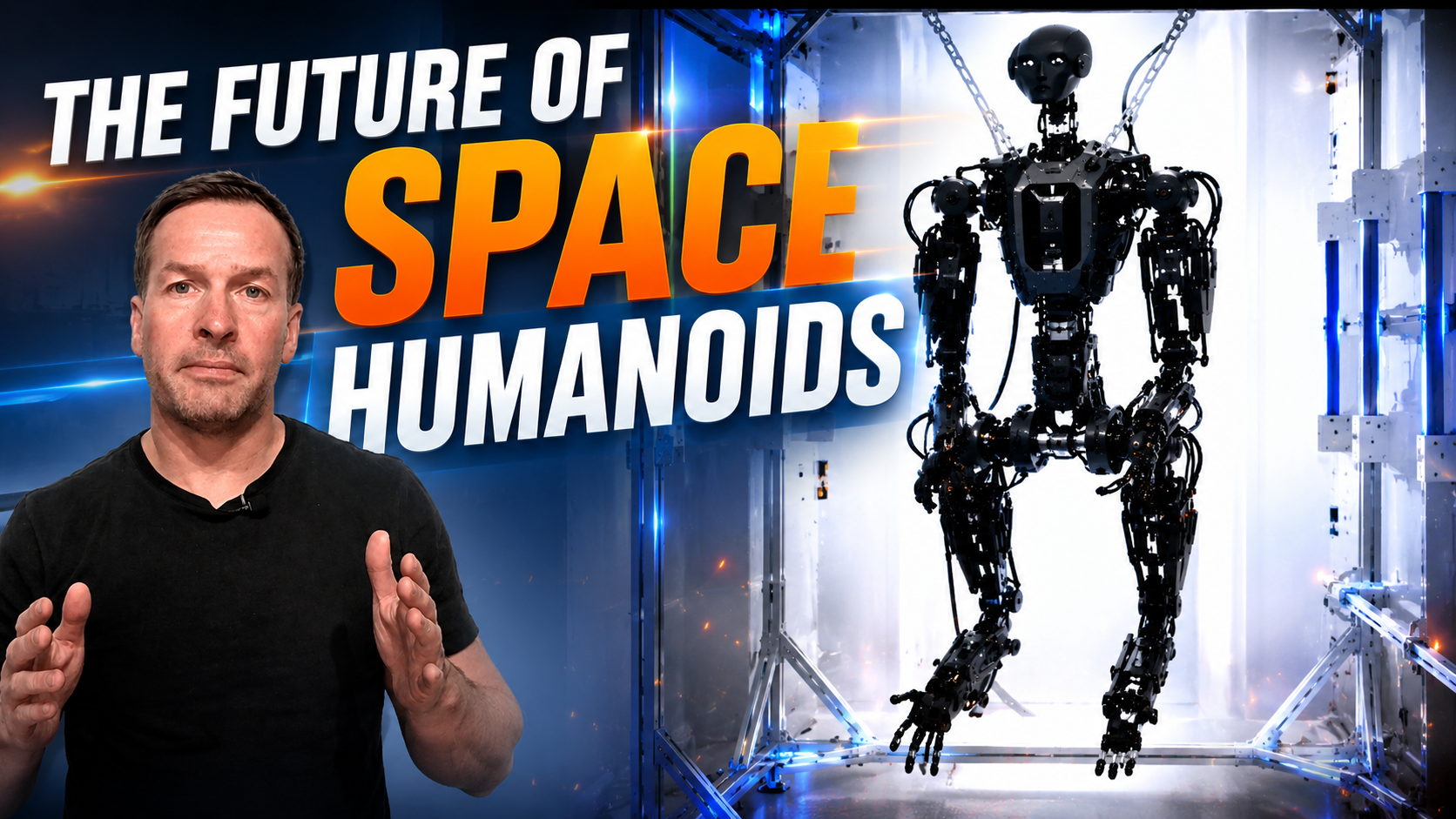
The Future of Space Humanoids: How AI Robots Could Build the Next Space Economy
Humanoid robots are no longer just a science fiction idea. They are becoming a serious part of the future of robotics, automation, and artificial intelligence. While many people imagine humanoid robots working in factories, warehouses, homes, hospitals, hotels, or retail environments, one of the most exciting opportunities may be much bigger: space.
The future of space exploration will not only depend on rockets, satellites, astronauts, and space agencies. It will also depend on robots.
Space is dangerous, expensive, remote, and physically demanding. Every task outside Earth comes with major challenges. Construction, inspection, repair, maintenance, logistics, scientific research, and equipment handling all become far more complex when humans are involved. Astronauts are highly skilled, but they are also limited by safety risks, life support needs, time constraints, and the extreme cost of human space missions.
This is where space humanoids could become one of the most important categories in the future of robotics.
AI robots and humanoid robots could help build Moon bases, support astronauts, maintain orbital stations, inspect equipment, repair infrastructure, and eventually work on Mars. They may become the first true robotic workforce for space.
The question is no longer simply, “Can robots go into space?”
The better question is: “How much of the future space economy will be built by robots?”
Why Space Is a Natural Opportunity for Robotics
Robotics is often most valuable in environments that are dangerous, dirty, dull, distant, or difficult. Space fits all five.
A human working in space requires oxygen, pressure protection, radiation shielding, temperature control, food, water, training, medical support, and emergency backup. Every movement outside a spacecraft or habitat is complex. Every repair mission involves risk. Every construction task must be planned carefully.
Robots do not remove every challenge, but they change the economics of the mission.
A robot can be designed to handle dangerous environments. It can be controlled remotely, operate semi-autonomously, or perform repetitive tasks without fatigue. It can be sent into areas that are unsafe for humans. It can inspect equipment, carry tools, move materials, monitor systems, and work for long periods without the same biological limits.
This makes robotics technology essential for the next stage of space development.
If humanity wants long-term activity on the Moon, Mars, and orbital platforms, we will need more than astronauts. We will need robotic systems that can work before humans arrive, alongside humans when they are present, and after humans leave.
Space humanoids could become part of that infrastructure.
Why Humanoid Robots Make Sense in Space
At first, a humanoid robot may seem like an unusual choice for space. Wheels, tracks, robotic arms, drones, rovers, and specialised machines are already widely used in robotics. Many of these designs are more efficient for specific tasks than a human-shaped robot.
So why build humanoid robots for space?
The answer is simple: human environments are designed for human bodies.
Tools are designed for hands. Ladders are designed for legs and arms. Doors, handles, switches, panels, connectors, and equipment layouts are usually designed around human movement. The more space infrastructure is designed for astronauts, the more useful a humanoid robot could become.
A humanoid robot can potentially use the same tools as astronauts. It can move through human-designed spaces. It can operate equipment without every object needing to be redesigned for a machine. It can assist humans more naturally because its body shape is easier for people to understand and work around.
This is one of the most commercially interesting arguments for humanoid robots.
They may not be the best solution for every job. But in environments where human-style movement is useful, humanoid robotics could provide a flexible platform.
A humanoid robot in space could use drills, carry boxes, open hatches, turn valves, inspect panels, support construction, and perform maintenance tasks in environments originally designed for human crews.
This is why humanoid robots could become a key part of the future of robotics in space.
AI Robots and the Future of Space Autonomy
Artificial intelligence is one of the main technologies driving the next wave of robotics.
Traditional robots were often programmed to repeat specific actions in controlled environments. Modern AI robots are moving toward greater perception, decision-making, adaptability, and interaction with the real world.
In space, autonomy becomes extremely important.
Communication delays can make direct human control difficult, especially for missions beyond low Earth orbit. A robot operating on Mars, for example, cannot always rely on instant instructions from Earth. Even on the Moon, delays, bandwidth, mission complexity, and operational risk make autonomy valuable.
AI robots could help by recognising objects, navigating terrain, detecting faults, planning tasks, adapting to unexpected conditions, and supporting mission teams with real-time data.
This does not mean robots will instantly become fully independent space workers. The more realistic near-term future is a combination of remote control, supervised autonomy, AI assistance, and human-in-the-loop decision-making.
In other words, humans will still guide the mission, but robots will increasingly handle more of the physical execution.
That shift could transform the economics of space operations.
The Commercial Case for Space Humanoids
The space industry is changing. It is no longer only about government-funded exploration. Private companies, launch providers, satellite businesses, robotics startups, investors, research institutions, and industrial partners are all becoming part of the ecosystem.
As space becomes more commercial, automation becomes more important.
The cost of sending humans into space is extremely high. The cost of downtime is also high. If a satellite, habitat, rover, station, or piece of infrastructure needs maintenance, the ability to send or deploy a robot could be commercially valuable.
Space humanoids could support several business areas:
Space Construction
Building habitats, landing pads, equipment platforms, research stations, and future Moon bases will require physical work. Robots could prepare sites, move materials, assemble structures, and assist with installation.
Inspection and Maintenance
Space infrastructure will need regular inspection. Robots could check for damage, wear, leaks, dust buildup, loose components, and structural problems.
Repair and Tool Handling
Humanoid robots could potentially use tools designed for astronauts, making them useful for repair tasks in human-designed environments.
Astronaut Support
Robots could assist astronauts by carrying equipment, preparing work areas, monitoring safety, and performing support tasks before or after human activity.
Remote Operations
Robots could be controlled from Earth, from orbit, or from nearby habitats, reducing the need for constant human exposure to dangerous conditions.
Scientific Exploration
Robots could collect samples, set up experiments, inspect terrain, and gather data in difficult or risky environments.
This is why the future of robotics in space is not only an engineering story. It is a business story.
Where there is danger, cost, complexity, and scale, there is usually an opportunity for automation.
Space Robots Before Human Settlement
One of the most important roles for robots may be preparing environments before humans arrive.
If humans are going to live or work on the Moon or Mars, infrastructure must be built first. That may include power systems, communications, landing zones, storage units, habitats, laboratories, roads, shielding, and construction materials.
Sending humans first is expensive and risky. Sending robots first may be more practical.
A future mission could involve robots preparing a site, checking conditions, assembling equipment, and verifying systems before human crews arrive. This would reduce risk and increase mission efficiency.
This model is already familiar in other industries.
In warehouses, robots prepare goods before humans handle final tasks. In factories, automation performs repeatable work before human operators intervene. In inspection environments, robots gather data before engineers make decisions.
Space could follow a similar pattern.
Robots first. Humans second. Humans and robots together after that.
Humanoid Robots, Rovers, and Specialised Machines
It is important to understand that humanoid robots will not replace every other type of space robot.
Rovers are excellent for travelling across surfaces. Robotic arms are excellent for precise manipulation. Drones may be useful in certain planetary environments. Crawling robots, climbing robots, and modular robots may each have specific advantages.
The future of space robotics will likely include many robot types.
Humanoid robots are interesting because they offer flexibility. A humanoid platform may be able to perform many different tasks without needing a dedicated machine for each one.
This is the same reason businesses are interested in humanoid robots on Earth.
A warehouse robot may be excellent at moving goods. A robot arm may be excellent at pick-and-place tasks. But a humanoid robot could potentially operate in a more general human environment, using existing tools and workflows.
The same logic applies in space.
Specialised robots will do specialised jobs. Humanoid robots may become the flexible workers that help connect everything together.
The Role of Robotics Startups
Robotics startups will play a major role in the future of space humanoids.
Large aerospace companies and space agencies have the experience, funding, and mission knowledge to develop major platforms. But startups often move quickly, experiment with new designs, and build focused solutions for emerging markets.
The robotics industry is already seeing strong interest in humanoid robots, AI robots, teleoperation, autonomy, robotic manipulation, simulation, and embodied AI. These technologies are directly relevant to space robotics.
A startup working on humanoid manipulation for warehouses may eventually contribute technology useful for space tasks. A company building remote inspection robots may adapt its systems for extreme environments. A business developing AI navigation may find applications in planetary robotics.
This is why robotics investment is not limited to obvious space companies.
The technologies needed for space humanoids are being developed across many parts of the robotics ecosystem.
Why Businesses Should Pay Attention Now
Space humanoids may sound far away from most companies. But the technologies being developed for space robotics will influence many industries on Earth.
Robots designed for difficult environments can be useful in energy, construction, manufacturing, logistics, infrastructure, mining, utilities, defence, agriculture, healthcare, and emergency response.
When robotics technology improves for one extreme use case, it often creates opportunities elsewhere.
For example, a robot that can inspect equipment in a dangerous space environment may inspire better inspection robots for factories, oil and gas sites, power stations, or industrial plants. A humanoid robot that can use tools in space could help accelerate humanoid robot applications in warehouses, hotels, hospitals, or construction sites.
Business leaders should pay attention because robotics adoption often starts slowly and then accelerates quickly.
Companies that understand automation early can identify opportunities before competitors. Companies that wait too long may find themselves reacting to change rather than shaping it.
The future of robotics will not only affect robot manufacturers. It will affect every business that uses labour, tools, logistics, inspection, maintenance, customer interaction, or physical operations.
That means almost every industry should be watching AI robots and humanoid robots closely.
The Challenge of Making Space Humanoids Work
The vision is exciting, but the challenges are serious.
Space is one of the hardest environments for robotics. Robots must deal with radiation, dust, temperature extremes, communication delays, limited repair options, difficult terrain, and mission-critical reliability.
Humanoid robots also face major technical challenges. Walking, balancing, grasping objects, using tools, making decisions, and operating safely in unpredictable environments are all difficult. On Earth, these tasks are already challenging. In space, the problem becomes even more complex.
Battery life, materials, sensors, actuators, software, control systems, and AI models all need to improve. Robots must be robust enough to operate when human repair support is limited.
There is also a business challenge.
A robot may be impressive, but it must prove value. It must justify its cost. It must solve real problems better than alternative solutions.
This is where the robotics industry needs to focus less on hype and more on practical deployment.
The winners in space robotics will not simply be the companies with the most dramatic robot videos. They will be the companies that can deliver reliable, useful, mission-ready systems.
The Shift from Demonstrations to Deployment
One of the biggest changes in robotics is the move from demonstration to deployment.
For years, robots have impressed audiences in controlled videos, trade shows, laboratories, and staged environments. But real-world adoption is different.
A robot must work repeatedly. It must be safe. It must integrate with existing systems. It must provide measurable value. It must be maintained, supported, and improved over time.
This is true in factories, warehouses, hotels, hospitals, events, and commercial buildings. It will be even more true in space.
Space humanoids will need to move beyond being visually impressive. They will need to become reliable tools.
This is an important lesson for all robotics companies.
The future of robotics is not only about building robots that look amazing. It is about building robots that solve real problems.
Robotics Consulting and the Need for Strategy
As robotics technology advances, more businesses will need help understanding what is possible, what is practical, and what is commercially sensible.
Many companies are interested in robotics but do not know where to start. They may ask:
Which robot is right for our business?
Can a robot actually solve our problem?
What return on investment should we expect?
How do we integrate robots into our workflow?
Should we buy, rent, test, partner, or wait?
What skills will our team need?
How do we avoid investing in the wrong technology?
This is where robotics consulting becomes important.
The robotics industry is complex. There are industrial robots, collaborative robots, service robots, humanoid robots, inspection robots, delivery robots, social robots, warehouse robots, cleaning robots, security robots, and many specialist platforms.
Not every robot is right for every business.
A good robotics strategy starts with the problem, not the robot. It looks at the task, the environment, the people, the workflow, the budget, the risks, and the desired outcome.
This principle applies whether a company is exploring automation on Earth or thinking about the future of robotics in space.
RoboPhil Perspective: Seeing Robotics from the Front Line
Philip English, known as RoboPhil, works across the robotics industry through Robot Center, Robots of London, and Robot Philosophy.
This gives RoboPhil a practical perspective on robotics adoption. The work spans robot sourcing, robotics consulting, event robotics, automation discussions, product launches, business development, and helping companies understand how robots can be used in the real world.
Through Robot Center, the focus includes industrial robots, collaborative robots, humanoid robots, and next-generation automation solutions.
Through Robots of London, the focus includes robot hire for events, exhibitions, brand activations, entertainment, and public engagement.
Through Robot Philosophy, the focus is on robotics insights, consulting, education, and helping businesses understand the future of robotics.
This combination is important because robotics is not just an engineering subject. It is also a business, marketing, adoption, operations, and education challenge.
Many companies need someone who can translate robotics technology into commercial opportunities.
That is one of the reasons RoboPhil focuses on making robotics understandable, practical, and relevant for businesses.
What Space Humanoids Tell Us About the Future of Work
Space humanoids may seem like a futuristic topic, but they raise a much bigger question about work itself.
What tasks should humans do?
What tasks should robots do?
Where should humans and robots work together?
The future of work will not be a simple story of robots replacing humans. It will be more complex. Robots will take on some tasks, support others, and create new roles around operation, maintenance, supervision, programming, integration, safety, and strategy.
In space, this balance becomes even more important.
Humans bring judgement, creativity, leadership, problem-solving, and mission responsibility. Robots bring endurance, repeatability, remote operation, and the ability to work in dangerous environments.
The strongest future will likely be human-robot collaboration.
Robots will not remove the need for humans in space exploration. They may make human space exploration more achievable.
The Future of Robotics Beyond Earth
The future of robotics will be shaped by multiple forces: artificial intelligence, better sensors, improved batteries, advanced materials, simulation, teleoperation, cloud robotics, edge computing, manufacturing improvements, and falling hardware costs.
As these technologies improve, robots will become more capable and more commercially useful.
Space humanoids are one of the most exciting examples of where this could lead.
In the near future, we may see more robots supporting astronauts, inspecting equipment, and helping with mission preparation. Over time, robots may assist with construction, maintenance, logistics, and scientific research. Eventually, robotic systems could become a normal part of space infrastructure.
This will not happen overnight.
But the direction is clear.
If humanity wants to expand activity beyond Earth, robotics will be essential.
Conclusion: The Next Great Robotics Frontier
The future of space humanoids is not just about robots walking on the Moon or Mars. It is about building a new layer of automation for one of the most challenging environments imaginable.
AI robots and humanoid robots could help reduce risk, lower costs, support astronauts, and make long-term space infrastructure more realistic.
For the robotics industry, this is a powerful signal.
Robots are moving beyond controlled environments and into more complex, valuable, and mission-critical roles. The same technologies that could support space exploration will also transform industries on Earth.
The companies that understand robotics now will be better prepared for the automation opportunities ahead.
The future of robotics is not only in factories, warehouses, hospitals, hotels, and homes.
It may also be on the Moon.
And one day, the first permanent workforce building the next chapter of human civilisation may include humanoid robots.
Work with RoboPhil
If your business is exploring robotics, automation, AI robots, humanoid robots, robot sourcing, or robotics strategy, RoboPhil can help you understand the opportunities and make better decisions.
For robotics consulting, robot sourcing, robotics industry insights, automation strategy, event robots, and business support, contact:
Robot Center
https://robotcenter.co.uk/
Robots of London
https://robotsoflondon.co.uk/
Robot Philosophy
https://robophil.com/
Business enquiries
sales@robotcenter.co.uk