

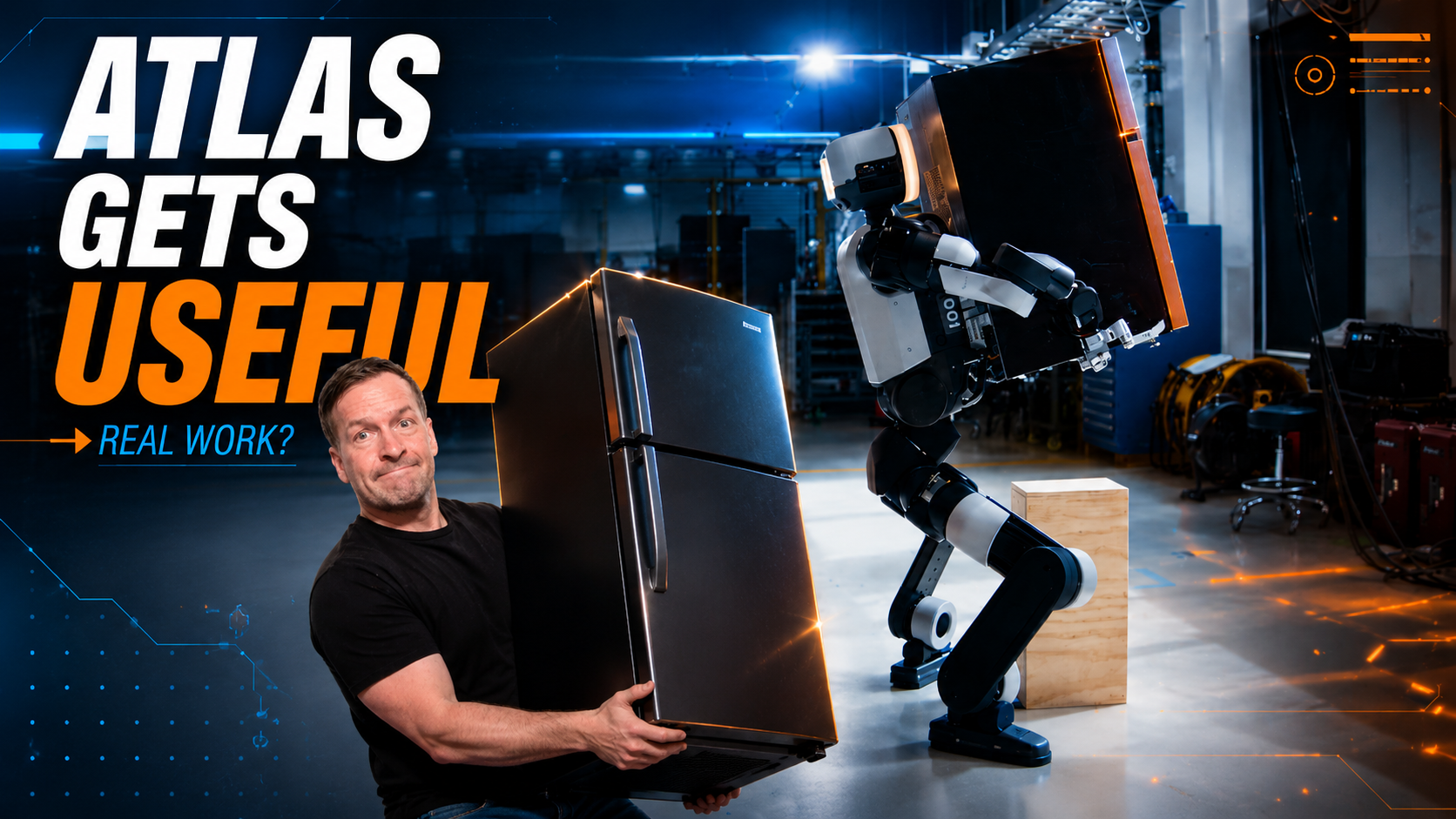
Atlas Gets Useful: Why Humanoid Robots Are Moving From Impressive Demos to Real Work
Humanoid robots have been part of the public imagination for decades. We have seen them in films, on research stages, at technology exhibitions, and in dramatic promotional videos that make the future look like it is only five minutes away.
But for most businesses, humanoid robots have remained interesting rather than useful.
That is starting to change.
Recent demonstrations from companies such as Boston Dynamics show a new generation of humanoid robots moving beyond walking, jumping, dancing, or performing carefully controlled routines. The real story is not that a robot can move a mini-fridge. The real story is that robots are learning how to deal with the physical world.
Weight.
Balance.
Awkward objects.
Unpredictable spaces.
Human-shaped environments.
That is where robotics becomes commercially interesting.
For business leaders, manufacturers, warehouse operators, logistics companies, retailers, healthcare providers, event agencies, and investors, the rise of humanoid robots is not just a technology story. It is a business story. It is about the future of labor, automation, productivity, safety, and competitive advantage.
The question is no longer, “Can robots do impressive things?”
The better question is, “When will robots become useful enough for everyday business tasks?”
And increasingly, the answer is: sooner than many people think.
The Shift From Robot Demos to Robot Deployment
For years, humanoid robots have attracted attention because they look exciting. A robot that walks like a person immediately grabs headlines. A robot that jumps, flips, dances, or waves creates viral content. It is visual, simple to understand, and emotionally powerful.
But businesses do not buy robots because they look impressive.
Businesses buy robots because they solve problems.
A factory does not need a robot that can dance. It needs a robot that can move parts, inspect equipment, reduce downtime, improve safety, and keep production moving.
A warehouse does not need a robot that can wave. It needs robots that can pick, move, sort, scan, carry, and operate consistently.
A healthcare provider does not need a robot that looks futuristic. It needs technology that can support staff, move supplies, guide visitors, improve patient experience, and reduce pressure on overstretched teams.
This is why the latest generation of humanoid robots matters. The industry is beginning to move from performance to practicality.
Humanoid robots are starting to show behaviors that are much closer to real work. Carrying objects. Navigating spaces. Balancing while under load. Responding to physical forces. Using the whole body to complete a task.
That may sound simple, but it is extremely important.
The real world is not a clean laboratory.
The real world is awkward.
Objects are heavy. Floors are uneven. Doors are narrow. People get in the way. Boxes are not always where they should be. A stockroom changes every hour. A warehouse never looks exactly the same two days in a row.
For robots to become truly useful, they must handle that messiness.
This is where humanoid robotics is entering a new phase.
Why Humanoid Robots Are So Difficult
Humanoid robots are difficult because human environments are difficult.
Most factories, offices, hospitals, shops, hotels, warehouses, and event spaces were designed around people. They have stairs, doors, handles, shelves, trolleys, lifts, corridors, counters, cupboards, and tools made for human bodies.
This creates an interesting challenge.
Traditional automation works extremely well when the environment is structured. Industrial robot arms are brilliant inside factories because their tasks are often clearly defined. They repeat movements with accuracy, strength, and consistency. Mobile robots work well in warehouses when routes are mapped and workflows are designed properly.
But many business environments are still built for humans.
A humanoid robot is attractive because, in theory, it can operate in spaces that already exist. It does not always require a business to redesign the entire building. It can use human tools. It can move through human spaces. It can work around human infrastructure.
That is the promise.
But the technical challenge is huge.
Walking on two legs is hard. Balancing while carrying a heavy object is harder. Understanding how an object will move when lifted, pulled, pushed, or tilted is harder again. Doing all of this safely around people is even more complex.
A humanoid robot needs advanced control systems, sensors, perception, artificial intelligence, mechanical design, power management, and software working together in real time.
It must understand not only where it is, but what is happening to its body.
It must react to forces.
It must compensate for movement.
It must decide how to use its arms, legs, torso, and balance together.
This is why a robot moving a fridge is more important than it first appears.
The fridge is not the headline.
The physical intelligence is the headline.
Physical AI: The Next Big Step in Robotics
Artificial intelligence has already transformed software. We now have AI systems that can write, summarize, analyze, generate images, answer questions, create code, and support decision-making.
But robotics brings AI into the physical world.
That is often called physical AI.
Physical AI is where intelligence is connected to action. Instead of simply producing text or predictions, the AI system helps a machine move, interact, lift, navigate, inspect, manipulate, and respond to the real world.
This is a major shift.
A chatbot can make a mistake and rewrite an answer.
A robot making a mistake in a warehouse could drop a box, damage goods, block a walkway, or create a safety issue.
That is why robotics is harder than software alone.
Physical AI needs to be reliable. It must deal with uncertainty. It must understand the consequences of movement. It must operate safely. It must work in real environments with real people.
This is where reinforcement learning, simulation, motion planning, computer vision, and whole-body control become important.
In simple terms, reinforcement learning allows robots to learn behaviors through trial, feedback, and improvement. Simulation allows robots to practice tasks virtually before attempting them physically. Whole-body control allows robots to coordinate the entire body, not just one arm or one hand.
For humanoid robots, this is essential.
A person carrying a fridge does not just use their hands. They use their legs, back, shoulders, hips, balance, grip, and judgement. They lean, brace, adjust, and reposition constantly.
For a humanoid robot to carry awkward objects, it must start doing something similar.
This is why the future of robotics is not just about better hardware.
It is about better intelligence connected to better movement.
Why Businesses Are Paying Attention
Businesses are interested in robots because almost every industry is under pressure.
Labor shortages are affecting logistics, manufacturing, healthcare, hospitality, agriculture, construction, and retail. Rising costs are forcing companies to look for efficiency. Customers expect faster service. Supply chains need resilience. Health and safety expectations are increasing. Skilled workers are often spending too much time on low-value repetitive tasks.
Robots offer a way to rethink how work is done.
The opportunity is not simply to replace people.
In many cases, the best use of robotics is to support people.
Robots can take on repetitive movement, heavy lifting, long-distance walking, stock movement, simple inspection, cleaning, guidance, delivery, and data collection. This allows human teams to focus on judgement, communication, problem-solving, customer service, supervision, and higher-value work.
This is especially important for small and medium-sized businesses.
Many SMEs assume robotics is only for large corporations with huge budgets. That is no longer true. Robotics as a Service, robot rental, flexible deployment models, and more accessible commercial robots are changing the economics.
The key is not to start with the robot.
The key is to start with the task.
A business should ask:
What tasks are repetitive?
Where are people losing time?
Where are injuries likely?
Where is service inconsistent?
Where are labor costs rising?
Where are customers waiting?
Where is data missing?
Where could automation improve the process?
Once the task is clear, the right robot can be considered.
That might be a humanoid robot in the future. But today, it could also be an autonomous mobile robot, a collaborative robot arm, a delivery robot, a cleaning robot, an inspection robot, a telepresence robot, a reception robot, or a service robot.
Humanoid robots are exciting, but they are part of a larger robotics ecosystem.
Real-World Applications for Humanoid Robots
Humanoid robots are not likely to become universal workers overnight. The more realistic future is that they will enter the workforce task by task.
The first applications will probably be narrow, repetitive, and commercially measurable.
Warehousing and Logistics
Warehouses are one of the most obvious areas for robotics adoption.
They involve movement, repetitive tasks, stock handling, scanning, sorting, picking, packing, and transportation. Many warehouses are already using automation, including conveyor systems, autonomous mobile robots, automated storage systems, robot arms, and vision technology.
Humanoid robots could eventually support tasks in facilities that are not fully automated.
For example, they may assist with moving awkward items, handling goods in human-designed spaces, supporting loading and unloading, or helping with exception handling where traditional automation struggles.
The key value is flexibility.
A fixed automation system is powerful but often expensive and rigid. A humanoid robot could, in theory, be redeployed across different tasks as business needs change.
That flexibility is one of the biggest commercial arguments for humanoid robotics.
Manufacturing
Manufacturing has used robots for decades, but humanoid robots could open new possibilities in areas that are still difficult to automate.
Many production environments include tasks that are too variable for traditional automation but too repetitive or physically demanding for humans to do comfortably all day.
Humanoid robots could support line-side logistics, tool delivery, machine tending, part movement, quality inspection, and maintenance support.
They may not replace industrial robot arms. Instead, they could work alongside existing automation, filling the gaps between fixed systems and human workers.
Retail and Stockrooms
Retail is often overlooked in robotics discussions, but it has huge potential.
Stockrooms, shelves, inventory management, customer guidance, and back-of-house logistics all involve repetitive work.
A humanoid robot that can move through human retail environments could eventually support stock movement, shelf checking, delivery from stockroom to shop floor, and customer assistance.
The challenge will be safety, cost, reliability, and customer acceptance.
The opportunity is improved efficiency and better use of staff time.
Healthcare and Care Environments
Healthcare is under pressure worldwide. Staff shortages, aging populations, and rising demand are creating a need for supportive technology.
Robots in healthcare do not need to replace nurses or doctors. The better opportunity is support.
Robots can move supplies, guide visitors, support logistics, help with cleaning, provide telepresence, transport samples, and reduce routine workload.
Humanoid robots may eventually support physical assistance tasks, but this area will require careful regulation, testing, and trust-building.
The future of healthcare robotics will depend not only on technical capability, but also on ethics, safety, and emotional acceptance.
Facilities Management
Large buildings require constant movement, inspection, cleaning, monitoring, delivery, and maintenance.
Humanoid robots could support facilities teams by checking equipment rooms, moving items, reporting issues, carrying tools, or assisting with routine tasks.
This is especially relevant in airports, hospitals, campuses, hotels, data centers, and large corporate sites.
The commercial benefit is not only labor saving.
It is also consistency, data collection, and operational visibility.
The Robotics Startup Explosion
The robotics industry is entering an exciting period.
For years, robotics was seen as expensive, slow-moving, hardware-heavy, and difficult to scale. That is still partly true. Robotics is hard. Hardware has real-world costs. Deployment is complex.
But several trends are changing the market.
AI is improving rapidly. Sensors are becoming better and cheaper. Batteries are improving. Simulation tools are more powerful. Cloud robotics, edge computing, and better connectivity are supporting smarter systems. Investors are paying attention to physical AI. Businesses are more open to automation because of labor and cost pressures.
This has created a wave of robotics startups working on humanoid robots, warehouse automation, delivery robots, agriculture robots, construction robots, healthcare robots, inspection robots, service robots, and industrial AI systems.
The next major robotics companies may not come from one single category.
Some will build robots.
Some will build robot software.
Some will provide deployment and integration.
Some will offer robot fleets as a service.
Some will specialize in data, maintenance, training, recruitment, or industry-specific automation.
The robotics industry is not just about machines.
It is becoming an ecosystem.
That ecosystem needs manufacturers, consultants, trainers, integrators, service providers, marketers, recruiters, investors, and operators.
This is why robotics consulting is becoming more important.
Many companies are interested in robots, but they do not know where to start. They may not understand the difference between a good robot demo and a good business case. They may be impressed by technology that does not fit their operation. They may underestimate training, maintenance, safety, integration, and workflow design.
Robotics adoption requires strategy.
Why Many Companies Are Not Ready for Robots
One of the biggest barriers to robotics adoption is not the robot.
It is the business.
Many companies want automation but have not clearly defined their processes. Their workflows may rely on informal knowledge. Their data may be poor. Their teams may not be trained for technology adoption. Their sites may not be prepared for robots. Their expectations may be unrealistic.
A robot cannot fix a broken process by itself.
In fact, adding a robot to a badly designed process can make the problem more visible.
This is why the first stage of robotics adoption should be discovery.
Before buying a robot, a business should understand:
What problem are we solving?
How often does this task happen?
How much does it cost?
How many people are involved?
How much variation exists?
What does success look like?
What are the safety requirements?
What happens if the robot fails?
Who will manage the robot?
How will staff be trained?
How will return on investment be measured?
Without these answers, robotics projects can become expensive experiments.
With the right answers, robots can create real value.
This is where robotics consultants and experienced deployment partners play an important role.
They help businesses move from curiosity to clarity.
Humanoid Robots and the Future of Work
The future of work will not be a simple story of robots replacing humans.
It will be more complex.
Some tasks will be automated. Some jobs will change. New roles will appear. Workers will need new skills. Businesses will redesign workflows around human-robot collaboration.
In many industries, the most valuable employees will not be the people who compete against robots. They will be the people who know how to work with robots.
Robot supervisors.
Automation managers.
Robot trainers.
Maintenance specialists.
AI workflow designers.
Robotics deployment consultants.
Human-robot interaction specialists.
Data and operations analysts.
The rise of humanoid robots will create new opportunities as well as disruption.
Businesses that wait too long may find themselves reacting to change instead of shaping it. Businesses that start learning now will have an advantage.
They do not need to buy a humanoid robot tomorrow.
But they should start understanding where robotics could fit into their operations.
They should identify tasks.
They should test small deployments.
They should educate teams.
They should speak to robotics experts.
They should watch the market carefully.
The companies that build internal robotics knowledge now will be better prepared when humanoid robots become commercially viable at scale.
Investors and the Robotics Opportunity
Robotics is becoming an increasingly important area for investors.
The reason is simple: robotics connects AI to the physical economy.
Software has already transformed communication, finance, media, marketing, design, and administration. Robotics has the potential to transform labor, logistics, manufacturing, healthcare, agriculture, construction, retail, and infrastructure.
That is a huge opportunity.
However, robotics investment is not easy.
Hardware companies can be capital intensive. Timelines can be long. Manufacturing is difficult. Safety and reliability matter. Customer adoption can be slower than expected.
Investors need to look beyond hype.
A robotics company should not be judged only by how impressive its demo looks. It should be judged by the problem it solves, the market size, the deployment model, the reliability, the cost structure, the service model, the data advantage, and the ability to scale.
The most successful robotics businesses may be those that combine strong technology with clear commercial focus.
In other words, the robot must not only work.
It must make business sense.
Events, Marketing, and Public Engagement With Robots
One area where robots are already creating value is events and experiential marketing.
Robots attract attention. They start conversations. They create memorable moments. They help brands stand out. They bring future technology into the room.
For product launches, exhibitions, conferences, retail activations, and corporate events, robots can be powerful engagement tools.
This matters because public understanding of robotics often begins with experience.
When people see a robot in person, interact with it, ask questions, and understand what it can do, robotics becomes less abstract.
Events can help businesses, investors, and the public become more comfortable with robotics technology.
They can also help robotics manufacturers introduce products to new markets.
A robot at an event is not just entertainment.
Used properly, it can be education, lead generation, brand positioning, and market testing.
RoboPhil Perspective: Helping Businesses Understand Robotics
Philip English, known as RoboPhil, works across the robotics industry through Robot Center, Robots of London, and Robot Philosophy.
This work covers robotics consulting, robot deployment, robot hire, robotics events, business strategy, robot sourcing, industry insight, and helping companies understand how robotics can apply to real commercial environments.
The RoboPhil perspective is practical.
Robotics should be exciting, but it also needs to be commercially useful.
A robot should not be adopted just because it looks futuristic. It should be adopted because it solves a problem, improves a process, supports a team, attracts customers, generates leads, improves safety, creates data, or opens a new business opportunity.
This is especially important as humanoid robots become more visible.
Many companies will see impressive videos and wonder whether they should invest. The answer depends on the use case.
Some businesses may be ready for robotics now. Others may need to prepare their workflows first. Some may benefit from robot hire or event robotics before moving toward long-term deployment. Others may need advice on robot sourcing, automation strategy, or robotics recruitment.
The role of a robotics consultant is to help businesses make better decisions.
Not every robot is right for every business.
But almost every business should now be thinking about robotics.
What Happens Next in Robotics?
The next stage of robotics will be defined by usefulness.
Humanoid robots will continue to improve. AI robots will become more capable. Industrial robots will become easier to deploy. Service robots will become more common. Mobile robots will continue to spread through warehouses, hospitals, hotels, campuses, and public spaces.
The most important shift will be the move from isolated robot products to integrated robot strategies.
Businesses will not simply ask, “Which robot should we buy?”
They will ask:
How do robots fit into our operations?
How do we train our teams?
How do we measure value?
How do we combine robotics with AI?
How do we manage robot fleets?
How do we maintain and support robots?
How do we use robotics as a competitive advantage?
This is where the future of robotics becomes genuinely transformative.
The winners will not only be the companies with the most advanced robots.
The winners will be the companies that understand how to apply robotics in the real world.
Conclusion: The Future of Robotics Is Practical, Physical, and Commercial
Humanoid robots moving objects may look like a simple demonstration.
But it represents a much larger shift.
Robots are beginning to move from controlled environments into the messy, physical world of business. They are learning to handle weight, balance, movement, and unpredictable tasks. They are becoming more connected to AI, more capable in human environments, and more relevant to real commercial problems.
The future of robotics will not arrive all at once.
It will arrive through specific tasks, practical use cases, and businesses willing to experiment intelligently.
For business leaders, the opportunity is clear. Robotics is no longer a distant concept. It is becoming part of the modern business toolkit.
The companies that understand robotics early will be better positioned to reduce costs, improve productivity, support staff, create better customer experiences, and build competitive advantage.
Humanoid robots are not just about machines that look like people.
They are about machines that can work in a world built for people.
That is why robotics matters now.
And that is why every serious business should start paying attention.
Work With RoboPhil
For businesses exploring robotics, automation, AI robots, humanoid robots, robot sourcing, robotics consulting, robotics industry insights, or automation strategy, RoboPhil can help you understand the opportunities and make smarter decisions.
Robot Center
https://robotcenter.co.uk/
Robots of London
https://robotsoflondon.co.uk/
Robot Philosophy
https://robophil.com/
Business enquiries
sales@robotcenter.co.uk