

Hospital Robots Are Coming: How Autonomous Patient Transport Could Transform Healthcare Robotics
Hospital robots are no longer a distant science fiction idea. They are beginning to move through real healthcare environments, solving real operational problems, and creating new opportunities for hospitals, robotics companies, automation providers, and investors.
One of the most interesting areas emerging right now is autonomous patient transport.
At first, that may not sound as dramatic as humanoid robots walking into factories or AI robots serving customers in restaurants. But in many ways, patient transport could become one of the most commercially important use cases in the robotics industry.
Why?
Because hospitals are complex, high-pressure environments where time, safety, staff availability, and patient flow matter every minute of every day. Moving patients from one part of a hospital to another may seem simple from the outside, but inside the system it can create bottlenecks, delays, staff strain, patient frustration, and lost operational efficiency.
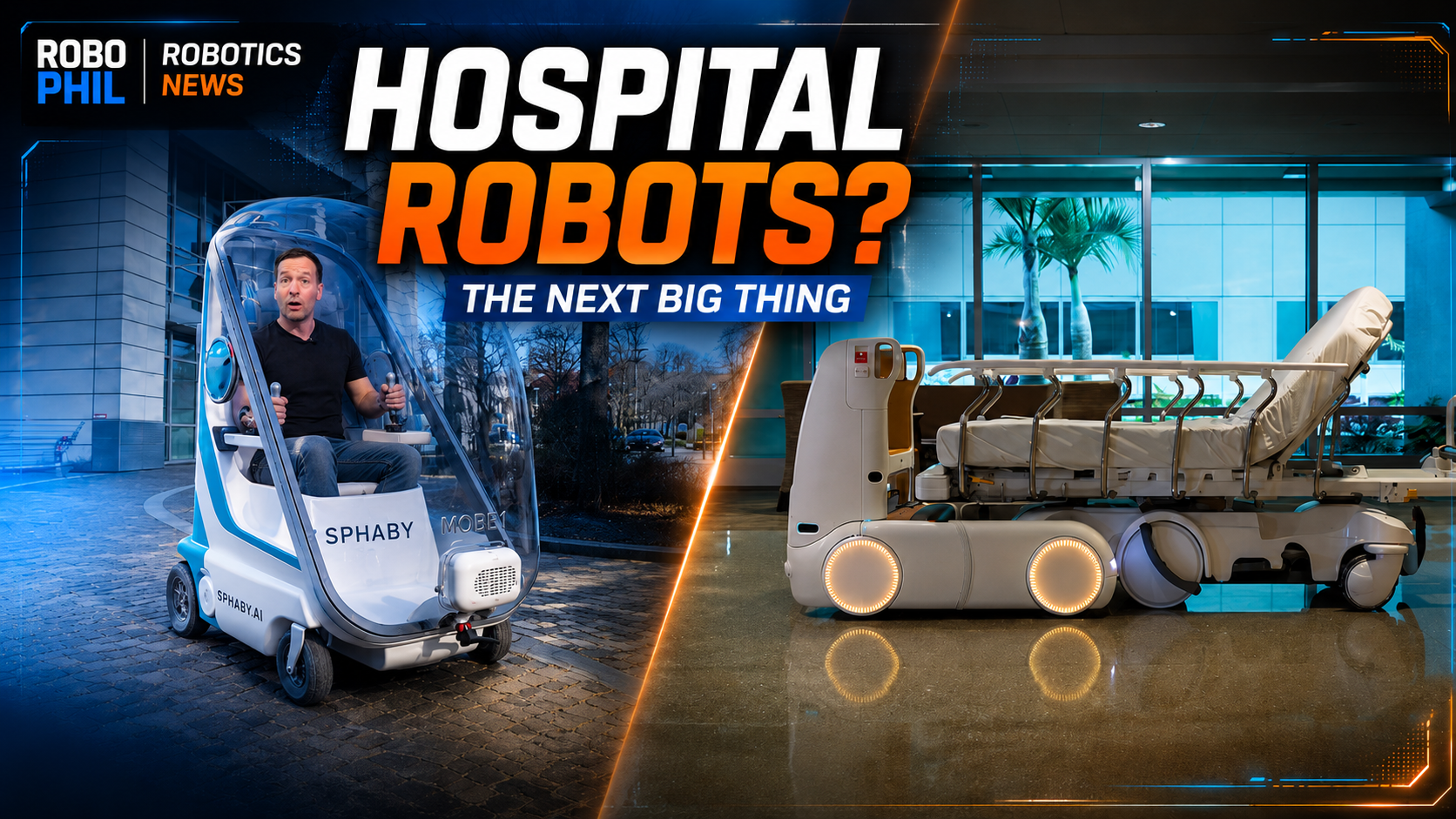
Companies such as Rovex and Sphaira are now showing how robots could change that.
Rovex is developing autonomous hospital transportation systems that can help move existing beds, stretchers, gurneys, and wheelchairs through hospital corridors. Sphaira is working on protective patient transport pods and autonomous patient shuttles, including systems designed to support safe movement in healthcare environments.
This is not robotics for show.
This is robotics solving an expensive, physical, repetitive problem that healthcare systems deal with every single day.
And that is exactly why business leaders, robotics companies, automation professionals, healthcare providers, and investors should be paying attention.
Why Autonomous Patient Transport Matters
Hospitals are full of movement.
Patients move from emergency departments to imaging rooms. They move from wards to operating theaters. They move from recovery areas to specialist units. Beds, equipment, medication, linen, samples, food, and supplies all move constantly through the building.
This movement is essential. But it is also time-consuming.
When patient transport is slow, the impact is felt across the whole hospital. A patient waiting to be moved for a scan may delay diagnosis. A bed that is not returned quickly may slow admissions. A member of staff pushing a patient through a long corridor is not available elsewhere. A transporter dealing with heavy physical work all day faces strain and injury risk.
In other words, transport is not a small background task.
It is part of the hospital’s operating system.
This is why autonomous patient transport robots are so interesting. They do not need to replace doctors, nurses, or care teams. Instead, they can support the system by handling the movement layer more efficiently.
That is the commercial sweet spot for robotics.
The best robots are not always the most glamorous. They are often the robots that solve the repetitive, hidden problems that cost organizations time, money, and energy.
The Problem with Manual Patient Transport
Most people outside healthcare do not realize how much time can be lost moving patients through a hospital.
Hospitals are large buildings with long corridors, elevators, doorways, crowded departments, waiting areas, and unpredictable human movement. Patient transport is not like moving a trolley through an empty warehouse. It requires care, safety, coordination, communication, and awareness.
A patient may be anxious, elderly, injured, sedated, infectious, immunocompromised, or physically vulnerable. Staff need to move them carefully. They may need to navigate around other patients, visitors, equipment, and clinical teams.
That means patient transport cannot simply be made faster by pushing harder.
The challenge is to make movement smoother, safer, more predictable, and better integrated into hospital workflows.
This is where robotics technology can help.
Autonomous navigation, obstacle avoidance, mapping, safety systems, sensor technology, and smart scheduling can all contribute to better patient movement. If a robot can safely assist with towing or transporting a patient, it could reduce delays and give staff more time for higher-value care.
The business case is not just about labor savings.
It is about throughput, patient experience, staff safety, equipment utilization, and operational efficiency.
Rovex: Adding Autonomy to Existing Hospital Equipment
One of the most interesting things about Rovex is that its approach appears commercially practical.
Rather than asking hospitals to replace all their existing beds and stretchers with completely new robotic equipment, Rovex focuses on adding autonomous mobility to the equipment hospitals already use.
That matters.
Hospitals are not simple environments for new technology adoption. They are highly regulated, budget-conscious, safety-focused, and operationally complex. A solution that requires a complete replacement of existing infrastructure can be difficult to adopt at scale.
A solution that works with existing beds, gurneys, stretchers, and wheelchairs may be far easier to test, deploy, and justify.
Rovex’s system is designed around autonomous towing. The robot attaches to existing hospital transport equipment and helps move it through corridors. This means the robot does not need to reinvent the bed. It needs to move the bed safely.
That is a very important distinction.
It makes the robot more like an intelligent mobility layer for healthcare environments.
From a robotics consulting perspective, this is exactly the type of thinking businesses should apply when considering automation. The question is not always, “How do we replace everything with robots?” The better question is often, “Where can robotics fit into the current workflow and remove friction?”
That is where adoption becomes realistic.
Sphaira: Medical Transport Pods and Autonomous Patient Shuttles
Sphaira is approaching the opportunity from another angle: protected patient movement and autonomous shuttles.
Its Moby system has been described as a mobile protective transport pod, designed to support safe movement for vulnerable patients, including those who may be immunocompromised or infectious. The company has also been developing autonomous patient shuttle concepts that could move people through hospital environments.
This opens up a broader conversation about the future of healthcare mobility.
Patient transport is not only about moving beds.
It is also about moving people safely through complex healthcare spaces while maintaining comfort, infection control, privacy, and operational efficiency.
In hospitals, mobility is not one-size-fits-all. Some patients need a bed. Some need a wheelchair. Some need isolation. Some need assistance but not full clinical transport. Some may need to travel between buildings or departments repeatedly.
Autonomous shuttles, pods, and smart mobility platforms could eventually form a new layer of hospital infrastructure.
Imagine a hospital where mobility is coordinated by a fleet of robotic systems. Beds are moved automatically when appropriate. Patients are transported in protective pods. Equipment is delivered by service robots. Staff can request movement support through digital systems. The building itself becomes more intelligent.
That is not just a robot story.
That is a hospital operations story.
Why Healthcare Robotics Is Moving Beyond Gimmicks
For many years, service robots in public environments were often treated as novelty items. A robot in a lobby. A robot waving at visitors. A robot delivering a speech at an event. These robots were useful for engagement, marketing, and experimentation, but the business case was not always deep enough for widespread adoption.
That is changing.
Healthcare robotics is moving into more practical areas:
Medication delivery.
Hospital logistics.
Cleaning and disinfection.
Surgical assistance.
Remote monitoring.
Rehabilitation.
Patient lifting and transfer.
Autonomous patient transport.
These are real operational categories where robots can create measurable value.
The key shift is that robotics is becoming less about spectacle and more about systems.
A robot does not need to look like a human to be valuable. In fact, many of the most useful robots will look nothing like humans. They will be mobile bases, towing systems, carts, arms, pods, sensors, platforms, and specialist machines designed for specific tasks.
That is important for businesses to understand.
The future of robotics will not be defined only by humanoid robots. Humanoid robots will be important, especially in environments designed around human movement and tools. But the broader robotics industry will include many specialized robots built to solve targeted problems.
Autonomous patient transport is a perfect example.
It may not look as flashy as a humanoid robot, but it could deliver a far clearer return on investment.
The Business Case for Hospital Robots
For healthcare providers, the business case for autonomous patient transport could be significant.
First, there is staff efficiency.
If a robot can assist with moving patients or equipment, human staff can spend more time on patient-facing care, coordination, and higher-value tasks. This does not necessarily remove the need for human involvement. In many situations, a human may still supervise, reassure the patient, or manage clinical considerations. But the physical burden of movement can be reduced.
Second, there is patient flow.
Hospitals are under pressure to move patients through care pathways efficiently. Delays in transport can create knock-on effects across departments. Faster, more reliable transport can improve scheduling, reduce waiting time, and support better use of imaging rooms, wards, operating areas, and discharge processes.
Third, there is staff safety.
Moving beds, stretchers, and patients is physically demanding. It can contribute to injuries and fatigue. Robots that assist with towing, lifting, or transport can reduce strain and help protect healthcare workers.
Fourth, there is capacity.
When movement becomes more predictable and efficient, hospitals may be able to increase throughput without adding proportional increases in staffing or infrastructure. This is particularly important in healthcare systems facing demand pressure.
Fifth, there is data.
Autonomous robots generate operational data. Over time, that data could reveal patterns about movement, bottlenecks, corridor congestion, department delays, and workflow inefficiencies. In the future, hospital robotics may become not just a movement tool, but an intelligence layer for hospital operations.
That may become one of the most valuable parts of the robotics industry: not only doing the work, but showing where work can be improved.
The Role of AI Robots in Healthcare
AI robots are becoming more capable because several technologies are improving at the same time.
Computer vision allows robots to understand their surroundings.
Sensors help robots detect obstacles, people, walls, doors, and movement.
Mapping and localization allow robots to navigate complex buildings.
AI planning helps robots choose routes and adapt to changing environments.
Connectivity allows robots to interact with hospital systems, elevators, doors, scheduling software, and staff interfaces.
This combination is what makes modern robotics technology more powerful than traditional automation.
In a factory, automation often happens in controlled environments. In a hospital, the environment is much less predictable. People move unpredictably. Corridors change. Equipment gets left in places. Elevators are busy. Visitors do unexpected things. Patients may feel nervous or confused.
That means hospital robots need to be safe, cautious, reliable, and easy to understand.
This is where AI robotics becomes useful, but also where careful deployment matters.
Businesses should not think of AI robots as magic machines that can simply be dropped into any environment. They need mapping, workflow planning, staff training, safety assessment, maintenance support, and integration with real operations.
The winners in healthcare robotics will not only be the companies with the best robots. They will be the companies that understand deployment.
Why Deployment Is the Real Challenge
Many robotics projects fail not because the robot is bad, but because the deployment plan is weak.
The robot may be technically impressive but poorly integrated into the business. Staff may not understand how to use it. The workflow may not be redesigned properly. The environment may not be prepared. The business case may be unclear. Maintenance and support may not be planned. The robot may be introduced as a gadget rather than a tool.
This is particularly important in healthcare.
A hospital robot must fit into clinical reality. It must support staff, not create extra work. It must be trusted. It must be safe. It must be easy to operate. It must have clear escalation processes when something goes wrong. It must integrate into existing routines.
This is why robotics consulting is becoming more important.
As more companies explore robots, they need independent advice on what to buy, where to deploy it, how to measure success, and how to avoid expensive mistakes.
The future of robotics is not just about manufacturing robots.
It is also about helping organizations adopt them properly.
Lessons for Other Industries
Autonomous patient transport may be focused on hospitals, but the lessons apply far beyond healthcare.
Many industries have similar problems.
Warehouses need to move goods.
Hotels need to move linen and supplies.
Airports need to move luggage, passengers, and equipment.
Retail environments need stock movement and customer service support.
Factories need internal logistics.
Events need robots for engagement, delivery, entertainment, and brand interaction.
Care homes need mobility support and service automation.
Office buildings need cleaning, delivery, and security automation.
The core question is the same: where is time being wasted on repetitive physical movement?
That is where robots often make sense first.
A business does not need to start with the most advanced humanoid robot. It can start with a practical robot that solves a specific operational problem.
This is a key point for business leaders.
Robotics adoption should begin with pain points, not technology hype.
Do not ask, “What robot looks impressive?”
Ask, “Where are we losing time, money, staff energy, customer experience, or operational efficiency?”
Then look for the robot that solves that problem.
Humanoid Robots and Hospital Environments
It is impossible to discuss the future of robotics without mentioning humanoid robots.
Humanoid robots are attracting huge attention because they promise a flexible form factor. A robot shaped like a person could potentially work in environments designed for humans. It could use stairs, doors, tools, counters, shelves, handles, and workspaces without requiring the environment to be completely redesigned.
In healthcare, humanoid robots may eventually support tasks such as carrying supplies, guiding visitors, assisting with basic logistics, monitoring environments, or helping with routine physical tasks.
However, hospitals are safety-critical environments, and humanoid deployment will take time.
Before humanoid robots become common in healthcare, we are likely to see more specialized service robots being adopted first. Delivery robots, cleaning robots, telepresence robots, lifting systems, patient transport robots, and autonomous mobility platforms are all more targeted and easier to justify.
This does not mean humanoid robots are unimportant.
It means the path to adoption will include many different types of robots.
The future hospital may not have one robot type. It may have a mixed robotic workforce: humanoids, mobile robots, autonomous beds, transport pods, delivery bots, robotic arms, cleaning systems, and AI-powered monitoring tools.
That ecosystem is where the robotics industry is heading.
Robotics Startups and Investment Opportunities
The rise of companies such as Rovex and Sphaira shows that the robotics startup ecosystem is expanding into more specialized markets.
Investors are increasingly looking for robotics companies that solve clear business problems. The strongest opportunities often combine hardware, software, data, and workflow integration.
Autonomous patient transport has several attractive features from an investment perspective.
It addresses a large market.
It solves a measurable operational problem.
It can potentially reduce costs and improve efficiency.
It creates data opportunities.
It can be expanded into fleets and platform models.
It may support recurring revenue through service, maintenance, software, and Robotics as a Service.
However, robotics startups also face real challenges.
Hardware is difficult. Safety is critical. Sales cycles in healthcare can be long. Regulation and validation matter. Hospitals require trust, evidence, and support. Deployment can be complex. Scaling across multiple sites is harder than running a successful pilot.
That is why partnerships will matter.
Robotics startups may need healthcare partners, manufacturers, system integrators, consultants, investors, and commercial deployment teams to move from pilot projects to real adoption.
The companies that succeed will not only build good robots. They will build good adoption pathways.
What Businesses Can Learn from Hospital Robotics
Even if your company is not in healthcare, the rise of hospital robots offers several important lessons.
First, robotics works best when it solves a specific problem.
Second, the best robot may be the one that fits into the existing workflow, not the one that requires everything to change.
Third, safety and trust are essential.
Fourth, adoption depends on people as much as technology.
Fifth, data may become a major part of the long-term value.
Sixth, robots should be measured by outcomes, not excitement.
This is especially important for businesses exploring automation for the first time.
Robotics can be transformative, but only when approached strategically. Buying a robot without understanding the business case can be expensive. Deploying robots without training staff can create resistance. Choosing technology before identifying the problem can lead to disappointment.
The smart approach is to begin with a robotics audit.
Where are the bottlenecks?
Where is physical work repetitive?
Where are staff under pressure?
Where could automation improve customer experience?
Where could robots generate revenue, reduce cost, improve safety, or create marketing impact?
Once these questions are answered, the right robotics strategy becomes much clearer.
The RoboPhil Perspective
Philip English, known as RoboPhil, works across Robot Center, Robots of London, and Robot Philosophy, helping businesses understand, adopt, promote, and deploy robotics in the real world.
Through Robot Center, the focus includes robot consultancy, robotics deployment, commercial robots, industrial robots, Robotics as a Service, physical AI, and helping businesses explore how to buy robot solutions that fit their operations.
Through Robots of London, the focus includes robot hire, robot rental, exhibition robots, event robotics, brand activations, and using robots to create engagement, attention, and memorable experiences.
Through Robot Philosophy, the focus includes robotics insights, robot advice, robotics strategy, robot recruitment, industry commentary, and helping businesses understand where the robotics industry is heading.
From this perspective, the rise of autonomous patient transport is part of a much bigger shift.
Robots are moving from novelty to necessity.
Businesses are starting to understand that robotics is not just about futuristic demonstrations. It is about practical adoption, commercial outcomes, and strategic advantage.
Healthcare is one of the clearest examples of this shift because the problems are visible, measurable, and urgent.
Hospitals need better flow. Staff need support. Patients need safe and efficient care. Robots can help.
That does not mean every hospital will become fully automated overnight. It means the next decade will likely see more robotics systems entering specific parts of healthcare operations, proving value, and then expanding.
The Future of Autonomous Patient Transport
The future of autonomous patient transport will likely develop in stages.
The first stage is pilot projects. Hospitals test robots in limited areas, often without patients at first, to assess navigation, safety, integration, and staff response.
The second stage is supervised deployment. Robots begin assisting with selected transport tasks under human oversight.
The third stage is workflow integration. Robots become part of scheduling, logistics, and hospital operations systems.
The fourth stage is fleet coordination. Multiple robots work together across departments, using shared data and intelligent routing.
The fifth stage is infrastructure transformation. Hospitals may be designed or redesigned with robotics in mind, including robot-friendly corridors, elevators, charging stations, storage areas, and digital systems.
This final stage is especially important.
Today, many robots must adapt to buildings designed entirely for humans. In the future, buildings may be designed for humans and robots working together.
That will change architecture, operations, staffing, procurement, and technology strategy.
Healthcare robotics will not be just about robots inside hospitals. It will be about hospitals becoming more intelligent environments.
Why This Matters Now
The timing matters because several trends are converging.
Healthcare systems are under pressure.
Staff shortages and burnout remain major issues.
Aging populations are increasing demand.
Hospitals need more efficiency.
AI is accelerating robotics capability.
Investors are looking for practical robotics markets.
Businesses are becoming more open to automation.
Robotics technology is becoming more reliable, more connected, and more commercially viable.
This creates the conditions for healthcare robotics to grow.
Autonomous patient transport is not the only opportunity, but it is one of the most interesting because it connects directly to hospital efficiency and patient flow.
It also shows a wider truth about the robotics industry.
The most important robots may not arrive with dramatic music and a humanoid face.
They may arrive quietly, connect to a hospital bed, and move a patient safely down a corridor.
That is the real future of robotics: practical, useful, measurable, and integrated into everyday work.
Conclusion: Hospital Corridors Could Become the Next Robotics Frontier
Autonomous patient transport may sound like a niche area, but it could become a major example of how robots transform real-world operations.
Rovex and Sphaira are part of a growing movement in healthcare robotics, where robots are being designed not just to impress, but to solve specific business and operational problems.
For hospitals, this could mean faster patient movement, reduced staff strain, better workflow, improved safety, and more efficient use of resources.
For robotics companies, it represents a growing market where practical deployment and measurable value matter.
For investors, it highlights the commercial potential of service robots and physical AI in complex environments.
For business leaders, it offers a clear lesson: the future of robotics will be won by solving real problems.
The robots that matter most will not always be the most human-looking or the most dramatic. They will be the robots that save time, reduce pressure, improve service, and fit into the way organizations actually work.
Healthcare is one of the toughest environments for robotics. But that is also why success there matters.
If robots can safely and effectively support patient transport in hospitals, they can help prove the value of robotics in some of the most demanding workplaces in the world.
The future of robotics is not coming.
It is already rolling down the corridor.
For robotics consulting, robot sourcing, robotics industry insights, automation strategy, robot deployment, robot hire, and practical advice on adopting robotics, contact RoboPhil and the team.
Robot Center
https://robotcenter.co.uk/
Robots of London
https://robotsoflondon.co.uk/
Robot Philosophy
https://robophil.com/
Business enquiries
sales@robotcenter.co.uk