

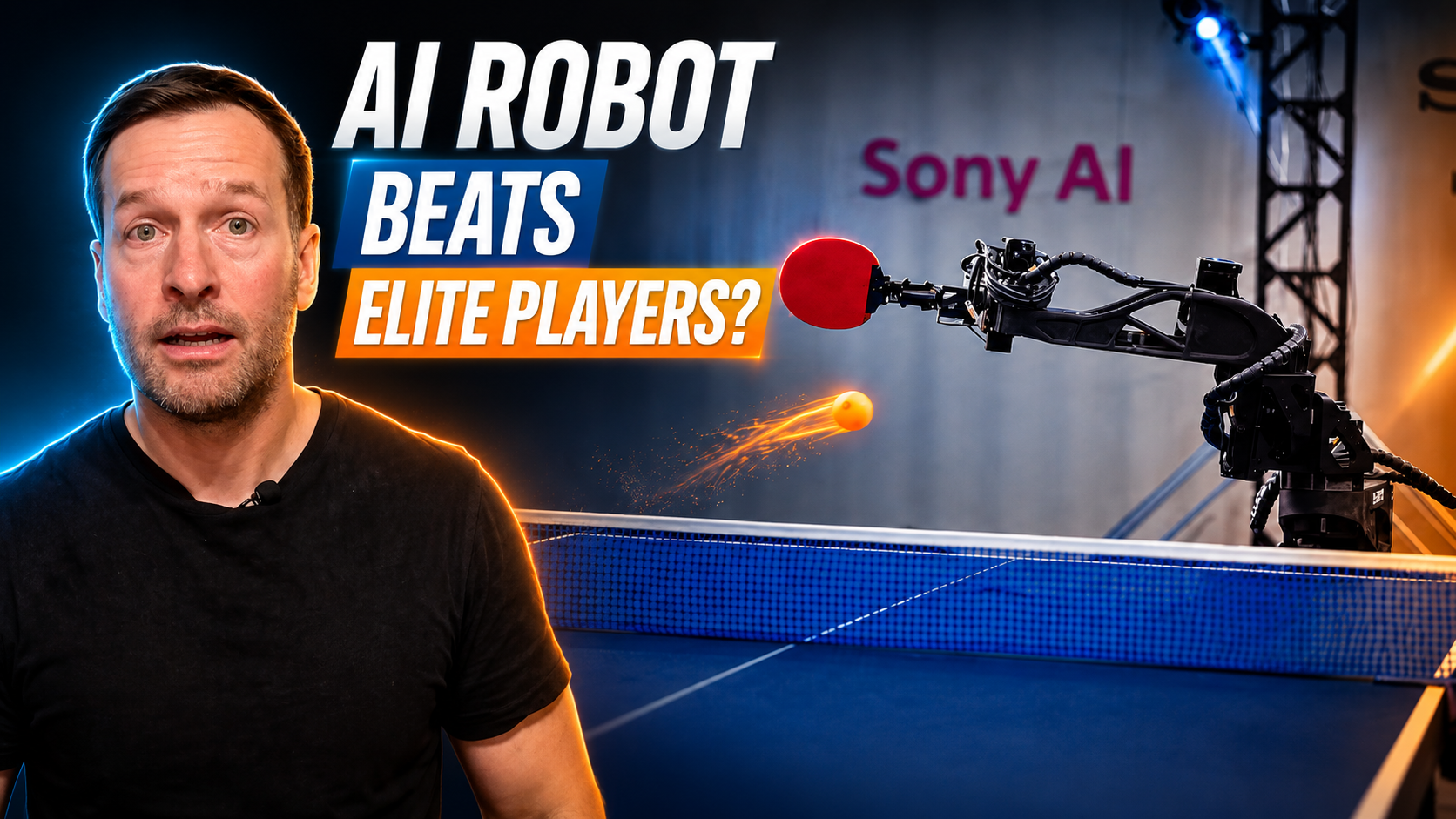
AI Robot Beats Elite Table Tennis Players: What Sony AI’s Ace Reveals About the Future of Robotics
A robot beating elite table tennis players sounds like a fun technology headline.
But underneath the novelty is something far more important.
Sony AI’s table tennis robot, Ace, has shown that AI robots are moving beyond simple, controlled demonstrations and into fast, unpredictable, real-world environments. Table tennis is not easy for machines. The ball is small. It moves quickly. It spins. It bounces. It changes direction. It demands timing, perception, motion control, and instant decision-making.
In other words, it is a brutal test for robotics.
That is why this story matters.
Ace is not just a robot playing sport. It is a sign of where robotics technology is heading next: robots that can see, predict, react, learn, and adapt in real time.
For businesses, investors, engineers, automation professionals, and robotics companies, this is not just entertainment. It is a glimpse into the commercial future of physical AI.
Why a Table Tennis Robot Matters
At first glance, a robot playing table tennis may seem like a publicity stunt.
It is not.
Table tennis is one of the hardest physical challenges for a robot because the environment changes constantly. A robot has to track the ball, calculate speed, understand spin, predict where the ball will land, move into position, and return the shot correctly.
All of this happens in fractions of a second.
For humans, this is natural. Our eyes, brain, muscles, and reflexes work together without us thinking too much about it. For robots, this is incredibly difficult.
Traditional industrial robots are excellent at repetition. They can weld, lift, cut, pack, and assemble with impressive precision. But they usually work best in predictable environments where everything is controlled.
Ace represents a different kind of robotics challenge.
It must operate in a dynamic environment.
It must respond to human behavior.
It must deal with uncertainty.
It must improve through experience.
That is why this development is important for the future of robotics. The world does not behave like a perfect factory line. Warehouses, hospitals, restaurants, retail stores, construction sites, farms, and event spaces are messy, unpredictable, and full of movement.
If AI robots can learn to perform in these kinds of environments, their commercial potential becomes enormous.
From Programmed Machines to Adaptive Robots
For decades, robots have mainly been programmed machines.
They followed instructions.
They repeated tasks.
They performed the same motion again and again.
That has been incredibly useful in manufacturing and industrial automation, but it also limited where robots could be deployed.
Many businesses still imagine robots as machines locked behind safety cages, doing the same job forever. That picture is now becoming outdated.
The next generation of robotics is adaptive.
AI robots are beginning to combine machine vision, sensors, artificial intelligence, motion control, and real-time decision-making. Instead of only following fixed instructions, they can increasingly interpret what is happening around them.
That is the shift.
A robot that can adapt is far more valuable than a robot that can only repeat.
In business, adaptation is everything. Products vary. Customers behave differently. Staff move around. Items are placed in the wrong location. Lighting changes. Surfaces change. Stock levels change. Machines fail. Environments are rarely perfect.
This is where physical AI becomes commercially powerful.
Physical AI means artificial intelligence operating through machines in the real world. It is not just software on a screen. It is AI connected to movement, vision, manipulation, navigation, and physical action.
Ace playing table tennis is a visible example of this shift.
The bigger opportunity is what this kind of capability could unlock across industries.
The Commercial Importance of Robot Vision
One of the most important parts of modern robotics is vision.
Robots need to see.
More importantly, they need to understand what they are seeing.
Robot vision allows machines to identify objects, track movement, inspect products, navigate spaces, and respond to people. In Ace’s case, vision systems help the robot track a fast-moving ball from multiple angles and calculate how to return it.
In a factory, similar vision technology could be used for quality control.
In a warehouse, it could help robots pick irregular items from shelves.
In healthcare, it could help robots navigate safely around patients and staff.
In agriculture, it could help robots identify fruit, weeds, or crop health.
In retail, it could help service robots interact with customers and understand store environments.
In logistics, it could help automate sorting, scanning, packing, and loading.
Vision is one of the key technologies that turns robots from blind machines into intelligent systems.
Without good robot vision, robots struggle in the real world.
With advanced vision, robots can become more flexible, more useful, and more commercially viable.
Why Businesses Are Paying Attention to AI Robots
Businesses are interested in robotics for a simple reason: pressure.
Labor costs are rising.
Staff shortages are common.
Customers expect faster service.
Supply chains are under strain.
Manufacturers need more productivity.
Warehouses need more efficiency.
Healthcare providers need support.
Retailers need better customer experiences.
Food businesses need consistency.
Events need new ways to attract attention.
Robots offer a possible answer to many of these challenges.
However, the companies that benefit most from robotics are not the ones that buy robots randomly. They are the ones that understand the problem first.
This is where many businesses go wrong.
They see an exciting robot, buy it, and then try to find a use for it.
The smarter approach is the opposite.
Identify the business problem.
Understand the process.
Look at the environment.
Calculate the commercial value.
Then choose the right robot.
A robot should not be a gimmick unless the goal is attention and engagement, as in events and exhibitions. In most business environments, a robot should solve a measurable problem.
That could include reducing repetitive work, increasing throughput, improving safety, collecting data, supporting staff, extending service hours, or improving customer experience.
Ace is not a warehouse robot, a healthcare robot, or a retail robot.
But the technology principles behind it point toward the kind of adaptive robotics that businesses will increasingly need.
Robotics in Warehousing and Logistics
Warehousing is one of the strongest areas for robotics adoption.
The reason is obvious.
Warehouses involve movement, picking, packing, sorting, scanning, and repetitive handling. These are tasks where automation can create serious commercial value.
But warehouse environments are not always simple. Products vary in size, shape, weight, and packaging. Items may be stacked differently. Demand changes. Human workers move around the space. Robots need to operate safely and efficiently.
AI robotics and robot vision are helping solve these challenges.
Autonomous mobile robots can move goods around warehouses.
Robotic arms can pick and place items.
Vision systems can identify products.
AI software can optimize workflows.
The future warehouse will not be fully robotic overnight. Instead, businesses are likely to adopt robots step by step.
The most successful companies will use robots to support people, not simply replace them.
Robots can take on repetitive, physically demanding, or time-sensitive tasks, while humans handle supervision, exceptions, customer requirements, maintenance, and decision-making.
This is the practical future of automation.
Robotics in Manufacturing
Manufacturing has always been one of the strongest markets for robotics.
Industrial robots have transformed automotive production, electronics manufacturing, metalwork, packaging, and many other sectors.
However, manufacturing is now entering a new phase.
Traditional industrial robots are powerful and precise, but they often need structured environments and specialist programming. Newer robotics technology is becoming easier to deploy, easier to control, and more flexible.
Collaborative robots, machine vision, AI-powered inspection, and adaptive automation are opening robotics to more small and medium-sized manufacturers.
This is especially important for companies that cannot afford massive automation projects.
A smaller manufacturer may not need a fully automated factory.
They may need one robot to handle a repetitive task.
One vision system to improve quality control.
One mobile robot to move materials.
One automation project to reduce bottlenecks.
This is where robotics consulting becomes valuable. The question is not “Should we automate everything?”
The better question is “Where will automation create the strongest return?”
Robotics in Healthcare
Healthcare is another major area where AI robots could have a large impact.
Hospitals and care environments are under pressure from staffing shortages, aging populations, rising costs, and increasing demand.
Robots can help in several ways.
They can deliver supplies.
They can transport medication.
They can support cleaning.
They can assist with rehabilitation.
They can guide visitors.
They can support remote consultation.
They can help reduce the burden of repetitive non-clinical tasks.
The key point is that healthcare robots must be safe, reliable, and easy to use.
This is where advances in perception, navigation, and human-robot interaction become critical.
A robot in a hospital cannot behave like a machine in a closed factory cell. It must work around people, beds, equipment, corridors, lifts, and unpredictable situations.
That is why developments in adaptive robotics matter.
The more robots can understand real-world environments, the more useful they become in healthcare.
Robotics in Retail and Customer Service
Retail is often overlooked in robotics discussions, but it is an important market.
Robots in retail can be used for customer greeting, product guidance, inventory scanning, cleaning, security support, and promotional engagement.
The challenge in retail is that customers are unpredictable.
They ask different questions.
They move in different ways.
They respond emotionally.
They expect natural interaction.
This means retail robots need more than movement. They need good design, good software, strong user experience, and a clear commercial purpose.
A robot in a shop should not simply look impressive. It should either improve customer experience, collect useful data, increase engagement, support staff, or generate measurable attention.
This is also why robots are powerful in events and exhibitions.
A robot can stop people walking past a stand.
It can start conversations.
It can collect leads.
It can explain a product.
It can make a brand look innovative.
But again, deployment matters.
A badly deployed robot becomes a novelty.
A well-deployed robot becomes a business asset.
Robotics in Food and Hospitality
Food service and hospitality are also seeing growing interest in robotics.
Robots can deliver food, make drinks, clean floors, support kitchens, greet guests, and automate repetitive service tasks.
The commercial appeal is clear.
Hospitality businesses often face staffing challenges, high operating costs, and pressure to deliver consistent service.
However, food and hospitality environments are complex. They involve people, spills, noise, narrow spaces, unpredictable movement, and high customer expectations.
This makes adaptive robotics important.
Robots need to be safe.
They need to be reliable.
They need to fit into the existing workflow.
They need to create value without annoying customers or staff.
The best hospitality robots will not replace hospitality. They will support it.
They will take on repetitive tasks so human staff can focus on service, personality, problem-solving, and customer experience.
Humanoid Robots and the Future of Work
Humanoid robots are attracting huge attention.
The reason is simple: the world is designed for humans.
Doors, stairs, tools, shelves, kitchens, vehicles, and workspaces are built around the human body. If a robot can operate in a human-shaped world, it could theoretically perform a wide range of tasks without requiring every environment to be redesigned.
That is the promise of humanoid robots.
However, the reality is more complicated.
Humanoid robots are still technically difficult. Walking, balancing, manipulating objects, understanding environments, and working safely around people are all major challenges.
Despite this, investment in humanoid robotics is growing quickly.
Companies are betting that advances in AI, batteries, motors, sensors, simulation, and manufacturing will make humanoid robots more practical over time.
In the short term, humanoid robots are likely to appear in controlled environments first.
Warehouses.
Factories.
Research labs.
Demonstration spaces.
Security patrols.
Customer engagement.
Over time, as reliability improves and costs come down, humanoid robots may become more common in commercial environments.
But businesses should avoid getting swept up in hype.
The question is not whether a robot looks human.
The question is whether it solves a real business problem.
Robotics Startups and Investment
The robotics industry is attracting growing attention from investors.
AI has already transformed software. The next major opportunity may be AI moving into the physical world.
That is why robotics startups are becoming so interesting.
The market includes humanoid robots, warehouse robots, service robots, agricultural robots, healthcare robots, inspection robots, delivery robots, cleaning robots, construction robots, and industrial automation systems.
However, robotics is different from software.
It is harder.
It involves hardware, supply chains, safety, maintenance, manufacturing, installation, support, and real-world failure.
A software product can often scale quickly.
A robotics company has to deal with atoms, not just bits.
This makes robotics challenging but also creates strong competitive advantages for companies that can execute well.
The winners in robotics will not only have impressive technology. They will also understand deployment, service, reliability, customer support, and commercial use cases.
That is where many robotics companies need help.
A great robot is not enough.
It needs a market.
It needs a business model.
It needs training.
It needs support.
It needs integration.
It needs trust.
Why Robotics Adoption Is Still Difficult
Despite all the excitement, robotics adoption is not always easy.
Many businesses are interested in robots but unsure where to start.
Common challenges include cost, integration, staff training, safety, maintenance, unclear return on investment, and choosing the wrong technology.
Some businesses also underestimate the importance of workflow.
A robot does not operate in isolation.
It becomes part of a business process.
If the process is badly designed, the robot may not deliver the expected value.
This is why robotics consulting is becoming more important.
Companies need advice on what is realistic, what is commercially useful, and what should be avoided.
They need help comparing different robots.
They need support with deployment.
They need training.
They need a strategy.
The robotics industry is full of exciting technology, but not every robot is suitable for every business.
The right robot in the right environment can create huge value.
The wrong robot in the wrong environment can become an expensive distraction.
The Role of Robotics Consulting
Robotics consulting sits between technology and business strategy.
A robotics consultant helps businesses understand where robots can create value and how to deploy them successfully.
This can include robot sourcing, automation strategy, feasibility studies, supplier introductions, process analysis, staff training, event robotics, commercial deployment, and robotics market insight.
For businesses, this reduces risk.
Instead of guessing, they can make informed decisions.
For robot manufacturers, consulting can help connect products with the right markets and use cases.
For investors, robotics insight can help separate genuine opportunities from hype.
For event agencies, robotics expertise can turn a robot appearance into a high-impact experience.
As the robotics industry grows, the need for practical advice will grow with it.
Businesses do not just need robots.
They need guidance.
The RoboPhil Perspective
Philip English, known as RoboPhil, works across the robotics industry as a robotics entrepreneur, consultant, creator, and commentator.
Through Robot Center, Robots of London, and Robot Philosophy, RoboPhil works with robot manufacturers, businesses exploring robotics adoption, companies launching robotics products, automation providers, and events using robots for engagement.
This gives him a practical view of robotics from multiple angles.
Not just the technology.
The business case.
The deployment.
The customer reaction.
The sales challenge.
The marketing opportunity.
The operational reality.
That perspective is important because robotics is not just about what a robot can do in a demonstration. It is about what it can do repeatedly, safely, reliably, and profitably in the real world.
The future of robotics will be shaped by companies that understand both engineering and commercial application.
That is where RoboPhil aims to help businesses make better robotics decisions.
What Happens Next in Robotics?
The next stage of robotics will be defined by adaptation.
Robots will become better at seeing.
Better at moving.
Better at learning.
Better at working around people.
Better at handling variation.
Better at connecting with AI systems.
Better at fitting into real business environments.
We should expect more robots in warehouses, factories, healthcare, retail, food service, logistics, events, inspection, security, and customer engagement.
We should also expect more companies to experiment with humanoid robots and physical AI.
However, the future will not arrive evenly.
Some industries will adopt robots quickly because the business case is obvious.
Others will move slowly because of regulation, cost, complexity, or cultural resistance.
The most successful businesses will not wait until robots are everywhere.
They will start learning now.
They will test small projects.
They will understand the technology.
They will build internal knowledge.
They will work with the right partners.
They will prepare their teams.
Robotics adoption is not just a technology decision.
It is a strategic decision.
Conclusion: A Robot Playing Table Tennis Is a Bigger Signal Than It Looks
Sony AI’s Ace beating elite table tennis players is a fascinating story.
But the bigger message is not about sport.
It is about the future of robotics.
A robot that can track, predict, move, react, and improve in a fast-changing environment points toward a new era of physical AI.
This matters because real businesses operate in fast-changing environments too.
Warehouses are unpredictable.
Factories have variation.
Hospitals are complex.
Retail spaces are human.
Food service is demanding.
Events are dynamic.
Logistics is time-sensitive.
The more robots can adapt to the real world, the more valuable they become.
The future of robotics will not be defined only by machines that repeat tasks. It will be defined by robots that can understand what is happening and respond intelligently.
That is why businesses should pay attention now.
The companies that understand robotics early will be better prepared for the next wave of automation.
The question is no longer whether robots will become important.
The question is which businesses will use them well.
For robotics consulting, robot sourcing, robotics industry insights, automation strategy, and practical advice on adopting robots, contact RoboPhil.
Robot Center
https://robotcenter.co.uk/
Robots of London
https://robotsoflondon.co.uk/
Robot Philosophy
https://robophil.com/
Business enquiries
sales@robotcenter.co.uk