

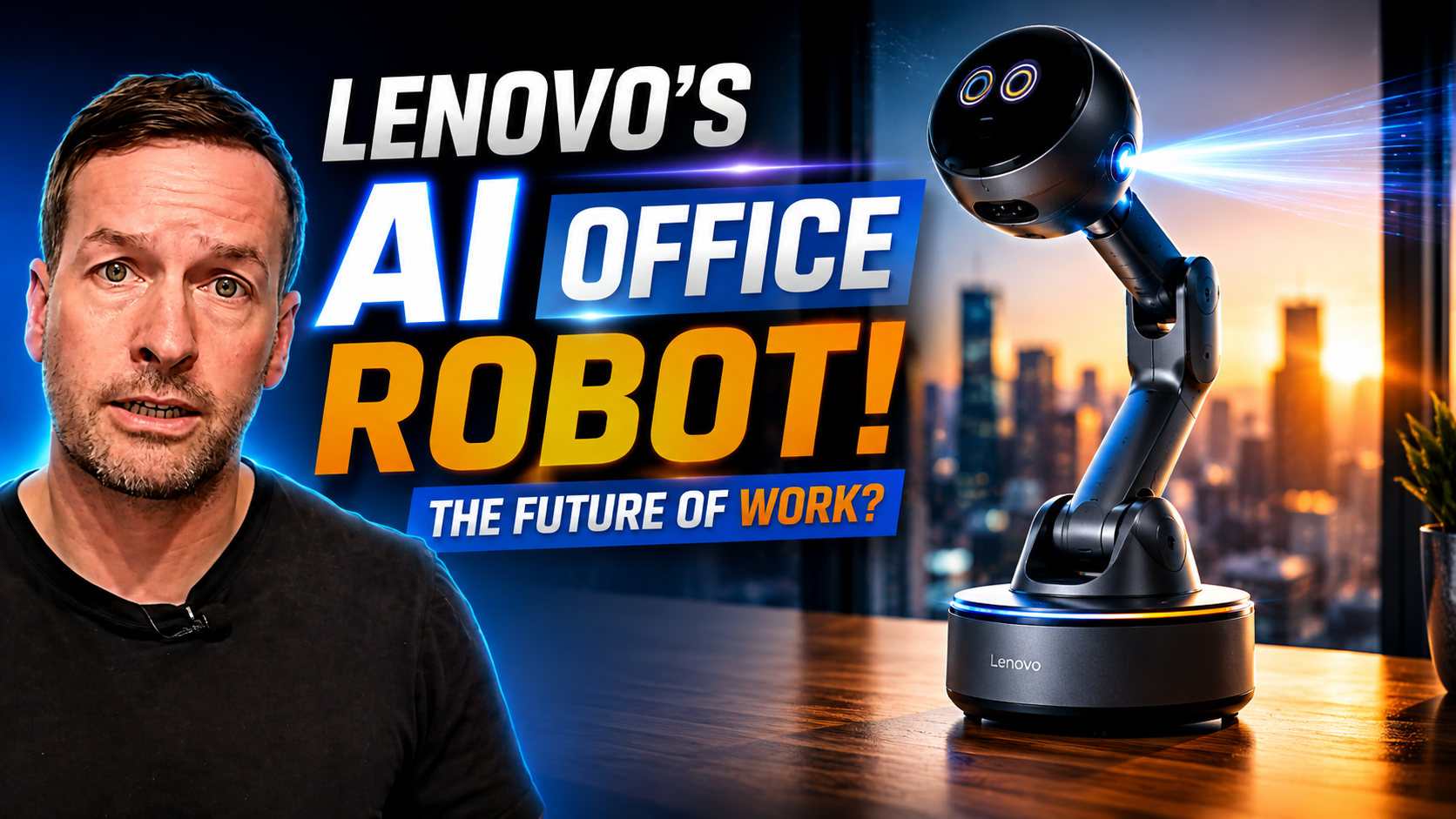
The Future of AI Robots in the Workplace: Why Physical AI Could Transform Business Forever
Artificial intelligence is already transforming the modern workplace. From AI-powered customer service tools to automated scheduling software and predictive analytics platforms, businesses across nearly every industry are exploring how automation can improve productivity, reduce costs, and increase efficiency.
But now a new trend is beginning to emerge — one that could fundamentally change how humans interact with artificial intelligence at work.
Physical AI.
Instead of AI existing purely as invisible software running quietly inside computers and cloud systems, companies are now exploring the idea of AI robots physically sharing workspaces alongside employees.
One of the latest examples comes from Lenovo, which recently unveiled its AI Workmate Concept — a desktop AI robot featuring cameras, voice controls, a projector, and an animated LCD face designed to act as an office assistant.
At first glance, it may seem like a futuristic gadget or a novelty concept. However, beneath the unusual design sits a much larger question:
Could AI robots eventually become normal workplace tools?
And more importantly…
Could businesses genuinely benefit from physical AI in the workplace?
The answer may shape the future of robotics, automation, and office work for decades to come.
The Rise of Physical AI
For years, artificial intelligence has largely existed behind screens. Employees interact with AI through chatbots, software assistants, analytics dashboards, and mobile apps.
But humans naturally respond differently to physical objects than digital interfaces.
A physical robot creates presence.
It occupies space.
It captures attention.
And psychologically, people tend to engage more naturally with machines they can physically see and interact with.
This is one reason why robotics companies are investing heavily in humanoid robots, service robotics, and AI-powered machines capable of collaborating directly with humans.
The concept behind Lenovo’s AI Workmate is relatively simple.
The robot sits on a desk and acts as a workplace assistant capable of:
- Responding to voice commands
- Accessing office files
- Reading handwritten notes
- Understanding sketches and diagrams
- Projecting presentations
- Summarizing information
- Assisting with workflows
In many ways, it is essentially an AI assistant with a physical body.
That may sound insignificant at first.
But the implications could be enormous.
Why Businesses Are Investing in AI Robots
The robotics industry is no longer focused solely on factories and warehouses.
Today, businesses are exploring robots for offices, retail stores, hospitals, hotels, restaurants, and customer-facing environments.
Why?
Because labor shortages, rising operational costs, and increasing competition are forcing companies to improve efficiency.
Automation is no longer optional for many businesses.
It is becoming essential.
AI robots offer several potential advantages in workplace environments:
Increased Productivity
AI assistants can help employees manage repetitive tasks, organize information, schedule meetings, summarize documents, and reduce administrative workload.
This allows staff to focus on higher-value work.
Improved Collaboration
Physical AI systems may eventually become collaboration tools that interact naturally with teams during meetings, brainstorming sessions, and project planning.
A robot capable of projecting presentations, accessing company knowledge, and responding conversationally could streamline workflows significantly.
Enhanced Data Access
Modern businesses generate enormous amounts of data.
AI robots could act as real-time interfaces for accessing information instantly without employees needing to navigate multiple applications or systems.
Competitive Advantage
Companies adopting robotics early often gain operational advantages over competitors.
This is already happening across manufacturing automation, warehouse robotics, and logistics.
The same pattern may eventually occur in office environments.
The Technology Driving Workplace Robots
Several major technologies are converging to make AI workplace robots possible.
Large Language Models (LLMs)
AI models similar to ChatGPT are enabling robots to communicate more naturally with humans.
These systems allow robots to understand requests, answer questions, summarize information, and generate useful responses conversationally.
Computer Vision
Advanced cameras and computer vision systems allow robots to interpret handwritten notes, gestures, diagrams, and physical objects.
This helps bridge the gap between physical and digital workflows.
Edge AI and Local Processing
One of the biggest concerns businesses have regarding AI is security.
Many organizations are uncomfortable sending sensitive company data to cloud-based AI systems.
This is why Lenovo’s emphasis on local AI processing is important.
Running AI models locally could allow businesses to maintain tighter control over sensitive information while still benefiting from automation.
Robotics Hardware Miniaturization
Robotics hardware is becoming smaller, cheaper, and more capable.
Compact sensors, lightweight motors, efficient processors, and improved battery technology are making smaller AI robots commercially viable.
The Human Side of Robotics
One of the most fascinating aspects of workplace robotics is human psychology.
Humans often interact differently with physical systems compared to software.
People may ignore a chatbot notification on a screen.
But a physical robot turning toward someone and speaking directly creates a stronger behavioral response.
This is particularly relevant for industries focused on customer engagement and collaboration.
Service robots in retail, hospitality, healthcare, and entertainment already demonstrate this effect.
The physical presence of a robot creates novelty, engagement, and emotional interaction.
This could eventually become valuable inside office environments as well.
For example:
- AI meeting assistants
- Reception robots
- Office concierge robots
- Collaborative brainstorming assistants
- AI project coordinators
These concepts may sound futuristic today, but many robotics companies are already developing similar technologies.
Challenges Slowing Adoption
Despite the excitement surrounding AI robots, several major barriers still exist.
Security Concerns
Businesses remain extremely cautious about granting AI systems access to sensitive information.
An office robot connected to emails, calendars, files, and internal communications introduces cybersecurity and privacy risks.
Companies will demand strong safeguards before deploying these systems widely.
Reliability Issues
AI systems still make mistakes.
Hallucinations, inaccurate responses, scheduling errors, and misunderstandings remain common problems.
Businesses need reliable systems.
A robot assistant accidentally scheduling meetings incorrectly or presenting inaccurate financial data could create serious operational problems.
Cost vs ROI
Robotics adoption ultimately comes down to return on investment.
Businesses need clear financial justification.
If workplace robots cost thousands of dollars without delivering measurable productivity improvements, adoption will remain limited.
IT Management Complexity
Large organizations already manage enormous technology ecosystems.
Adding another device category introduces additional maintenance, updates, security requirements, and support challenges.
This is one reason enterprise robotics adoption can move slowly.
Humanoid Robots and the Bigger Picture
The rise of workplace robots is part of a much larger trend within the robotics industry.
Humanoid robots are attracting massive investment globally.
Companies including Tesla, Figure AI, Apptronik, Sanctuary AI, and numerous Chinese robotics firms are racing to develop commercially viable humanoid robots.
The long-term goal is clear:
Create robots capable of operating in human-designed environments.
Unlike traditional industrial robots, humanoid robots can theoretically use existing infrastructure, tools, workflows, and spaces designed for humans.
This could eventually transform industries including:
- Manufacturing
- Logistics
- Healthcare
- Retail
- Hospitality
- Construction
- Warehousing
- Customer service
- Office administration
While Lenovo’s desktop robot is not a humanoid robot, it reflects the same underlying shift toward physical AI systems integrated into daily human environments.
Real-World Robotics Adoption Trends
Businesses are already deploying robots across multiple sectors.
Manufacturing Automation
Factories increasingly use industrial robots for assembly, welding, inspection, and material handling.
Collaborative robots, or cobots, are allowing humans and robots to work together safely.
Warehouse Robotics
Warehouse automation has exploded due to e-commerce growth.
Autonomous mobile robots, robotic picking systems, and AI logistics platforms are becoming standard in modern fulfillment centers.
Service Robotics
Hotels, hospitals, airports, and restaurants are experimenting with service robots for delivery, customer interaction, cleaning, and assistance tasks.
Healthcare Robotics
Healthcare providers are exploring robotics for surgery, rehabilitation, logistics, telepresence, and patient support.
AI-Powered Business Automation
AI software combined with robotics is enabling more intelligent automation systems capable of adapting dynamically to changing environments.
The future likely involves increasing integration between software AI and physical robotics systems.
The RoboPhil Perspective
Philip English, also known as RoboPhil, has spent years working across the robotics industry helping businesses understand how robotics and automation can create commercial value.
Through Robot Center, Robots of London, and Robot Philosophy, RoboPhil works with organizations exploring robotics deployment, commercial robot sourcing, automation strategy, and robotics consultancy.
This includes:
- Industrial robots
- Service robotics
- Event robots
- Humanoid robotics
- Robotics recruitment
- AI automation systems
- Robotics business strategy
One of the biggest misconceptions businesses have is assuming robotics is only relevant for giant corporations.
In reality, robotics opportunities increasingly exist for SMEs, retailers, logistics companies, manufacturers, healthcare providers, and service businesses.
The key challenge is identifying the right robotics applications that deliver genuine ROI.
As physical AI continues developing, robotics consultants may become increasingly important in helping businesses navigate a rapidly changing automation landscape.
What the Future of Workplace Robotics Could Look Like
The future workplace may look dramatically different from today.
AI robots could eventually become integrated into daily workflows in ways that currently seem futuristic.
Possible future developments include:
AI Meeting Assistants
Robots capable of attending meetings, summarizing discussions, assigning action items, and tracking project progress.
Autonomous Office Support
Robots managing deliveries, visitor interaction, workspace organization, and administrative tasks.
Collaborative AI Workspaces
Interactive robots assisting brainstorming sessions, presentations, and real-time information retrieval.
Hybrid Human-Robot Teams
Humans and robots working collaboratively across operational, creative, and analytical tasks.
Emotionally Intelligent AI
Future robots may become more capable of understanding tone, behavior, and emotional context during interactions.
While widespread adoption may still be years away, the direction of travel is becoming increasingly clear.
Physical AI is coming.
The Future of Robotics Is Just Beginning
The robotics industry is entering one of the most important periods in its history.
Artificial intelligence is accelerating robotics capabilities at an unprecedented rate.
What once seemed like science fiction is gradually becoming commercially viable.
Workplace robots may not immediately appear on every office desk tomorrow morning.
But the idea itself represents something much bigger.
The merging of AI and robotics is creating a future where intelligent machines increasingly operate within human environments.
Businesses that begin understanding robotics now will likely be better positioned for the future.
The companies experimenting with automation, AI robots, and robotics technology today may become the market leaders of tomorrow.
For businesses exploring robotics consulting, automation opportunities, commercial robots, or AI deployment strategies, now is the time to start learning.
Explore Robotics with RoboPhil
For robotics consulting, robot sourcing, automation strategy, and robotics industry insights, visit:
Robot Center
https://robotcenter.co.uk/
Robots of London
https://robotsoflondon.co.uk/
Robot Philosophy
https://robophil.com/
Business enquiries:
sales@robotcenter.co.uk