

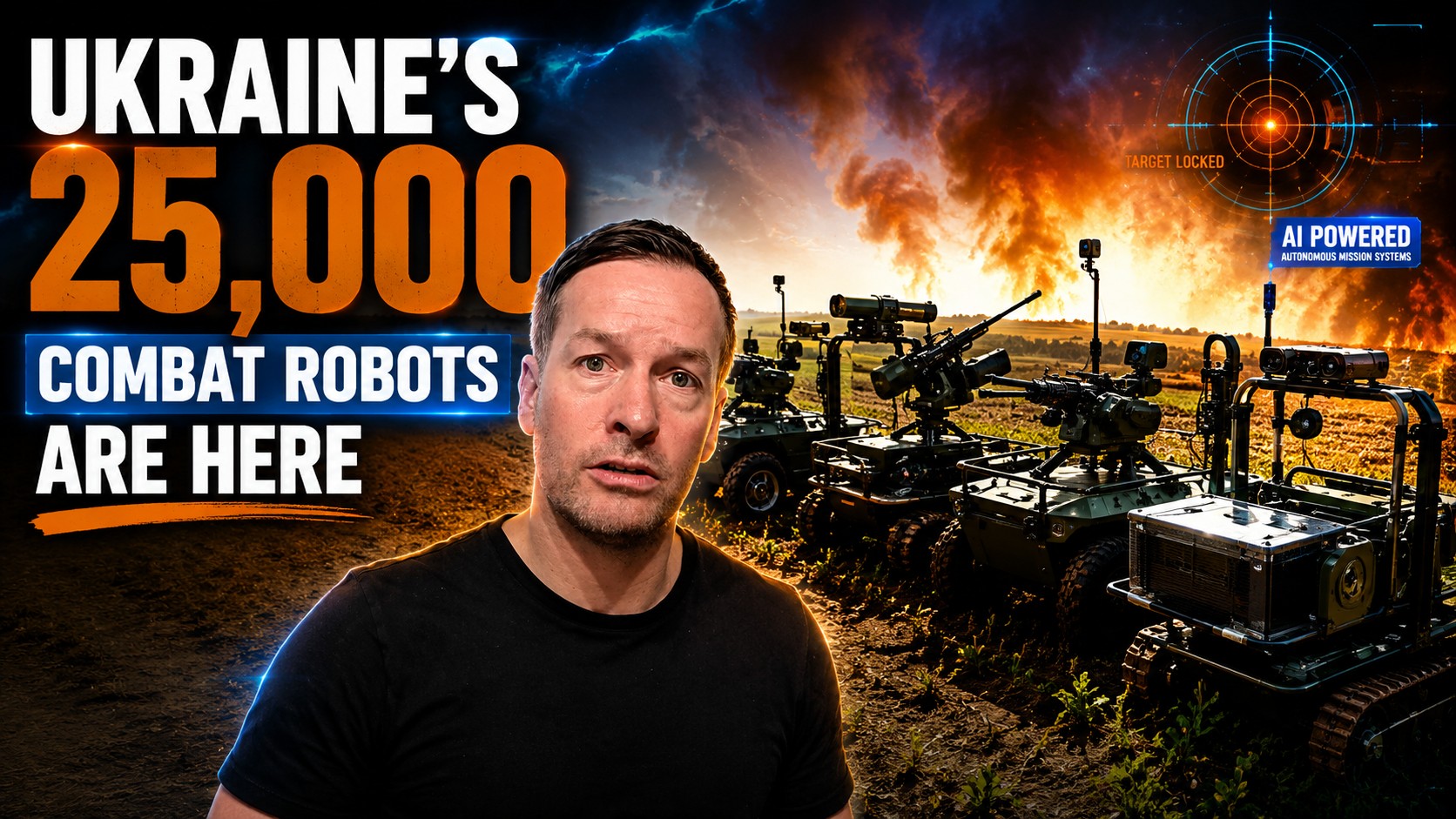
Ukraine’s 25,000 Combat Robots: What This Means for the Future of Robotics, AI Automation, and Business
The robotics industry has just received another major signal that the future is arriving much faster than most people expected.
Ukraine is planning to manufacture and deploy 25,000 ground combat robots in 2026. These are not flying drones or experimental concepts hidden away in laboratories. These are real-world autonomous robotic systems already being used in dangerous frontline operations including logistics, supply transport, evacuations, mine placement, and combat support.
The implications of this go far beyond military technology.
For anyone watching the future of robotics, AI robots, automation, and autonomous systems, this is one of the clearest examples yet of how rapidly robotic deployment is accelerating.
More importantly, history suggests that technologies developed in extreme environments rarely stay there forever.
The internet was originally military technology.
GPS was originally military technology.
Drone systems evolved from military use into commercial tools used in photography, agriculture, logistics, inspections, surveying, and security.
Now we may be witnessing the next major leap in robotics technology.
The rise of autonomous ground robots.
And while many people still think robots are “future technology,” businesses across multiple industries are already beginning to explore what these systems could mean for operations, productivity, safety, and long-term competitiveness.
Why Ukraine Is Deploying Combat Robots at Scale
According to reports, Ukraine’s robotic systems are already completing thousands of missions every month.
These unmanned ground vehicles, often called UGVs, are being used because frontline environments have become extremely dangerous due to drone surveillance and rapid-response attacks. Areas close to the frontline are now described by soldiers as “kill zones,” where any movement can quickly become a target.
Traditional logistics methods using vehicles and personnel are increasingly vulnerable.
Robots change that equation.
Instead of risking human lives, autonomous systems can transport supplies, evacuate wounded soldiers, and carry out dangerous tasks remotely.
From a robotics perspective, what makes this so significant is not simply the number of robots being deployed. It is the operational dependency being created around them.
This is no longer robotics as experimentation.
This is robotics as infrastructure.
That distinction matters enormously.
The moment organizations begin relying on robotic systems for mission-critical operations is the moment robotics moves from innovation to necessity.
The Rise of Autonomous Ground Robots
For years, most public attention around robotics focused on humanoid robots or aerial drones.
Ground robots received far less mainstream attention.
That is now changing rapidly.
Ground-based autonomous robots have several major advantages:
- Greater payload capacity
- Longer operational endurance
- Reduced aerial vulnerability
- Easier scalability
- Lower operational costs
- More practical use cases for logistics and industrial environments
In military environments, these robots can carry equipment, transport supplies, and enter dangerous areas.
In commercial environments, the exact same principles apply.
Warehouses can use autonomous robots for inventory movement.
Factories can use robots for hazardous inspections.
Construction sites can deploy robotic systems in dangerous environments.
Agriculture businesses can automate repetitive field operations.
Ports and logistics hubs can automate transportation tasks.
The crossover between military robotics and commercial robotics is becoming increasingly visible.
Why Businesses Should Pay Attention
Many business owners still see robotics as something reserved for massive corporations with huge budgets.
That perception is rapidly becoming outdated.
The cost of robotics hardware is decreasing.
AI systems are becoming more capable.
Sensors are improving.
Battery technology is evolving.
And robotics software is advancing at an incredible pace.
The result is that robotics adoption is becoming increasingly accessible to small and medium-sized businesses.
The real business opportunity is not simply replacing labor.
It is improving operational resilience.
Businesses around the world continue to face challenges involving:
- Labor shortages
- Rising operational costs
- Health and safety requirements
- Staffing instability
- Productivity pressure
- Supply chain disruption
Robotics and automation offer solutions to many of these problems.
A robot does not get tired during a night shift.
A robot can operate in dangerous environments.
A robot can perform repetitive tasks consistently.
A robot can gather operational data continuously.
And increasingly, AI robots can make decisions in real time based on environmental conditions.
This is why the robotics industry is attracting such enormous investment globally.
AI Robots Are Changing the Definition of Automation
Traditional automation relied heavily on predictable environments.
Conveyor systems, programmed machinery, and industrial robotics worked well in controlled settings but struggled with dynamic environments.
Modern AI robots are different.
Thanks to advances in artificial intelligence, machine vision, sensors, and machine learning, robots are becoming more adaptable.
Instead of following rigid instructions, AI robots can increasingly:
- Navigate changing environments
- Detect obstacles
- Identify objects
- Make route decisions
- Analyze situations
- Learn from operational data
This shift is extremely important.
It means robotics is moving beyond repetitive factory tasks and into environments previously considered too unpredictable for automation.
That includes:
- Retail
- Hospitality
- Healthcare
- Agriculture
- Construction
- Security
- Logistics
- Food production
- Event management
The commercial robotics market is expanding because robots are becoming more useful in real-world conditions.
The Future of Robotics Is Physical AI
One of the biggest trends shaping the robotics industry right now is the rise of physical AI.
For years, artificial intelligence was mostly digital.
Chatbots.
Software.
Search algorithms.
Data analysis.
Now AI is entering the physical world through robotics.
Physical AI combines artificial intelligence with robotic systems capable of interacting with real environments.
This is where things become transformative.
An AI chatbot can answer questions.
An AI robot can move objects, transport goods, inspect infrastructure, serve customers, assist workers, or navigate dangerous environments.
That dramatically increases the commercial potential of AI.
This is why robotics companies, AI startups, automation firms, and investors are racing to develop next-generation robotic systems.
The market opportunity is enormous.
Humanoid Robots and Public Attention
Although Ukraine’s deployment focuses on ground robots rather than humanoid robots, the broader robotics industry is also seeing huge growth in humanoid robotics development.
Companies around the world are investing heavily in humanoid robots because human environments are already designed for human movement.
Factories, offices, warehouses, retail stores, and homes are built around human behavior and physical dimensions.
Humanoid robots theoretically require less infrastructure adaptation.
However, humanoid robots still face major challenges involving:
- Battery life
- Cost
- Reliability
- Speed
- Dexterity
- Safety
- Scalability
Ground robots currently offer more practical commercial deployment opportunities in many industries because they are simpler and more efficient for specific tasks.
That said, humanoid robots continue to generate enormous investor interest because of their long-term potential.
The robotics industry is likely to see both approaches evolve simultaneously.
Robotics Investment Is Accelerating
One of the clearest indicators of where technology is heading is investment activity.
Global investment into robotics startups, AI robots, autonomous systems, and automation technologies continues to increase.
Investors understand several key realities:
- Labor shortages are increasing globally
- Aging populations are affecting workforces
- Businesses want higher efficiency
- AI capabilities are improving rapidly
- Automation demand continues to grow
The companies developing robotics infrastructure today could become some of the most influential technology companies of the next decade.
Many experts believe robotics may eventually become larger than the software industry because robotics combines:
- Hardware
- AI
- Sensors
- Mobility
- Manufacturing
- Data
- Cloud systems
- Automation
- Real-world deployment
It is one of the most complex and commercially significant technology sectors emerging today.
Challenges Slowing Robotics Adoption
Despite rapid progress, robotics still faces several major challenges.
Cost
Many robotic systems remain expensive for smaller businesses.
Integration Complexity
Deploying robots into existing operations can require significant workflow adjustments.
Technical Support
Businesses often underestimate the importance of ongoing maintenance and support.
Public Perception
Many people still fear robots replacing jobs entirely.
Regulation
As robots become more autonomous, regulation and safety standards will become increasingly important.
However, history suggests that technology adoption often accelerates once systems become affordable, reliable, and commercially proven.
That tipping point may arrive faster than many people expect.
What Happens Next?
The most important takeaway from Ukraine’s robotics deployment may not be military at all.
It may be what it signals about robotics maturity.
When robotic systems become trusted enough for critical operations in extreme environments, it suggests the technology is reaching a new level of operational confidence.
That confidence eventually spreads into commercial industries.
Over the next decade, we are likely to see major growth in:
- Warehouse robotics
- Autonomous logistics
- Security robots
- Agricultural robotics
- Inspection robots
- Healthcare robotics
- Service robots
- Construction robots
- AI-powered industrial automation
Robots will not replace every human worker.
But they will increasingly change how humans work.
The companies adapting early are likely to gain major advantages in productivity, scalability, efficiency, and operational resilience.
The RoboPhil Perspective on Robotics Adoption
Philip English, also known as RoboPhil, works across Robot Center, Robots of London, and Robot Philosophy helping businesses understand the rapidly evolving robotics landscape.
As robotics adoption accelerates, many companies are trying to answer critical questions:
- Which robots are commercially viable?
- Where can robotics create genuine ROI?
- What industries are ready for automation?
- How should businesses approach robotics deployment?
- Which robotics trends actually matter?
Through Robot Center, businesses can explore commercial robots, industrial robotics, AI robots, and robotics deployment opportunities.
Through Robots of London, companies and event agencies can experience robots in customer-facing environments including exhibitions, conferences, marketing activations, and live events.
Through Robot Philosophy, Philip English shares robotics insights, consulting, strategy, and industry analysis focused on helping businesses prepare for the future of automation.
One thing is becoming increasingly clear:
The robotics industry is no longer a niche market.
It is becoming one of the defining industries of the next generation.
Conclusion
Ukraine’s deployment of 25,000 combat robots is more than just a military story.
It is a signal.
A signal that robotics technology is evolving rapidly.
A signal that autonomous systems are becoming operationally trusted.
And a signal that AI robots are moving from experimental technology into real-world deployment at scale.
History shows that technologies developed in extreme environments often reshape civilian industries later.
The same may now happen with autonomous robotics.
Businesses that ignore robotics entirely may eventually find themselves at a significant competitive disadvantage.
Because robotics is no longer simply about innovation.
It is becoming about resilience, scalability, efficiency, and long-term operational strategy.
The future of robotics is arriving much faster than most people expected.
And the businesses paying attention today may be the ones leading tomorrow.
Robot Center
https://robotcenter.co.uk/
Robots of London
https://robotsoflondon.co.uk/
Robot Philosophy
https://robophil.com/
Business enquiries
sales@robotcenter.co.uk