

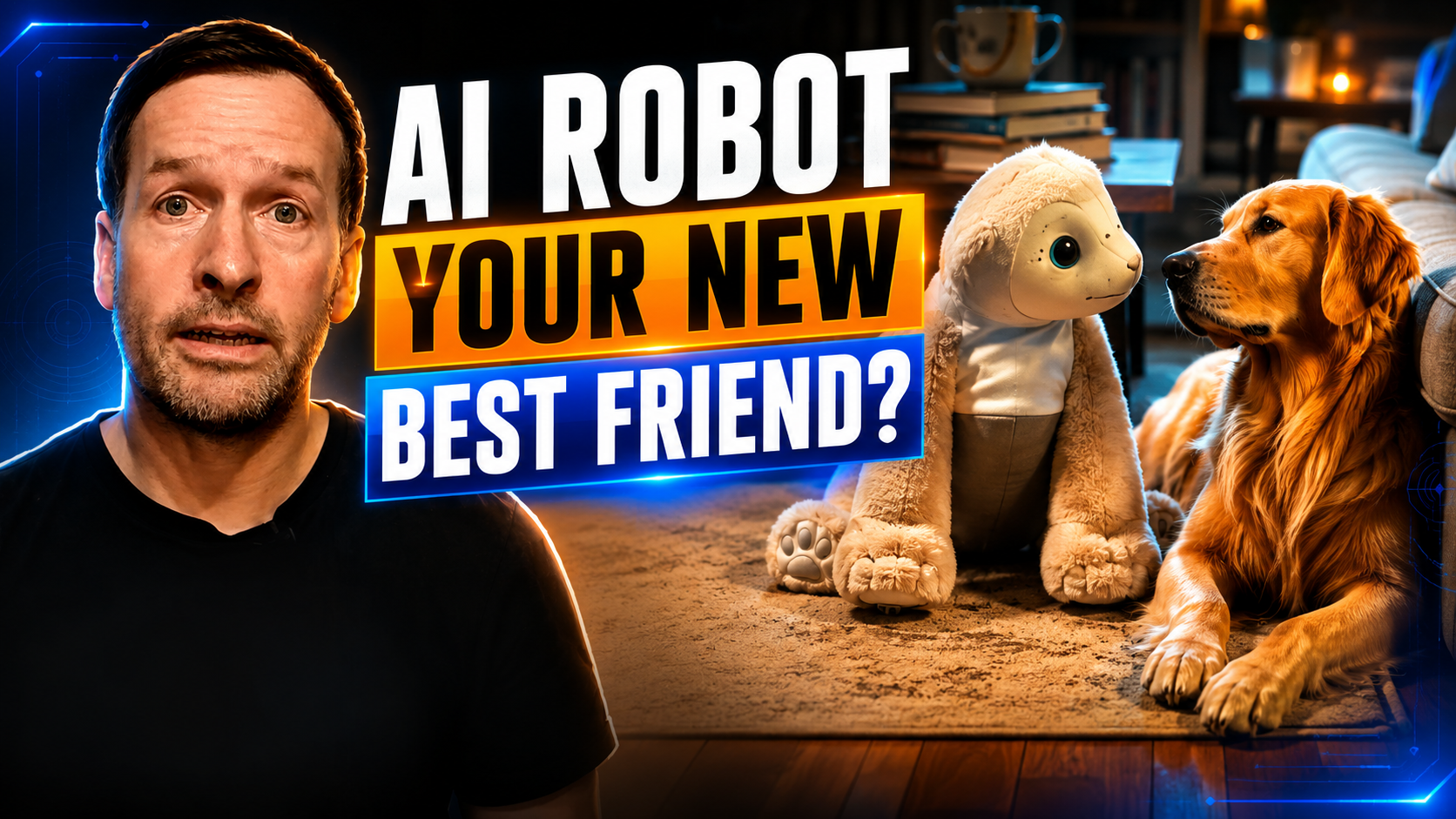
The Roomba Founder’s New AI Robot Could Change Human Loneliness Forever
The Rise of AI Companion Robots: Why Emotional Robotics Could Become the Next Major Technology Industry
For decades, robots have mainly been designed to perform tasks.
Clean the floor.
Move boxes in a warehouse.
Assemble products in factories.
Deliver food in restaurants.
But a new category of robotics is now beginning to emerge — robots designed not just to work for humans, but to emotionally interact with them.
This shift could become one of the most important developments in the future of robotics.
The launch of new AI companion robots by companies such as Familiar Machines & Magic, founded by Roomba creator Colin Angle, signals the beginning of a potentially enormous new robotics industry. These are not traditional industrial robots or service robots focused purely on productivity. Instead, they are emotionally aware AI robots designed to become part of everyday human life.
The implications go far beyond technology.
They touch business, healthcare, mental health, retail, hospitality, entertainment, and even the future relationship between humans and machines.
As robotics technology evolves, emotional intelligence may become just as important as mechanical capability.
And businesses paying attention to this shift early could gain a major advantage.
The Evolution of Robotics
The robotics industry has gone through several major phases.
The first wave focused heavily on industrial automation. Large robotic arms transformed automotive manufacturing and heavy industry. These robots were powerful, reliable, and highly efficient, but they operated inside controlled environments away from people.
The second wave introduced service robotics. Autonomous machines began appearing in warehouses, hospitals, hotels, airports, and retail environments. Robots started interacting more directly with humans, although still primarily through task-based functions.
Today, a third wave is emerging.
Emotionally intelligent robotics.
This is where robotics becomes more personal, interactive, and socially integrated.
Instead of simply asking what a robot can do physically, companies are now asking:
How should a robot behave?
How should it interact with people?
How can robots create emotional engagement?
This may sound futuristic, but the foundations are already being built.
Why AI Companion Robots Matter
At first glance, AI companion robots may appear to be novelty products.
Cute robots with personalities.
Digital pets.
Interesting gadgets.
But underneath the surface lies something much bigger.
Companion robots represent the convergence of multiple fast-growing industries:
- Artificial intelligence
- Robotics technology
- Behavioral AI
- Smart homes
- Healthcare technology
- Service robotics
- Consumer electronics
- Emotional computing
This combination creates a potentially massive market opportunity.
The reason is simple.
Humans are social creatures.
Most current technology is screen-based. Smartphones, tablets, laptops, and televisions dominate modern life. Yet despite being more digitally connected than ever before, loneliness and social isolation are becoming major global concerns.
This creates an opportunity for robotics companies to develop machines that provide interaction, engagement, and companionship in physical space rather than purely through screens.
That is a completely different technological challenge.
And potentially a much larger commercial opportunity.
From Utility Robots to Relationship Robots
Historically, robots have succeeded when they delivered clear utility.
The Roomba succeeded because it solved a real problem. It automated floor cleaning in a practical, accessible way.
Warehouse robots succeed because they increase efficiency and reduce operational costs.
Delivery robots succeed when they improve logistics.
Companion robots operate differently.
Their value is not only based on productivity.
It is based on interaction.
Behavior.
Engagement.
Consistency.
Emotional familiarity.
That changes how robotics companies think about design.
The goal is no longer simply building a machine that performs a task. The goal becomes building a robot people want to spend time around.
This requires advancements in several areas simultaneously:
- Vision systems
- Behavioral AI
- Emotional recognition
- Movement realism
- Voice interaction
- Context awareness
- Personality modeling
- On-device AI processing
The challenge is enormous.
But recent advances in AI are making it increasingly achievable.
Why This Is Happening Now
The timing is not accidental.
Several technologies have matured at the same time.
AI Has Improved Dramatically
Modern AI models are far more capable of understanding language, context, and human behavior than previous systems.
Large language models, multimodal AI systems, and edge AI processing now allow robots to interpret and react to real-world environments in ways that were impossible only a few years ago.
Sensors Have Become Cheaper
Robots now have access to high-quality cameras, microphones, lidar systems, and environmental sensors at lower costs.
This makes sophisticated robotics platforms more commercially viable.
Battery Technology Has Improved
Modern batteries allow robots to operate for longer periods while maintaining compact designs.
Consumers Are More Comfortable With Robots
Years of exposure to smart devices, AI assistants, and autonomous systems have made consumers far more open to robotics technology.
People who once viewed robots as science fiction now interact with AI daily.
That psychological shift matters.
The Importance of Emotional Intelligence in Robotics
One of the most important trends in robotics is the move from IQ-focused robots to EQ-focused robots.
For years, robotics companies concentrated on intelligence.
Can the robot calculate?
Can it navigate?
Can it process information?
But human interaction depends heavily on emotional intelligence.
Humans respond strongly to behavior, body language, movement, tone, and timing.
This is why companion robotics focuses heavily on subtle interaction design.
A robot that reacts appropriately to a situation may feel far more natural than a robot capable of answering complex trivia questions.
This is particularly important for home robotics.
Inside homes, robots are entering deeply personal environments.
People do not necessarily want machines that feel cold, clinical, or overly mechanical.
They want robots that feel approachable.
Predictable.
Comfortable.
Familiar.
This may become critically important as humanoid robots eventually enter mainstream society.
The Future of Humanoid Robots
Much of the robotics industry is currently focused on humanoid robots.
Companies around the world are investing billions into machines designed to operate in human environments.
Factories.
Warehouses.
Retail stores.
Healthcare facilities.
Hotels.
Restaurants.
Homes.
The long-term vision is clear.
Humanoid robots could eventually become a general-purpose labor platform capable of performing many physical tasks currently done by humans.
However, there is a major challenge.
Humanoid robots can easily become unsettling if their behavior feels unnatural.
This is known as the “uncanny valley” problem.
Companion robotics may help solve this.
By creating emotionally familiar robotic interactions first, society may gradually become more comfortable with advanced humanoid systems later.
In many ways, companion robots could become the social bridge toward wider humanoid robot adoption.
Real-World Business Applications
Although companion robotics sounds consumer-focused, the business implications are enormous.
Healthcare and Elder Care
Aging populations are creating serious workforce pressures globally.
Healthcare systems face shortages of caregivers, nurses, and support staff.
Companion robots could assist with:
- Routine reminders
- Monitoring behavior
- Encouraging activity
- Providing engagement
- Supporting mental wellbeing
They are unlikely to replace human care entirely, but they may help supplement overstretched healthcare systems.
Hospitality and Retail
Emotionally intelligent robots may eventually become customer-facing service systems in hotels, retail stores, and entertainment venues.
A robot capable of understanding customer mood and behavior could significantly improve user experience.
Education
Companion robots may become educational assistants for children, helping support learning through interactive engagement.
Mental Health Support
While robots cannot replace therapists, companion systems may eventually provide additional emotional support and engagement for isolated individuals.
Challenges Facing the Robotics Industry
Despite the excitement, major challenges remain.
Cost
Advanced robotics systems remain expensive to develop and manufacture.
Achieving consumer-scale pricing will be critical.
Reliability
People expect consumer products to work consistently.
A robot that frequently fails, crashes, or behaves unpredictably will quickly lose user trust.
Privacy Concerns
Home robots equipped with cameras and microphones naturally raise concerns about data privacy and surveillance.
Companies will need to prioritize trust and transparency.
Emotional Expectations
Humans form emotional attachments surprisingly easily.
This creates ethical questions around emotional dependence on machines.
Technical Complexity
Creating emotionally believable robots requires integrating many difficult technologies simultaneously.
Hardware, AI, movement, sensing, and interaction design must all work together seamlessly.
That is extremely challenging.
Why Businesses Should Pay Attention Now
Many companies still view robotics as something distant or experimental.
That mindset is becoming increasingly risky.
Robotics technology is advancing rapidly across multiple sectors simultaneously:
- AI automation
- Warehouse robotics
- Humanoid robots
- Service robotics
- Delivery robots
- Companion robotics
- Industrial automation
The businesses exploring robotics early are likely to gain several advantages:
- Improved efficiency
- Reduced labor dependency
- Stronger scalability
- Better customer engagement
- Competitive differentiation
- Enhanced data collection
- Greater operational consistency
Companies waiting too long may eventually struggle to compete against more automated rivals.
The Robotics Startup Explosion
The robotics industry is entering a major growth phase.
Investment into robotics startups has accelerated significantly over recent years.
Investors increasingly recognize robotics as the next major technological platform after software and mobile computing.
Several factors are driving this:
- Labor shortages
- Rising wages
- AI advancements
- Manufacturing reshoring
- E-commerce growth
- Aging populations
- Autonomous systems development
As a result, robotics startups are appearing across nearly every industry sector.
Some focus on industrial robots.
Others focus on agriculture, healthcare, logistics, retail, hospitality, or defense.
Companion robotics may become one of the largest opportunities of all because it targets everyday consumer interaction.
The RoboPhil Perspective
At Robot Philosophy, Robot Center, and Robots of London, Philip English (RoboPhil) works closely with businesses exploring the future of robotics and automation.
This includes:
- Robot deployment
- Robotics consulting
- Robotics strategy
- Commercial robot sourcing
- Service robotics
- Event robotics
- Automation insights
- Robotics industry education
One of the biggest shifts currently happening is that businesses are no longer asking whether robotics matters.
They are asking how quickly they can adopt it effectively.
Companies across hospitality, retail, manufacturing, healthcare, logistics, and events are becoming increasingly interested in robotics solutions that improve engagement, efficiency, and customer experience.
The robotics industry is moving from experimentation into practical commercial deployment.
And that shift is accelerating.
What the Future of Robotics Looks Like
Over the next decade, robotics is likely to become deeply integrated into everyday life.
Factories will become increasingly autonomous.
Warehouses will become heavily robotized.
Humanoid robots may enter commercial environments at scale.
Service robots will become more common in hospitality and retail.
Companion robots may eventually become normal household products.
The most important point is this:
Robotics is no longer just about machinery.
It is becoming about interaction.
Behavior.
Experience.
Emotion.
The companies that understand this shift early may become the defining robotics leaders of the future.
Conclusion
The rise of AI companion robots represents a major turning point for the robotics industry.
For decades, robots were designed mainly for productivity and automation.
Now, robotics companies are beginning to explore emotional intelligence, companionship, and human interaction.
This opens the door to entirely new industries and business opportunities.
Companion robotics may eventually influence healthcare, retail, hospitality, education, customer service, and even the future development of humanoid robots.
The technology is still early.
The challenges are significant.
But the direction is becoming increasingly clear.
Robotics is moving closer to humans — physically, emotionally, and socially.
And that could transform society far more than most people currently realize.
For robotics consulting, robot sourcing, automation strategy, and robotics industry insights, contact RoboPhil and the team:
Robot Center
https://robotcenter.co.uk/
Robots of London
https://robotsoflondon.co.uk/
Robot Philosophy
https://robophil.com/
Business enquiries
sales@robotcenter.co.uk