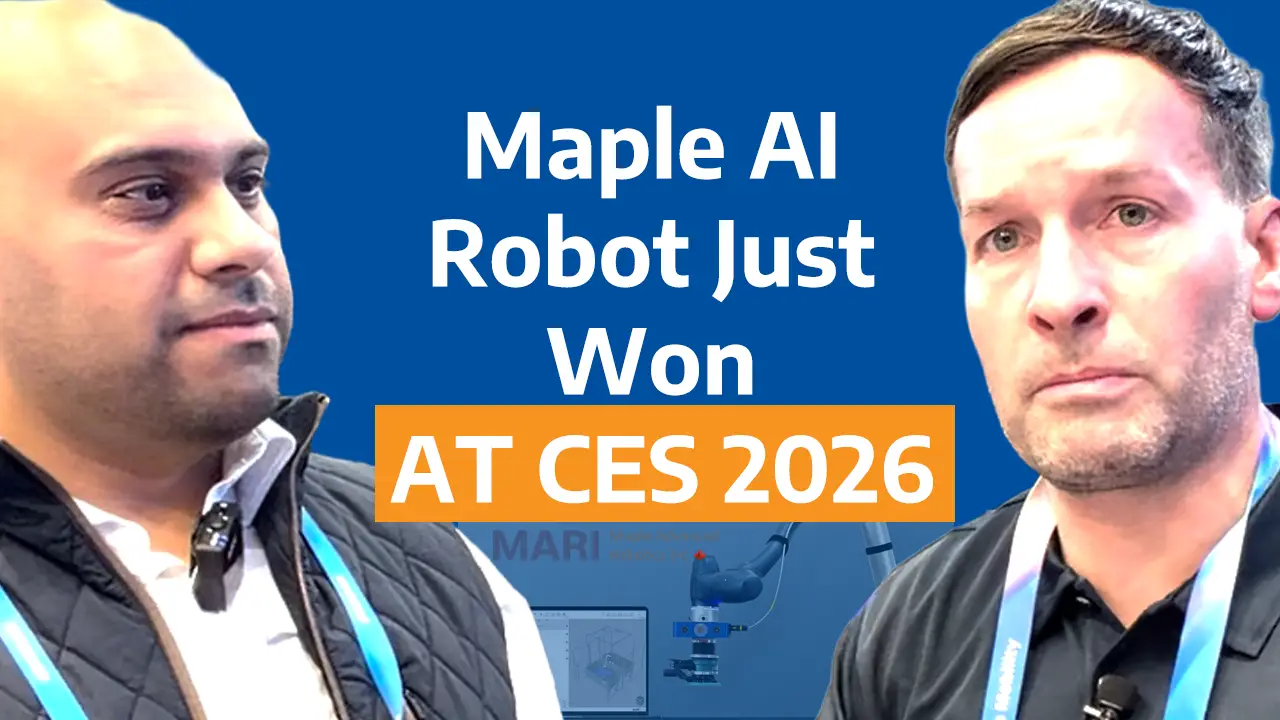
Maple Advanced Robotics and Doosan at CES 2026: A Turning Point for AI Robotics and Automation
Introduction
Every year, CES showcases the latest innovations in technology, but occasionally a moment stands out that signals a deeper shift in an entire industry.
At CES 2026, that moment came when Maple Advanced Robotics (MARI) won an award alongside Doosan Robotics.
This wasn’t just another robotics demonstration or incremental upgrade. It was a clear indication that AI robots are entering a new phase—one where intelligence, adaptability, and real-world usability converge.
For businesses, entrepreneurs, and investors watching the robotics industry, this is more than news. It’s a signal of what’s coming next in automation—and how quickly companies will need to adapt.
The Current State of Robotics
The robotics industry has evolved rapidly over the past decade.
What started as rigid, pre-programmed machines in controlled environments has now expanded into intelligent systems capable of operating in dynamic, unpredictable settings. Traditional industrial robots, once confined to automotive assembly lines, are now being joined by collaborative robots (cobots), service robots, and increasingly sophisticated AI robots.
Today, robotics technology is defined by three major trends:
- Increased intelligence through AI and machine learning
- Greater flexibility in deployment
- Expansion into non-industrial environments
Companies are no longer just investing in robots for efficiency. They are investing in robotics as a strategic advantage.
And this is where Maple Advanced Robotics’ CES recognition becomes important.
Why the MARI and Doosan Win Matters
The collaboration between Maple Advanced Robotics and Doosan Robotics represents a powerful combination of software intelligence and hardware capability.
Doosan has established itself as a global leader in collaborative robot arms—systems designed to work safely alongside humans. Maple Advanced Robotics, on the other hand, is focused on intelligent control systems that enable robots to perform complex tasks with minimal programming.
Together, they are solving one of the biggest challenges in robotics:
Making robots easier to deploy and more adaptable to real-world tasks.
Historically, deploying robots has required significant expertise, time, and cost. Systems needed to be carefully programmed, calibrated, and maintained.
Now, with AI-driven robotics systems, we are seeing a shift toward:
- Faster deployment
- Reduced need for specialist programming
- Greater autonomy in operation
This is critical for businesses that want to adopt automation without building large in-house robotics teams.
Key Technologies Driving This Shift
The success of AI robots like those demonstrated by MARI and Doosan is underpinned by several key technological advancements.
AI and Machine Learning
Modern robots are no longer limited to fixed instructions.
AI allows robots to interpret data, learn from their environment, and make decisions in real time. This is particularly important in environments where variability is high—such as logistics, retail, or service industries.
Computer Vision
Computer vision enables robots to “see” and understand their surroundings.
This allows for:
- Object recognition
- Quality inspection
- Navigation in dynamic environments
For example, a robot can identify different items on a production line without needing each one to be precisely positioned.
No-Code and Low-Code Robotics
One of the most significant developments in robotics technology is the move toward no-code or low-code interfaces.
This allows non-experts to program and deploy robots using intuitive visual tools rather than complex coding.
This is a major step toward mass adoption.
Collaborative Robotics (Cobots)
Cobots are designed to work safely alongside humans.
This opens up new possibilities for automation in environments that were previously unsuitable for traditional robots, such as:
- Small and medium-sized businesses
- Warehouses
- Retail environments
- Events and customer-facing roles
Real-World Applications of AI Robots
The impact of these technologies is already being felt across multiple industries.
Manufacturing
Manufacturing remains the largest market for robotics.
AI robots are now being used for:
- Assembly
- Inspection
- Packaging
- Material handling
The difference is that these systems are becoming more flexible, allowing manufacturers to adapt quickly to changing product lines.
Logistics and Warehousing
Automation in logistics is accelerating rapidly.
Robots are being deployed for:
- Picking and packing
- Sorting
- Inventory management
With AI integration, these systems can optimize workflows and improve efficiency in real time.
Retail and Customer Experience
Service robots are beginning to transform customer-facing environments.
From digital signage robots to interactive assistants, businesses are using robots to:
- Engage customers
- Provide information
- Enhance brand experiences
Events and Marketing
Robots are increasingly being used at events to create memorable experiences.
They attract attention, generate engagement, and provide a unique way for brands to stand out.
This is an area where adoption is growing quickly.
Challenges Slowing Adoption
Despite rapid progress, several challenges remain.
Awareness and Understanding
One of the biggest barriers is not technology—it’s awareness.
Many businesses still don’t fully understand what robots can do or how they can be implemented.
Cost Perception
While the cost of robotics is decreasing, there is still a perception that robots are expensive and complex.
In reality, the return on investment can be significant when deployed correctly.
Integration
Integrating robots into existing workflows can be challenging.
It requires:
- Process redesign
- Staff training
- Ongoing support
This is where robotics consulting becomes essential.
Industry Insight: A Market Accelerating
The robotics industry is entering a new phase of growth.
Investment in robotics startups is increasing, particularly in areas such as:
- AI-driven robotics
- Autonomous systems
- Humanoid robots
We are also seeing increased collaboration between hardware manufacturers and software companies, as demonstrated by the MARI and Doosan partnership.
This convergence is accelerating innovation.
At the same time, global trends such as labor shortages and rising operational costs are driving demand for automation.
Businesses are no longer asking if they should adopt robotics.
They are asking how quickly they can do it.
The Business Case for Robotics
For businesses, the case for robotics is becoming clearer.
Efficiency and Productivity
Robots can operate continuously, reducing downtime and increasing output.
Consistency and Quality
Automation reduces variability, leading to more consistent results.
Competitive Advantage
Early adopters of robotics can differentiate themselves in their markets.
Scalability
Robotics allows businesses to scale operations without a proportional increase in labor costs.
The RoboPhil Perspective
From my perspective as Philip English (RoboPhil), working across Robot Center, Robots of London, and Robot Philosophy, the shift we are seeing now is significant.
Over the past few years, I’ve worked with:
- Businesses exploring robotics adoption
- Events using robots for engagement
- Companies launching robotics products in the UK
What’s changing is the mindset.
Businesses are moving from curiosity to action.
They are starting to see robots not as futuristic concepts, but as practical tools that can deliver real value today.
The challenge is knowing where to start.
This is where robotics consulting plays a crucial role—helping companies identify opportunities, select the right technologies, and implement solutions effectively.
What the Future of Robotics Looks Like
Looking ahead, the future of robotics is defined by several key trends.
Increased Autonomy
Robots will become more independent, requiring less human intervention.
Expansion into New Industries
We will see robotics adoption expand into sectors such as:
- Healthcare
- Hospitality
- Construction
- Agriculture
Rise of Humanoid Robots
Humanoid robots are gaining attention and investment.
While still in early stages, they have the potential to transform industries that rely heavily on human labor.
Integration with AI Ecosystems
Robots will become part of broader AI ecosystems, connected to data platforms, cloud systems, and other technologies.
Conclusion
The award won by Maple Advanced Robotics and Doosan at CES 2026 is more than a recognition of innovation.
It is a signal of a broader transformation in the robotics industry.
AI robots are becoming more intelligent, more accessible, and more practical for real-world applications.
For businesses, the message is clear:
The future of robotics is not something to watch from a distance.
It is something to engage with now.
Those who understand and adopt these technologies early will be better positioned to compete in an increasingly automated world.
Call to Action
If you are exploring how robotics could work in your business, now is the time to act.
Whether you are looking for robotics consulting, robot sourcing, or automation strategy, RoboPhil works with companies to identify opportunities and implement real solutions.
Robotics services and partners:
Robot Center
https://robotcenter.co.uk/
Robots of London
https://robotsoflondon.co.uk/
Robot Philosophy
https://robophil.com/
Business enquiries
sales@robotcenter.co.uk