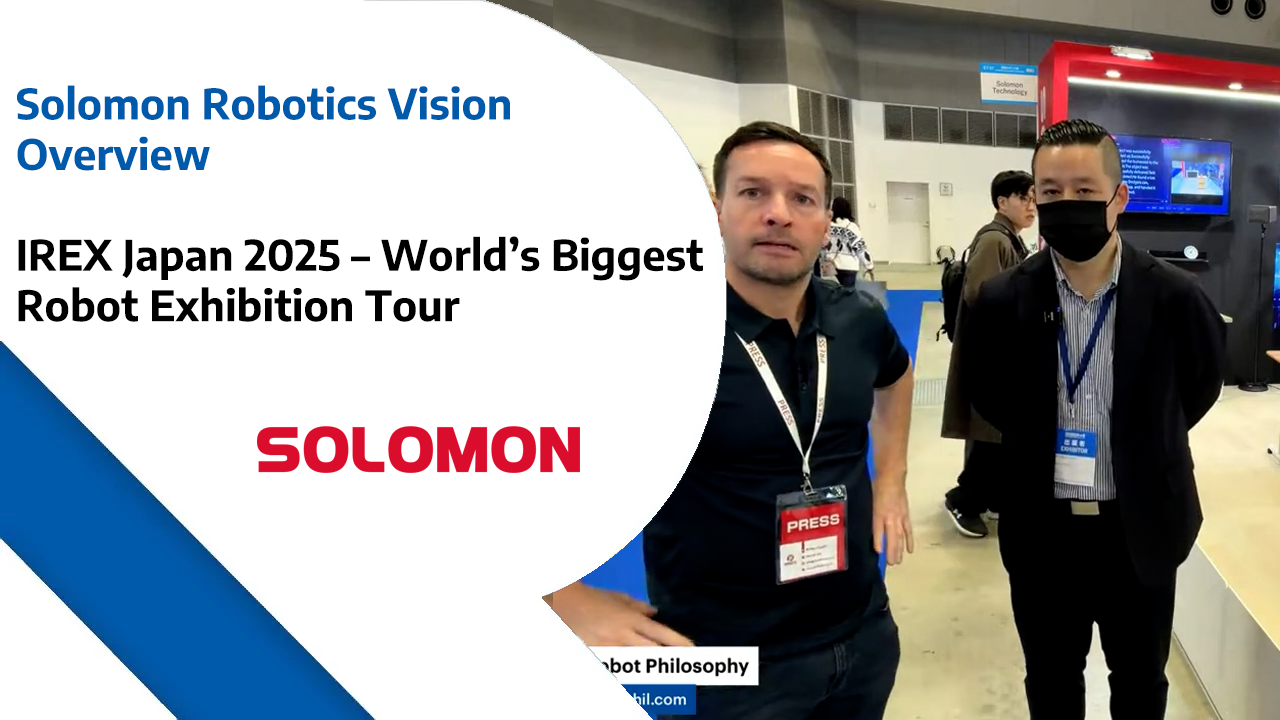
Solomon Robotics Vision Overview – IREX Japan 2025 World’s Biggest Robotics Exhibition Tour
At International Robot Exhibition (IREX) Japan 2025, the world’s largest robotics exhibition, one theme was unmistakable:
Industrial robots are no longer just machines that repeat tasks.
They are becoming systems that see, interpret, and decide.
One of the standout demonstrations came from Solomon Technology Corporation, whose AI-powered 3D vision platform is helping manufacturers bridge the gap between traditional robotics and intelligent automation.
This article breaks down:
What Solomon demonstrated at IREX
How AI vision systems work
Why 3D robot vision is becoming essential
The commercial implications for UK manufacturers
How businesses can deploy this technology successfully
The Shift: From Fixed Automation to Intelligent Automation
For decades, industrial robots have relied on structured environments:
Fixed fixtures
Exact part positioning
Pre-programmed movements
Limited variation
This worked well for high-volume, low-mix production.
But modern manufacturing is changing.
Today’s factories demand:
High-mix, low-volume flexibility
Faster changeovers
Smaller batch production
Greater traceability
Higher quality control
That’s where AI vision becomes critical.
Instead of programming every possible movement, a vision-guided robot can:
Capture a 3D image of its environment
Identify objects using AI models
Determine orientation and position
Adjust its motion path dynamically
This transforms a robot from a repetitive machine into an adaptive system.
What Solomon Demonstrated at IREX 2025
At IREX Japan 2025, Solomon showcased several live applications of its AI-based machine vision platform.
1. 3D Bin Picking
Random bin picking has traditionally been one of the hardest automation challenges.
Parts arrive in mixed orientations inside a container. A robot must:
Identify individual objects
Understand depth and spatial positioning
Avoid collisions
Select the correct gripping angle
Solomon’s 3D system demonstrated:
Fast object recognition
Accurate depth calculation
Stable pick success rates
Integration with standard robot arms
For manufacturers, this eliminates manual part feeding — a major labour bottleneck.
2. AI-Powered Defect Detection
Quality control is under increasing pressure.
Manual inspection is:
Inconsistent
Labour intensive
Difficult to scale
Solomon’s AI inspection system uses deep learning to detect:
Surface scratches
Assembly errors
Missing components
Dimensional deviations
Unlike rule-based vision systems, AI-based inspection improves over time as it processes more data.
This is particularly powerful for electronics, automotive components, and precision engineering sectors.
3. Vision-Guided Robot Programming
One of the biggest barriers to robot adoption for SMEs is complexity.
Traditional robotic deployment requires:
Skilled integrators
Extensive calibration
Rigid positioning
Time-consuming programming
AI vision reduces that burden by allowing the robot to adapt to slight positional changes without reprogramming.
That significantly reduces:
Integration time
Downtime
Reconfiguration costs
For SMEs, that changes the investment equation.
Why AI Vision Is Becoming Core Infrastructure
Across the UK and Europe, manufacturers are facing structural challenges:
Skilled labour shortages
Rising wages
Energy cost volatility
Increased compliance requirements
Global competitive pressure
The answer is not simply “more robots.”
The answer is smarter robots.
AI vision systems:
Increase picking accuracy
Reduce scrap rates
Improve consistency
Lower reliance on human handling
Provide data for continuous optimisation
This is the transition from automation to intelligent automation.
Industry 4.0 and Smart Factory Integration
Modern robotics is no longer isolated hardware.
Solomon’s system supports integration into:
MES systems
ERP systems
Production analytics platforms
Quality traceability databases
When vision data feeds into factory systems, companies gain:
Real-time defect analysis
Predictive maintenance signals
Production pattern recognition
Continuous process optimisation
The robot becomes part of a larger intelligent ecosystem.
The Commercial Impact for UK Businesses
From a commercial standpoint, AI vision changes the ROI model of robotics.
Instead of asking:
“Can we automate this task?”
Businesses now ask:
“How flexible can our automation become?”
Flexible automation means:
Faster product changeovers
Lower tooling costs
Reduced operator dependency
Greater resilience
In a volatile economic climate, flexibility is leverage.
Where AI Vision Makes Immediate Impact
Based on our experience in the UK market, vision-guided robotics creates rapid value in:
1. Warehouse & Logistics
Mixed SKU picking
Parcel handling
Sorting and inspection
2. Manufacturing
CNC part loading
Assembly verification
Kitting operations
3. Electronics
PCB inspection
Micro-component handling
4. Automotive
Component alignment
Surface inspection
Part validation
These are all environments where structured automation struggles.
The Barriers to Adoption
Despite the potential, many businesses hesitate because of:
Unclear ROI
Fear of complexity
Integration concerns
Workforce resistance
This is where structured robotics consultancy becomes critical.
Technology alone does not create impact.
Deployment strategy does.
How We Approach Robotics Deployment in the UK
Through Robot Center, we help businesses implement robotics with clarity and structure.
We follow a simple framework:
R – Resources
Identify where robotics intersects with operational bottlenecks.
O – Optimise
Deploy and integrate robots properly, including AI vision systems.
I – Intellectify
Use robotics data to enhance decision-making and productivity.
📧 sales@robotcenter.co.uk
📞 0845 528 0404
🌍 https://robotcenter.co.uk/
Robotics for Events & Market Entry
For robotics manufacturers looking to enter or expand in the UK market, exhibitions are crucial.
Through Robots of London, we provide:
Humanoid robots for engagement
Robot arms for live demonstrations
Digital signage robots
Lead-generation exhibition robotics
🌍 https://robotsoflondon.co.uk/
📧 sales@robotsoflondon.co.uk
📞 0845 528 0404
Live demonstrations accelerate adoption.
Seeing a robot adapt in real time removes scepticism.
The Bigger Picture: Hardware + Intelligence
What IREX Japan 2025 reinforced is that robotics is evolving in three layers:
Hardware (robot arms, AMRs, humanoids)
Intelligence (AI vision, learning systems)
Integration (data, analytics, optimisation)
Companies that focus only on hardware will fall behind.
The competitive advantage lies in combining robotics with intelligence.
Solomon Technology Corporation’s AI vision platform is part of that broader shift.
Final Thoughts
AI-powered robot vision is moving from optional enhancement to core infrastructure.
Manufacturers that adopt flexible, intelligent automation will:
Improve resilience
Increase margins
Reduce dependency on labour markets
Scale faster
Those who delay risk structural disadvantage.
If you are exploring:
AI vision systems
Robotics integration
UK market entry
Automation strategy
Now is the time to act.
For robotics consultancy, integration, or partnership discussions:
📧 sales@robotcenter.co.uk
📞 0845 528 0404
For robotics hire, demonstrations, and exhibition support:
🌍 https://robotsoflondon.co.uk/
For robotics insights and strategic thinking:
The future of automation isn’t just robotic.
It’s intelligent.