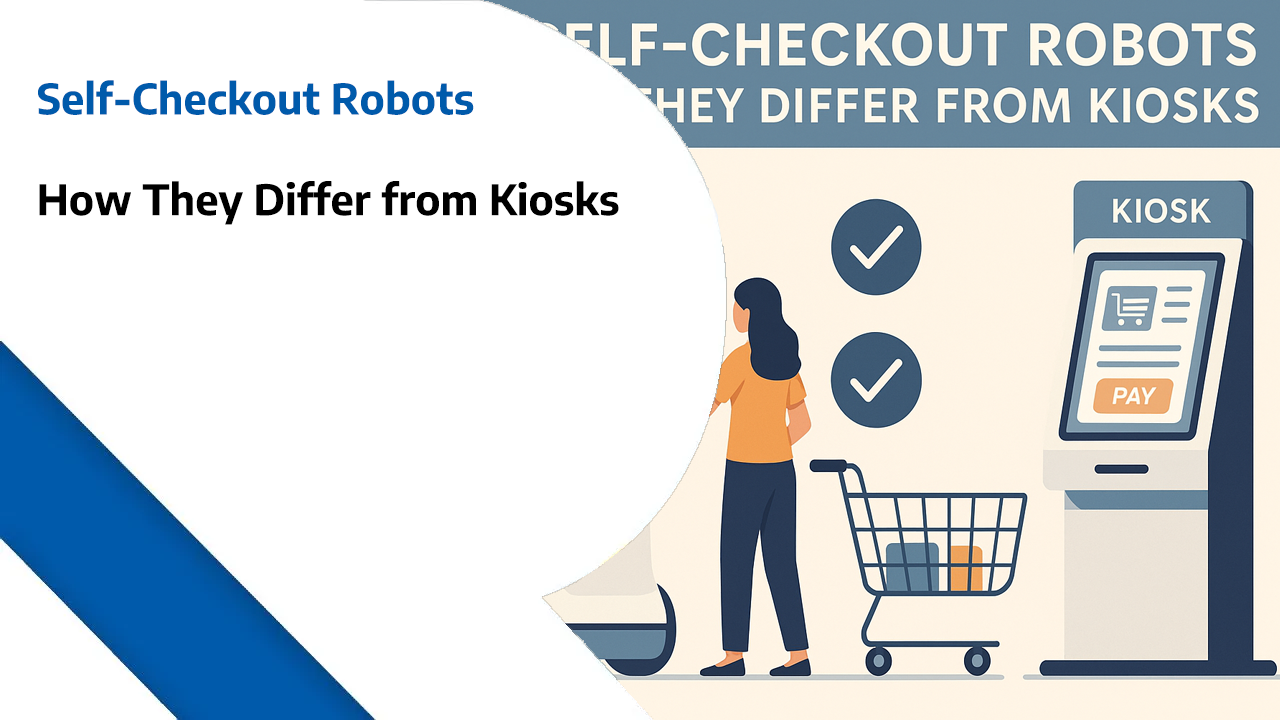
Self-Checkout Robots – How They Differ from Kiosks
Over the last decade, automation has revolutionised the retail landscape. From self-service kiosks to intelligent robots, the way customers interact with stores has evolved dramatically. Yet, despite both being forms of automation, self-checkout kiosks and self-checkout robots are not the same.
The differences go far beyond appearance — they define entirely new models of retail interaction, data collection, and customer experience. In this article, we’ll explore what makes self-checkout robots distinct from kiosks, the advantages they bring, and how they fit into the broader evolution of retail automation.
We’ll also show how your business can stay ahead of the curve through robot consultancy and recruitment — helping you find, install, and scale automation that works for you.
1. The Rise of Retail Automation
Retail automation started with a simple goal: reduce queues, increase efficiency, and cut costs. Early innovations included self-checkout kiosks, which first appeared in the 1990s and became mainstream by the 2010s.
These machines allowed customers to scan, bag, and pay for their own items — freeing up human staff to focus on other tasks. However, kiosks had one major limitation: they were static.
They didn’t move, interact beyond touchscreens, or engage customers in meaningful ways. They solved one operational issue (speed at checkout) but didn’t transform the customer journey.
That’s where self-checkout robots come in.
2. What Exactly Is a Self-Checkout Robot?
A self-checkout robot is a mobile, intelligent robot equipped with a built-in payment interface, AI-powered customer interaction, and the ability to move around the store or venue.
Unlike kiosks that stay in one place, these robots can navigate to customers, handle payments, and even assist with upselling or cross-selling products through voice and screen interactions.
They combine the best of both worlds:
The transactional function of a kiosk
The human-like engagement of a sales assistant
The mobility of a robot
Examples include autonomous robots that roam a supermarket or café, allowing customers to scan items and pay without standing in line. Some can even carry items or provide delivery-to-table services, merging checkout and fulfilment into one seamless experience.
3. Self-Checkout Kiosks – The First Generation
Before understanding the leap to robotics, it’s important to appreciate the role kiosks have played.
A self-checkout kiosk is a fixed station where customers scan items and complete transactions without a cashier. These systems rely on barcode scanners, touchscreens, and card readers.
While highly effective, kiosks come with challenges:
Limited throughput: A small number of kiosks can quickly create queues.
Maintenance and downtime: Fixed hardware means physical wear, requiring regular servicing.
No adaptability: Kiosks can’t move or change location based on demand flow.
Limited engagement: There’s no personal touch or interaction, which can frustrate customers when problems arise.
Kiosks were revolutionary in their time — but they represent a static form of automation. The world is now moving toward dynamic, intelligent, and mobile solutions.
4. Key Differences Between Self-Checkout Robots and Kiosks
| Feature | Self-Checkout Kiosks | Self-Checkout Robots |
|---|---|---|
| Mobility | Stationary | Mobile, can navigate around the store |
| Interactivity | Basic touchscreen | Voice, facial recognition, AI chatbot |
| Customer Experience | Self-service | Engaging and personal |
| Functionality | Scan and pay | Scan, pay, deliver, recommend |
| Data Collection | Transactional only | Behavioural, spatial, emotional data |
| Maintenance | Fixed installation | Modular, remote updates |
| Scalability | Requires physical space | Easily deployed across multiple areas |
| Branding Opportunity | Limited | High visibility, interactive marketing |
This comparison highlights a fundamental shift: robots don’t just replace kiosks — they redefine the retail experience.
5. Why Retailers Are Moving Toward Robots
Retailers are under pressure to create more personalised, efficient, and memorable customer experiences.
Self-checkout robots address several pain points simultaneously:
a. Reducing Checkout Friction
Instead of customers queuing, robots can approach them directly. They can even appear during quieter moments to prompt impulse purchases or loyalty sign-ups.
b. Enhancing Customer Engagement
Using voice AI, facial recognition, and natural language understanding, robots provide human-like interaction. They can answer questions, make suggestions, and even remember repeat customers.
c. Dynamic Deployment
During peak hours, robots can focus on checkout tasks. During off-peak times, they can switch to other duties — such as greeting, stock monitoring, or advertising promotions.
d. Increasing Operational Flexibility
Robots operate without the constraints of fixed hardware, making them ideal for changing store layouts, pop-up venues, or multi-location deployments.
6. The Role of AI and Machine Learning
The intelligence behind self-checkout robots comes from their integration of AI, computer vision, and machine learning.
Unlike kiosks, which rely solely on barcode scanning, robots can:
Recognise products using cameras and object detection
Identify customers through facial recognition (where permitted)
Learn from behaviour patterns to optimise deployment routes
Analyse emotional responses to improve engagement strategies
This data-driven approach makes self-checkout robots not just a payment tool, but a business intelligence asset.
7. The Cost Factor: Robots vs. Kiosks
At first glance, robots may appear more expensive. However, when you factor in mobility, multi-functionality, and marketing potential, the total ROI is often higher.
A single robot can:
Serve multiple customers per hour across different areas
Act as an advertising screen and brand ambassador
Perform analytics and data collection simultaneously
Eliminate the need for multiple static kiosks
In many cases, retailers can rent or hire robots through partners such as Robots of London, reducing upfront costs and testing performance before full-scale rollout.
8. Self-Checkout Robots in Action
Hospitality
Restaurants are deploying robots to handle both ordering and payment. A customer can order via voice, pay using contactless or mobile apps, and receive their meal at the table — all managed by a robot.
Retail
Supermarkets are using robots to scan shelves for pricing accuracy and assist customers with mobile checkout, reducing human workload and boosting accuracy.
Events and Exhibitions
At trade shows, robots combine checkout, customer registration, and product information — turning every transaction into a brand engagement moment.
Cafés and Quick Service Outlets
Some cafes integrate robots that both prepare drinks and manage payment, merging barista and cashier roles into one fluid system.
9. The Future of Self-Checkout Robots
In the next five years, expect to see:
Voice-first checkout powered by conversational AI
Full integration with e-commerce and loyalty systems
Smart mobility that adapts to store traffic patterns
Augmented reality on robot screens for interactive product demos
Ultimately, the self-checkout robot will evolve from a transactional assistant into a personal retail companion.
10. How to Implement Self-Checkout Robots in Your Business
Transitioning from kiosks to robots requires careful planning.
Here’s a simple framework:
Step 1 – Consultation
Engage a robot consultancy like Robot Philosophy to assess your needs. The goal is to identify where automation will have the biggest impact — checkout, service, or marketing.
Step 2 – Selection
Work with a provider such as Robot Center to find the best-fit robot hardware. Factors include screen size, mobility type, payment integration, and AI compatibility.
Step 3 – Pilot
Test one or two robots in specific locations. Monitor usage patterns, queue times, and customer feedback.
Step 4 – Integration
Connect the robots to your existing POS, CRM, and loyalty systems. This ensures seamless operation and data flow.
Step 5 – Scale
Once proven, scale deployment across multiple stores or events — using robot recruitment services to hire or train staff who can manage, maintain, and optimise your robotic fleet.
11. The Human Element: Why Robot Recruitment Matters
Even the most advanced robots need human oversight. Companies introducing self-checkout robots often underestimate the need for skilled professionals who understand both robotics and retail operations.
That’s where robot recruitment comes in.
Through Robot Philosophy, you can access professionals trained in:
Robot installation and configuration
Customer interaction monitoring
Maintenance and support
Data analytics and reporting
Our team connects businesses with robot-ready talent — people who can bridge the gap between technology and customer experience.
To find the right people or explore career opportunities in robotics, contact info@robophil.com or call 0845 528 0404.
12. Why Work with a Robot Consultant?
The world of automation moves fast — and mistakes can be costly. Partnering with a robot consultant ensures you select the right robot for your business model, infrastructure, and budget.
A consultant can:
Audit your operations for automation potential
Recommend suitable hardware and software
Manage installation and training
Provide ongoing strategy and optimisation
At Robot Philosophy, our consultancy framework — Resources, Optimise, Intellectify — is designed to ensure every robot adds measurable value.
13. Sponsors of This Article
This article is proudly supported by three industry-leading organisations at the forefront of robotics:
Robot Center
Buy Robot. Robot Buy. Robot Consultancy. Robotics Consultancy.
Robot Center provides access to cutting-edge robotic solutions and expert consultancy for businesses looking to automate operations and improve efficiency.
Robots of London
Robot Hire. Robot Rental. Rent Robot. Hire Robot. Robot Events.
Robots of London offers a wide range of robots for hire across events, retail, and hospitality — from humanoid greeters to self-checkout units and digital signage robots.
Robot Philosophy
Robot Consultancy. Robot Recruitment. Robot Advice. Robot Insights. Robot Ideas.
Founded by RoboPhil (Philip English) — a leading Robot YouTuber, Influencer, Trainer, Consultant, and Streamer — Robot Philosophy connects businesses with the knowledge and talent needed to implement robotics successfully.
14. The Bottom Line
Self-checkout robots represent the next stage of retail evolution.
Where kiosks gave customers independence, robots add intelligence, personality, and adaptability. They’re more than machines — they’re brand ambassadors, data collectors, and operational allies.
For businesses ready to transition from static self-service to dynamic customer engagement, now is the time to act.
Work with the experts who understand robotics from every angle — consultancy, recruitment, and implementation.
Book a Consultation Today
Get expert advice on how self-checkout robots can transform your business.
📩 Email: info@robophil.com
📞 Call: 0845 528 0404
Partner with Robot Center, Robots of London, and Robot Philosophy — your trusted allies in the next retail revolution.
https://www.youtube.com/watch?v=1r1iAX3pB5w