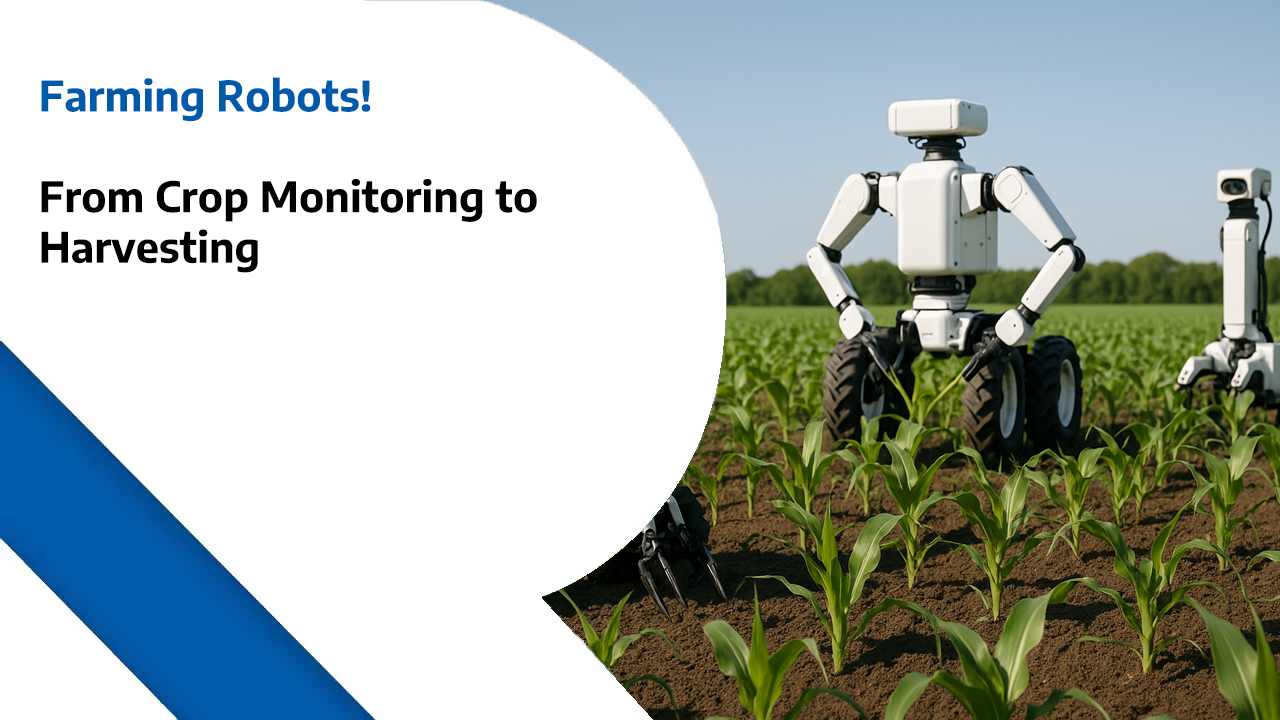
Farming Robots: From Crop Monitoring to Harvesting
In recent years, the agricultural sector has begun a transformation: robots are no longer sci-fi curiosities but real, practical tools helping farmers monitor crops, optimize inputs, and harvest produce. The shift toward automation is driven by labor shortages, rising costs, climate pressures, and demand for more sustainable, data-driven farming. But adoption comes with challenges: which robots to deploy, how to integrate them with existing workflows, and how to recruit the right talent to operate and maintain them.
In this article, we’ll explore:
The spectrum of farming robots from crop monitoring to harvesting
Key enabling technologies and real-world examples
Benefits, limitations, and adoption challenges
How your farm can get started
How Robot Philosophy / RoboPhil (robophil.com) can help — from consulting to recruitment
A call to action to book a call with us
We’ll also acknowledge our sponsors: Robot Center (robotcenter.co.uk), Robots of London (robotsoflondon.co.uk), and Robot Philosophy / RoboPhil.
1. The Robotics Spectrum in Farming
Robots in agriculture perform a wide range of tasks. At one end are “scouting” or monitoring robots, drones, or autonomous rovers; at the other, harvesting robots doing the hands-on work of picking fruit, root crops or vegetables. In between lie tasks like planting, weeding, spraying, fertilizing, and soil sensing. Let’s look at these in turn.
1.1 Crop Monitoring & Scouting Robots
The most widespread early use of robotics in farming is monitoring: capturing data about plant health, soil moisture, pest infestments, disease onset, nutrient stress, and so on.
Drones / UAVs: Equipped with multispectral, hyperspectral, or thermal sensors, drones fly above fields to scan for stress signatures invisible to the naked eye. These capture NDVI (Normalized Difference Vegetation Index), detect water stress, disease hotspots, or pest damage. Wikipedia+2Fresh Consulting+2
Ground rovers / mobile robots: Wheeled or tracked robots can travel through crop rows closer to the plants. They carry cameras, LiDAR, soil sensors, and environmental sensors. They can detect plant height, leaf color, disease lesions, and more. arXiv+3howtorobot.com+3Fresh Consulting+3
Autonomous tractors & sensor platforms: Modified tractors or sensor platforms can carry payloads of sensors, making passes over fields to collect continuous spatial data.
Fixed and semi-fixed sensor networks: While not strictly robots, many farms integrate ground sensors (soil moisture, nutrient probes) and connected IoT systems that feed data to the same analytics pipelines.
By collecting rich datasets, farms can move from blanket treatments (e.g. applying fertilizer or pesticide uniformly) to precision interventions: treat only where needed, in the right dose, at the right time.
1.2 Planting, Seeding & Soil Preparation
Robotic systems are increasingly employed in planting and seeding tasks, especially where precision is critical:
Seeders and planters can be automated with GPS guidance and sensors to place seeds at exact intervals and depths.
Some robots combine seeding with soil sensing (e.g. measuring moisture or compaction before placing the seed) to decide optimal locations.
In projects like the Hands Free Hectare (UK), an autonomous tractor was adapted to plant and roll a hectare of barley autonomously, culminating in a full cropping cycle with zero human operation in the field. Wikipedia
1.3 Weed Control, Pest Management & Fertilization
One of the biggest opportunities for robotics is “smart weeding” and targeted applications of inputs:
Weeding robots: These use vision to distinguish weeds from crops and then mechanically remove weeds (cut, pull, or burn) or apply spot herbicide only where required. This reduces chemical usage and cost. For example, FarmWise provides automated mechanical weeders under a service model. Wikipedia+2Fresh Consulting+2
Robotic spraying / spot-spraying: Robots can apply fungicides, pesticides or nutrients precisely, reducing drift, overuse, and environmental impact.
Smart fertilization: Robots can analyze soil nutrient levels and only deposit fertilizer where needed, in optimal amounts.
Pest and disease robots: Some systems detect pest infestations or early disease onset and apply micro-interventions (e.g. micro-spray, LED light, or biocontrol).
1.4 Harvesting Robots
Harvesting is one of the most complex tasks — requiring gentle handling, recognition of ripeness, and adaptability to variation in plant geometry. Yet this is where robotics is making strides.
Robotic harvesting systems often combine vision systems, AI/ML models, and robotic arms or grippers. They locate individual fruits or produce, estimate orientation, and execute pick operations. arXiv+4meegle.com+4howtorobot.com+4
For example, a recent robot called AHPPEBot (for tomato harvesting) achieved a harvest success rate of ~86.7% in greenhouse trials using phenotyping and pose estimation. arXiv
In orchards or vineyards, robots use geometry-aware grasping estimation to deal with occlusions and branch complexity. arXiv
Other robots are built for root crops or more robust produce — for instance, systems built to dig and lift root vegetables.
Integration is key: harvested produce must be sorted, conveyed, cleaned, and packaged — robots are integrating with those downstream systems.
2. Enabling Technologies & Technical Foundations
What makes farming robots possible? Let’s review the core technologies that underpin these systems.
2.1 Sensing, Vision & Perception
RGB / multispectral / hyperspectral cameras: Provide the “eyes” for robots to detect plant health, stress, diseases, pests, and ripeness. For example, Swiss company Gamaya uses hyperspectral drone cameras to “see” plant signals beyond what human eyes detect. Wikipedia
LiDAR / depth sensors / stereo vision: Enable 3D mapping of plants and obstacles, enabling path planning and collision avoidance.
Proximity / touch sensors: For robotic arms or end effectors to gently contact produce.
Environmental sensors: Soil moisture probes, temperature/humidity, nutrient sensors.
GPS / RTK / precision localization: Critical for navigation, ensuring robots know where they are in the field with centimeter accuracy.
IMUs, wheel encoders, odometry: To support localization and control in real time.
2.2 Navigation & Control
Path planning algorithms: To plan efficient routes through crop rows, minimize overlap, and avoid damaging plants.
Row-following / visual servoing: Robots can follow crop rows using camera input without full maps or GPS. E.g. works that exploit crop-row structure to guide navigation using only onboard cameras. arXiv
Motion control & actuation: Controlling robot speed, steering, wheel traction especially over uneven terrain.
Manipulation / grasp planning: For harvesting robots, determining how to approach, grasp, and detach produce without damaging it — often under occlusion or variable geometry. arXiv+1
Machine learning / AI / computer vision models: To classify crops vs weeds, detect ripeness, estimate pose, or classify disease.
Sensor fusion & decision logic: Combining data streams (vision, LiDAR, soil) to make real-time decisions about where to act.
2.3 Connectivity, Data & Analytics
Edge computing: Robots must often process data onboard (especially vision) due to latency or connectivity constraints.
Cloud & IoT integration: Aggregating data from fleets of robots, running large-scale analytics, generating dashboards, and aggregating historical trends.
Agronomic models & decision support systems: To convert sensor data into actionable recommendations (e.g. “spray zone here,” “fertilize patch there”).
APIs & integration with farm management software (FMS / ERP): Ensuring that the robot data feeds into the farm’s broader planning and logistics systems.
2.4 Power, Reliability & Ruggedization
Many agricultural robots are battery-powered and require energy-efficient design. Solar assist is being explored.
Systems must be weather-resistant, robust to dust, moisture, temperature, and mechanical shocks.
Maintenance and modular design are key for uptime, serviceability, and cost control.
3. Benefits, Challenges & Adoption Barriers
3.1 Benefits
Increased productivity & efficiency: Robots don’t tire, can run overnight, and provide consistent performance. Fresh Consulting+1
Labor scarcity mitigation: Many agricultural regions suffer chronic labor shortages — robots can fill in critical gaps. The Robot Report+1
Precision & reduced input usage: By targeting only zones that need treatment, robots reduce fertilizer, pesticide, water use — lowering costs and environmental impact. Fresh Consulting+2The Robot Report+2
Better crop yield & quality: Continuous monitoring and early detection of disease or stress allow preemptive action to save yield or enhance quality. Fresh Consulting+1
Sustainability & environmental stewardship: Reduced chemical runoff, lower energy usage (especially with electric robots), and site-specific management support sustainable farming goals. Fresh Consulting+2Farmonaut®+2
Data-driven decision-making: Over time, farms gain predictive insights and can optimize planting, rotations, and resource allocation.
3.2 Challenges & Risks
High capital cost and ROI uncertainty: The up-front cost of robotic systems is still high, and many farmers hesitate on payback timelines.
Technology maturity & robustness: Edge cases — occlusions, mixed varieties, weather, unexpected obstacles — can still confound systems.
Integration & interoperability: Integrating robotic systems into existing infrastructure, workflows, and management software is nontrivial.
Talent gap: Operating, maintaining, programming and troubleshooting robots requires specialized skills often lacking on farms.
Regulations & safety: Ensuring robots operate safely around humans, comply with local agricultural regulations or drone laws.
Scalability and flexibility: Many robots are tailored to a narrow crop type or environment; generalization remains a challenge.
Data management and privacy: Handling large sensor datasets, ensuring cybersecurity, managing connectivity in rural areas.
4. Real-World Examples & Case Studies
The Hands Free Hectare project in the UK successfully completed a full cropping cycle with no human intervention in the field, including planting, tending, and harvesting. Wikipedia
FarmWise offers robotic weeding as a service, enabling vegetable growers to outsource weed removal with AI-powered machines. Wikipedia
Small Robot Company (UK) employs robots called “Tom” and “Dick”: Tom scans wheat plants for weed presence, then Dick applies micro-treatments (e.g. small doses of herbicide). This approach reduces chemical use drastically. WIRED
Solinftec in Brazil launched Solix, an autonomous robot that scouts fields for plant health, weeds, insect damage, and then applies targeted spray or control strategies — potentially reducing herbicide use by up to 95%. Wikipedia
Research prototypes like AHPPEBot show the potential for automated tomato harvesting using pose estimation and phenotyping techniques. arXiv
Academic works on visual servoing show navigation techniques for robots to traverse row crops using only onboard cameras, without expensive GPS. arXiv
These examples demonstrate both the promise and the current frontier of agriculture robotics.
5. Getting Started: Roadmap for Farms & Agribusinesses
Transitioning to robotic farming is a journey. Here’s a suggested roadmap:
Pilot & proof-of-concept
Choose a manageable plot or field to pilot monitoring or weeding robots.
Start with lower-risk tasks (monitoring, data collection) before moving to critical functions like harvesting.
Data collection & baseline analytics
Use drones, sensors, or data capture systems to collect baseline crop health, yield variability, and site maps.
Build analytics that correlate sensor readings with yield outcomes.
Select the right robot or partner
Evaluate robotic providers, comparing cost, maturity, support, integration.
Decide between CapEx purchase or Robot-as-a-Service models.
Integration & workflow adaptation
Map how robot data and outputs feed into planning, irrigation, fertilization, and harvesting workflows.
Ensure compatibility with farm management systems.
Staff training & recruitment
You will need technical talent: robotics engineers, data scientists, robot operators, maintainers.
Upskill existing staff or recruit externally.
Scale & iteration
Expand to more fields, more robot types.
Iterate based on feedback, failure modes, and ROI tracking.
Continuous learning & improvement
Keep AI models updated, retrain on new data, and improve reliability.
Monitor and benchmark performance gains over time.
6. Why Use a Consulting & Recruitment Partner?
This is where Robot Philosophy / RoboPhil (robophil.com) comes in. Many farms and agribusinesses know they need robots — but struggle with:
Selecting the right robotic systems
Designing integration and workflows
Recruiting the right talent
Project management and risk mitigation
At Robot Philosophy, we offer:
Robot Consulting: We audit your farm operations, identify robotic use cases, run feasibility assessments, project costing models, and integration plans.
Robot Recruitment: We help you hire the right staff — robotics engineers, operators, data scientists — whether permanent or contract.
Robot Advice, Insights & Ideas: Through thought leadership, trend scanning, and our network, we help you stay ahead of the curve.
Hands-on support: We can co-manage pilots, proof-of-concepts, or large-scale deployment projects.
If you’re considering robotics but don’t know where to begin, or want help scaling your current operations, we can assist.
7. Call to Action & Contact
Are you ready to explore robotics for your farm or agribusiness? Book a call with Robot Philosophy / RoboPhil:
Email: info@robophil.com
Call: 0845 528 0404
Let’s assess your operation, run a pilot plan, and help you recruit the right team to succeed.
8. Sponsor Acknowledgments
We gratefully acknowledge our sponsors:
Robot Center (robotcenter.co.uk) — experts in buying robots, robot consultancy, and robotics integration.
Robots of London (robotsoflondon.co.uk) — specialists in robot hire, robot rental, robot events and robot deployment.
Robot Philosophy / RoboPhil (robophil.com) — your partner in robot consulting, robot recruitment, and robotic insight.
9. Concluding Thoughts
Agricultural robotics is no longer a distant vision — it’s happening now. From crop monitoring to robotic harvesting, the tools exist today, though successful adoption requires planning, expertise, and integration.
If you want to move from “thinking about robotics” to effective deployment, you don’t have to go it alone. Robot Philosophy is here to help with consulting, recruitment, and strategic guidance. Reach out via info@robophil.com or call 0845 528 0404 and let’s get your robotics journey underway.
https://www.youtube.com/watch?v=iVQB6Kb92Io