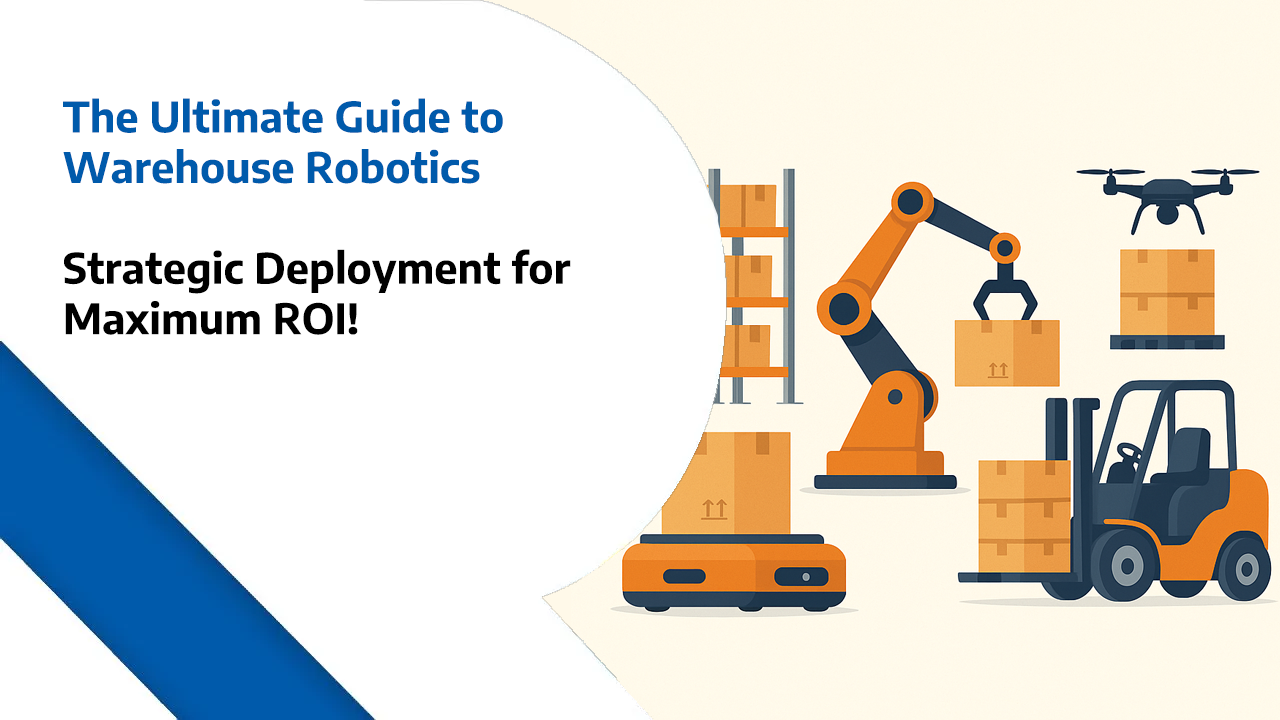
The Ultimate Guide to Warehouse Robotics: Strategic Deployment for Maximum ROI
The New Logistics Paradigm
In today’s hypercompetitive marketplace, warehouses have evolved from simple storage facilities into sophisticated fulfillment engines driving the global economy. As we navigate through 2025, unprecedented challenges are reshaping how logistics operations must function:
- Explosive e-commerce growth (47% increase in online order volume since 2022)
- Labor shortages reaching critical levels (63% of warehouses reporting unfilled positions)
- Customer delivery expectations compressed to hours, not days
- SKU proliferation expanding by 27% annually
- Rising real estate costs making spatial efficiency paramount
These pressures have created what industry experts call “the warehouse innovation imperative”—a fundamental shift where automation isn’t just advantageous, it’s existential.
However, implementing robotics without strategic alignment is the fastest route to wasted capital. According to research from the Robotics Operations Group, 38% of warehouse automation projects fail to meet ROI targets, often due to misalignment between technology selection and operational needs.
This comprehensive guide will help you navigate the rapidly evolving robotics landscape with clarity and purpose, ensuring your automation investments deliver transformative results.
Warehouse Robotics Ecosystem: The Definitive Analysis
1. Autonomous Mobile Robots (AMRs): The Versatile Workforce Multiplier
Core capabilities: Dynamic navigation, human collaboration, task adaptation, fleet management
Optimal applications:
- Goods-to-person order fulfillment (reducing picker walking by up to 70%)
- Wave picking across multiple zones
- Just-in-time replenishment
- Returns processing
- Flexible material transport
Leading platforms and their differentiation:
- Locus Robotics — Excels with multi-bot coordination and seamless WMS integration; demonstrating 200-300% productivity improvements in high-SKU environments
- 6 River Systems (now Ocado) — Collaborative “Chuck” robots optimize for both speed and ergonomics, with integrated pick-to-light and worker guidance
- Fetch Robotics (now Zebra) — Versatile platforms accommodating varying payload capacities from 78kg to 1,500kg, combined with advanced fleet management
- Geek+ — Dense swarm coordination specializing in multi-tiered picking operations
- Boston Dynamics Stretch — Highly flexible case and pallet handling with adaptive control systems
Strategic considerations: AMRs offer the fastest implementation timeline (typically 3-4 months) and lowest infrastructure changes among robotic solutions. Their modular scaling approach allows for incremental deployment, starting with as few as 5-10 robots and expanding based on validated performance.
Case study highlight: “Revol Snacks deployed a mixed fleet of 27 Locus robots across their 130,000 sq ft facility, achieving 218% increase in units picked per hour while reducing onboarding time for new associates from two weeks to just three days.”
2. Automated Storage and Retrieval Systems (ASRS): The Density Revolutionaries
Core capabilities: Vertical space maximization, goods-to-person delivery, high-throughput sequencing
Optimal applications:
- High-density inventory storage (up to 90% space reduction)
- Ultra-fast small item retrieval
- Precise inventory control
- Buffer staging for downstream operations
- Temperature-controlled environments
Leading platforms and their differentiation:
- AutoStore — Pioneering grid-based architecture with robots operating on top of storage cubes; ideal for small-to-medium sized items in ultra-dense configurations
- Exotec Skypod — Vertical climbing robots accessing inventory on racks up to 12 meters high, blending density with extreme adaptability
- Attabotics — Inspired by ant colonies, this solution uses 3D storage architecture to reduce footprint by up to 85% compared to traditional systems
- OPEX Perfect Pick — iBOT technology enables both horizontal and vertical movement within aisles, optimizing for both speed and redundancy
- Swisslog CycloneCarrier — Specializes in micro-fulfillment centers and compact, high-throughput operations
Strategic considerations: ASRS requires significant capital investment and infrastructure changes, but delivers unparalleled space efficiency and throughput consistency. Implementation timelines typically range from 9-18 months depending on system complexity and scale.
Case study highlight: “Northwest Pharmaceuticals implemented an Exotec Skypod system, reducing their storage footprint by 67% while increasing order processing capacity by 340% during peak seasons. The system’s modularity allowed them to expand capacity without disrupting operations.”
3. Articulated Robotic Arms: The Precision Specialists
Core capabilities: Repeatability, dexterity, continuous operation, vision integration
Optimal applications:
- Precise item sortation (up to 99.9% accuracy)
- Complex depalletizing and palletizing
- Kitting operations
- Packaging customization
- Quality control inspection
Leading platforms and their differentiation:
- Universal Robots (UR) — Collaborative cobots prioritizing safety and programmability; ideal for operations where humans and robots work in proximity
- RightHand Robotics — Revolutionary piece-picking solutions combining advanced grippers with AI-powered item recognition
- Fanuc — Heavy-duty solutions capable of managing substantial payloads with industrial-grade reliability
- ABB FlexPicker — Delta robot configuration specializing in high-speed, lightweight picking operations
- Dorabot DoraPalletizer — AI-driven mixed case palletizing with advanced stack optimization
Strategic considerations: Robotic arms offer the highest precision for specific, repeatable tasks but require careful integration with upstream and downstream processes. Vision systems and gripper selection are critical success factors that must be tailored to your specific product range.
Case study highlight: “Global Sports Direct implemented RightHand Robotics piece-picking systems at their returns processing center, increasing sorting throughput by 273% while reducing mis-sorts by 92%, allowing skilled staff to focus on exception handling and customer service.”
4. Inventory Drones: The Visibility Enablers
Core capabilities: Autonomous navigation, image capture, data processing, anomaly detection
Optimal applications:
- Continuous inventory auditing (reducing manual counts by up to 95%)
- Hard-to-reach location scanning
- Exception identification and investigation
- Safety and compliance monitoring
- Real-time inventory visibility
Leading platforms and their differentiation:
- Verity — Fully autonomous drone fleets that operate during off-hours with zero human supervision
- Ware — Specialized in integration with existing WMS platforms for streamlined inventory reconciliation
- Dronify — Advanced computer vision systems capable of reading barcodes, detecting damage, and assessing inventory conditions
- Corvus Robotics — Combines drone technology with AI for predictive inventory management
- Gather AI — Cloud-based intelligence platform enabling rapid deployment with minimal infrastructure changes
Strategic considerations: Drones represent the lowest capital investment among robotic solutions but require careful planning for charging infrastructure, flight path optimization, and data integration. They excel as an entry point to automation for facilities with high-value inventory or persistent accuracy challenges.
Case study highlight: “Eastern Distribution deployed a fleet of Verity drones to conduct nightly cycle counts across their 280,000 sq ft facility, reducing inventory discrepancies by 84% and eliminating the need for quarterly shutdown counts—recapturing 1,200 labor hours annually.”
5. Autonomous Forklifts and Pallet Movers: The Heavy Lifters
Core capabilities: Heavy load transport, precise positioning, safety-first operation, integration with facility systems
Optimal applications:
- Repetitive pallet transport over medium-to-long distances
- Trailer loading/unloading
- Cross-docking operations
- Raw material movement
- Work-in-process transport
Leading platforms and their differentiation:
- Seegrid — Vision-guided vehicles using camera arrays for navigation without the need for infrastructure changes
- OTTO Motors (now Rockwell) — Adaptable platforms handling payloads up to 1,500kg with advanced obstacle avoidance
- Toyota Autonomous Forklifts — Industry-leading reliability metrics with seamless transition from manual to autonomous operation
- Vecna Robotics — Orchestration system specializing in mixed-fleet environments combining human and robotic operators
- Balyo — Transforms standard forklifts into autonomous vehicles with minimal modifications
Strategic considerations: These solutions deliver immediate ROI in operations with predictable pallet movement patterns, high labor costs, or safety concerns. Implementation typically requires integration with warehouse execution systems and careful planning of traffic patterns.
Case study highlight: “Midwest Consumer Products deployed a fleet of 8 Seegrid pallet movers, achieving 99.8% uptime over 18 months of 24/7 operation, eliminating 3 reportable safety incidents annually, and reducing per-pallet movement costs by 62%.”
6. Emerging Technologies: Tomorrow’s Warehouse Today
Core capabilities: Breakthrough approaches solving previously intractable challenges
Noteworthy innovations:
- Stretch Robotics — Flexible, wall-climbing systems for inventory management in ultra-high bay facilities
- Covariant AI — Universal pick systems handling previously “unrobotic” items like soft goods and irregular shapes
- Nimble Robotics — Combining manipulation expertise with sophisticated AI for complex picking tasks
- Plus One Robotics — “Humans in the loop” supervision allowing robots to handle exceptions efficiently
- Ambi Robotics — Simulation-to-reality transfer learning enabling rapid deployment for varied applications
Strategic considerations: These cutting-edge technologies may offer breakthrough capabilities for specific challenges, but typically come with higher implementation complexity and should be evaluated carefully as part of a broader automation strategy.
Strategic Decision Framework: Matching Robots to Your Warehouse Reality
Step 1: Conduct a Comprehensive Operations Analysis
Before evaluating any robotics solution, establish your operational baseline:
- Process mapping — Document current workflows from receiving through shipping
- Labor analysis — Break down worker time allocation across tasks
- Space utilization assessment — Identify constraints and optimization opportunities
- Data quality evaluation — Assess inventory accuracy and systems integration readiness
- Pain point prioritization — Determine which challenges impose the highest costs
Step 2: Define Clear Automation Objectives
Precision in goal-setting directly correlates with implementation success:
- Quantifiable targets — Specific metrics for productivity, accuracy, and throughput
- Workforce impact planning — How automation will complement existing staff
- Growth accommodation — Future-proofing for projected volume increases
- Seasonal flexibility — Managing variability in demand patterns
- Total cost of ownership — Looking beyond purchase price to maintenance, training, and system life
Step 3: Develop a Phased Implementation Strategy
The most successful automation journeys follow a systematic progression:
- Launch with contained pilot projects — Create proof points with manageable scope
- Scale validated solutions — Expand based on documented results
- Integrate systems — Ensure seamless data flow between robotic and management systems
- Optimize human-machine collaboration — Refine workflows to leverage the strengths of each
- Build continuous improvement cycles — Establish metrics and feedback mechanisms
Step 4: Ensure Organizational Readiness
Technology alone doesn’t guarantee success—your team must be prepared:
- Executive sponsorship — Secure leadership commitment to the transformation
- Cross-functional governance — Involve operations, IT, finance, and HR
- Technical capability building — Develop internal expertise in robotics management
- Change management planning — Address workforce concerns proactively
- Vendor relationship structure — Establish expectations for ongoing support
The Robot Philosophy Approach: Beyond Equipment to Ecosystem
At Robot Philosophy, we’ve developed a proprietary methodology that transcends traditional automation consulting. Our approach is built on three core principles:
1. Systems Thinking Over Siloed Solutions
We analyze your entire operation as an interconnected ecosystem, identifying how robotic implementations will ripple through all aspects of your business. This holistic perspective prevents the common pitfall of optimizing one area while creating bottlenecks elsewhere.
2. Data-Driven Decision Making
Our team leverages advanced simulation modeling to predict performance outcomes before capital commitment. This approach:
- Validates ROI projections with statistical confidence
- Tests multiple scenarios to identify optimal configurations
- Reveals unexpected constraints before they become implementation problems
- Provides clear visualization of future-state operations
3. Collaborative Implementation
We don’t just recommend technology—we partner with you throughout the entire journey:
- Comprehensive readiness assessment examining over 180 operational factors
- Vendor-agnostic selection process based on your specific requirements
- Implementation management ensuring on-time, on-budget deployment
- Performance optimization through continuous monitoring and refinement
- Capability transfer building your team’s expertise for long-term success
Expert Consultation: Your First Step Toward Warehouse Transformation
If you’re navigating the complex decision of which robotic solutions best fit your operation, our team of warehouse automation strategists can help.
The Robot Philosophy Diagnostic Process:
Our initial consultation includes:
- Process efficiency analysis identifying your highest-impact automation opportunities
- Technology alignment assessment matching robotic capabilities to your specific challenges
- Preliminary ROI modeling providing realistic financial projections
- Implementation roadmap development outlining your optimal path forward
Take Action Now:
Schedule your complimentary Warehouse Automation Strategy Session:
- Email: strategic.consult@robophil.com
- Phone: (415) 827-3905
- Web: www.robotphilosophy.com/diagnostic
“The conversation with Robot Philosophy completely changed our automation strategy. Instead of jumping straight to the most advanced technology, they helped us identify a phased approach that delivered immediate ROI while building toward our long-term vision.” — Operations Director, Fortune 500 Consumer Goods Company
About Robot Philosophy
Founded by Phil English after 15 years leading automation initiatives at Amazon, Walmart, and Target, Robot Philosophy combines deep operational expertise with cutting-edge technical knowledge. Our team includes certified robotics engineers, supply chain specialists, and change management experts dedicated to transforming warehouse operations through strategic automation.
Unlike equipment vendors with inherent product bias, we serve as your trusted advisor throughout the automation journey—ensuring you implement the right solutions, in the right sequence, for the right reasons.
Our clients typically achieve:
- 30-50% reduction in operating costs
- 150-400% improvement in throughput capacity
- 60-90% decrease in fulfillment errors
- 12-18 month ROI on initial implementations
Transform your warehouse from a cost center to a competitive advantage.
Contact us today to begin your robotics journey with confidence and clarity.